Gratitude for My Home

I live in a great place. A safe place.

I walk around alone, unarmed, without fear. This is true even in the dark, even when the nights are completely fogged in. This is true even in a city where homelessness is rampant, and car break-ins happen on a regular basis, and everyone’s windows and doors are covered with anti-human bars.

For me, there is no need to worry.

My water is clean, or at least as clean as it can be in an increasingly polluted world. I can even afford a secondary water filter.

Our house is warm. We are never cold. We might complain about the cold, but it is just the whining of the rich.

It is just the same for food: we are never hungry. Our food is nourishing and plentiful. We have never truly known hunger or starvation or privation.

We can afford substances that alter our mind in a variety of ways. And we can afford the time to use them.

We can afford the time to loaf and complain and explode over tiny meaningless offenses. Because that is how wonderful our lives have become. We find problems in the mundane and minute.  

We can read all day.

We have endless power.

I can feel the presence of the ocean in the air. I can even walk to the ocean and back in a day’s journey. That can be shortened to mere minutes with a car, of which we have a luxurious one.

Every morning, I have a difficult choice to make: which park do I walk the dog to? There are 8 options that immediately come to mind, and I’m certain there are more I’ve yet to discover.

It is a beautiful country we live in.

The Leadership Principles of Glover Johns

Below is a set of leadership principles I transcribed from Jocko podcast episode 87 (The Clay Pigeons of St. Lô). I loved them and wanted to share them with you. In episode 341, he revisited these rules and dedicated the entire podcast to discussing them.

While Jocko was focused on Glover Johns’s book during the episode, he wraps up his coverage by reading from David Hackworth’s book About Face, who was covering a farewell speech by his idol. 

David Hackworth on Glover Johns

“He was a leader who taught by example.” 

“to hear in a single speech this great man’s basic philosophy of soldiering was like being let in on the secret ingredients of some magic formula.”

Leadership principles of Glover Johns

  • Strive to do small things well.
  • Be a doer and a self starter.  Aggressiveness and initiative are two most admired qualities in a leader, but you also must put up your feet and think.
  • Strive for self improvement through constant self evaluation.
  • Never be satisfied. Ask of any project, “How can it be done better?”
  • Don’t overinspect or oversupervise. Allow your leaders to learn through mistakes in training so they can profit from their errors and not make them in combat.
  • Keep the troops informed. Telling them what, how, and why will builds their confidence.
  • The harder the training, the more the troops will brag.
  • Enthusiasm, fairness, and moral and physical courage: four of the most important aspects of leadership.
  • Showmanship: a vital technique of leadership.
  • The ability to speak and write well: two essential tools of leadership.
  • There is a salient difference between profanity and obscenity. The leader employs profanity tempered with discretion, he never uses obscenities
  • Have consideration for others.
  • Yelling detracts from your dignity. Take your men aside and counsel them.
  • Understand and use judgment. Know when to stop fighting for something you believe is right. Discuss and argue your point of view until a decision is made, and then support the decision wholeheartedly.
  • Stay ahead of your boss.

I transcribed the quotes, so there may be differences from what the book says.

References

Time Enough at Last

My second realization in this year of enough is that I actually have enough time.

Complaints about never having enough time abound in today’s world. Examples throughout history can be found too, so we might even venture to posit that it is fundamental to the human condition.

Lines from Chinese Zen poet Stonehouse come to mind:

“A human life last one hundred years but which of us get them all”

As well as these lines from Chinese Zen poet Cold Mountain:

“A man lives less than a hundred years but harbors cares for a thousand”

It is true. I harbor cares for a thousand years. And yet, even the less-than-one-hundred that I am most likely to receive are enough.

We can’t have it all. Aren’t constraints an essential element for creation? Why bemoan what we cannot change?

In my own life, I spent last year feeling like I was stretched thin. Between a new born child, a business, cooking three meals a day – there never seemed to be enough hours in the day to accomplish everything I wanted. Fitness fell by the wayside. Projects languished. I did not play music. I never gardened.

At the same time, I spent 8 months of the year not working at all. I spent time with my wife and son. I spent time preparing beautiful and loving meals that were enjoyed by friends and family. I spent time with my father on his birthday – whole days, uninterrupted by any other cares of the world. I spent time with my father while he was dying, making it so that he could leave this world without the pain that had been haunting him for years, ultimately building into a final, unbearable crescendo. I spent time focusing on honoring my father’s life, arranging a beautiful service, and celebrating him with our family.

What I had was too many cares, not too little time.

Moreover, the past two weeks have proven that I do have enough time to fit everything that I want. Perhaps that was the ultimate trick: changing my concept of time and admitting that I have enough of it.

I can fit in five hours a day of work, 3-4 hours a day with my son (allowing mom to work and to have a life), I work out five days a week, I spend 1+ hrs a day walking my dog, I play music, I read books, I still prepare 2-3 meals a day, and I am working in the SF Japanese Tea Garden once again.

I have enough time, and it is glorious.

Enough Digital Hoarding

I was inspired by Diana Montalion’s "Year of Enough". I’ve been thinking about the concept of "enough" in my own life.

My first realization is that I possess enough information. Thousands of e-books, hundreds of physical books, thousands of papers and articles and presentations. Information on things I care about (and some things I don’t). With the importance of action over information, there’s no need to keep acquiring more.

I have enough. This year:

  • I will not buy audio books
  • I will not buy apps on my phone
  • I will not buy new books
  • I will not buy new books, even on my Kindle, which I considered a loophole
  • I will not add new digital subscriptions

There’s gold in my archives, unexploited and unmined. Yet, I keep acquiring more.

I’ve got more than enough for a lifetime already.

Eulogy for My Father

Delivered at St. Bernadette’s Catholic Church in Stockton, CA on 20 December 2019.

Hello everyone. Thanks for being with our family today to celebrate my father, Lester Silvester Johnston, Jr.

Many of you have said to us, “I had no idea that Lester was ill”. We’re all in the same boat. Admittedly, I had some idea, but I thought that I would be saying goodbye to my father next year. I was just starting to see the pain he was in, and I thought that I could get him to talk to me about it. I thought that I had the holidays to pick his brain. I never got to have those conversations. The only insights I can share are the small hints he dropped or the things that I could see directly.

My father was a private man. He rarely volunteered details about his life unless they were cherished stories from his past, like:

  • The time he got a free vacation in Banff, Canada to help haul a truckload of fresh elk meat back to Stockton for his boss
  • The time he was stationed in Germany and traded American chocolates with little old German ladies for steaks
  • The time he was the Colonel’s driver, which meant he hung out in the air conditioned tents watching football while the rest of the boys were stuck sleeping in the dirt

He didn’t even tell his wife about the full extent of his illness or pain. You could ask him directly, but he would never answer you with the level of detail you wanted. Perhaps he didn’t want to be forced into treatment. Perhaps he didn’t want to be constantly reminded by family and friends about his impending doom. We can only wonder now.

My father was a strong and proud man. As a kid, I always marveled at my father’s seemingly infinite powers. He worked hard. He built things right in front of our eyes. He climbed ladders, trees, and houses. He could fix everything. He never stained his image by complaining about his circumstances, admitting to pain, or begging for help.

This never changed. When I visited my father two months ago for his birthday, I saw that he couldn’t walk to the end of the driveway and back due to his COPD. His back was killing him, and he just made it seem like it was sore muscles, not cancer. Even still, he was lifting and throwing huge oak rounds into the back of his truck. I managed to convince him to let me do it. He begrudgingly agreed once I pointed out it was his birthday, and that old men should let the young men do the hard work. After that, he let me do all of the work for him. The fact that my dad accepted my help so readily during the last few months was my first hint that something was going on.

My father took his pain like a man, one of the old breed that seems to be fading from the modern world. During his final days, the lightest touch was enough to shoot pain throughout his body. He only let out the occasional involuntary moan, and my guess is that he would have kept quiet if it was within his power to do so. I cried because of how much I hurt my father while helping him, yet he asked me to hang in there and hold it together. Another time, I told him I wished I could take on his pain to make it easier for him. He just smiled and said, “Oh, I don’t think you’d want any part of this.”

I’m sure that he’s right. I’d whine to my mom when he made me pick up sticks on the trails in our woods. Clearly, we were made of different stuff. 

The day before he died, Kevin, Bridget, Janet, and Steve arrived at the house. Hospice hadn’t come yet. My dad woke up from a nap. Mary, Anthony, and I helped him walk to the bathroom for the final time. He could barely stand up. His walking was so shaky that we were all terrified for him. But he made it. He was pure willpower embodied. 

Then, sitting there resting after using the bathroom, he asked us to make him look good. We put his clothes back on and washed his face. He rinsed with mouthwash. He put his dentures in. He asked Anthony to brush his hair.

He asked me how he looked, and I laughed and said that he wasn’t going to win any beauty contests anytime soon. He grunted and frowned and said, “Give me a mirror”. He wanted to make sure that his sons weren’t doing a half-assed job just because he was hurting.

These kinds of moments put someone’s character into focus. We are at the extreme end of our being. And yet, even with all of that pain and uncertainty, my father did what he loved until his final day on this Earth. What will you still fight to do when there is no time left, or when there is only pain? In those moments, the inessential drops away, and we get to see who you really are.

The first characteristic that stands out is that my dad loved to be outside. As far as I know, this has always been true. My dad used to be so tan that a much younger version of Kevin thought he was a black man. He loved to grill. He loved to have a garden. And he loved to just sit around and relax outside – especially by his pool. Each of his sons spent thousands of hours with dad at the pool. Having a pool is what he missed the most about his house in Georgia. He couldn’t fit one on the property in West Point. That didn’t stop him from having a little blue kiddie pool ready when we came up with Damien in the summer.

At the end of his life, he spent most of his time outside: pruning rose bushes, planting a vegetable garden, tending to his beloved pot plants, installing landscape lighting, painting yard decorations for my mom, battling moles, repairing the gate, and fortifying the garden against the nightly deer attacks.

Then, every day in West Point, around 10am, the sun would shine just right on the deck and the morning chill was gone. He’d take his coffee, go out to his chair, and smoke a cigarette, basking in the sun. The sun seemed to charge his batteries better than sleep did, and he had little enough of that at the end. He continued to perform his morning sun ritual, with my help, until his last day. Snow was falling then, and he was no longer able to get out of bed.

Another characteristic reflected until the end was that my dad was a chef at heart. We all have countless memories of Lester’s food. Stuffed mushrooms, backyard barbecues, holiday spreads, prime ribs, even a roast pig – I’m sure ya’ll remember Charlotte.

Even with the pain and chaos of the final days, the Thanksgiving week’s festivities were on the forefront of his mind. Every night he would ask me, “What’s for dinner?”, although we both knew he wouldn’t be eating it. After my mom came back from grocery shopping, while dad and I were sitting together in the sun, he demanded a full report on what she purchased. He dictated a list of everything she missed and asked me to go get it for him. Thanksgiving was one of his favorite days, and he wanted us to have the full holiday spread. I wanted to make sure he still involved in the process. I got everything on his list, planned the menu with him, and asked for his advice whenever I could.

My dad passed away the day before Thanksgiving. Taking care of my dad was a full time job, and Rozi and I figure that he knew we couldn’t actually cook the meal if we were busy doting over him. To make things even harder, our power went out at 5:30 in the morning and stayed out for 11 hours. That didn’t stop us from channeling Lester’s spirit. Rozi and I adapted to the situation without complaint, threw the turkey and ham on the grill, and pulled off the meal that my dad and I envisioned. We would have been proud to show our turkey to him.

It wasn’t just Thanksgiving that was dear to my father – it seemed like every holiday was especially important to him. After having a chance to think deeply about my father’s life, I think I know why.

My father was a man with a big heart full of love to share, even when he didn’t feel any of that love for himself. Maybe he loved the holidays because they were a great excuse for him to take time off of work, to host a party, to prepare a delicious spread of food for people he loved, to laugh, to give gifts, and to play games. He was the life of the party, and parties with Lester were guaranteed to be fun. People always came by, especially if there were fireworks – everyone would join in to echo Lester’s favorite phrase, “fire in the hole!”

It’s not just the laughter and joy and company of the holidays that I remember. My parents were also especially welcoming to our friends. Both of them were loved by our friends, and they frequently earned the titles “mom”, “dad”, and “second family”. Dad taught Kevin’s friend Jeffery how to swim. He taught some of my friends how to swim too. He cooked for our friends, played games with them, joked with them, involved them in his projects, and taught them how to build and repair things. I’m not sure that my father ever realized how much of a role model he was to our friends, especially those without their own fathers in their lives.

Kevin’s friend Joey wrote us a letter saying, “I just wanted to let you know how sorry I was to hear about the passing of Les. You guys are the closest thing I have to a 2nd family, and I’ll always cherish the great memories I have of growing up in Covington and spending time at your house. Les was a great man and a great cook and he’ll be missed terribly.”

Our friend Mario said, “It took me a few days to figure out how to respond. I’m sorry for your loss, your dad was an awesome man who I learned a lot from. Your family exposed me to a life filled with so much love and friendship, and I appreciate that more than I could ever explain.”

My father loved his family more than he could ever explain, and he frequently tried to tell us us so. Things weren’t always good, but even in the bad times, he did his best to make sure things were still good for his sons.

My father was deeply proud of his three sons. We all learned how to work hard, how to forge our own paths through life, and how to have a good time. Two of his sons own their own businesses, and the third son earned himself a full-ride scholarship to USC, an internship at Disney World (a place my father loved dearly), and a job at Microsoft.

Anthony, Kevin, I hope that you both can feel his love for you. You were both frequently on his mind at the end, and he held on until you were there with him. And if you don’t feel his love, I hope that one day you can hold a child of your own in your arms. When you feel exactly how much love you have for that child, then you’ll know without a doubt just how much dad loved you. 

Anthony, dad knew how hard you worked at school and he saw the rewards that you earned for your efforts. He was proud of your work ethic and accomplishments, and he was adamant that he wouldn’t be the one to interfere. Every time your name came up he would say, “No, you can’t call Anthony, he’s got tests and projects and I can’t mess that up”. But when we told him that you changed your flight, there was only love in his voice. He said “for me?” as if it was the best gift in the world. I’m glad that you changed your flight, because you wouldn’t have made it to him due to the snow storm. And we needed your help.

Kevin, you were the last son in Georgia. Dad could always count on your help when he needed it. You and Bridget kept the holidays alive for him and kept the games going after Anthony and I were gone. You were always the best at getting dad to laugh. Dad endured the pain for you, Kevin. He waited for you to be there before he gave himself permission to relax. Rozi and I both saw that. I know that it was hard seeing him when you arrived. You never saw him eat food, you didn’t get to speak with him, and his health failed unbelievably fast. But you gave him what he really wanted: his entire family was home with him for the first time in years.

Mom, I want you to know that over the past 6 months, it became clear to me that all dad worried about was you. All of the projects dad and I worked on were to get things ready for you. At the time, he made it seem like he was taking care of things because he would be traveling for work. Now I can see that his time was running out. 

On our last walk together to sit in the sun, only a few minutes after Mary told him he was dying, his first question to me was, “Do you think your mom will be ok?” Mom, I know that you endured the fights, the silence, the not knowing. I didn’t have to deal with that. All I saw from my end was his love and concern for you.

I’d like to offer my thanks and praise to the many people involved during this difficult time.

First, thank you to my wife Rozi for kicking me out of the house to visit my dad on his birthday. I spent four days with him and we both loved every moment of it. 

It wasn’t even two full months later that I said goodbye to my father forever.

Rozi got the ball rolling with hospice care by reaching out to Jim and Mary. On top of taking care of Damien, she worked tirelessly to help me care for my father and to ensure that I had whatever support I needed. Thank you, Rozi.

Mary was an angel. She came to us straight from work and had the awful job of telling my father that he was dying. My father did not want to go to a hospital, he did not want an IV, and he did not want to be tied up to machines. He wanted to be home with his family, so Mary talked him into hospice care. She came back later that same night and stayed with us, after only napping for two hours (I don’t know if I even believe that she napped that long). Mary and Anthony tended to my father that night, and they gave Rozi and me our first break in days. She repeatedly called hospice for two days until they agreed to help us. She only left once the hospice nurse arrived with the medicine and got dad set up in bed. It’s not like Mary got a break after that – she went home and took on grandma duties, and she continued to pick up the phone whenever we called for advice, no matter the time of day.

Aunt Mary, thank you. You made my father’s passing so much more comfortable than it would have been. In the end, he got to die exactly how he wanted: at home, without pain, surrounded by his family. I’ll forever remember that moment of pure joy that we both shared when, after two days of talking to hospice, you came out to tell me that they were on the way. I will never be able to thank you enough for your support.

Thank you Anthony, Kevin, and Bridget for changing your plans. You were able to get to dad on time, and because of that we could give him what he cared about most of all: the presence of his family. I am also grateful for your help caring for dad.

Thank you nurse Madeline, who who came to us twice in the snow. She treated my father lovingly, and she gave strength to the family. The night he died, another hospice nurse told us from the bottom of our driveway that we’d have to keep my father’s body in the house until the morning. Madeline was angry when she heard that. She made it to us in the dark, while it was snowing, after she got stuck in the snow and called her son to tow her out. I honor her for her bravery and her dedication to helping a family that she had only just met that morning.

Likewise, thank you to the morticians who made it to us in the dark, in the same conditions. They hiked through the snow with a gurney in their suits and dress shoes to take my father away.

Thank you Janet, Steve, Randayn, and Clemen for coming to visit my father. I know it was hard to see him like that. I am grateful for every bit of love that we could show him at the end. 

Thank you to everyone who lit off fireworks on Thanksgiving to celebrate Lester. We loved seeing the videos, and it was just the kind of celebration he would have wanted.

Thank you to those individuals who made this service possible: 

  • Rozi, scheduling the service and coordinating the details with St. Bernadettes
  • Edie in the St. Bernadette’s office for wrangling Father John Peter on his day off to get the service booked
  • Aunt Janet for helping to arrange and prepare the lunch that we are about to eat, as well as for hosting people after the luncheon.
  • Katelyn for watching Damien during the service, allowing Rozi and I to be fully present here today

Thanks to all of our family and friends for the ongoing support, visits, food, flowers, and well wishes.

And thank you again for being here with us today.

It is a Good Thing that Lester existed. What we learned from him, the experiences we all had with him, far outweigh anything negative he put us through. His Being is worth celebrating. And now, we all must feel a great big Lester-sized hole in our hearts. What is gone from our lives now that he is gone? Those of us who survive him will slowly learn the answer.

Sayonara, Lester. Fire in the hole.

Can I Get a Mulligan?

I was my father’s primary caretaker during the last four days of his life. I dressed and undressed my father. I walked with him. I prepared food for him. I gave him medicine. I changed his soiled sheets. I combed his hair after he died.

He was in excruciating pain. He did not want doctors or hospitals. Luckily, we successfully talked him into hospice. That helped me reduce his baseline level of pain.

Right now, my mind is running a continual visual loop of errors and lessons. I think of a thousand moments I could have executed more skillfully. To create a better experience for my father. To reduce pain. To prevent hurt. To instill confidence. To serve as a good example. To remain level-headed. To reduce anger.

I have been through the most painful, important, and present duty in my life. 

I was there. The whole time. Doing nothing else. Now that it is done, I am plagued by the ways it could have been much better.

We just didn’t know any better.

I know that I did my best. I relieved my dad’s suffering. I put everything I had into it. There were no distractions.

But now I know so much more.

I wish I could give him the benefit of that knowledge. He could have had an even better end.

That’s what I find myself wishing for each day.

A mulligan. A chance to run the scenario again. It could have been so much better.

Reactions to My Father’s Death

Sometimes, I want to scream

Others, to destroy

Others, to make love

Others, to laugh

Mostly I feel as if I am in a dream that I can’t wake up from. A dream with walls, like a cold prison that traps me. It already feels unreal, is already a faded memory. 

But I lived it so intensely! How could it fade, and fade so fast?

I was there for every moment. It took so much. I never want to lose those lessons, those memories. What if you need them again?

And at some level, it’s all I have left of my dad.

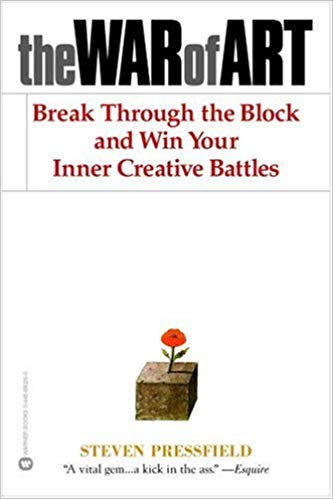
The War of Art

Author: Steven Pressfield
Recommended for: Anyone working on a creative or entrepreneurial endeavor
Read: November 2014, October 2019

Quick Summary:

The War of Art is an essential book for anyone working on a creative or entrepreneurial endeavor. In The War of Art, Steven Pressfield identifies the force that opposes our creative efforts as Resistance. Pressfield points out the different forms that Resistance takes and methods that it uses to undermine us every step of the way. Pressfield also provides strategies for overcoming Resistance, primarily by focusing on mastering our craft and showing up every single day.

If you enjoyed The War of Art, you can follow the book with Do the Work, a short follow-up read that focuses on overcoming and defeating Resistance.

There’s a secret that real writers know that wannabe writers don’t, and the secret is this: It’s not the writing part that’s hard. What’s hard is sitting down to write. What keeps us from sitting down is Resistance. 

What does it tell us about the architecture of our psyches that, without our exerting effort or even thinking about it, some voice in our head pipes up to counsel us (and counsel us wisely) on how to do our work and live our lives? Whose voice is it? What software is grinding away, scanning gigabytes, while we, our mainstream selves, are otherwise occupied? 

Key Lessons:

  • That feeling that I feel inside – the one that attempts to block me at every turn – that is real, and not something I made up. All creative individuals must wrestle with it.
  • We can defeat Resistance by simply dedicating ourselves to our work at the same time every day. Treat your work professionally. Show up, no matter what.

My Highlights

Italicized sub-bullet comments are mine.

  • When inspiration touches talent, she gives birth to truth and beauty. 
  • How many pages have I produced? I don’t care. Are they any good? I don’t even think about it. All that matters is I’ve put in my time and hit it with all I’ve got. 
    • Eventually, once you’ve put in enough time, you’ll come up with something good!
  • There’s a secret that real writers know that wannabe writers don’t, and the secret is this: It’s not the writing part that’s hard. What’s hard is sitting down to write. What keeps us from sitting down is Resistance. 
  • Most of us have two lives. The life we live, and the unlived life within us. Between the two stands Resistance. 
  • One night I was layin’ down, I heard Papa talkin’ to Mama. I heard Papa say, to let that boy boogie-woogie. ‘Cause it’s in him and it’s got to come out. — John Lee Hooker, “Boogie Chillen”
  • How many of us have become drunks and drug addicts, developed tumors and neuroses, succumbed to painkillers, gossip, and compulsive cell-phone use, simply because we don’t do that thing that our hearts, our inner genius, is calling us to? Resistance defeats us. 
  • The enemy is a very good teacher. — the Dalai Lama 
  • Resistance is not a peripheral opponent. Resistance arises from within. It is self-generated and self-perpetuated. Resistance is the enemy within. 
  • Rule of thumb: The more important a call or action is to our soul’s evolution, the more Resistance we will feel toward pursuing it. 
  • We’re wrong if we think we’re the only ones struggling with Resistance. Everyone who has a body experiences Resistance. 
  • The warrior and the artist live by the same code of necessity, which dictates that the battle must be fought anew every day. 
  • Resistance has no strength of its own. Every ounce of juice it possesses comes from us. We feed it with power by our fear of it. Master that fear and we conquer Resistance. 
  • RESISTANCE IS MOST POWERFUL AT THE FINISH LINE 
  • Odysseus almost got home years before his actual homecoming. Ithaca was in sight, close enough that the sailors could see the smoke of their families’ fires on shore. Odysseus was so certain he was safe, he actually lay down for a snooze. It was then that his men, believing there was gold in an ox-hide sack among their commander’s possessions, snatched this prize and cut it open. The bag contained the adverse Winds, which King Aeolus had bottled up for Odysseus when the wanderer had touched earlier at his blessed isle. The winds burst forth now in one mad blow, driving Odysseus’ ships back across every league of ocean they had with such difficulty traversed, making him endure further trials and sufferings before, at last and alone, he reached home for good. 
  • The danger is greatest when the finish line is in sight. At this point, Resistance knows we’re about to beat it. It hits the panic button. It marshals one last assault and slams us with everything it’s got. 
  • The professional must be alert for this counterattack. Be wary at the end. Don’t open that bag of wind. 
  • The reason is that they are struggling, consciously or unconsciously, against their own Resistance. The awakening writer’s success becomes a reproach to them. If she can beat these demons, why can’t they? 
  • Often couples or close friends, even entire families, will enter into tacit compacts whereby each individual pledges (unconsciously) to remain mired in the same slough in which she and all her cronies have become so comfortable. 
  • The highest treason a crab can commit is to make a leap for the rim of the bucket. 
  • The awakening artist must be ruthless, not only with herself but with others. Once you make your break, you can’t turn around for your buddy who catches his trouser leg on the barbed wire. The best thing you can do for that friend (and he’d tell you this himself, if he really is your friend) is to get over the wall and keep motating. 
  • The best and only thing that one artist can do for another is to serve as an example and an inspiration. 
  • The most pernicious aspect of procrastination is that it can become a habit. We don’t just put off our lives today; we put them off till our deathbed. 
  • Never forget: This very moment, we can change our lives. There never was a moment, and never will be, when we are without the power to alter our destiny. This second, we can turn the tables on Resistance. 
  • We get ourselves in trouble because it’s a cheap way to get attention. Trouble is a faux form of fame. It’s easier to get busted in the bedroom with the faculty chairman’s wife than it is to finish that dissertation on the metaphysics of motley in the novellas of Joseph Conrad. 
  • Ill health is a form of trouble, as are alcoholism and drug addiction, proneness to accidents, all neurosis including compulsive screwing-up, and such seemingly benign foibles as jealousy, chronic lateness, and the blasting of rap music at 110 dB from your smoked-glass ’95 Supra. Anything that draws attention to ourselves through pain-free or artificial means is a manifestation of Resistance. 
    • I have certainly been guilty here. For years at a time.
  • The working artist will not tolerate trouble in her life because she knows trouble prevents her from doing her work. The working artist banishes from her world all sources of trouble. She harnesses the urge for trouble and transforms it in her work. 
    • And this is my cure
  • When we drug ourselves to blot out our soul’s call, we are being good Americans and exemplary consumers. We’re doing exactly what TV commercials and pop materialist culture have been brainwashing us to do from birth. Instead of applying self-knowledge, self-discipline, delayed gratification and hard work, we simply consume a product. 
  • What finally convinced me to go ahead was simply that I was so unhappy not going ahead. I was developing symptoms. As soon as I sat down and began, I was okay. 
  • John Lennon once wrote: Well, you think you’re so clever and classless and free / But you’re all fucking peasants / As far as I can see 
  • We unplug ourselves from the grid by recognizing that we will never cure our restlessness by contributing our disposable income to the bottom line of Bullshit, Inc., but only by doing our work. 
  • We’re wired tribally, to act as part of a group. Our psyches are programmed by millions of years of hunter-gatherer evolution. We know what the clan is; we know how to fit into the band and the tribe. What we don’t know is how to be alone. We don’t know how to be free individuals. 
  • The artist and the fundamentalist arise from societies at differing stages of development. The artist is the advanced model. His culture possesses affluence, stability, enough excess of resource to permit the luxury of self-examination. The artist is grounded in freedom. He is not afraid of it. He is lucky. He was born in the right place. He has a core of self- confidence, of hope for the future. He believes in progress and evolution. His faith is that humankind is advancing, however haltingly and imperfectly, toward a better world. 
  • Fundamentalism is the philosophy of the powerless, the conquered, the displaced and the dispossessed. Its spawning ground is the wreckage of political and military defeat, as Hebrew fundamentalism arose during the Babylonian captivity, as white Christian fundamentalism appeared in the American South during Reconstruction, as the notion of the Master Race evolved in Germany following World War I. In such desperate times, the vanquished race would perish without a doctrine that restored hope and pride. 
  • The humanist believes that humankind, as individuals, is called upon to co-create the world with God. This is why he values human life so highly. In his view, things do progress, life does evolve; each individual has value, at least potentially, in advancing this cause. 
  • The paradox seems to be, as Socrates demonstrated long ago, that the truly free individual is free only to the extent of his own self-mastery. While those who will not govern themselves are condemned to find masters to govern over them. 
  • If you find yourself criticizing other people, you’re probably doing it out of Resistance. When we see others beginning to live their authentic selves, it drives us crazy if we have not lived out our own. 
  • Individuals who are realized in their own lives almost never criticize others. If they speak at all, it is to offer encouragement. 
  • Remember our rule of thumb: The more scared we are of a work or calling, the more sure we can be that we have to do it. 
  • The professional tackles the project that will make him stretch. He takes on the assignment that will bear him into uncharted waters, compel him to explore unconscious parts of himself. 
  • (Conversely, the professional turns down roles that he’s done before. He’s not afraid of them anymore. Why waste his time?) 
  • If you didn’t love the project that is terrifying you, you wouldn’t feel anything. 
  • Grandiose fantasies are a symptom of Resistance. They’re the sign of an amateur. The professional has learned that success, like happiness, comes as a by-product of work. 
  • The professional concentrates on the work and allows rewards to come or not come, whatever they like. 
  • What are we trying to heal, anyway? The athlete knows the day will never come when he wakes up pain-free. He has to play hurt. 
  • Have you ever been to a workshop? These boondoggles are colleges of Resistance. They ought to give out Ph.D.’s in Resistance. What better way of avoiding work than going to a workshop? But what I hate even worse is the word support. 
    • Pressfield’s view certainly makes me feel less guilty about holding this view as well!
  • It is one thing to study war and another to live the warrior’s life. — Telamon of Arcadia, mercenary of the fifth century B.C. 
  • Someone once asked Somerset Maugham if he wrote on a schedule or only when struck by inspiration. “I write only when inspiration strikes,” he replied. “Fortunately it strikes every morning at nine o’clock sharp.” That’s a pro. 
  • I’m keenly aware of the Principle of Priority, which states (a) you must know the difference between what is urgent and what is important, and (b) you must do what’s important first. 
  • The artist committing himself to his calling has volunteered for hell, whether he knows it or not. He will be dining for the duration on a diet of isolation, rejection, self-doubt, despair, ridicule, contempt, and humiliation. 
  • Remember, the Muse favors working stiffs. She hates prima donnas. To the gods the supreme sin is not rape or murder, but pride. To think of yourself as a mercenary, a gun for hire, implants the proper humility. It purges pride and preciousness. 
  • Resistance loves pride and preciousness. Resistance says, “Show me a writer who’s too good to take Job X or Assignment Y and I’ll show you a guy I can crack like a walnut.”
  • The professional arms himself with patience, not only to give the stars time to align in his career, but to keep himself from flaming out in each individual work. He knows that any job, whether it’s a novel or a kitchen remodel, takes twice as long as he thinks and costs twice as much. He accepts that. He recognizes it as reality. 
  • A pro views her work as craft, not art. Not because she believes art is devoid of a mystical dimension. On the contrary. She understands that all creative endeavor is holy, but she doesn’t dwell on it. She knows if she thinks about that too much, it will paralyze her. So she concentrates on technique. The professional masters how, and leaves what and why to the gods. Like Somerset Maugham she doesn’t wait for inspiration, she acts in anticipation of its apparition. The professional is acutely aware of the intangibles that go into inspiration. Out of respect for them, she lets them work. She grants them their sphere while she concentrates on hers. 
  • The professional shuts up. She doesn’t talk about it. She does her work. 
  • The amateur believes he must first overcome his fear; then he can do his work. The professional knows that fear can never be overcome. He knows there is no such thing as a fearless warrior or a dread-free artist. 
  • The professional conducts his business in the real world. Adversity, injustice, bad hops and rotten calls, even good breaks and lucky bounces all comprise the ground over which the campaign must be waged. The field is level, the professional understands, only in heaven. 
  • A PROFESSIONAL DEDICATES HIMSELF TO MASTERING TECHNIQUE 
  • The professional respects his craft. He does not consider himself superior to it. He recognizes the contributions of those who have gone before him. He apprentices himself to them. 
  • The professional dedicates himself to mastering technique not because he believes technique is a substitute for inspiration but because he wants to be in possession of the full arsenal of skills when inspiration does come. The professional is sly. He knows that by toiling beside the front door of technique, he leaves room for genius to enter by the back. 
  • A PROFESSIONAL DOES NOT HESITATE TO ASK FOR HELP 
  • Tiger Woods is the consummate professional. It would never occur to him, as it would to an amateur, that he knows everything, or can figure everything out on his own. On the contrary, he seeks out the most knowledgeable teacher and listens with both ears. The student of the game knows that the levels of revelation that can unfold in golf, as in any art, are inexhaustible. 
  • The professional cannot take rejection personally because to do so reinforces Resistance. Editors are not the enemy; critics are not the enemy. Resistance is the enemy. The battle is inside our own heads. We cannot let external criticism, even if it’s true, fortify our internal foe. That foe is strong enough already. 
  • A professional schools herself to stand apart from her performance, even as she gives herself to it heart and soul. The Bhagavad-Gita tells us we have a right only to our labor, not to the fruits of our labor. All the warrior can give is his life; all the athlete can do is leave everything on the field. 
  • The professional loves her work. She is invested in it wholeheartedly. But she does not forget that the work is not her. Her artistic self contains many works and many performances. Already the next is percolating inside her. The next will be better, and the one after that better still. 
  • The professional cannot let himself take humiliation personally. Humiliation, like rejection and criticism, is the external reflection of internal Resistance. 
  • First, he didn’t react reflexively. He didn’t allow an act that by all rights should have provoked an automatic response of rage to actually produce that rage. He controlled his reaction. He governed his emotion. 
  • What he did do was maintain his sovereignty over the moment. He understood that, no matter what blow had befallen him from an outside agency, he himself still had his job to do, the shot he needed to hit right here, right now. And he knew that it remained within his power to produce that shot. Nothing stood in his way except whatever emotional upset he himself chose to hold on to. Tiger’s mother, Kultida, is a Buddhist. Perhaps from her he had learned compassion, to let go of fury at the heedlessness of an overzealous shutter- clicker. In any event Tiger Woods, the ultimate professional, vented his anger quickly with a look, then recomposed himself and returned to the task at hand. 
  • The professional cannot allow the actions of others to define his reality. 
  • Tomorrow morning the critic will be gone, but the writer will still be there facing the blank page. Nothing matters but that he keep working. 
  • Tomorrow morning the critic will be gone, but the writer will still be there facing the blank page. Nothing matters but that he keep working. Short of a family crisis or the outbreak of World War III, the professional shows up, ready to serve the gods. 
  • Remember, Resistance wants us to cede sovereignty to others. It wants us to stake our self-worth, our identity, our reason-for-being, on the response of others to our work. Resistance knows we can’t take this. No one can. 
  • The professional learns to recognize envy-driven criticism and to take it for what it is: the supreme compliment. The critic hates most that which he would have done himself if he had had the guts. 
  • A PROFESSIONAL RECOGNIZES HER LIMITATIONS She gets an agent, she gets a lawyer, she gets an accountant. She knows she can only be a professional at one thing. She brings in other pros and treats them with respect. 
  • A PROFESSIONAL REINVENTS HIMSELF 
  • The professional does not permit himself to become hidebound within one incarnation, however comfortable or successful. Like a transmigrating soul, he shucks his outworn body and dons a new one. He continues his journey. 
  • Making yourself a corporation (or just thinking of yourself in that way) reinforces the idea of professionalism because it separates the artist-doing-the-work from the will-and- consciousness-running-the-show. No matter how much abuse is heaped on the head of the former, the latter takes it in stride and keeps on trucking. Conversely with success: You-the-writer may get a swelled head, but you-the-boss remember how to take yourself down a peg. 
  • Have you ever worked in an office? Then you know about Monday morning status meetings. The group assembles in the conference room and the boss goes over what assignments each team member is responsible for in the coming week. When the meeting breaks up, an assistant prepares a work sheet and distributes it. When this hits your desk an hour later, you know exactly what you have to do that week. I have one of those meetings with myself every Monday. I sit down and go over my assignments. Then I type it up and distribute it to myself. I have corporate stationery and corporate business cards and a corporate checkbook. I write off corporate expenses and pay corporate taxes. I have different credit cards for myself and my corporation. 
  • If we think of ourselves as a corporation, it gives us a healthy distance on ourselves. We’re less subjective. We don’t take blows as personally. We’re more cold-blooded; we can price our wares more realistically. Sometimes, as Joe Blow himself, I’m too mild-mannered to go out and sell. But as Joe Blow, Inc., I can pimp the hell out of myself. I’m not me anymore. I’m Me, Inc. 
  • The first duty is to sacrifice to the gods and pray them to grant you the thoughts, words, and deeds likely to render your command most pleasing to the gods and to bring yourself, your friends, and your city the fullest measure of affection and glory and advantage. –Xenophon, The Cavalry Commander 
  • If it does, you have my permission to think of angels in the abstract. Consider these forces as being impersonal as gravity. Maybe they are. It’s not hard to believe, is it, that a force exists in every grain and seed to make it grow? Or that in every kitten or colt is an instinct that impels it to run and play and learn. 
  • Here’s Socrates, in Plato’s Phaedrus, on the “noble effect of heaven-sent madness”: The third type of possession and madness is possession by the Muses. When this seizes upon a gentle and virgin soul it rouses it to inspired expression in lyric and other sorts of poetry, and glorifies countless deeds of the heroes of old for the instruction of posterity. But if a man comes to the door of poetry untouched by the madness of the Muses, believing that technique alone will make him a good poet, he and his sane compositions never reach perfection, but are utterly eclipsed by the performances of the inspired madman. 
  • Our ancestors were keenly cognizant of forces and energies whose seat was not in this material sphere but in a loftier, more mysterious one. What did they believe about this higher reality? First, they believed that death did not exist there. The gods are immortal. The gods, though not unlike humans, are infinitely more powerful. To defy their will is futile. To act toward heaven with pride is to call down calamity. Time and space display an altered existence in this higher dimension. The gods travel “swift as thought.” They can tell the future, some of them, and though the playwright Agathon tells us, This alone is denied to God: the power to undo the past yet the immortals can play tricks with time, as we ourselves may sometimes, in dreams or visions. The universe, the Greeks believed, was not indifferent. The gods take an interest in human affairs, and intercede for good or ill in our designs. The contemporary view is that all this is charming but preposterous. Is it? Then answer this. Where did Hamlet come from? Where did the Parthenon come from? Where did Nude Descending a Staircase come from? 
  • I’ll take Xenophon at his word; before I sit down to work, I’ll take a minute and show respect to this unseen Power who can make or break me. 
  • Artists have invoked the Muse since time immemorial. There is great wisdom to this. There is magic to effacing our human arrogance and humbly entreating help from a source we cannot see, hear, touch, or smell. 
    • A good habit to build
  • Sustain for me. Homer doesn’t ask for brilliance or success. He just wants to keep this thing going. This song. That about covers it. From The Brothers Karamazov to your new venture in the plumbing-supply business. 
  • I admire particularly the warning against the second crime, to destroy for meat the oxen of the most exalted Sun. That’s the felony that calls down soul-destruction: the employment of the sacred for profane means. Prostitution. Selling out. 
  • Concerning all acts of initiative (and creation) there is one elementary truth, the ignorance of which kills countless ideas and splendid plans: that the moment one definitely commits oneself, then providence moves too. All sorts of things occur to help one that would not otherwise have occurred. A whole stream of events issues from the decision, raising in one’s favour all manner of unforeseen incidents and meetings and material assistance which no man would have dreamed would come his way. I have learned a deep respect for one of Goethe’s couplets: “Whatever you can do, or dream you can, begin it. Boldness has genius, magic, and power in it. Begin it now.” — W. H. Murray, The Scottish Himalayan Expedition 
  • When I finish a day’s work, I head up into the hills for a hike. I take a pocket tape recorder because I know that as my surface mind empties with the walk, another part of me will chime in and start talking. 
  • What does it tell us about the architecture of our psyches that, without our exerting effort or even thinking about it, some voice in our head pipes up to counsel us (and counsel us wisely) on how to do our work and live our lives? Whose voice is it? What software is grinding away, scanning gigabytes, while we, our mainstream selves, are otherwise occupied? 
  • The principle of organization is built into nature. Chaos itself is self-organizing. Out of primordial disorder, stars find their orbits; rivers make their way to the sea. 
  • How do we experience this? By having ideas. Insights pop into our heads while we’re shaving or taking a shower or even, amazingly, while we’re actually working. The elves behind this are smart. If we forget something, they remind us. If we veer off-course, they trim the tabs and steer us back. 
  • What can we conclude from this? Clearly some intelligence is at work, independent of our conscious mind and yet in alliance with it, processing our material for us and alongside us. 
  • The power to take charge was in my hands; all I had to do was believe it. 
  • You’re supposed to learn that things that you think are nothing, as weightless as air, are actually powerful substantial forces, as real and as solid as earth. 
  • The moment a person learns he’s got terminal cancer, a profound shift takes place in his psyche. At one stroke in the doctor’s office he becomes aware of what really matters to him. Things that sixty seconds earlier had seemed all- important suddenly appear meaningless, while people and concerns that he had till then dismissed at once take on supreme importance. 
  • Other thoughts occur to the patient diagnosed as terminal. What about that gift he had for music? What became of the passion he once felt to work with the sick and the homeless? Why do these unlived lives return now with such power and poignancy? 
  • Faced with our imminent extinction, Tom Laughlin believes, all assumptions are called into question. What does our life mean? Have we lived it right? Are there vital acts we’ve left unperformed, crucial words unspoken? Is it too late? 
  • The Ego, Jung tells us, is that part of the psyche that we think of as “I.” Our conscious intelligence. Our everyday brain that thinks, plans and runs the show of our day-to-day life. The Self, as Jung defined it, is a greater entity, which includes the Ego but also incorporates the Personal and Collective Unconscious. Dreams and intuitions come from the Self. The archetypes of the unconscious dwell there. It is, Jung believed, the sphere of the soul. 
  • Have you ever wondered why the slang terms for intoxication are so demolition-oriented? Stoned, smashed, hammered. It’s because they’re talking about the Ego. It’s the Ego that gets blasted, waxed, plastered. We demolish the Ego to get to the Self. 
  • The instinct that pulls us toward art is the impulse to evolve, to learn, to heighten and elevate our consciousness. The Ego hates this. Because the more awake we become, the less we need the Ego. 
  • These are serious fears. But they’re not the real fear. Not the Master Fear, the Mother of all Fears that’s so close to us that even when we verbalize it we don’t believe it. Fear That We Will Succeed. 
  • We know that if we embrace our ideals, we must prove worthy of them. And that scares the hell out of us. What will become of us? We will lose our friends and family, who will no longer recognize us. We will wind up alone, in the cold void of starry space, with nothing and no one to hold on to. 
  • Personally I’m with Wordsworth: Our birth is but a sleep and a forgetting: The soul that rises with us, our life’s star, Hath had elsewhere its setting, And cometh from afar: Not in entire forgetfulness, And not in utter nakedness, But trailing clouds of glory do we come, From God who is our home. 
  • Our job in this lifetime is not to shape ourselves into some ideal we imagine we ought to be, but to find out who we already are and become it. 
  • In the animal kingdom, individuals define themselves in one of two ways — by their rank within a hierarchy (a hen in a pecking order, a wolf in a pack) or by their connection to a territory (a home base, a hunting ground, a turf). 
  • We thrash around, flashing our badges of status (Hey, how do you like my Lincoln Navigator?) and wondering why nobody gives a shit. 
  • We have entered Mass Society. The hierarchy is too big. It doesn’t work anymore. 
  • But the artist cannot look to others to validate his efforts or his calling. If you don’t believe me, ask Van Gogh, who produced masterpiece after masterpiece and never found a buyer in his whole life. 
  • In other words, the hack writes hierarchically. He writes what he imagines will play well in the eyes of others. He does not ask himself, What do I myself want to write? What do I think is important? Instead he asks, What’s hot, what can I make a deal for? 
  • The artist and the mother are vehicles, not originators. They don’t create the new life, they only bear it. This is why birth is such a humbling experience. The new mom weeps in awe at the little miracle in her arms. She knows it came out of her but not from her, through her but not of her. 
  • Instead let’s ask ourselves like that new mother: What do I feel growing inside me? Let me bring that forth, if I can, for its own sake and not for what it can do for me or how it can advance my standing. 
  • Here’s another test. Of any activity you do, ask yourself: If I were the last person on earth, would I still do it? 
  • Someone once asked the Spartan king Leonidas to identify the supreme warrior virtue from which all others flowed. He replied: “Contempt for death.” For us as artists, read “failure.” Contempt for failure is our cardinal virtue. By confining our attention territorially to our own thoughts and actions — in other words, to the work and its demands — we cut the earth from beneath the blue-painted, shield-banging, spear-brandishing foe. 
  • When Krishna instructed Arjuna that we have a right to our labor but not to the fruits of our labor, he was counseling the warrior to act territorially, not hierarchically. We must do our work for its own sake, not for fortune or attention or applause. 
  • Then there’s the third way proffered by the Lord of Discipline, which is beyond both hierarchy and territory. That is to do the work and give it to Him. Do it as an offering to God. Give the act to me. Purged of hope and ego, Fix your attention on the soul. Act and do for me. The work comes from heaven anyway. Why not give it back? 
  • Creative work is not a selfish act or a bid for attention on the part of the actor. It’s a gift to the world and every being in it. Don’t cheat us of your contribution. Give us what you’ve got. 
    • Put this somewhere that you can see it.

Obituary of Lester Sylvester Johnston, Jr.

Lester Sylvester Johnston, Jr., passed away on November 27th, 2019 at 67 years old. He died peacefully at home in West Point, CA, and was surrounded by his family. He is survived by his wife Debbie and his sons Phillip, Kevin, and Anthony.

A memorial service will be held at at 11:00 am on Friday, December 20th at St. Bernadette’s Catholic Church in Stockton, CA. Lunch will be served after the service at the church, followed by a gathering at Aunt Janet’s house at 3pm. 

Social Media Exhaustion

Today, I opened up Twitter and I felt disgusted.

For years I’ve been reducing slowly my social media presence. I do not like the weaponization of attention. I do not like the unending impulse to cultivate and display my “best self” just to impress people whose opinions I don’t actually care about. I do not like the fact that my own human psychology is being used to control my opinions and feelings for someone else’s benefit.

Twitter was my last holdout. I was able to interact with interesting people and to find countless new ideas. I had a pretty good set of filters which allowed me to avoid too much detritus.

But now everything I see is negative. No filtering can save me from the constant flow of verbal violence.

Virtue signaling. Direct attacks. Racism. Sexism. Pick any side, hate will spew from the fingers of its members. The platform force feeds us negativity, plays our emotions, and keeps us enthralled in its poisonous grasp.

I am exhausted. The question is: for what? Why am I tolerating any of this?

When I look around at my life in the real world, none of this outrage is manifested. There is joy and light and pleasurable interactions with random strangers.

I can’t stand the negativity anymore. It steals my life force away.

If you want to talk to me, write me a letter or send me an email.