The Philip K Dick Anthology

Author: Philip K. Dick
Rating: 4/5
Last Read: December 2014
Who Should Read: Sci-fi fans, short story fans

The Philip K. Dick Anthology is a collection of thirteen short stories by the famed sci-fi writer Philip K. Dick. Many of his stories have been turned into movies such as Total Recall, Minority Report, and Blade Runner.

This collection contains a different list of stories than those in the Selected Stories of Philip K. Dick. The thirteen included stories are:

  • “The Eyes Have It”
  • “Beyond the Door”
  • “Beyond Lies the Wub”
  • “Mr. Spaceship”
  • “The Skull”
  • “The Crystal Crypt”
  • “The Defenders”
  • “The Hanging Stranger”
  • “The Gun”
  • “Tony and the Beetles”
  • “The Variable Man”
  • “Piper in the Woods”
  • “Second Variety”

My Highlights

Apparently in my first pass through I was only struck by a single passage, but it is a beautiful one:

find in your Odysseus a figure common to the mythology of most self-conscious races. As I interpret it, Odysseus wanders as an individual, aware of himself as such. This is the idea of separation, of separation from family and country. The process of individuation.”
“But Odysseus returns to his home.” Peterson looked out the port window, at the stars, endless stars, burning intently in the empty universe. “Finally he goes home.”
“As must all creatures. The moment of separation is a temporary period, a brief journey of the soul. It begins, it ends. The wanderer returns to land and race….”

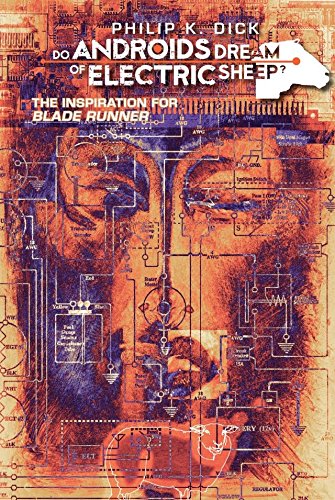
Do Androids Dream of Electric Sheep?

Author: Philip K. Dick
Rating: 4/5
Last Read: November 2014
Who Should Read: Sci-fi fans, people who liked the movie Blade Runner

Do Androids Dream of Electric Sheep?, like many other Philip K. Dick stories, inspired the movie Blade Runner. Unlike the other movies-inspired-by-stories, Do Androids Dream of Electric Sheep? is a full novel, though you might find yourself finishing it in a single sitting as if it were a short story.

The novel and the movie are markedly different, but do share similarities. The main plot still follows a bounty hunter, Rick Deckard, who is tasked with retiring escaped androids. As with most Philip K. Dick stories, there is an exploration of an underlying theme about what it means to be human.

Do Androids Dream of Electric Sheep? is an excellent entry point into the work of Philip K. Dick. You won’t be disappointed.

It is no good. I can’t do it. I can play the Thirteen Ways of Looking at a Trash Compactor Repairman Game, but I cannot turn it into a story at once puzzling, poignant, grotesque, philosophical, satirical, and fun. There is a very special way of doing this and the first step in its mastery involves being Philip K. Dick.

My Highlights

Empathy, evidently, existed only within the human community, whereas intelligence to some degree could be found throughout every phylum and order including the arachnida.

Because, ultimately, the empathic gift blurred the boundaries between hunter and victim, between the successful and the defeated. As in the fusion with Mercer, everyone ascended together

The tyranny of an object, he thought. It doesn’t know I exist. Like the androids, it had no ability to appreciate the existence of another.

But maybe she doesn’t know how to cook, he thought suddenly. Okay, I can do it; I’ll fix dinner for both of us. And I’ll show her how so she can do it in the future if she wants. She’ll probably want to, once I show her how; as near as I can make out, most women, even young ones like her, like to cook: it’s an instinct.

“I am your friend,” the old man said. “But you must go on as if I did not exist. Can you understand that?” He spread empty hands.
“No,” Rick said. “I can’t understand that. I need help.”
“How can I save you,” the old man said, “if I can’t save myself?” He smiled. “Don’t you see? There is no salvation.”

“You will be required to do wrong no matter where you go. It is the basic condition of life, to be required to violate your own identity. At some time, every creature which lives must do so. It is the ultimate shadow, the defeat of creation; this is the curse at work, the curse that feeds on all life. Everywhere in the universe.”

Do androids dream? Rick asked himself. Evidently; that’s why they occasionally kill their employers and flee here. A better life, without servitude.

Time and tide, he thought. The cycle of life. Ending in this, the last twilight. Before the silence of death. He perceived in this a micro-universe, complete.

She seemed more externally composed now. But still fundamentally frantic and tense. Yet, the dark fire waned; the life force oozed out of her, as he had so often witnessed before with other androids. The classic resignation. Mechanical, intellectual acceptance of that which a genuine organism—with two billion years of the pressure to live and evolve hagriding it—could never have reconciled itself to.

You have to be with other people, he thought. In order to live at all.

You can’t go back, he thought. You can’t go from people to nonpeople. In panic he thought, I’m dependent on them. Thank god they stayed.

“That’s because you’re a highly moral person. I’m not. I don’t judge, not even myself.”

Buy the Book

If you are interested in purchasing this book, you can support the website by using our Amazon affiliate link.




Total Recall

Author:  Philip K. Dick
Rating: 5/5 (A most excellent short story)
Last Read: December 2014
Who Should Read: Sci-fi fans, short story fans, Total Recall movie fans

Fans of the movie Total Recall may not realize that it is based on a short story by the science fiction writer Philip K. Dick. This book is actually just a single short-story publication of “We Can Remember It For You Wholesale,” the work that inspired the movie.

This story is included in the collection Selected Stories of Philip K. Dick. That collection contains some of the best stories written throughout his career.

My Highlights

Was this the answer? After all, an illusion, no matter how convincing, remained nothing more than an illusion. At least objectively. But subjectively—quite the opposite entirely.

“You’re not accepting second best. The actual memory, with all its vagueness, omissions, and ellipses, not to say distortions—that’s second best.”

Buy the Book

If you are interested in purchasing this book, you can support the website by using our Amazon affiliate link.


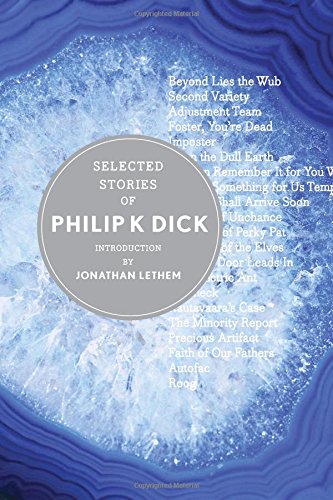
Selected Stories of Philip K. Dick

Author:  Philip K. Dick
Rating: 4/5
Last Read: December 2018
Who Should Read: Sci-fi fans, short story fans

My favorite form of science fiction is the short story. The short story format enables science fiction writers to paint a picture and separate us from our day-to-day reality, while simultaneously holding up a mirror and highlighting aspects of our human experience that we may not consciously consider.

Philip K. Dick is one of sci-fi’s short story masters. Somehow I avoided his writing for most of my sci-fi reading career, and I’ve been rectifying that by working through various collections. 

Selected Stories of Philip K. Dick is an excellent entry point into his work. Contained within are twenty-one of his best short stories, showcasing work spanning his entire career. Many of these stories are sci-fi classics and inspired films, such as Minority Report and Total Recall

My favorite stories in this collection are:

  • “The Minority Report”
  • “We Can Remember It For You Wholesale”
  • “The Exit Door Leads In”
  • “Rautavaara’s Case”

My Highlights

Kabir, the sixteenth-century Sufi poet, wrote, “If you have not lived through something, it is not true.” So live through it; I mean, go all the way to the end. Only then can it be understood, not along the way.

The existence of a majority logically implies a corresponding minority.

“But there can be no valid knowledge about the future. As soon as precognitive information is obtained, it cancels itself out. The assertion that this man will commit a future crime is paradoxical. The very act of possessing this data renders it spurious. In every case, without exception, the report of the three police precogs has invalidated their own data. If no arrests had been made, there would still have been no crimes committed.”

“There were three minority reports,” he told Witwer, enjoying the young man’s confusion. Someday, Witwer would learn not to wade into situations he didn’t fully understand. Satisfaction was Anderton’s final emotion. Old and worn out as he was, he had been the only one to grasp the real nature of the problem.

“Where would you like to go first? New York City? Broadway? To the night clubs and theaters and restaurants . . .”
“No, to Central Park. To sit on a bench.”
“But there is no more Central Park, Mr. Biskle. It was turned into a parking lot for government employees while you were on Mars.”
“I see,” Milt Biskle said. “Well, then Portsmouth Square in San Francisco will do.” He opened the door of the ’copter.
“That, too, has become a parking lot,” Miss Ableseth said, with a sad shake of her long, luminous red hair. “We’re so darn overpopulated. Try again, Mr. Biskle; there are a few parks left, one in Kansas, I believe, and two in Utah in the south part near St. George.”
“This is bad news,” Milt said. “May I stop at that amphetamine dispenser and put in my dime? I need a stimulant to cheer me up.”

Ironically, he had gotten exactly what he had asked Rekal, Incorporated for. Adventure, peril, Interplan police at work, a secret and dangerous trip to Mars in which his life was at stake—everything he had wanted as a false memory. The advantages of it being a memory—and nothing more—could now be appreciated.

DOCTRINES OF THE ABSOLUTE BENEFACTOR ANTICIPATED IN THE POETRY OF BAHA AD-DIN ZUHAYR OF THIRTEENTH-CENTURY ARABIA
Glancing down the initial pages of the essay, Chien saw a quatrain familiar to him; it was called “Death,” and he had known it most of his adult, educated life.
Once he will miss, twice he will miss,
He only chooses one of many hours;
For him nor deep nor hill there is,
But all’s one level plain he hunts for flowers.

“Don’t you see, Mr. Chien? You’ve learned something. The Leader is not the Leader; he is something else, but we can’t tell what. Not yet. Mr. Chien, with all due respect, have you ever had your drinking water analyzed? I know it sounds paranoiac, but have you?”
“No,” he said. “Of course not.”
Knowing what she was going to say. Miss Lee said briskly, “Our tests show that it’s saturated with hallucinogens. It is, has been, will continue to be. Not the ones used during the war; not the disorientating ones, but a synthetic quasi-ergot derivative called Datrox-3. You drink it here in the building from the time you get up; you drink it in restaurants and other apartments that you visit. You drink it at the Ministry; it’s all piped from a central, common source.” Her tone was bleak and ferocious. “We solved that problem; we knew, as soon as we discovered it, that any good phenothiazine would counter it. What we did not know, of course, was this—a variety of authentic experiences; that makes no sense, rationally. It’s the hallucination which should differ from person to person, and the reality experience which should be ubiquitous—it’s all turned around. We can’t even construct an ad hoc theory which accounts for that, and God knows we’ve tried. Twelve mutually exclusive hallucinations—that would be easily understood. But not one hallucination and twelve realities.”

But His Greatness, Chien thought, jolted. He did not appear, on the TV screen, to be Occidental. “On TV—” he began. “The image,” Tso-pin interrupted, “is subjected to a variegated assortment of skillful refinements. For ideological purposes. Most persons holding higher offices are aware of this.” He eyed Chien with hard criticism. So everyone agrees, Chien thought. What we see every night is not real. The question is, How unreal? Partially? Or—completely?

All this time, he thought. Hallucinogens in our water supply. Year after year. Decades. And not in wartime but in peacetime. And not to the enemy camp but here in our own. The evil bastards, he said to himself.

And—he was curious. A bad emotion, he knew. Curiosity was, especially in Party activities, often a terminal state careerwise.

“Did it ever occur to you,” Chien said, “that good and evil are names for the same thing? That God could be both good and evil at the same time?”

the computer found no programming circuit. Do I want to interfere with the reality tape? And if so, why? Because, he thought, if I control that, I control reality. At least so far as I’m concerned. My subjective reality . . . but that’s all there is. Objective reality is a synthetic construct, dealing with a hypothetical universalization of a multitude of subjective realities.

Maybe what I want to do, Poole thought, is die.

What I want, he realized, is ultimate and absolute reality, for one micro-second. After that it doesn’t matter, because all will be known; nothing will be left to understand or see.

“Addi has got more to live for than we do.” “Every man has more to live for than any other man. I don’t have a cute chick to sleep with, but I’d like to see the semis rolling along Riverside Freeway at sunset a few more times. It’s not what you have to live for; it’s that you want to live to see it, to be there—that’s what is so damn sad.”

Explanations—that’s what we need. Explanations for problems that don’t exist yet; we can develop the problems later.”

It was hell living in the twenty-first century. Information transfer had reached the velocity of light. Bibleman’s older brother had once fed a ten-word plot outline into a robot fiction machine, changed his mind as to the outcome, and found that the novel was already in print. He had had to program a sequel in order to make his correction.

To himself he thought, I was born in the wrong century. A hundred years ago this wouldn’t have happened and a hundred years from now it will be illegal. What I need is a lawyer.

The first pamphlet pointed out that it was a great honor to be admitted to the College. That was its name—the one word. How strange, he thought, puzzled. It’s like naming your cat Cat and your dog Dog. This is my mother, Mrs. Mother, and my father, Mr. Father. Are these people working right? he wondered. It had been a phobia of his for years that someday he would fall into the hands of madmen—in particular, madmen who seemed sane up until the last moment. To Bibleman this was the essence of horror.

“My point,” Major Casals said, “is simply that certain information such as architectural principles of long-standing—”
“Most architectural principles are long-standing,” Mary said. Major Casals paused. “Otherwise they’d serve no purpose,” Mary said.

Do you know yourself? But you’ll be getting into that when the College bombards you with early Greek thought. ‘Know thyself.’ Apollo’s motto at Delphi. It sums up half of Greek philosophy.”

“It is generally considered that Thales was the first rational man in history,” the terminal said.
“What about Ikhnaton?” Bibleman said.
“He was strange.”
“Moses?”
“Likewise strange.”
“Hammurabi?”
“How do you spell that?”
“I’m not sure. I’ve just heard the name.”
“Then we will discuss Anaximander,” the College terminal said. “And, in a cursory initial survey, Anaximenes, Xenophanes, Paramenides, Melissus—wait a minute; I forgot Heraclitus and Cratylus. And we will study Empedocles, Anaxagoras, Zeno—”
“Christ,” Bibleman said.
“That’s another program,” the College terminal said.

“Since you are so full of conflict, you should find Empedocles interesting. He was the first dialectical philosopher. Empedocles believed that the basis of reality was an antithetical conflict between the forces of Love and Strife. Under Love the whole cosmos is a duly proportioned mixture, called a krasis. This krasis is a spherical deity, a single perfect mind which spends all its time—”
“Is there any practical application to any of this?” Bibleman interrupted.
“The two antithetical forces of Love and Strife resemble the Taoist elements of Yang and Yin with their perpetual interaction from which all change takes place.”
“Practical application.”
“Twin mutually opposed constituents.” On the holoscreen a schematic diagram, very complex, formed. “The two-rotor Panther Engine.”

Blame is a mere cultural matter; it does not travel across species boundaries.

No wonder he loved Martine so; she herself loved back, loved the beauties of the world, and treasured and cherished them as she treasured and cherished him; it was a protective love that nourished but did not stifle.

“Hi,” Martine said, off the VF now. “What are you thinking?”
“Just that you keep alive what you love,” he said.
“I think that’s what you’re supposed to do,” Martine said.

Buy the Book

If you are interested in purchasing this book, you can support the website by using our Amazon affiliate link.


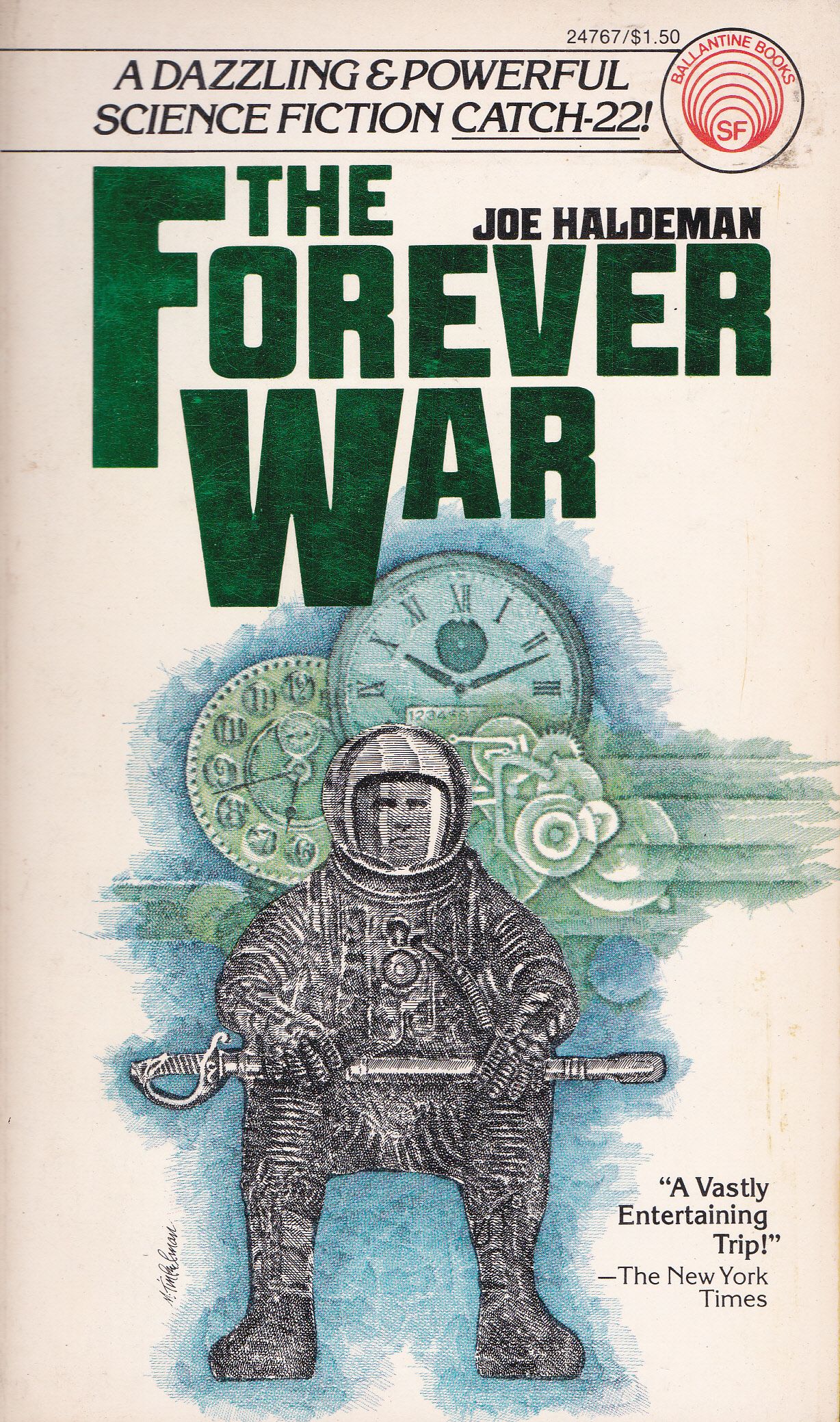
The Forever War

Author:  Joe Haldeman
Rating: 5/5
Last Read: November 2018
Who Should Read: Sci-fi fans, fans of military fiction, fans of Old Man’s War

I’ve been told that I should read The Forever War at least three times a year for the past ten years. I finally got around to reading it, like John Scalzi in the book’s introduction, and all I really have to say is: everyone was absolutely right. The Forever War is a wonderful book.

The novel is set in a future (circa 1996) where Earth is engaged in a war in the far-out reaches of space with another sentient race. Earth conscripts the best of humanity for soldiering and trains them to fight in laser-equipped battle suits. The novel follows the soldiering career of William Mandella, starting with his “boot camp” experiences and moving through various interstellar battles. Each battle involves a large relative time shift for Mandella, so on each return trip to our solar system he experiences “future” shock due to societal changes that happened in the hundreds of years he was away.

This book is an award-winning sci-fi classic for a good reason. There’s plenty of action, interesting future scenarios, and commentary on society and humanity.

To my mind, there are two things that make a novel a “classic”—a genuine classic, as opposed to merely “old and continuing to sell.” The first is that it speaks to the time in which the novel first appeared. There is no doubt The Forever War did this; its awards and acclaim are signifiers of that fact. The second thing is tougher, and that is that it keeps speaking to readers outside its time, because what’s in the book touches on something that never goes away, or at the very least keeps coming around.

I stopped at the first book (I tend to avoid series), but if you are interested in continuing there is another book in the series.

If you enjoy The Forever War, you will also enjoy John Scalzi’s Old Man’s War. (The same applies if you loved Old Man’s War – read this book!)

My Highlights

‘Man was born into barbarism, when killing his fellow man was a normal condition of existence. He became endowed with a conscience. And he has now reached the day when violence toward another human being must become as abhorrent as eating another’s flesh.’ — Martin Luther King, Jr.

Relativity propped it up, at least gave it the illusion of being there … the way all reality becomes illusory and observer-oriented when you study general relativity. Or Buddhism. Or get drafted.

Since the planet rotated rather slowly — once every ten and one-half days — a ‘stationary’ orbit for the ship had to be 150,000 klicks out. This made the people in the ship feel quite secure, with 6,000 miles of rock and 90,000 miles of space between them and the enemy. But it meant a whole second’s time lag in communication between us on the ground and the ship’s battle computer. A person could get awful dead while that neutrino pulse crawled up and back.

‘Sarge, tell that computer to do something! We’re gonna get—’
‘Oh, shut up, Mandella. Trust in th’ lord.’
‘Lord’ was definitely lower-case when Cortez said it.

… I felt my gorge rising and knew that all the lurid training tapes, all the horrible deaths in training accidents, hadn’t prepared me for this sudden reality … that I had a magic wand that I could point at a life and make it a smoking piece of half-raw meat; I wasn’t a soldier nor ever wanted to be one nor ever would want—

‘Night.’ It’s almost impossible to get sexually excited inside a suit, with the relief tube and all the silver chloride sensors poking you, but somehow this was my body’s response to the emotional impotence, maybe remembering more pleasant sleeps with Marygay, maybe feeling that in the midst of all this death, personal death could be very soon, cranking up the procreative derrick for one last try … lovely thoughts like this.

I fell asleep and dreamed that I was a machine, mimicking the functions of life, creaking and clanking my clumsy way through a world, people too polite to say anything but giggling behind my back, and the little man who sat inside my head pulling the levers and clutches and watching the dials, he was hopelessly mad and was storing up hurts for the day—

I hardly heard him for trying to keep track of what was going on in my skull. I knew it was just post-hypnotic suggestion, even remembered the session in Missouri when they’d implanted it, but that didn’t make it any less compelling. My mind reeled under the strong pseudo-memories: shaggy hulks that were Taurans (not at all what we now knew they looked like) boarding a colonists’ vessel, eating babies while mothers watched in screaming terror (the colonists never took babies; they wouldn’t stand the acceleration), then raping the women to death with huge veined purple members (ridiculous that they would feel desire for humans), holding the men down while they plucked flesh from their living bodies and gobbled it (as if they could assimilate the alien protein) … a hundred grisly details as sharply remembered as the events of a minute ago, ridiculously overdone and logically absurd. But while my conscious mind was rejecting the silliness, somewhere much deeper, down in that sleeping animal where we keep our real motives and morals, something was thirsting for alien blood, secure in the conviction that the noblest thing a man could do would be to die killing one of those horrible monsters

I spent a long time after that telling myself over and over that it hadn’t been me who so gleefully carved up those frightened, stampeding creatures. Back in the twentieth century, they had established to everybody’s satisfaction that ‘I was just following orders’ was an inadequate excuse for inhuman contact … but what can you do when the orders come from deep down in that puppet master of the unconscious?

While I was lying there being squeezed, a silly thought took hold of my brain and went round and round like a charge in a superconductor: according to military formalism, the conduct of war divides neatly into two categories, tactics and logistics. Logistics has to do with moving troops and feeding them and just about everything except the actual fighting, which is tactics. And now we’re fighting, but we don’t have a tactical computer to guide us through attack and defense, just a huge, super-efficient pacifistic cybernetic grocery clerk of a logistic, mark that word, logistic computer. The other side of my brain, perhaps not quite as pinched, would argue that it doesn’t matter what name you give to a computer, it’s a pile of memory crystals, logic banks, nuts and bolts … If you program it to be Genghis Khan, it is a tactical computer, even if its usual function is to monitor the stock market or control sewage conversion. But the other voice was obdurate and said by that kind of reasoning, a man is only a hank of hair and a piece of bone and some stringy meat; and no matter what kind of a man he is, if you teach him well, you can take a Zen monk and turn him into a slavering bloodthirsty warrior.

‘She’s very pretty.’ A remarkable observation, her body torn and caked with crusting blood, her face smeared where I had tried to wipe away the tears. I suppose a doctor or a woman or a lover can look beneath that and see beauty.

‘One cannot make command decisions simply by assessing the tactical situation and going ahead with whatever course of action will do the most harm to the enemy with a minimum of death and damage to your own men and material. Modern warfare has become very complex, especially during the last century. Wars are won not by a simple series of battles won, but by a complex interrelationship among military victory, economic pressures, logistic maneuvering, access to the enemy’s information, political postures — dozens, literally dozens of factors.’

‘I hope none of you ever has to face such a decision. When we get back to Stargate, I will in all probability be court-martialed for cowardice under fire. But I honestly believe that the information that may be gained from analysis of the damage to the Anniversary is more important than the destruction of this one Tauran base.’ He sat up straight. ‘More important than one soldier’s career.’

‘William, face it. It’s a miracle she survived to get into surgery. So there’s a big chance she won’t make it back to Earth. It’s sad; she’s a special person, the special person to you, maybe. But we’ve had so much death … you ought to be getting used to it, come to terms with it.’
I took a long pull at my drink, identical to hers except for the citric acid. ‘You’re getting pretty hard-boiled.’
‘Maybe … no. Just realistic. I have a feeling we’re headed for a lot more death and sorrow.’

‘I don’t know. If they could condition us to kill on cue, they can condition us to do almost anything. Re-enlist.’

‘I’m twenty-three, so I was still in diapers when you people left for Aleph … to begin with, how many of you are homosexual?’
Nobody.
‘That doesn’t really surprise me. I am, of course. I guess about a third of everybody in Europe and America is. ‘Most governments encourage homosexuality — the United Nations is neutral, leaves it up to the individual countries — they encourage homolife mainly because it’s the one sure method of birth control.’
That seemed specious to me. Our method of birth control in the army is pretty foolproof: all men making a deposit in the sperm bank, and then vasectomy.

‘Of course, an illegal market developed, and soon there was great inequality in the amount of food people in various strata of society consumed. A vengeance group in Ecuador, the Imparciales, systematically began to assassinate people who appeared to be well-fed. The idea caught on pretty quickly, and in a few months there was a full-scale, undeclared class war going on all over the world. The United Nations managed to get things back under control in a year or so, by which time the population was down to four billion, crops were more or less recovered, and the food crisis was over.

‘Incidentally, the General translated the money coming to you into dollars just for your own convenience. The world has only one currency now, calories. Your thirty-two thousand dollars comes to about three thousand million calories. Or three million k’s, kilocalories.

‘Also, we no longer have the abundance of electrical power I remember from boyhood … probably a good deal less than you remember. There are only a few places in the world where you can have power all day and night. They keep saying it’s a temporary situation, but it’s been going on for over a decade.’

Wars in the past often accelerated social reform, provided technological benefits, even sparked artistic activity. This one, however, seemed tailor-made to provide none of these positive by-products.

And in the past, people whose country was at war were constantly in contact with the war. The newspapers would be full of reports, veterans would return from the front; sometimes the front would move right into town, invaders marching down Main Street or bombs whistling through the night air — but always the sense of either working toward victory or at least delaying defeat. The enemy was a tangible thing, a propagandist’s monster whom you could understand, whom you could hate. But this war … the enemy was a curious organism only vaguely understood, more often the subject of cartoons than nightmares. The main effect of the war on the home front was economic, unemotional — more taxes but more jobs as well. After twenty-two years, only twenty-seven returned veterans; not enough to make a decent parade. The most important fact about the war to most people was that if it ended suddenly, Earth’s economy would collapse.

We got into a discussion about the war, with a bunch of people who knew Marygay and I were veterans. It’s hard to describe their attitude, which was pretty uniform. They were angry in an abstract way that it took so much tax money to support; they were convinced that the Taurans would never be any danger to Earth; but they all knew that nearly half the jobs in the world were associated with the war, and if it stopped, everything would fall apart.

Every time I’ve come down to Earth the past ten years, I’ve wondered whether she’d still be there. Neither of us had enough money to keep in very close touch.’ He had told us in Geneva that a letter from Luna to Earth cost $100 postage — plus $5,000 tax. It discouraged communication with what the UN considered to be a bunch of regrettably necessary anarchists.

Desperate fun, as I said. Unless the war changed radically, our chances of surviving the next three years were microscopic. We were remarkably healthy victims of a terminal disease, trying to cram a lifetime of sensation into a half of a year.

‘It doesn’t add up, though. Why would they haul me all the way from Heaven to take a chance on my “shaping up,” when probably a third of the people here on Stargate are better officer material? God, the military mind!’ ‘I suspect the bureaucratic mind, at least, had something to do with it. You have an embarrassing amount of seniority to be a footsoldier.’

Perhaps this statement is true of any hierarchical structure, but certainly of businesses:

A good sign that an army has been around too long is that it starts getting top-heavy with officers.

One thing we didn’t have to worry about in this war was enemy agents. With a good coat of paint, a Tauran might be able to disguise himself as an ambulatory mushroom. Bound to raise suspicions.

Hilleboe had called them to attention and was dutifully telling them what a good commander I was going to be; that I’d been in the war from the beginning, and if they intended to survive through their enlistment they had better follow my example. She didn’t mention that I was a mediocre soldier with a talent for getting missed.

‘Part of UNEF. Only has authority on Earth.’ She took a deep sniff at the empty capsule. ‘The idea was to keep people from making babies the biological way. Because, A, people showed a regrettable lack of sense in choosing their genetic partner. And B, the Council saw that racial differences had an unnecessarily divisive effect on humanity; with total control over births, they could make everybody the same race in a few generations.’

The art of chastising subordinates is a delicate art. I could see that I’d have to keep reminding Hilleboe that she wasn’t in charge.

‘As you will read in this book, the war ended 221 years ago. Accordingly, this is the year 220. Old style, of course, it is 3138 ad ‘You are the last group of soldiers to return. When you leave here, I will leave as well. And destroy Stargate. It exists only as a rendezvous point for returnees and as a monument to human stupidity. And shame. As you will read. Destroying it will be a cleansing.’ He stopped speaking and the woman started without a pause. ‘I am sorry for what you’ve been through and wish I could say that it was for good cause, but as you will read, it was not.

The 1143-year-long war had been begun on false pretenses and only because the two races were unable to communicate. Once they could talk, the first question was ‘Why did you start this thing?’ and the answer was ‘Me?’

‘Say, bartender.’
‘Yes, Major?’ ‘Do you know of a place called Middle Finger? Is it still there?’
‘Of course it is. Where else would it be?’ Reasonable question. ‘A very nice place. Garden planet. Some people don’t think it’s exciting enough.’

Summary

Major Characters

  • William Mandella
  • Marygay Potter
  • Sgt Cortes

Most other characters appear and die quickly.

Outline

When I read fiction, I make an outline as a memory aide. If you don’t want to see any spoilers, skip this section.

  1. Boot camp – elite conscripts w/ IQ over 150
  2. Sent to Charon – dark + cold – for training in battle suits
  3. Training + Deaths + Graduation
  4. Sent to Starbase for construction
  5. Sent to first battle against the Taurans – massive slaughter – one escapes
  6. Second battle – advanced weapons used, kill 1/3 of crew, abort attacks
  7. Leave army, return to Earth – Potter + Mandella experience future shock
  8. Mandella stays with Marygay’s family; family gets attacked and killed
  9. Return to Mandella’s mom – she does of illness
  10. Rejoin army as instructors on Luna. They immediately get transferred to a strick force
  11. Attack goes poorly; Potter + Mandella are amputees and sent to Heaven to regrow limbs and recover
  12. Marygay + Mandella are separated on separate strike forces
  13. Travel to the farthest known gate
  14. Set up base + wait for Taurans to attack
  15. Outlast Tauren attack, return to Starbase
  16. Meets “Man”, learns the war is over and was a big mistake
  17. Reunited with Marygay on Middle Finger

My Highlights

‘Man was born into barbarism, when killing his fellow man was a normal condition of existence. He became endowed with a conscience. And he has now reached the day when violence toward another human being must become as abhorrent as eating another’s flesh.’ — Martin Luther King, Jr.

Relativity propped it up, at least gave it the illusion of being there … the way all reality becomes illusory and observer-oriented when you study general relativity. Or Buddhism. Or get drafted.

Since the planet rotated rather slowly — once every ten and one-half days — a ‘stationary’ orbit for the ship had to be 150,000 klicks out. This made the people in the ship feel quite secure, with 6,000 miles of rock and 90,000 miles of space between them and the enemy. But it meant a whole second’s time lag in communication between us on the ground and the ship’s battle computer. A person could get awful dead while that neutrino pulse crawled up and back.

‘Sarge, tell that computer to do something! We’re gonna get—’
‘Oh, shut up, Mandella. Trust in th’ lord.’
‘Lord’ was definitely lower-case when Cortez said it.

… I felt my gorge rising and knew that all the lurid training tapes, all the horrible deaths in training accidents, hadn’t prepared me for this sudden reality … that I had a magic wand that I could point at a life and make it a smoking piece of half-raw meat; I wasn’t a soldier nor ever wanted to be one nor ever would want—

‘Night.’ It’s almost impossible to get sexually excited inside a suit, with the relief tube and all the silver chloride sensors poking you, but somehow this was my body’s response to the emotional impotence, maybe remembering more pleasant sleeps with Marygay, maybe feeling that in the midst of all this death, personal death could be very soon, cranking up the procreative derrick for one last try … lovely thoughts like this.

I fell asleep and dreamed that I was a machine, mimicking the functions of life, creaking and clanking my clumsy way through a world, people too polite to say anything but giggling behind my back, and the little man who sat inside my head pulling the levers and clutches and watching the dials, he was hopelessly mad and was storing up hurts for the day—

I hardly heard him for trying to keep track of what was going on in my skull. I knew it was just post-hypnotic suggestion, even remembered the session in Missouri when they’d implanted it, but that didn’t make it any less compelling. My mind reeled under the strong pseudo-memories: shaggy hulks that were Taurans (not at all what we now knew they looked like) boarding a colonists’ vessel, eating babies while mothers watched in screaming terror (the colonists never took babies; they wouldn’t stand the acceleration), then raping the women to death with huge veined purple members (ridiculous that they would feel desire for humans), holding the men down while they plucked flesh from their living bodies and gobbled it (as if they could assimilate the alien protein) … a hundred grisly details as sharply remembered as the events of a minute ago, ridiculously overdone and logically absurd. But while my conscious mind was rejecting the silliness, somewhere much deeper, down in that sleeping animal where we keep our real motives and morals, something was thirsting for alien blood, secure in the conviction that the noblest thing a man could do would be to die killing one of those horrible monsters

I spent a long time after that telling myself over and over that it hadn’t been me who so gleefully carved up those frightened, stampeding creatures. Back in the twentieth century, they had established to everybody’s satisfaction that ‘I was just following orders’ was an inadequate excuse for inhuman contact … but what can you do when the orders come from deep down in that puppet master of the unconscious?

While I was lying there being squeezed, a silly thought took hold of my brain and went round and round like a charge in a superconductor: according to military formalism, the conduct of war divides neatly into two categories, tactics and logistics. Logistics has to do with moving troops and feeding them and just about everything except the actual fighting, which is tactics. And now we’re fighting, but we don’t have a tactical computer to guide us through attack and defense, just a huge, super-efficient pacifistic cybernetic grocery clerk of a logistic, mark that word, logistic computer. The other side of my brain, perhaps not quite as pinched, would argue that it doesn’t matter what name you give to a computer, it’s a pile of memory crystals, logic banks, nuts and bolts … If you program it to be Genghis Khan, it is a tactical computer, even if its usual function is to monitor the stock market or control sewage conversion. But the other voice was obdurate and said by that kind of reasoning, a man is only a hank of hair and a piece of bone and some stringy meat; and no matter what kind of a man he is, if you teach him well, you can take a Zen monk and turn him into a slavering bloodthirsty warrior.

‘She’s very pretty.’ A remarkable observation, her body torn and caked with crusting blood, her face smeared where I had tried to wipe away the tears. I suppose a doctor or a woman or a lover can look beneath that and see beauty.

‘One cannot make command decisions simply by assessing the tactical situation and going ahead with whatever course of action will do the most harm to the enemy with a minimum of death and damage to your own men and material. Modern warfare has become very complex, especially during the last century. Wars are won not by a simple series of battles won, but by a complex interrelationship among military victory, economic pressures, logistic maneuvering, access to the enemy’s information, political postures — dozens, literally dozens of factors.’

‘I hope none of you ever has to face such a decision. When we get back to Stargate, I will in all probability be court-martialed for cowardice under fire. But I honestly believe that the information that may be gained from analysis of the damage to the Anniversary is more important than the destruction of this one Tauran base.’ He sat up straight. ‘More important than one soldier’s career.’

‘William, face it. It’s a miracle she survived to get into surgery. So there’s a big chance she won’t make it back to Earth. It’s sad; she’s a special person, the special person to you, maybe. But we’ve had so much death … you ought to be getting used to it, come to terms with it.’
I took a long pull at my drink, identical to hers except for the citric acid. ‘You’re getting pretty hard-boiled.’
‘Maybe … no. Just realistic. I have a feeling we’re headed for a lot more death and sorrow.’

‘I don’t know. If they could condition us to kill on cue, they can condition us to do almost anything. Re-enlist.’

‘I’m twenty-three, so I was still in diapers when you people left for Aleph … to begin with, how many of you are homosexual?’
Nobody.
‘That doesn’t really surprise me. I am, of course. I guess about a third of everybody in Europe and America is. ‘Most governments encourage homosexuality — the United Nations is neutral, leaves it up to the individual countries — they encourage homolife mainly because it’s the one sure method of birth control.’
That seemed specious to me. Our method of birth control in the army is pretty foolproof: all men making a deposit in the sperm bank, and then vasectomy.

‘Of course, an illegal market developed, and soon there was great inequality in the amount of food people in various strata of society consumed. A vengeance group in Ecuador, the Imparciales, systematically began to assassinate people who appeared to be well-fed. The idea caught on pretty quickly, and in a few months there was a full-scale, undeclared class war going on all over the world. The United Nations managed to get things back under control in a year or so, by which time the population was down to four billion, crops were more or less recovered, and the food crisis was over.

‘Incidentally, the General translated the money coming to you into dollars just for your own convenience. The world has only one currency now, calories. Your thirty-two thousand dollars comes to about three thousand million calories. Or three million k’s, kilocalories.

‘Also, we no longer have the abundance of electrical power I remember from boyhood … probably a good deal less than you remember. There are only a few places in the world where you can have power all day and night. They keep saying it’s a temporary situation, but it’s been going on for over a decade.’

> Wars in the past often accelerated social reform, provided technological benefits, even sparked artistic activity. This one, however, seemed tailor-made to provide none of these positive by-products.

And in the past, people whose country was at war were constantly in contact with the war. The newspapers would be full of reports, veterans would return from the front; sometimes the front would move right into town, invaders marching down Main Street or bombs whistling through the night air — but always the sense of either working toward victory or at least delaying defeat. The enemy was a tangible thing, a propagandist’s monster whom you could understand, whom you could hate. But this war … the enemy was a curious organism only vaguely understood, more often the subject of cartoons than nightmares. The main effect of the war on the home front was economic, unemotional — more taxes but more jobs as well. After twenty-two years, only twenty-seven returned veterans; not enough to make a decent parade. The most important fact about the war to most people was that if it ended suddenly, Earth’s economy would collapse.

We got into a discussion about the war, with a bunch of people who knew Marygay and I were veterans. It’s hard to describe their attitude, which was pretty uniform. They were angry in an abstract way that it took so much tax money to support; they were convinced that the Taurans would never be any danger to Earth; but they all knew that nearly half the jobs in the world were associated with the war, and if it stopped, everything would fall apart.

Every time I’ve come down to Earth the past ten years, I’ve wondered whether she’d still be there. Neither of us had enough money to keep in very close touch.’ He had told us in Geneva that a letter from Luna to Earth cost $100 postage — plus $5,000 tax. It discouraged communication with what the UN considered to be a bunch of regrettably necessary anarchists.

Desperate fun, as I said. Unless the war changed radically, our chances of surviving the next three years were microscopic. We were remarkably healthy victims of a terminal disease, trying to cram a lifetime of sensation into a half of a year.

‘It doesn’t add up, though. Why would they haul me all the way from Heaven to take a chance on my “shaping up,” when probably a third of the people here on Stargate are better officer material? God, the military mind!’ ‘I suspect the bureaucratic mind, at least, had something to do with it. You have an embarrassing amount of seniority to be a footsoldier.’

Perhaps this statement is true of any hierarchical structure, but certainly of businesses:

> A good sign that an army has been around too long is that it starts getting top-heavy with officers.

One thing we didn’t have to worry about in this war was enemy agents. With a good coat of paint, a Tauran might be able to disguise himself as an ambulatory mushroom. Bound to raise suspicions.

Hilleboe had called them to attention and was dutifully telling them what a good commander I was going to be; that I’d been in the war from the beginning, and if they intended to survive through their enlistment they had better follow my example. She didn’t mention that I was a mediocre soldier with a talent for getting missed.

‘Part of UNEF. Only has authority on Earth.’ She took a deep sniff at the empty capsule. ‘The idea was to keep people from making babies the biological way. Because, A, people showed a regrettable lack of sense in choosing their genetic partner. And B, the Council saw that racial differences had an unnecessarily divisive effect on humanity; with total control over births, they could make everybody the same race in a few generations.’

The art of chastising subordinates is a delicate art. I could see that I’d have to keep reminding Hilleboe that she wasn’t in charge.

‘As you will read in this book, the war ended 221 years ago. Accordingly, this is the year 220. Old style, of course, it is 3138 ad ‘You are the last group of soldiers to return. When you leave here, I will leave as well. And destroy Stargate. It exists only as a rendezvous point for returnees and as a monument to human stupidity. And shame. As you will read. Destroying it will be a cleansing.’ He stopped speaking and the woman started without a pause. ‘I am sorry for what you’ve been through and wish I could say that it was for good cause, but as you will read, it was not.

The 1143-year-long war had been begun on false pretenses and only because the two races were unable to communicate. Once they could talk, the first question was ‘Why did you start this thing?’ and the answer was ‘Me?’

‘Say, bartender.’
‘Yes, Major?’ ‘Do you know of a place called Middle Finger? Is it still there?’
‘Of course it is. Where else would it be?’ Reasonable question. ‘A very nice place. Garden planet. Some people don’t think it’s exciting enough.’

Summary

Major Characters

  • William Mandella
  • Marygay Potter
  • Sgt Cortes

Most other characters appear and die quickly.

Outline

When I read fiction, I make an outline as a memory aide. If you don’t want to see any spoilers, skip this section.

  1. Boot camp – elite conscripts w/ IQ over 150
  2. Sent to Charon – dark + cold – for training in battle suits
  3. Training + Deaths + Graduation
  4. Sent to Starbase for construction
  5. Sent to first battle against the Taurans – massive slaughter – one escapes
  6. Second battle – advanced weapons used, kill 1/3 of crew, abort attacks
  7. Leave army, return to Earth – Potter + Mandella experience future shock
  8. Mandella stays with Marygay’s family; family gets attacked and killed
  9. Return to Mandella’s mom – she does of illness
  10. Rejoin army as instructors on Luna. They immediately get transferred to a strick force
  11. Attack goes poorly; Potter + Mandella are amputees and sent to Heaven to regrow limbs and recover
  12. Marygay + Mandella are separated on separate strike forces
  13. Travel to the farthest known gate
  14. Set up base + wait for Taurans to attack
  15. Outlast Tauren attack, return to Starbase
  16. Meets “Man”, learns the war is over and was a big mistake
  17. Reunited with Marygay on Middle Finger

Buy the Book

If you are interested in purchasing this book, you can support the website by using our Amazon affiliate link.

 

The Forever War

By Joe Haldeman


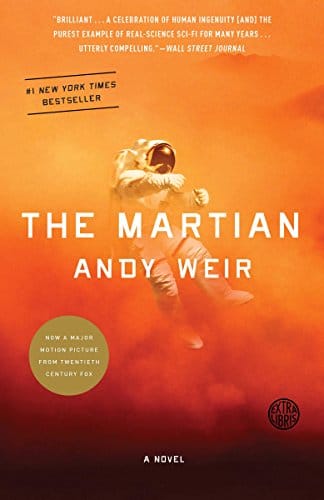
The Martian

Author: Andy Weir
Rating: 7/10
Last Read: October 2015

The Martian is a relatively well-known book about an astronaut who is abandoned on Mars after his companions thought he was dead. He tries to stay alive and establish contact with Earth, hoping they can figure out how to get him back home. The novel is told from the point of view of multiple characters, but focuses primarily on the astronaut and his struggle to live.

I enjoyed The Martian and thought it was a decent sci-fi novel. The book is clearly targeted at engineers, so the details and explanations and jokes are perhaps nerdier than other sci-fi novels.

My Highlights

Chuck shrugged. “Never occurred to us. We never thought someone would be on Mars without an MAV.”
“I mean, come on!” Morris said. “What are the odds?”
Chuck turned to him. “One in three, based on empirical data. That’s pretty bad if you think about it.”

“How’d I do today?” Venkat asked.
“Eeeh,” Annie said, putting her phone away. “You shouldn’t say things like ‘bring him home alive.’ It reminds people he might die.”
“Think they’re going to forget that?”
“You asked my opinion. Don’t like it? Go fuck yourself.”
“You’re such a delicate flower, Annie. How’d you end up NASA’s director of media relations?”
“Beats the fuck out of me,” Annie said.

Irene carefully formed her answer before speaking. “When facing death, people want to be heard. They don’t want to die alone. He might just want the MAV radio so he can talk to another soul before he dies.”

“Jesus, what a complicated process,” Venkat said.
“Try updating a Linux server sometime,” Jack said.
After a moment of silence, Tim said, “You know he was telling a joke, right? That was supposed to be funny.”
“Oh,” said Venkat. “I’m a physics guy, not a computer guy.”
“He’s not funny to computer guys, either.”

I started the day with some nothin’ tea. Nothin’ tea is easy to make. First, get some hot water, then add nothin’. I experimented with potato skin tea a few weeks ago. The less said about that the better.

Buy the Book

If you are interested in purchasing this book, you can support the website by using our Amazon affiliate link:


The Martian

By Andy Weir


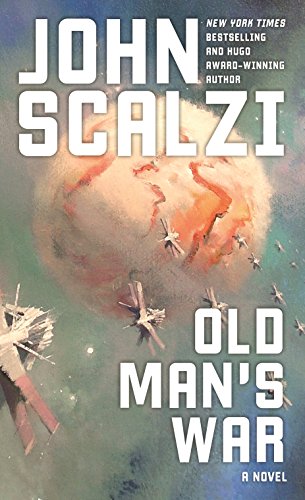
Old Man’s War

Author: John Scalzi
Rating: 8/10
Last Read: 12/2014

Old Man’s War is an excellent science fiction novel with some thought provoking aspects to it. The novel is set in man’s future, where we have expanded to the stars. The interesting twist of the book is that the Colonial Defense Force (CDF) recruits soldiers from the elderly population: 65 and up. Although they are not sure why old farts are wanted, they eventually find their minds transferred into genetically engineered super-soldier bodies. Their new lease on life comes at the cost of serving in the CDF’s ongoing wars, however.

The overall concept is interesting, and I certainly haven’t read another sci-fi book with this particular theme. I highly recommend Old Man’s War for sci-fi lovers.

P.S.: The first book is the best in the trilogy, but I also enjoyed the two novels that follow Old Man’s War.

My Highlights

Kathy’s marker has her name (Katherine Rebecca Perry), her dates, and the words: BELOVED WIFE AND MOTHER. I read those words over and over every time I visit. I can’t help it; they are four words that so inadequately and so perfectly sum up a life. The phrase tells you nothing about her, about how she met each day or how she worked, about what her interests were or where she liked to travel. You’d never know what her favorite color was, or how she liked to wear her hair, or how she voted, or what her sense of humor was. You’d know nothing about her except that she was loved. And she was. She’d think that was enough.

For as much as I hate the cemetery, I’ve been grateful it’s here, too. I miss my wife. It’s easier to miss her at a cemetery, where she’s never been anything but dead, than to miss her in all the places where she was alive.

The problem with aging is not that it’s one damn thing after another—it’s every damn thing, all at once, all the time.

“I didn’t mind getting old when I was young, either,” I said. “It’s the being old now that’s getting to me.”

“What is the weak point of the human body?” Ruiz asked as he circled around our platoon. “It’s not the heart, or the brain, or the feet, or anywhere you think it is. I’ll tell you what it is. It’s the blood, and that’s bad news because your blood is everywhere in your body. It carries oxygen, but it also carries disease. When you’re wounded, blood clots, but often not fast enough to keep you from dying of blood loss. Although when it comes down to it, what everyone really dies of is oxygen deprivation—from blood being unavailable because it’s spewed out on the fucking ground where it doesn’t do you a goddamned bit of good.

“What is it like when you lose someone you love?” Jane asked.
“You die, too,” I said. “And you wait around for your body to catch up.”

“Is that what you’re doing now?” Jane said. “Waiting for your body to catch up, I mean.”
“No, not anymore,” I said. “You eventually get to live again. You just live a different life, is all.

“I’m not insane, sir,” I said. “I have a finely calibrated sense of acceptable risk.”

Buy the Book

If you are interested in purchasing this book, you can support the website by using our Amazon affiliate link:


Old Man’s War

By John Scalzi


The Collapsing Empire

Author: John Scalzi
Rating: 8/10
Last Read: April 2017

Quick Summary:  The Collapsing Empire is a newer book of John Scalzi’s (the latest at the time of this writing). The Collapsing Empire is a quick and fun read – it sets up a new universe on the verge of a massive problem. The future space-based empire of man lives on a network of worlds connected by “the flow”. The flow has been assumed to be a stable network between worlds; in the manner of most assumptions, this turns out to not be true and soon the flow will close and mankind will be stranded alone in the dark.

Naturally, many characters are poised to respond to this nascent information – some seek political advantage and power in the coming future, and others seek to prevent the mass extinction of mankind across its many colonies.

The Collapsing Empire is a fun (and mostly light-hearted) read. The only thing I really take points off for is the lack of real resolution at the end of the book. Scalzi is clearly building a new universe and series that will continue on.  However, I contrast this against Old Man’s War, which was the first part of a series but still had a satisfying ending of its own. I prefer my stories to be complete, rather than lacking a satisfying ending.

My Highlights

“You have this all planned out, then.”
“It’s not personal, Captain.”
“Getting murdered for money feels personal, Ollie.”
–loc 104

“But you just said it’s a politically advantageous match.” Batrin gave the very slightest of shrugs.
“It is, but so what? You’ll be emperox soon enough.”
“And then no one can tell me what to do.”
“Oh, no,” Batrin said. “Everyone will tell you what to do. But you won’t always have to listen.”
–loc 459

“If you like we can adjust my conversational model to be more like I was in life.”
“You’re telling me you lied to me in life.”
“No more than to anyone else.”

–loc 1203

“But you just said you were a prophet.”
“Anyone can be a prophet. You just have to say that what you’re talking about is a reflection of God. Or of the gods. Or of some divine spirit. However you want to put it. Whether those things come true isn’t one way or another about it.”
–loc 2638

“He’s a mess,” Marce said.
“Yes, well. Lady Kiva tossed him out an airlock,” Pinton answered.
“You threw him into space?”
“Yup.”
“And he didn’t die?”
“We only threw him out a little bit.”
–loc 3092

“Because he was in the corridor with your ‘associate’ when the bomb went off. He and several other crew members were trying to interrupt your friend. He survived. Two other crew members didn’t.”
“Condolences, Captain.”
“You just threatened to destroy my ship and kill my entire crew, Captain. Your condolences are hollow.”
–loc 3188

“You and me and him. There you’ll explain the entire situation to him, and apologize to him.”
“Sir, for what? As I said, this is entirely a misunderstanding.”
“Then you’ll apologize for the misunderstanding. Ghreni, it doesn’t matter whether you actually have anything to apologize for. The act of apologizing is the thing. You should know that already. That’s basic diplomacy.
–loc 3424

Mount snorted. “I’m not going to appoint her just because the duke died and now she doesn’t have to overthrow him. They are still in rebellion. You don’t win a rebellion by default.” –loc 3683

“I’m continually confronted with the human tendency to ignore or deny facts until the last possible instant. And then for several days after that, too.” –loc 5097

“That’s the human brain,” Attavio VI said. “It creates patterns when there aren’t any. Imagines causality when there is none. Imagines a narrative where none exists. It’s in the design of the brain itself. It’s primed to lie.” “And –loc 5137

Hitchhiker’s Guide to the Galaxy (Book 1)

Author: Douglas Adams
Rating: 9/10
Last Read: February 2017

Quick Summary:  Hitchhiker’s Guide is a science fiction book that follows the adventure of Arthur Dent and his unlikely companions. This books is full of nonsense – aliens with two heads, ridiculous names, strange encyclopedia articles, and mice running experiments on humans.  If you love to laugh, this book is for you. No, really, that’s the only recommendation you need.

If you want to take your enjoyment of this book to the next level, I recommend reading it out loud to yourself, your friends, your dog, or your spouse. Adams’s humor jumps to another level when you have to try to say the words written on the page out loud. Having read this book multiple times, I can definitely say that everything was funnier when I said it out loud.

Definitely an enjoyable read (and re-read).  Also a worthy pre-bed book, though you might find that the giggles don’t help you fall asleep.

My Highlights

The thing that used to worry him most was the fact that people always used to ask him what he was looking so worried about. –loc 425

“Time is an illusion. Lunchtime doubly so.” –loc 668

At first Ford had formed a theory to account for this strange behavior. If human beings don’t keep exercising their lips, he thought, their mouths probably seize up. After a few months’ consideration and observation he abandoned this theory in favor of a new one. If they don’t keep on exercising their lips, he thought, their brains start working. –loc 984

Or do you just find that coming to terms with the mindless tedium of it all presents an interesting challenge?” –loc 1288

“You know,” said Arthur, “it’s at times like this, when I’m trapped in a Vogon airlock with a man from Betelgeuse, and about to die of asphyxiation in deep space, that I really wish I’d listened to what my mother told me when I was young.” “Why, what did she tell you?” “I don’t know, I didn’t listen.” “Oh.” Ford carried on humming. –loc 1346

They both sat on the pavement and watched with a certain unease as huge children bounced heavily along the sand and wild horses thundered through the sky taking fresh supplies of reinforced railings to the Uncertain Areas. –loc 1420

Curiously enough, the only thing that went through the mind of the bowl of petunias as it fell was Oh no, not again. Many people have speculated that if we knew exactly why the bowl of petunias had thought that we would know a lot more about the nature of the Universe than we do now. –loc 1933

It is an important and popular fact that things are not always what they seem. –loc 2356

For instance, on the planet Earth, man had always assumed that he was more intelligent than dolphins because he had achieved so much—the wheel, New York, wars and so on—while all the dolphins had ever done was muck about in the water having a good time. But conversely, the dolphins had always believed that they were far more intelligent than man—for precisely the same reasons. –loc 2357

“You know,” said Arthur thoughtfully, “all this explains a lot of things. All through my life I’ve had this strange unaccountable feeling that something was going on in the world, something big, even sinister, and no one would tell me what it was.”
“No,” said the old man, “that’s just perfectly normal paranoia. Everyone in the Universe has that.” –loc 2771

“Maybe. Who cares?” said Slartibartfast before Arthur got too excited. “Perhaps I’m old and tired,” he continued, “but I always think that the chances of finding out what really is going on are so absurdly remote that the only thing to do is to say hang the sense of it and just keep yourself occupied. Look at me: I design coastlines. I got an award for Norway.” –loc 2776

The Man in the High Castle

Author: Philip K. Dick
Rating: 7/10
Last Read: February 2017

Quick Summary:  As a long time sci-fi fan (and Philip K. Dick fan), I was disappointed that I never read The Man in the High Castle.  Once I saw it was being made into a mini-series, I was motivated to finally read it.

The Man in the High Castle is a short novel set in an alternate universe. The notable difference between the book’s universe and our own is that the Axis won WWII. The United States is split between Japan and Germany. The book takes place in Japanese-occupied San Francisco and follows multiple Japanese, American, and German characters. The characters are interrelated, if only through chance meetings, and they provide different views into the culture and challenges of this alternative world.

If you’re looking for a complete story with a nice ending, The Man in the High Castle is not for you. The book offers no resolution, it is simply a glimpse into an alternative reality and a study of the characters who live there.

Overall I enjoyed reading the book – it was an excellent pre-bed reading option.

My Highlights

Yes, these new young people, of the rising generation, who did not remember the days before the war or even the war itself—they were the hope of the world. Place difference did not have the significance for them. It will end, Childan thought. Someday. The very idea of place. Not governed and governing, but people. –loc 92

‘What profit it a man if he gain the whole world but in this enterprise lose his soul?’” –loc 170

Random, and yet rooted in the moment in which he lived, in which his life was bound up with all other lives and particles in the universe. –loc 190

Tagomi had never ridden on such a ship; when he met Mr. Baynes he would have to take care to appear blasé, no matter how large the rocket turned out to be. Now to practice. He stood in front of the mirror on the office wall, creating a face of composure, mildly bored, inspecting his own cold features for any giveaway. Yes, they are very noisy, Mr. Baynes, sir. One cannot read. But then the flight from Stockholm to San Francisco is only forty-five minutes. –loc 225

“You never know what they’re going to do,” Juliana said. “They hide their real thoughts.” –loc 438

Watching him, Juliana thought, It’s idealism that makes him that bitter. Asking too much out of life. Always moving on, restless and griped. I’m the same way; I couldn’t stay on the West Coast and eventually I won’t be able to stand it here. Weren’t the old-timers like that? But, she thought, now the frontier isn’t here; it’s the other planets. –loc 492

Perhaps if you know you are insane then you are not insane. Or you are becoming sane, finally. Waking up. I suppose only a few are aware of all this. Isolated persons here and there. But the broad masses . . . what do they think? All these hundreds of thousands in this city, here. Do they imagine that they live in a sane world? Or do they guess, glimpse, the truth . . . –loc 572

They want to be the agents, not the victims, of history. They identify with God’s power and believe they are godlike. That is their basic madness. They are overcome by some archetype; their egos have expanded psychotically so that they cannot tell where they begin and the godhead leaves off. It is not hubris, not pride; it is inflation of the ego to its ultimate—confusion between him who worships and that which is worshiped. Man has not eaten God; God has eaten man. –loc 587

What they do not comprehend is man’s helplessness. I am weak, small, of no consequence to the universe. It does not notice me; I live on unseen. But why is that bad? Isn’t it better that way? Whom the gods notice they destroy. Be small . . . and you will escape the jealousy of the great. –loc 590

That McCarthy, he thought, is a damn good shop foreman. He has the knack of needling a man, getting him to put out his best efforts, to do his utmost in spite of himself. He’s a natural leader; he almost inspired me, for a moment, there. But—McCarthy had gone off, now; the effort had failed. –loc 691

“We must all have faith in something,” Mr. Tagomi said. “We cannot know the answers. We cannot see ahead, on our own.” –loc 1001

Gemeinschaft—folkness. –loc 2316

“Juliana, it’s all darkness,” Joe said. “Nothing is true or certain. Right?” “Maybe so,” she said absently, continuing to try to read. –loc 2329

Nothing. Heart pounding. Respiration and all somatic processes, including all manner of diencephalic-controlled autonomic responses to crisis: adrenaline, greater heartbeat, pulse rate, glands pouring, throat paralyzed, eyes staring, bowels loose, et al. Stomach queasy and sex instinct suppressed. –loc 2363

And yet, nothing to see; nothing for body to do. Run? All in preparation for panic flight. But where to and why? Mr. Tagomi asked himself. No clue. Therefore impossible. Dilemma of civilized man; body mobilized, but danger obscure. –loc 2365

Calmly, even harshly, Paul said, “Robert, you must face reality with more courage.” –loc 2531

Childan thought, He’s actually saying: Which are you Robert? He whom the oracle calls “the inferior man,” or that other for whom all the good advice is meant? Must decide, here. You may trot on one way or the other, but not both. Moment of choice now. –loc 2581

The oracle enigmatic. Perhaps it has withdrawn from the world of man in sorrow. The sages leaving. We have entered a Moment when we are alone. We cannot get assistance, as before. Well, Mr. Tagomi thought, perhaps that too is good. Or can be made good. One must still try to find the Way. –loc 3179

But we cannot do it all at once; it is a sequence. An unfolding process. We can only control the end by making a choice at each step. –loc 3516

We do not have the ideal world, such as we would like, where morality is easy because cognition is easy. Where one can do right with no effort because he can detect the obvious. –loc 3519

Juliana said, “Oracle, why did you write The Grasshopper Lies Heavy? What are we supposed to learn?”
“You have a disconcertingly superstitious way of phrasing your question,” Hawthorne said. –loc 3680