The Philip K Dick Anthology

Author: Philip K. Dick
Rating: 4/5
Last Read: December 2014
Who Should Read: Sci-fi fans, short story fans

The Philip K. Dick Anthology is a collection of thirteen short stories by the famed sci-fi writer Philip K. Dick. Many of his stories have been turned into movies such as Total Recall, Minority Report, and Blade Runner.

This collection contains a different list of stories than those in the Selected Stories of Philip K. Dick. The thirteen included stories are:

  • “The Eyes Have It”
  • “Beyond the Door”
  • “Beyond Lies the Wub”
  • “Mr. Spaceship”
  • “The Skull”
  • “The Crystal Crypt”
  • “The Defenders”
  • “The Hanging Stranger”
  • “The Gun”
  • “Tony and the Beetles”
  • “The Variable Man”
  • “Piper in the Woods”
  • “Second Variety”

My Highlights

Apparently in my first pass through I was only struck by a single passage, but it is a beautiful one:

find in your Odysseus a figure common to the mythology of most self-conscious races. As I interpret it, Odysseus wanders as an individual, aware of himself as such. This is the idea of separation, of separation from family and country. The process of individuation.”
“But Odysseus returns to his home.” Peterson looked out the port window, at the stars, endless stars, burning intently in the empty universe. “Finally he goes home.”
“As must all creatures. The moment of separation is a temporary period, a brief journey of the soul. It begins, it ends. The wanderer returns to land and race….”

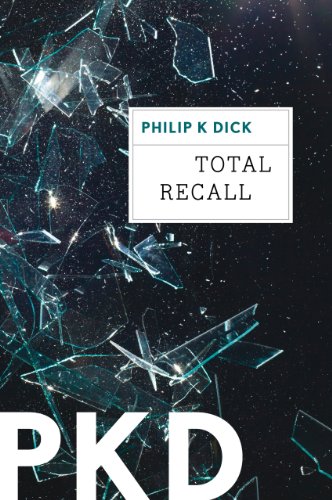
Total Recall

Author:  Philip K. Dick
Rating: 5/5 (A most excellent short story)
Last Read: December 2014
Who Should Read: Sci-fi fans, short story fans, Total Recall movie fans

Fans of the movie Total Recall may not realize that it is based on a short story by the science fiction writer Philip K. Dick. This book is actually just a single short-story publication of “We Can Remember It For You Wholesale,” the work that inspired the movie.

This story is included in the collection Selected Stories of Philip K. Dick. That collection contains some of the best stories written throughout his career.

My Highlights

Was this the answer? After all, an illusion, no matter how convincing, remained nothing more than an illusion. At least objectively. But subjectively—quite the opposite entirely.

“You’re not accepting second best. The actual memory, with all its vagueness, omissions, and ellipses, not to say distortions—that’s second best.”

Buy the Book

If you are interested in purchasing this book, you can support the website by using our Amazon affiliate link.



Selected Stories of Philip K. Dick

Author:  Philip K. Dick
Rating: 4/5
Last Read: December 2018
Who Should Read: Sci-fi fans, short story fans

My favorite form of science fiction is the short story. The short story format enables science fiction writers to paint a picture and separate us from our day-to-day reality, while simultaneously holding up a mirror and highlighting aspects of our human experience that we may not consciously consider.

Philip K. Dick is one of sci-fi’s short story masters. Somehow I avoided his writing for most of my sci-fi reading career, and I’ve been rectifying that by working through various collections. 

Selected Stories of Philip K. Dick is an excellent entry point into his work. Contained within are twenty-one of his best short stories, showcasing work spanning his entire career. Many of these stories are sci-fi classics and inspired films, such as Minority Report and Total Recall

My favorite stories in this collection are:

  • “The Minority Report”
  • “We Can Remember It For You Wholesale”
  • “The Exit Door Leads In”
  • “Rautavaara’s Case”

My Highlights

Kabir, the sixteenth-century Sufi poet, wrote, “If you have not lived through something, it is not true.” So live through it; I mean, go all the way to the end. Only then can it be understood, not along the way.

The existence of a majority logically implies a corresponding minority.

“But there can be no valid knowledge about the future. As soon as precognitive information is obtained, it cancels itself out. The assertion that this man will commit a future crime is paradoxical. The very act of possessing this data renders it spurious. In every case, without exception, the report of the three police precogs has invalidated their own data. If no arrests had been made, there would still have been no crimes committed.”

“There were three minority reports,” he told Witwer, enjoying the young man’s confusion. Someday, Witwer would learn not to wade into situations he didn’t fully understand. Satisfaction was Anderton’s final emotion. Old and worn out as he was, he had been the only one to grasp the real nature of the problem.

“Where would you like to go first? New York City? Broadway? To the night clubs and theaters and restaurants . . .”
“No, to Central Park. To sit on a bench.”
“But there is no more Central Park, Mr. Biskle. It was turned into a parking lot for government employees while you were on Mars.”
“I see,” Milt Biskle said. “Well, then Portsmouth Square in San Francisco will do.” He opened the door of the ’copter.
“That, too, has become a parking lot,” Miss Ableseth said, with a sad shake of her long, luminous red hair. “We’re so darn overpopulated. Try again, Mr. Biskle; there are a few parks left, one in Kansas, I believe, and two in Utah in the south part near St. George.”
“This is bad news,” Milt said. “May I stop at that amphetamine dispenser and put in my dime? I need a stimulant to cheer me up.”

Ironically, he had gotten exactly what he had asked Rekal, Incorporated for. Adventure, peril, Interplan police at work, a secret and dangerous trip to Mars in which his life was at stake—everything he had wanted as a false memory. The advantages of it being a memory—and nothing more—could now be appreciated.

DOCTRINES OF THE ABSOLUTE BENEFACTOR ANTICIPATED IN THE POETRY OF BAHA AD-DIN ZUHAYR OF THIRTEENTH-CENTURY ARABIA
Glancing down the initial pages of the essay, Chien saw a quatrain familiar to him; it was called “Death,” and he had known it most of his adult, educated life.
Once he will miss, twice he will miss,
He only chooses one of many hours;
For him nor deep nor hill there is,
But all’s one level plain he hunts for flowers.

“Don’t you see, Mr. Chien? You’ve learned something. The Leader is not the Leader; he is something else, but we can’t tell what. Not yet. Mr. Chien, with all due respect, have you ever had your drinking water analyzed? I know it sounds paranoiac, but have you?”
“No,” he said. “Of course not.”
Knowing what she was going to say. Miss Lee said briskly, “Our tests show that it’s saturated with hallucinogens. It is, has been, will continue to be. Not the ones used during the war; not the disorientating ones, but a synthetic quasi-ergot derivative called Datrox-3. You drink it here in the building from the time you get up; you drink it in restaurants and other apartments that you visit. You drink it at the Ministry; it’s all piped from a central, common source.” Her tone was bleak and ferocious. “We solved that problem; we knew, as soon as we discovered it, that any good phenothiazine would counter it. What we did not know, of course, was this—a variety of authentic experiences; that makes no sense, rationally. It’s the hallucination which should differ from person to person, and the reality experience which should be ubiquitous—it’s all turned around. We can’t even construct an ad hoc theory which accounts for that, and God knows we’ve tried. Twelve mutually exclusive hallucinations—that would be easily understood. But not one hallucination and twelve realities.”

But His Greatness, Chien thought, jolted. He did not appear, on the TV screen, to be Occidental. “On TV—” he began. “The image,” Tso-pin interrupted, “is subjected to a variegated assortment of skillful refinements. For ideological purposes. Most persons holding higher offices are aware of this.” He eyed Chien with hard criticism. So everyone agrees, Chien thought. What we see every night is not real. The question is, How unreal? Partially? Or—completely?

All this time, he thought. Hallucinogens in our water supply. Year after year. Decades. And not in wartime but in peacetime. And not to the enemy camp but here in our own. The evil bastards, he said to himself.

And—he was curious. A bad emotion, he knew. Curiosity was, especially in Party activities, often a terminal state careerwise.

“Did it ever occur to you,” Chien said, “that good and evil are names for the same thing? That God could be both good and evil at the same time?”

the computer found no programming circuit. Do I want to interfere with the reality tape? And if so, why? Because, he thought, if I control that, I control reality. At least so far as I’m concerned. My subjective reality . . . but that’s all there is. Objective reality is a synthetic construct, dealing with a hypothetical universalization of a multitude of subjective realities.

Maybe what I want to do, Poole thought, is die.

What I want, he realized, is ultimate and absolute reality, for one micro-second. After that it doesn’t matter, because all will be known; nothing will be left to understand or see.

“Addi has got more to live for than we do.” “Every man has more to live for than any other man. I don’t have a cute chick to sleep with, but I’d like to see the semis rolling along Riverside Freeway at sunset a few more times. It’s not what you have to live for; it’s that you want to live to see it, to be there—that’s what is so damn sad.”

Explanations—that’s what we need. Explanations for problems that don’t exist yet; we can develop the problems later.”

It was hell living in the twenty-first century. Information transfer had reached the velocity of light. Bibleman’s older brother had once fed a ten-word plot outline into a robot fiction machine, changed his mind as to the outcome, and found that the novel was already in print. He had had to program a sequel in order to make his correction.

To himself he thought, I was born in the wrong century. A hundred years ago this wouldn’t have happened and a hundred years from now it will be illegal. What I need is a lawyer.

The first pamphlet pointed out that it was a great honor to be admitted to the College. That was its name—the one word. How strange, he thought, puzzled. It’s like naming your cat Cat and your dog Dog. This is my mother, Mrs. Mother, and my father, Mr. Father. Are these people working right? he wondered. It had been a phobia of his for years that someday he would fall into the hands of madmen—in particular, madmen who seemed sane up until the last moment. To Bibleman this was the essence of horror.

“My point,” Major Casals said, “is simply that certain information such as architectural principles of long-standing—”
“Most architectural principles are long-standing,” Mary said. Major Casals paused. “Otherwise they’d serve no purpose,” Mary said.

Do you know yourself? But you’ll be getting into that when the College bombards you with early Greek thought. ‘Know thyself.’ Apollo’s motto at Delphi. It sums up half of Greek philosophy.”

“It is generally considered that Thales was the first rational man in history,” the terminal said.
“What about Ikhnaton?” Bibleman said.
“He was strange.”
“Moses?”
“Likewise strange.”
“Hammurabi?”
“How do you spell that?”
“I’m not sure. I’ve just heard the name.”
“Then we will discuss Anaximander,” the College terminal said. “And, in a cursory initial survey, Anaximenes, Xenophanes, Paramenides, Melissus—wait a minute; I forgot Heraclitus and Cratylus. And we will study Empedocles, Anaxagoras, Zeno—”
“Christ,” Bibleman said.
“That’s another program,” the College terminal said.

“Since you are so full of conflict, you should find Empedocles interesting. He was the first dialectical philosopher. Empedocles believed that the basis of reality was an antithetical conflict between the forces of Love and Strife. Under Love the whole cosmos is a duly proportioned mixture, called a krasis. This krasis is a spherical deity, a single perfect mind which spends all its time—”
“Is there any practical application to any of this?” Bibleman interrupted.
“The two antithetical forces of Love and Strife resemble the Taoist elements of Yang and Yin with their perpetual interaction from which all change takes place.”
“Practical application.”
“Twin mutually opposed constituents.” On the holoscreen a schematic diagram, very complex, formed. “The two-rotor Panther Engine.”

Blame is a mere cultural matter; it does not travel across species boundaries.

No wonder he loved Martine so; she herself loved back, loved the beauties of the world, and treasured and cherished them as she treasured and cherished him; it was a protective love that nourished but did not stifle.

“Hi,” Martine said, off the VF now. “What are you thinking?”
“Just that you keep alive what you love,” he said.
“I think that’s what you’re supposed to do,” Martine said.

Buy the Book

If you are interested in purchasing this book, you can support the website by using our Amazon affiliate link.


A Hunger Artist

Author: Franz Kafka
Rating: 8/10
Last Read: 7/2017

Kafka certainly is a strange one. A Hunger Artist is a short story about a man who travels from town to town while putting on fasting displays. The hunger artist becomes famous, though he remains eternally unhappy and dissatisfied. Eventually the masses lose interest in fasting feats and hunger artists. He manages to perform one last fasting feat as a circus act.

If you’re looking for an interesting short story with an interesting ending, check out A Hunger Artist.

My Highlights

It was, however, merely a formality, introduced to reassure the masses, for those who understood knew well enough that during the period of fasting the hunger artist would never, under any circumstances, have eaten the slightest thing, not even if compelled by force. The honour of his art forbade it. Naturally, none of the watchers understood that.

For, in fact, no one was in a position to spend time watching the hunger artist every day and night, so no one could know, on the basis of his own observation, whether this was a case of truly uninterrupted, flawless fasting. The hunger artist himself was the only one who could know that and, at the same time, the only spectator capable of being completely satisfied with his own fasting. But the reason he was never satisfied was something different. Perhaps it was not fasting at all which made him so very emaciated that many people, to their own regret, had to stay away from his performance, because they couldn’t bear to look at him. For he was also so skeletal out of dissatisfaction with himself, because he alone knew something that even initiates didn’t know — how easy it was to fast. It was the easiest thing in the world. About this he did not remain silent, but people did not believe him.

But this dissatisfaction kept gnawing at his insides all the time and never yet — and this one had to say to his credit — had he left the cage of his own free will after any period of fasting.

And he looked up into the eyes of these women, apparently so friendly but in reality so cruel, and shook his excessively heavy head on his feeble neck.

Then a toast was proposed to the public, which was supposedly whispered to the impresario by the hunger artist, the orchestra confirmed everything with a great fanfare, people dispersed, and no one had the right to be dissatisfied with the event, no one except the hunger artist — he was always the only one.

Buy the Book

If you are interested in purchasing this book, you can support the website by using our Amazon affiliate link:


A Hunger Artist

By Franz Kafka


Letters from the Earth

Author: Mark Twain
Rating: 7/10
Last Read: April 2017

Quick Summary:  Letters from the Earth is a set of “essays” or short letters written from the perspective of the angel Lucifer while he spends a “timeout” of sorts on Earth. Lucifer writes to his fellow archangels Gabriel and Michael and shares his observations about mankind, God’s most recent creation. Lucifer is relentless is his mockery of the human religion, especially focusing on mankind’s inability to recognize that the God they worship and heaven they seek is n’t what they want at all.

This is an amusing and quick read, focusing on some idiosyncrasies of Christianity and the biblical stories we are familiar with. The Lucifer portrayed in the books is an amused observer rather than a silver-tongued trickster, and the tone of much of the work is what I would call “sarcastic astonishment”.

My Highlights

He prays for help, and favor, and protection, every day; and does it with hopefulness and confidence, too, although no prayer of his has ever been answered. The daily affront, the daily defeat, do not discourage him, he goes on praying just the same. There is something almost fine about this perseverance. I must put one more strain upon you: he thinks he is going to heaven! –loc 82

For instance, take this sample: he has imagined a heaven, and has left entirely out of it the supremest of all his delights, the one ecstasy that stands first and foremost in the heart of every individual of his race — and of ours — sexual intercourse! –loc 93

His heaven is like himself: strange, interesting, astonishing, grotesque. I give you my word, it has not a single feature in it that he actually values. It consists — utterly and entirely — of diversions which he cares next to nothing about, here in the earth, yet is quite sure he will like them in heaven. Isn’t it curious? Isn’t it interesting? –loc 96

Every man, according to the mental equipment that has fallen to his share, exercises his intellect constantly, ceaselessly, and this exercise makes up a vast and valued and essential part of his life. The lowest intellect, like the highest, possesses a skill of some kind and takes a keen pleasure in testing it, proving it, perfecting it. The urchin who is his comrade’s superior in games is as diligent and as enthusiastic in his practice as are the sculptor, the painter, the pianist, the mathematician and the rest. Not one of them could be happy if his talent were put under an interdict. –loc 112

It is because they do not think at all; they only think they think. Whereas they can’t think; not two human beings in ten thousand have anything to think with. And as to imagination — oh, well, look at their heaven! They accept it, they approve it, they admire it. That gives you their intellectual measure. –loc 153

Every man in the earth possesses some share of intellect, large or small; and be it large or be it small he takes pride in it. –loc 160

By this time you will have noticed that the human being’s heaven has been thought out and constructed upon an absolute definite plan; and that this plan is, that it shall contain, in labored detail, each and every imaginable thing that is repulsive to a man, and not a single thing he likes! –loc 170

This Bible is built mainly out of the fragments of older Bibles that had their day and crumbled to ruin. So it noticeably lacks in originality, necessarily. Its three or four most imposing and impressive events all happened in earlier Bibles; all its best precepts and rules of conduct came also from those Bibles; there are only two new things in it: hell, for one, and that singular heaven I have told you about. –loc 181

A Christian mother’s first duty is to soil her child’s mind, and she does not neglect it. –loc 237

Then at last, Noah sailed; and none too soon, for the Ark was only just sinking out of sight on the horizon when the monsters arrived, and added their lamentations to those of the multitude of weeping fathers and mothers and frightened little children who were clinging to the wave-washed rocks in the pouring rain and lifting imploring prayers to an All-Just and All-Forgiving and All-Pitying Being who had never answered a prayer since those crags were builded, grain by grain, out of the sands, and would still not have answered one when the ages should have crumbled them to sand again. –loc 339

Do you think he was able to stick to that upright and creditable position? No. He could keep to a bad resolution forever, but he couldn’t keep to a good one a month. By and by he threw aside and calmly claimed to be the only God in the entire universe. –loc 380

He equips the Creator with every trait that goes to the making of a fiend, and then arrives at the conclusion that a fiend and a father are the same thing! Yet he would deny that a malevolent lunatic and a Sunday school superintendent are essentially the same. What do you think of the human mind? I mean, in case you think there is a human mind. –loc 410

The poor’s most implacable and unwearying enemy is their Father in Heaven. The poor’s only real friend is their fellow man. He is sorry for them, he pities them, and he shows it by his deeds. He does much to relieve their distresses; and in every case their Father in Heaven gets the credit of it. –loc 451

For instance, he concedes that God made man. Made him without man’s desire of privity. This seems to plainly and indisputably make God, and God alone, responsible for man’s acts. But man denies this. –loc 520

He concedes that God has made the angels perfect, without blemish, and immune from pain and death, and that he could have been similarly kind to man if he had wanted to, but denies that he was under any moral obligation to do it. –loc 521

But man is only briefly competent; and only then in the moderate measure applicable to the word in his sex’s case. He is competent from the age of sixteen or seventeen thence-forward for thirty-five years. After fifty his performance is of poor quality, the intervals between are wide, and its satisfactions of no great value to either party; whereas his great-grandmother is as good as new. There is nothing the matter with her plant. Her candlestick is as firm as ever, whereas his candle is increasingly softened and weakened by the weather of age, as the years go by, until at last it can no longer stand, and is mournfully laid to rest in the hope of a blessed resurrection which is never to come. –loc 566

The first time the Deity came down to earth, he brought life and death; when he came the second time, he brought hell. –loc 619

He killed all those people — every male. They had offended the Deity in some way. We know what the offense was, without looking; that is to say, we know it was a trifle; some small thing that no one but a god would attach any importance to. –loc 689

For that had always been his idea of fair dealing. If he had had a motto, it would have read, “Let no innocent person escape.” –loc 695

Some Midianite must have repeated Onan’s act, and brought that dire disaster upon his nation. If that was not the indelicacy that outraged the feelings of the Deity, then I know what it was: some Midianite had been pissing against the wall. I am sure of it, for that was an impropriety which the Source of all Etiquette never could stand. A person could piss against a tree, he could piss on his mother, he could piss on his own breeches, and get off, but he must not piss against the wall — that would be going quite too far. The origin of the divine prejudice against this humble crime is not stated; but we know that the prejudice was very strong — so strong that nothing but a wholesale massacre of the people inhabiting the region where the wall was defiled could satisfy the Deity. –loc 701