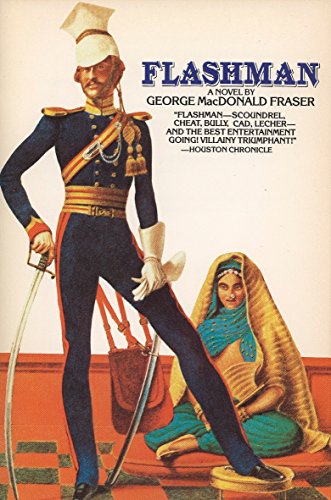
Flashman

Author: George MacDonald Fraser
Rating: 4/5
Last Read: November 2018
Who Should Read: People who like to laugh, those interested in military fiction or historical fiction

Flashman is the first book in a long series of novels about the life and exploits of Harry Flashman, an entirely unlikeable anti-hero.

Flashman describes himself openly as a coward, cheat, and a bully, and yet somehow he makes his way to the top of every situation and encounter he’s in. Flashman’s star rises throughout the novel, and everyone who recognizes him for who he is somehow ends up dead or pushed by the wayside.

It details his life from 1839 to 1842 and his travels to Scotland, India, and Afghanistan. It also contains a number of notes by the author, in the guise of a fictional editor, providing additional historical glosses on the events described. The history in these books is largely accurate; most of the prominent figures Flashman meets were real people.

I highly recommend Flashman to anyone who enjoys fiction. The book is fast-paced and full of amusing antics. I found myself laughing and cursing Flashman on every page. Those interested in military fiction or historical fiction will also enjoy the novel, as it covers the terrible defeat of the British in Afghanistan under General Elphinstone.

I stopped at the first book (I tend to avoid series), but if you are interested in continuing there are eleven more books in the series.

My Highlights

Anyway, he gave me a fine holy harangue, about how through repentance I might be saved—which I’ve never believed, by the way. I’ve repented a good deal in my time, and had good cause, but I was never ass enough to suppose it mended anything. But I’ve learned to swim with the tide when I have to, so I let him pray over me, and when he had finished I left his study a good deal happier than when I went in.

Anyway, I was content to let the matter rest just now; I have always believed in one thing at a time, and the thing that was occupying my mind was Miss Judy Parsons.

A lot has been said about the purchase of commissions—how the rich and incompetent can buy ahead of better men, how the poor and efficient are passed over—and most of it, in my experience, is rubbish. Even with purchase abolished, the rich rise faster in the Service than the poor, and they’re both inefficient anyway, as a rule. I’ve seen ten men’s share of service, through no fault of my own, and can say that most officers are bad, and the higher you go, the worse they get, myself included.

Some human faults are military virtues, like stupidity, and arrogance, and narrow-mindedness.

Of course if he had thought at all he would have sniffed something fishy about a ten thousand bribe in the first place. But he was greedy, and I’ve lived long enough to discover that there isn’t any folly a man won’t contemplate if there’s money or a woman at stake.

In her, ignorance and stupidity formed a perfect shield against the world: this, I suppose, is innocence.

“Not fair! Well, well, this is one lesson you’re learning. Nothing’s fair, you young fool.”

if the day comes, don’t wait to die on the field of honour.” He said it without a sneer. “Heroes draw no higher wages than the others, boy. Sleep well.”

But looking back I can say that, all unwittingly, Kabul and the army were right to regard Elphy’s arrival as an incident of the greatest significance. It opened a new chapter: it was a prelude to events that rang round the world. Elphy, ably assisted by McNaghten, was about to reach the peak of his career; he was going to produce the most shameful, ridiculous disaster in British military history.

Think of all the conceivable misfortunes that can arise from combinations of folly, cowardice, and sheer bad luck, and I’ll give you chapter and verse. But I still state unhesitatingly, that for pure, vacillating stupidity, for superb incompetence to command, for ignorance combined with bad judgement—in short, for the true talent for catastrophe—Elphy Bey stood alone.

Only he could have permitted the First Afghan War and let it develop to such a ruinous defeat. It was not easy: he started with a good army, a secure position, some excellent officers, a disorganised enemy, and repeated opportunities to save the situation. But Elphy, with the touch of true genius, swept aside these obstacles with unerring precision, and out of order wrought complete chaos. We shall not, with luck, look upon his like again.

So it always goes with dissension at the top:

And neither of them got on with Shelton, a rude boor of a man who was Elphy’s second-in-command, and this dissension at the top made for uneasiness and mistrust farther down.

I don’t pretend that I became an expert in a few weeks, or that I ever “knew” Afghanistan, but I picked up a little here and there, and began to realise that those who studied the country only from the cantonment at Kabul knew no more about it than you would learn about a strange house if you stayed in one room of it all the time.

It was unfortunate that he happened, about this time, to be awaiting his promotion and transfer to the Governorship of Bombay; I think the knowledge that he was leaving may have made him careless.

Ask him,” I shouted, “how I came here! Ask the lying, treacherous bastard!”
“Never try to flatter Gul Shah,” said the stout man cheerfully. “He’ll believe every word of it. No, there has been a mistake, regrettably, but it has not been irreparable. For which God be thanked—and my timely arrival, to be sure.” And he smiled at me again. “But you must not blame Gul Shah, or his people: they did not know you for what you were.”
Now, as he said those words, he ceased to be a waggish madman; his voice was as gentle as ever, but there was no mistaking the steel underneath. Suddenly things became real again, and I understood that the kindly smiling man before me was strong in a way that folk like Gul Shah could never be: strong and dangerous.

You have to manage morale:

“First, my dear friend Flashman,” says he, all charm, “I must tell you that you have been kept here not only for your own good but for your people’s. Their situation is now bad. Why, I do not know, but Elfistan Sahib has behaved like a weak old woman. He has allowed the mobs to rage where they will, he has left the deaths of his servants unavenged, he has exposed his soldiers to the worst fate of all—humiliation—by keeping them shut up in cantonments while the Afghan rabble mock at them. Now his own troops are sick at heart; they have no fight in them.”

“The British cannot stay here now,” he went on. “They have lost their power, and we Afghans wish to be rid of them. There are those who say we should slaughter them all—needless to say, I do not agree.” And he smiled. “For one thing, it might not be so easy—”
“It is never easy,” said old Muhammed Din. “These same feringhees took Ghuznee Fort; I saw them, by God.”
“—and for another, what would the harvest be?” went on Akbar. “The White Queen avenges her children. No, there must be a peaceful withdrawal to India; this is what I would prefer myself. I am no enemy of the British, but they have been guests in my country too long.”

I have observed, in the course of a dishonest life, that when a rogue is outlining a treacherous plan, he works harder to convince himself than to move his hearers. Akbar wanted to cook his Afghan enemies’ goose, that was all, and perfectly understandable, but he wanted to look like a gentleman still—to himself.

“Now,” went on Akbar, “you must deliver my proposals to McLoten Sahib personally, and in the presence of Muhammed Din and Khan Hamet here, who will accompany you. If it seems”—he flashed his smile—“that I don’t trust you, my friend, let me say that I trust no one. The reflection is not personal.”

You don’t know one of the first rules of politics: that a man can be trusted to follow his own interest. I see perfectly well that Akbar is after undisputed power among his own people; well, who’s to blame him? And I tell you, I believe you wrong Akbar Khan; in our meetings he has impressed me more than any other Afghan I have met. I judge him to be a man of his word.”

“To my most beloved Hector,” and I thought, by God, she’s cheating on me, and has sent me the wrong letter by mistake. But in the second line was a reference to Achilles, and another to Ajax, so I understood she was just addressing me in terms which she accounted fitting for a martial paladin; she knew no better. It was a common custom at that time, in the more romantic females, to see their soldier husbands and sweethearts as Greek heroes, instead of the whoremongering, drunken clowns most of them were. However, the Greek heroes were probably no better, so it was not so far off the mark.

But chance helped me, as she always does if you keep your wits about you

“Why should you want to preserve my life?” says I. “What do you owe me?”
“We have been friends,” says he, grinning that sudden grin of his. “Also I admired the compliments you paid me as you rode away from Mohammed Khan’s fort the other day.”
“They weren’t meant to flatter you,” says I.
The insults of an enemy are a tribute to the brave,” laughs he.

When I woke it was broad day, and Sergeant Hudson had a little fire going and was brewing coffee. It was the first hot drink I had tasted in days; he even had a little sugar for it.
“Where the devil did you come by this, Hudson?” says I, for there had been nothing but dried mutton and a few scraps of biscuit on the last few days of the march.
“Foraged, sir,” says he, cool as you please, so I asked no more questions, but sipped contentedly as I lay in my blankets.

He’s a pretty a terrible leader:

So I agreed, and found myself considering this Sergeant Hudson for the first time, for beyond noting that he was a steady man I had given him not much notice before. After all, why should one notice one’s men very much?

There is a painting of the scene at Gandamack, which I saw a few years ago, and it is like enough the real thing as I remember it. No doubt it is very fine and stirs martial thoughts in the gloryblown asses who look at it; my only thought when I saw it was, “You poor bloody fools!” and I said so, to the disgust of other viewers. But I was there, you see, shivering with horror as I watched, unlike the good Londoners, who let the roughnecks and jailbirds keep their empire for them; they are good enough for getting cut up at the Gandamacks which fools like Elphy and McNaghten bring ’em to, and no great loss to anybody.

So we were safe, and to come safe out of a disaster is more gratifying than to come safe out of none at all.

There is great pleasure in catastrophe that doesn’t touch you, and anyone who says there isn’t is a liar. Haven’t you seen it in the face of a bearer of bad news, and heard it in the unctuous phrases at the church gate after a funeral?

Hudson, of course, didn’t understand why I should be so horrified at this, until I told him the whole story—about Narreeman, and how Akbar had rescued me from Gul’s snakes in Kabul. Heavens, how I must have talked, but when I tell you that we were in the cellar a week together, without ever so much as seeing beyond the door, and myself in a sweat of anxiety about what our fate might be, you will understand that I needed an audience. Your real coward always does, and the worse his fear the more he blabs.

God, how I called; I roared like a bull calf, and got nothing back, not even echoes. I would do it again, too, in the same position, for all that I don’t believe in God and never have. But I blubbered like an infant, calling on Christ to save me, swearing to reform and crying gentle Jesus meek and mild over and over again. It’s a great thing, prayer. Nobody answers, but at least it stops you from thinking.

God alone knew what I was supposed to have done that was so brave, but doubtless I should learn in time. All I could see was that somehow appearances were heavily on my side—and who needs more than that? Give me the shadow every time, and you can keep the substance—it’s a principle I’ve followed all my life, and it works, if you know how to act on it.

It calls for nice judgement, this art of bragging; you must be plain, but not too plain, and you must smile only rarely. Letting them guess more than you say is the kernel of it, and looking uncomfortable when they compliment you.

But you will have noticed, no doubt, that when a man has a reputation good or bad, folk will always delight in adding to it; there wasn’t a man in Afghanistan who knew me but who wanted to recall having seen me doing something desperate, and Broadfoot, quite sincerely, was like all the rest.

I forgot the incident at once. I remember it now, for it was that same day that everything happened all at once. There are days like that; a chapter in your life ends and another one begins, and nothing is the same afterwards.

This myth called bravery, which is half-panic, half-lunacy (in my case, all panic), pays for all; in England you can’t be a hero and bad. There’s practically a law against it.

We shook hands, and he drove off. I never spoke to him again. Years later, though, I told the American general, Robert Lee, of the incident, and he said Wellington was right—I had received the highest honour any soldier could hope for. But it wasn’t the medal; for Lee’s money it was Wellington’s hand. Neither, I may point out, had any intrinsic value.

Pride is a hellish thing; without it there isn’t any jealousy or ambition. And I was proud of the figure I cut—in bed and in barracks. And here was I, the lion of the hour, medal and all, the Duke’s handshake and the Queen’s regard still fresh—and I was gnawing my innards out about a gold-headed filly without a brain to her name.

Flashman shows his true character when finding out he’s been cheated on:

I looked, and seeing myself so damned dashing, and her radiant and fair beside me, I fought down the wretchedness and rage. No, it couldn’t be true….
“Susan, you have not put away my coat, silly girl. Take it at once, before it creases.”
By God, though, I knew it was. Or I thought I knew. To the devil with the consequences, no little ninny in petticoats was going to do this to me.
“Elspeth,” says I, turning.
“Hang it carefully, now, when you’ve brushed it. There. Yes, my love?”
“Elspeth….”
“Oh, Harry, you look so strong and fierce, on my word. I don’t think I shall feel easy in my mind when I see all these fancy London ladies making eyes at you.” And she pouted very pretty and touched her finger on my lips.
“Elspeth, I—”
“Oh, I had nearly forgot—you had better take some money with you. Susan, bring me my purse. In case of any need that may arise, you know. Twenty guineas, my love.”
“Much obliged,” says I. What the devil, you have to make do as best you can; if the tide’s there, swim with it and catch on to whatever offers. You only go by once.
“Will twenty be sufficient, do you think?”
“Better make it forty.”

Summary

Major Characters

  • Flashman
  • Earl of Cardigan
  • Bernier
  • Elspeth
  • Gul Shah
  • Burnes
  • Elby Bey (Elphinstone)
  • Akbar Khan
  • Sgt Hudson

Outline

When I read fiction, I make an outline as a memory aide. If you don’t want to see any spoilers, skip this section.

  1. Flashman is expelled from school
  2. Flashman joins the 11th Light Dragoons as an officer
  3. Flashman “wins” duel with Bernier after rigging it
  4. Flashman gets reassigned to Glasgow, marries Elspeth (Forced)
  5. Flashman gets transferred to India for marrying down
  6. Flashman learns Hindi, goes to a party with the governor, gets sent to Afghanistan
  7. Flashman learns Pashtu, gets sent as an emissary to the Gulzai
  8. Flashman rapes the dancer, makes an enemy of Gul Shah – ambushed while hunting
  9. The complacent garrison is attacked. Burnes dies.
  10. Flashman is captured by Gul Shah, then saved by Akbar Khan
  11. Flashman is sent to make a deal: British help double-cross a tribe, get safe retreat out of Afghanistan.
  12. British get double-crossed; still retreat out of Afghanistan
  13. Backstabbing by Akbar Khan – most of the force is wiped out in the Kabul pass (terrible decisions by Elphinstone)
  14. Flashman separates from the army with Sgt Hudson
  15. They see the massacre @ Gandamack, and are captured by Afghans
  16. Flashman is tortured by Gul Shah, he escapes with Sgt Hudson after they kill Gul Shah
  17. They make it to a fort outside of Jalalabad
  18. The fort is overrun, the only survivor is Flashman
  19. Flashman is sent to England as a hero – meets the Queen, Duke of Wellington, gets a medal
  20. Finds out his wife is cheating on him – fine with it because he wants money.

Buy the Book

If you are interested in purchasing this book, you can support the website by using our Amazon affiliate link.
 

Flashman: A Novel

By George MacDonald Fraser


The Lion’s Gate: On the Front Lines of the Six Day War

Author: Steven Pressfield
Rating: 8/10
Last Read: September 2016

Quick Summary:  I would classify this book as a “written oral history”.  Pressfield interviewed many participants of Israel’s Six Day War, putting together a compelling picture of the state of Israel and the mindset of its inhabitants and warriors during this challenging time.  From the interweaving of the various narratives, one gets a sense of the fog of war, the pain of combat, and the heartbreak of losing friends.  And even with all the talk of war, I learned much about the early history of Israel, a region I have not spent much time focusing on.  

My Highlights

Memory, we know, is notoriously unreliable. Memory can be self-serving, self-glorifying, self-exonerating. Memory fades. People forget. Memory contains gaps and blank spots. –loc 73

We are being bullied, my father said, and the only way to handle a bully is to punch him in the face. –loc 291

Second: Whatever you do, do it to your utmost. The way you tie your shoes. The way you navigate at night. Nothing is academic. –loc 335

If you had screwed up, you admitted it and took your medicine. Ego meant nothing. Improvement was everything. –loc 345

Voice is everything when you command. As a company commander in a tank battalion, you have fourteen four-man crews listening to you through their headsets. Many times in combat, when I have been frightened or unsure, I have deliberately paused to be certain that I had my voice under control. You don’t want your men to hear that chicken voice. –loc 633

I could see the sergeant’s eyes settle on the line on the enlistment form that said, “Religion.” On it, I had written, “Jewish.” All of a sudden the sergeant looked up. He hadn’t looked up for any of these Catholics, but he looked up for me. He eyed me up and down. “The Marine Corps is a tough outfit,” he said. “Are you sure you can make it?” I was so furious I wanted to tear this sergeant’s throat out. I knew the only reason he would ask that question was because my enlistment form said I was a Jew. But I also knew that I couldn’t get mad or shoot my mouth off or he might not let me join. So I stared him in the eye, as directly and as hard as I could. “If you made it, I can make it.” That was it. He stamped my form and I moved on. –loc 741

“Complexity at the top, simplicity at the bottom,” Arik declares, defining in a nutshell his philosophy of command. “A commander,” Sharon says, “may keep complicated schemes of battle in his head and among his staff, but when the orders reach the operational units, they must be so simple that a child can understand them. ‘Go here, do this.’ Nothing more complex.” –loc 1016

came to despise the idea of parade ground order. Wingate felt the same. “Keep your rifle clean and kill your man before he kills you.” That was all he wanted of discipline. –loc 1235

The principles Wingate espoused—fighting at night, the employment of stealth and surprise, taking the battle to the enemy, the use of unconventional tactics, timing, and weaponry—became the core precepts of the Haganah and later the IDF. –loc 1246

It is a terrible thing to shoot a man and see him die. A pilot does most of his killing at altitude; he can report later in the briefing room that he destroyed this many tanks or that many trucks. But down at eye level it’s another story. I did not feel so sure, anymore, about my resolve to slay the enemy without conscience. No one who has killed face-to-face will ever sleep the same again. –loc 1364

It is an inviolable principle in the Israel Air Force that one must speak the truth in a debriefing session, even if—particularly if—it reflects negatively on himself. –loc 1383

Dayan reserved time to think, and he did his thinking alone. When he had arrived at a plan or an idea, the door to his office would open. “What do you think of this?” –loc 1544

Once he asked my opinion and I hesitated. “The moment you think twice before answering,” he said, “our work together is over.” He liked it when people contested him. He listened. “Only a donkey,” he would say, “never changes his mind.” –loc 1546

Why do we train? To perfect our flying skills, yes. But far more important, we practice to elevate our threshold of emotional detachment, to inculcate that state of preparedness and equilibrium that enables a pilot to function effectively under conditions of peril, urgency, and confusion. –loc 2080

pull the crew out of a burning tank, a man must go in face-first. He reaches in with his hands and arms. The tank crewmen are screaming in pain and out of their minds with fear. The interior burns like a furnace. High-explosive shells are cooking, half a meter from their face. When you witness this, when you do it yourself, you cannot believe it. In war soldiers perform feats of valor of which they never, before they do them, believed themselves capable. –loc 3265

Improvisation is not a wild scramble at the last minute. You are not pulling plans out of thin air. Improvisation is the payoff of scrupulous preparation and drill. –loc 3302

Why am I still above the earth when so many friends, who are better men than I, have been taken beneath it? Why them? Why not me? I am not religious. I don’t think the way a religious person thinks. But now, driving across these ten kilometers of hell, I feel the presence of the Angel of Death. “You,” he says to one man. “I shall take you now.” To another: “You wait. I will come for you later.” It is a terrible feeling. –loc 3512

In the academies of war, students are instructed in the tactical level, the operational level, and the strategic level. Beyond these, ministers manipulate the political level, the diplomatic level, the international level. –loc 3849

In combat there is no time for grief. A commander must act. He must project decisiveness and certainty. No matter how grim the situation, he must act as if it is under control. If your soldiers read fear on your face or discern irresolution in your posture, you have failed them. –loc 4097

Time always works against the defender. The enemy is waiting to be killed and he knows it. –loc 4114

I have learned one thing from this, my first experience of war: Leaders are everything. Individually, we soldiers may be brave. Collectively, we may make up a skilled, well-trained unit. But without a strong hand to guide us, we balk and freeze. We become confused and surrender initiative. –loc 4198

I believe in being stupid. You have to be stupid in war because if you were smart you would never do what you need to do to survive. That’s why being young is so important in soldiers. When you’re young, you don’t know the horrible things that can happen to the human body and the human mind. –loc 4226

In war, the wish to believe the best can be overwhelming. –loc 4851

you. Why? Because you cannot let them. I ask myself sometimes, “Ori, are you afraid?” The answer is, “I have no time to be afraid.” The commander bears responsibility not just for the completion of the mission, but also for the lives of his men. A military unit, particularly a reconnaissance company, is like a street gang. You are closer than brothers. Each life is precious to you. For every man under my responsibility, I see in my mind’s eye his mother and father, his girlfriend or wife, his children, even if he has none yet—his children-to-be, and their children as well. All will suffer if he dies. Such a weight makes concerns such as personal fear, loss, even one’s own death seem trivial. War –loc 5004

My position denies me the luxury of doubt or hesitation or fear. –loc 5011

If there is a universal disease of the modern era, I believe it is the malady of exile. This affliction is experienced on the individual level as well as on the national and the racial—the agony of feeling that one is a part of nothing, that he belongs nowhere and to no one. –loc 5445

The primal Jewish issue is justice. Judaism is a religion of the law, and the seminal concept of the law is that the minority must be protected. –loc 5584

In the Jewish faith, you study. You wrestle with issues. You are a scholar. You deliberate, you dispute. A Jew asks over and over, “What is fair? What is just? Who is a good man, and why?” –loc 5585

Who among us is not in exile? Is not exile the spiritual condition of the human race? Isn’t that what we share, when all differences of language, tribe, and history have been stripped away: the sense that we are estranged at our core from—what? From God? From our higher nature? From who we might be or become, from who we truly are? What, then, does the exile desire beyond all other boons? Home. To come home. To set his feet upon those stones that are his, which belong to him and to which he belongs. –loc 5616

English soldiers captured this first Dov Gruner and put him on trial for participating in an assault on the police station at Ramat Gan. He was sentenced to death by hanging. At the final hour he was offered a reprieve, if he would admit his guilt. Dov Gruner would not. He refused to defend himself, standing upon the principle that to do so would be to acknowledge the legitimacy of the British court. –loc 5627

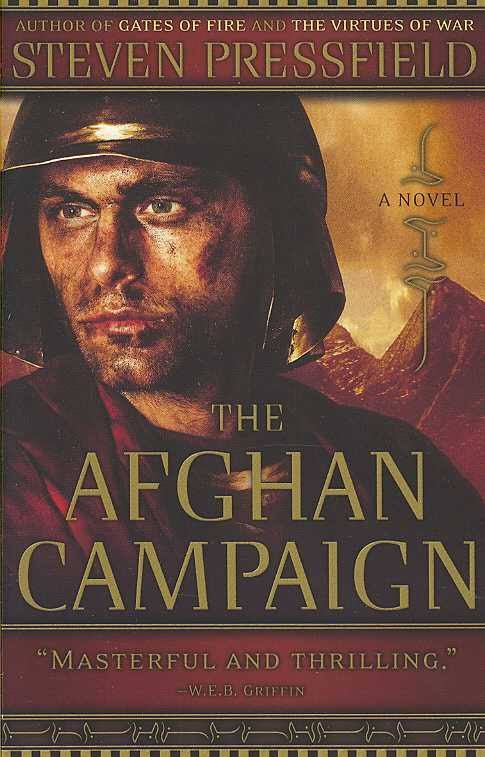
The Afghan Campaign: A Novel


Author: Steven Pressfield
Rating: 8/10
Last Read: August 2016

Quick Summary:  This novel lies in the same vein as Pressfield’s other historical novels – the narrator is a minor character following a famous historical figure.  The narrator joins up with a band of mercenaries who are leaving to fight alongside Alexander in Afghanistan.  However, this novel spends significantly more time focusing on the horror of war and the acts of atrocities enacted by Alexander’s troops.  It is a stark picture of human nature, but the descriptions ring true to the stories of war shared by my friends.  

I think it is an important thing to remember that war is not full of glory – only death, loss, and destruction.

“What’s wrong, you fuck,” answers Lucas, “is that words have meanings. People believe the bucketwash you put out. They think that’s how it is, particularly young men, who are suckers for tales of glamour and glory. You have an obligation to tell them the truth.”

My Highlights

Why do soldiers drink? To keep from thinking, says Flag. If you think, you start to fear. –loc 505

It is simultaneously extraordinary and appalling to see how efficiently our Macks work this. They slaughter an entire male household with barely a sound, so swiftly that the wives and infants are cast into dumbstruck shock. It is the kill of wolves or lions, the cold kill of predation. It is work. –loc 575

A soldier who cannot be counted on by his mates is more dangerous than an enemy. –loc 601

When a new man is initiated into the confederacy of murderers, his seniors make him commit the same crime they have. Now he is as guilty as they. He cannot turn on them. He is one of them. –loc 659

Fear, men say, is the most primal emotion. I don’t believe it. Shame is. My feeling as Tollo bolts past after the foe is one of joy and relief, that my senior sergeant has seen me take down my man, however clumsily, and profound release that my humiliation from the village has been at least partly effaced. –loc 687

“Perhaps, Matthias,” Stephanos says, “you and I might profit, in an alien land, by suspension of judgment.” –loc 1157

“Each precept of wisdom you gain,” says Ash, “bears you farther from God.” –loc 1163

“Take a war-name, Matthias. It solves a lot of problems.” –loc 1180

“You know,” Stephanos says, “I’ve taken to you from the start, Matthias. Shall I tell you why?”
“Because,” says Flag, “he never shuts up.”
“Because he asks questions.”
“That’s his problem.”
“And one day he might get answers.”
–loc 1203

The view of life is that of a noble resignation to fate. God determines all, the Afghan believes. One can do nothing except be a man and bear up. –loc 1354

Stephanos cheers the men by predicting victory in Bactria. We’ll catch Bessus and Spitamenes, he swears, with their bollocks in the breeze. Why? “Because they’re men of intelligence. It’s beyond their imagination to believe that anyone in their right salt-sucking mind would cross these mountains at this season.” –loc 1409

We hear no more talk of mutiny. Porters trek tight beside us. We will live or die together. This is the way peril overhauls you. One hand’s-breadth at a time. Suddenly you’re in it. –loc 1447

It takes Flag pummeling me with both elbows (he can no longer feel his hands) before I understand our Color Sergeant is dead. “He was croaked at the bottom,” Flag declares. I’m furious. Why didn’t Flag tell me? He has made us break our backs. But I am in awe of him too. My God, what a soldier! What a friend. –loc 1569

The crime I have committed, Elihu explains, is called in Dari al satwa. The Hebrews have a term for it, too—tol davi. It means to bring shame upon someone by performing an act of responsibility that they have failed to perform themselves. –loc 1703

“Why can’t you tell it straight?” Lucas demands.
Costas replies that the public only wants certain kinds of stories. There’s no demand for the other kind.
“You mean the true kind,” says Lucas.
–loc 1904

Costas defends himself. What does he, or any correspondent, want? “Just to acquire a modest name, sail home bearing tales of distant lands, and offer them for readings and recitals. What’s wrong with that?”
“What’s wrong, you fuck,” answers Lucas, “is that words have meanings. People believe the bucketwash you put out. They think that’s how it is, particularly young men, who are suckers for tales of glamour and glory. You have an obligation to tell them the truth.” –loc 1908

God, what a stench when a man’s guts are opened to the air. That doesn’t go into your dispatches, does it? We read nothing about the sound the ‘follow-on’ makes, going down the line of throat-slit men with a club, bashing skulls like walnuts, while the still-living men pray without voices or curse us in gurgling blood or plead for their lives. The silent ones are the scariest. Men with guts. Better men than we are.” –loc 1926

Can you defend the massacres we enact, Flag? Is this Macedonian honor?”
Our sergeant’s lips decline into a dark smile. “There is no honor in war, my friend. Only in poems of war.
–loc 1933

“Does a lion hesitate? Does an eagle hold back? What is the call of a gallant heart, except to aspire to mighty deeds? –loc 1946

The fellow possessed that quality, innate to all born commanders, of focused and dominating intention. –loc 2245

And, for both of us, the terror of death. “If I die,” he tells me when we stop the first night, “don’t let the army cook up some phony story. Tell my people what really happened.”
As for my own end, I make no such scruple. “Tell ’em the biggest-balled lie you can think of.”
–loc 2305

hear that the solitudes of the Scythians are made fun of in Greek proverbs, but we seek after places that are desert rather than cities and rich fields. Why? For freedom! Rather would we dine on coarse meal at liberty than feast on honeyed cakes in chains.” –loc 2457

“Great trees are long in growing but fall in a single hour. Even the lion has been made food for the smallest of birds, and rust consumes iron. Therefore tell your king to hold his fortune with tight hands; she is slippery and cannot be confined against her will. –loc 2469

But if he is a mortal man, let him remember his place in the scheme of the Almighty. For what indeed is madness, save to recall those things that make one forget himself?” –loc 2472

“I always imagined that hard experience would make you stronger and less afraid. But it’s the opposite. It undermines you because you know how vulnerable you are and how bad things can get.” –loc 2617

The instrument of counterguerrilla warfare is the massacre. Its object is terror, to make oneself an object of such dread that the foe fears to face you ever. This practice has worked for the army of Macedon across all Asia. It does not work here. The Afghan is so proud, so inured to privation, and so in love with liberty that he prefers death to capitulation. –loc 2943

“They say a man becomes old,” he says, “when more of his friends reside beneath the earth than above it.” –loc 3175

“To be a soldier,” he says, “is no lofty calling. Who acts as a brute is a brute.” –loc 3179

“This is what war is,” says Alexander. “Glory has fled. One searches in vain for honor. We’ve all done things we’re ashamed of. Even victory, as Aeschylus says, in whose august glow all felonies are effaced, is not the same in this war. What remains? To prevent the needless waste of lives. Too many good men have perished without cause. More will join them if we don’t make this peace now.” –loc 3661

“I know, dear child, that you believe heaven has turned its back on you. Perhaps that was so, once. But all things turn in their season. Not even as cruel a deity as that of this pitiless land can remain unmoved forever by his people’s affliction. The proof grows now in your belly. Your suffering has redeemed you, Shinar. God holds out his hand. Take it, I beg you. Can any act be more impious than to spurn the clemency of heaven?” –loc 3854

What is money for anyway? Only to get what you need—or keep away what you dread. –loc 4004

On Killing: The Psychological Cost of Learning to Kill in War and Society

Author: Lt. Col. Dave Grossman
Rating: 6/10
Last Read: August 2010

Quick Summary: Lt. Col. Grossman gives an overview of the psychological costs humans incur when they take a life and how societies are able to condition soldiers to get through these mental barriers. 

This is an interesting introduction to the subject, though I felt like Grossman does take too many opportunities to let his personal opinion through, rather than providing a well-cited academic work. He selects statistical sources that assist his claim, even though many of them have been shown to be sensationalized or discredited (trends of increasing violence, video games helping increase violent behavior, SLA Marshal’s study).  

The review of our barriers against killing and structures to overcome those barriers are still interesting even with this serious flaw.

My Highlights

The potential of close-up, inescapable, interpersonal hatred and aggression is more effective and has greater impact on the morale of the soldier than the presence of inescapable, impersonal death and destruction.

there is within most men an intense resistance to killing their fellow man. A resistance so strong that, in many circumstances, soldiers on the battlefield will die before they can overcome it

When a man is frightened, he literally stops thinking with his forebrain (that is, with the mind of a human being) and begins to think with the midbrain (that is, with the portion of his brain that is essentially indistinguishable from that of an animal), and in the mind of an animal it is the one who makes the loudest noise or puffs himself up the largest who will win.

when someone withholds something traumatic it can cause great damage. When you share something with someone it helps to place it in perspective, but when you hold it inside, as one of my psychology students once put it, “it eats you alive from the inside out.” Furthermore, there is great therapeutic value in the catharsis that comes with lancing these emotional boils. The essence of counseling is that pain shared is pain divided, and there was much pain shared during these periods.

“The soldier above all other people,” said MacArthur, “prays for peace, for they must suffer and bear the deepest wounds and scars of war.”

Robert Heinlein once wrote that fulfillment in life involved “loving a good woman and killing a bad man.”

Winston Churchill said that “it is the primary right of men to die and kill for the land they live in, and to punish with exceptional severity all members of their own race who have warmed their hands at the invader’s hearth.”

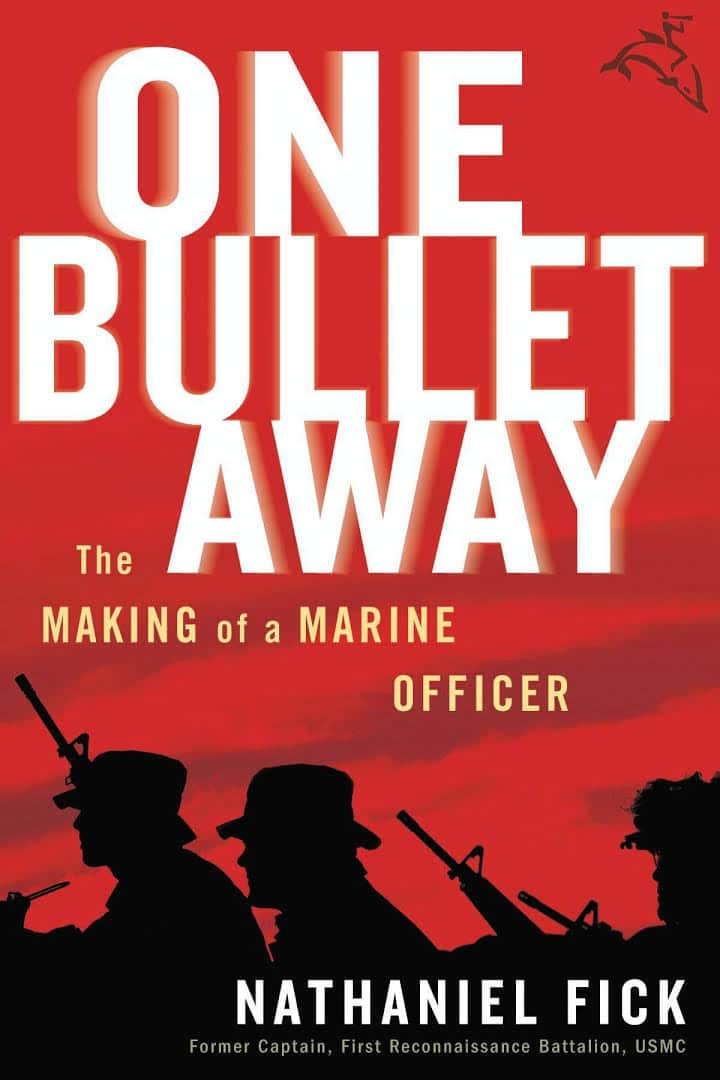
One Bullet Away: The Making of a Marine Officer

Author: Nathaniel C. Fink
Rating: 9/10
Last Read: June 2014

Quick Summary: This book recounts Fink’s journey through Marine Corps officer training and his experiences with war in Afghanistan and Iraq.  Fink shares some of the leadership training that he gained during his schooling and leadership roles in the USMC.  

While I don’t normally recommend books about war for those who are not interested, in this case I will do the opposite.  It takes me back to the years I spent in ROTC receiving similar training (with much lower stakes) – many people in leadership roles do not carry the same ideals or perspectives that the USMC instills in its leaders. There is much wisdom to be gained in the USMC leadership principles, and I think this book showcases some practical examples of their application.

My Highlights

We should remember that one man is much the same as another, and that he is best who is trained in the severest school.
—THUCYDIDES

“I saw a bumper sticker in the parking lot that said ‘Nobody ever drowned in sweat.’” –loc 127

Olds explained that orders slowly executed meant advantages lost. –loc 200

I wanted to be there, and I tried hard. For the first time in my life, desire and effort wouldn’t be enough. I was learning that in the Marines, the only easy day was yesterday. Success the day before meant nothing, and tomorrow might never happen. I woke up each morning at Quantico wondering whether I’d still be there that night. –loc 285

But in combat, we were told, there’s rarely time for discussion and debate. Complex ideas must be made simple, or they’ll remain ideas and never be put into action. –loc 308

We drilled them, and every other list, over and over again. I memorized them in the classroom, in line at the chow hall, and in my rack at night. The purpose, we were promised, was to make them instinctive. They would become innate to our decision-making process and infuse everything we did without even a conscious thought. –loc 310

“First,” he counseled, “you must be technically and tactically proficient.” There was no excuse for not knowing everything about the weapon, radio, aircraft, or whatever else it was you were trying to use. “Being a nice guy is great, but plenty of nice guys have gotten half their Marines killed because they didn’t know their jobs. –loc 355

A good plan violently executed now, he urged, was better than a great plan later. Be decisive, act, and be ready to adapt. –loc 359

“Fourth, know your men and look out for their welfare.” Fanning smiled as he remembered Marines he’d served with. They will, he said, follow you through the gates of hell if they trust you truly care about them. “This is not about you.” Fanning spoke the sentence slowly, emphasizing each word. He explained that the Corps existed for the enlisted infantryman. “Everyone else—you aspiring infantry officers included—is only support. –loc 364

From that afternoon on, I accepted the rules and lived by them. When getting dressed by the numbers, I tried to move faster and yell louder than anyone else. When Olds made me call cadence, I did it with heart and never backed down. He stopped caring that my calls confused the platoon. Marching didn’t matter. It was about cool under pressure. It was about detachment. We had to retain our ability to think when the world was crumbling around us. Not for ourselves, but for our Marines. –loc 374

His message was clear: you need discipline most when it’s hardest to muster—when you’re tired, hungry, outside your comfort zone. –loc 456

Being a Marine was not about money for graduate school or learning a skill; it was a rite of passage in a society becoming so soft and homogenized that the very concept was often sneered at. –loc 549

The Corps teaches three fundamentals of marksmanship: sight picture, bone support, and natural point of aim. –loc 571

The third element, natural point of aim, is the most important. With each of the shooter’s breaths, the rifle muzzle rises. It settles with exhalation back to a natural resting point between breaths—the natural point of aim. Make the bull’s-eye your natural point of aim, squeeze the trigger near the bottom of your breath, and you’ll hit the target. –loc 573

We learned the six troop-leading procedures by the acronym BAMCIS. Begin planning. Arrange for reconnaissance. Make reconnaissance. Complete the plan. Issue the order. Supervise. –loc 605

SMEAC: situation, mission, execution, administration and logistics, command and signal. –loc 608

Speed, we were taught, is a weapon. Be aggressive. Keep the tempo high. –loc 616

We learned that indecision is a decision, that inaction has a cost all its own. Good commanders act and create opportunities. Great commanders ruthlessly exploit those opportunities and throw the enemy into disarray. –loc 617

We learned that the Corps relies on mission-type orders: “Tell me what to do, not how to do it.” –loc 621

Decentralize command and allow subordinates to operate freely within the framework of the commander’s intent. –loc 621

I remembered the “80 percent solution”—a good plan now was better than a perfect plan later. We had crossed the threshold of action. This was enough information to do the job; now the task was to do it. –loc 684

Leaders have an ethical responsibility to serve as buffers, protecting their subordinates, and a moral obligation to act from the courage of their own convictions. The moral courage of their leaders is what separates combat units from armed mobs. –loc 765

He explained that Americans, especially young American men, exhibit posturing behavior. Two guys in a bar bump chests, get up in each other’s faces, and yell. If a fight follows, it’s about honor, saving face. That’s posturing. Marines on the battlefield must exhibit predatory behavior. In that bar, a predator would smile politely at his opponent, wait for him to turn around, and then cave in the back of his skull with a barstool. –loc 786

He identified five things an infantry leader can do to help maintain the psychiatric effectiveness of his men in combat: minimize fatigue by sleeping whenever possible, build confidence as a team, encourage communication, use spare time to practice emergency medical training, and do after-action critiques to address the shock of combat and killing. –loc 807

Your Marines will expect four things from you: competence, courage, consistency, and compassion.” –loc 879

The last thing they needed was a Pattonesque monologue from a newborn lieutenant, so I introduced myself and said I was happy to be the newest member of the platoon. I told them I wanted to meet with each man individually over the coming week and asked if they had any questions for me. There were none. Staff Sergeant Marine dismissed them, and they headed back to the armory. I thought I heard approval in his voice as we walked back to the office. “No bullshit, sir. Marines appreciate that.” –loc 993

“If safety were paramount,” Whitmer declared, “we’d stay in the barracks and play pickup basketball. Good training is paramount.” Whitmer’s idea of good training reminded me of something I’d read about the Roman legions—their exercises were bloodless battles so that their battles were bloody exercises. –loc 1002

Captain Whitmer replied that we, as infantry officers, had been trained to be aggressive. Nods all around. “But there’s a fine line between aggressive and foolish.” Good commanders, he explained, could operate right at that line, without crossing it. We had to know the difference between a risk and a gamble. All commanders take risks. They are calculated decisions to make gains in a dangerous environment. Gambles are pure chance—closing your eyes and running the gauntlet. –loc 1024

even if they had a low CDI factor. I took the bait. “What’s CDI?” “Chicks dig it, sir. Football team: high CDI. Chess club: low CDI. Platoon sergeant: high CDI. Mortar section: low CDI. Doesn’t matter that mortars have all the firepower. Life’s unfair. Didn’t they teach you that in college?” –loc 1078

‘Never regret not doing a real mission. Now you can have all golden memories and no ghosts.’ I –loc 1096

“The world breaks everyone and afterward many are strong at the broken places,” Hemingway wrote. –loc 1151

“But those that will not break it kills. It kills the very good and the very gentle and the very brave impartially. If you are none of these you can be sure that it will kill you too but there will be no special hurry.” –loc 1152

Past deeds are a young Marine’s source of pride, inspiration to face danger, and reassurance that death in battle isn’t consignment to oblivion. His buddies and all future Marines will keep the faith. Some people in my life would call that naivete, but I was coming to know it as esprit de corps. –loc 1164

I climbed up to Captain Whitmer’s cabin, to let him know his officers were all aboard. I found him sitting at his desk, wearing sweatpants and looking relaxed. His incense burner smoldered, and acoustic guitar played softly in the background. This was Captain Whitmer at his best, embodying the line from Rudyard Kipling’s poem about keeping your head when all around you are losing theirs. Yes, he knew about the attacks. Yes, he expected we’d be sailing earlier than planned. No, he saw no need for concern. –loc 1201

Captain Whitmer was too self-effacing to say it, but I knew the answer. Among the battalion’s company commanders, he was the iconoclast, the outcast stepchild who trained his Marines to be good instead of look good. He pushed us hard, questioned authority, and couldn’t even feign obsequiousness. –loc 1343

It is a central tenet of the Marines’ war-fighting philosophy that each subordinate must provide options to his boss—tell him what you can do, rather than what you can’t. Depending on the situation, two or three or four courses of action would be developed and then roughed out into basic operational plans. –loc 1361

Hardness was the ability to face an overwhelming situation with aplomb, smile calmly at it, and then triumph through sheer professional pride. –loc 2327

The pilot had requested the most favored method for guiding a helicopter into a landing zone in the dark. The NATO-Y, standard throughout the Western militaries, is four chem lights tied to premeasured lengths of parachute cord. When laid on the ground and pulled taut, they form a Y. One of the Marines pulled it out, already tied, and cracked the four chem lights. He laid them across the landing zone, with the base pointing into the wind and the two legs marking touchdown points for the helicopter’s main landing gear. –loc 2581

I remembered a story I’d heard from General Jones, the commandant who’d eaten dinner with us on the Peleliu. He’d quoted a former Marine officer who went on to be a Fortune 500 CEO. When asked for his guiding principle, the CEO replied, “Officers eat last.” The philosophy is simple, and it goes a long way. –loc 2907

Winning a firefight requires quick action by leaders. The key is to make decisions about your enemy and act on them faster than he is acting on decisions made about you. –loc 2917

In training, I was taught the OODA loop, a four-stage decision-making process described by Air Force fighter pilot Colonel John Boyd: observe, orient, decide, act. –loc 2918

Engage your brain before you engage your weapon. –loc 3082

“Well, sir,” Person said, turning in the seat to face me, oblivious to the fight all around him, “I guess I’m fighting for cheap gas and a world without ragheads blowing up our fucking buildings.”
“Good to know you’re such an idealist.”
“That world sounds pretty ideal to me right about now.”
–loc 4051

I remembered General Conway’s instruction back in Kuwait: “Your first obligation as an officer is the defense of your men.” –loc 4238

“Howdy, sir. How you doin’ this evening?” Espera said.
“Never better. Tired, cold, wet, hungry. I feel like a Marine.”
–loc 4274

“Last time I saw you in a cold hole, LT, was in Afghanistan. Makes me feel like an old campaigner.”
“Regular warhorse, Espera. Just wait. Next year it’ll be Syria, then North Korea, and who knows where after that. We’ll never have to train again. Just war, war, war.”
–loc 4276

I ached for him. No one knows the costs of war better than the grunts. I guessed the television news that night was full of reports of collateral damage and civilian casualties. I wished people could see how much we agonized over our decisions and prayed they were the right ones. These choices didn’t always translate into hesitation on the trigger or racking self-doubt, but sometimes it was enough to sit awake in the cold rain just thinking about them. –loc 4282

“Never pet a burning dog.” –loc 4335

Gunny Wynn’s priority as platoon sergeant, first and always, was the safety of his men. Mine, as platoon commander, was accomplishing our mission. –loc 4341

Gunny Wynn and the team leaders systematically strengthened the plan, pointing out weaknesses and suggesting improvements. It is a simple fact of human nature that people will more willingly go into danger when they have a say in crafting their fate. –loc 4347

Ironically, I remembered Colonel Ferrando’s words from a briefing the day before: “You can’t volunteer to go to war and then bitch about getting shot at.” –loc 4406

Strong combat leadership is never by committee. Platoon commanders must command, and command in battle isn’t based on consensus. It’s based on consent. –loc 4538

Any leader wields only as much authority and influence as is conferred by the consent of those he leads. –loc 4539

What’s past is past, but the present and future will kill you. –loc 4560

I finally understood why Whitmer had threatened us that night. Commanders always bear the heaviest responsibility. When you’re tired and under stress, your efforts to convey that gravitas can come out all wrong. –loc 4568

“The sacred geometry of chance, sir.”
“I like that.”
“Espera and I talked about it earlier. We can do a lot to influence the outcome, but sometimes it’s out of our hands,” Rudy said, then mimed firing a rifle. “A running man shoots a burst into a moving Humvee. Why do some miss? Why do some hit? Why a flesh wound and not a femoral artery? Aim and skill have nothing to do with it. The difference between life and death out here is seconds and millimeters—the sacred geometry of chance.” –loc 4599

After all, I would be right there at the front, in as much danger as anyone, sometimes more. An instructor at Quantico had told me that officers got paid to be gophers: when all the sane people were burrowing in the dirt, it was an officer’s job to poke his head up and see what was happening. –loc 5368

Anyone who looks with anguish on evils so great must acknowledge the tragedy of it all; and if anyone experiences them without anguish, his condition is even more tragic, since he remains serene by losing his humanity. —AUGUSTINE OF HIPPO –loc 5870

I left the Corps because I had become a reluctant warrior. Many Marines reminded me of gladiators. They had that mysterious quality that allows some men to strap on greaves and a breastplate and wade into the gore. I respected, admired, and emulated them, but I could never be like them. I could kill when killing was called for, and I got hooked on the rush of combat as much as any man did. But I couldn’t make the conscious choice to put myself in that position again and again throughout my professional life. –loc 5923

Great Marine commanders, like all great warriors, are able to kill that which they love most—their men. It’s a fundamental law of warfare. Twice I had cheated it. I couldn’t tempt fate again. –loc 5926

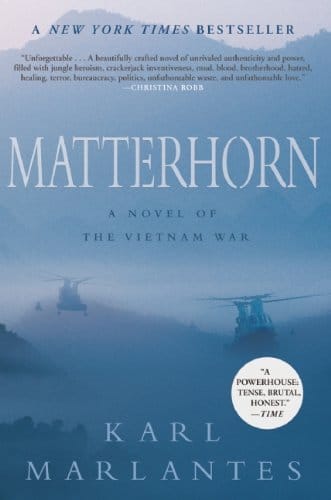
Matterhorn

Author: Karl Marlantes
Rating: 8/10
Last Read: March 2015

Quick Summary: This book follows a young Marine officer and his platoon as they build a firebase and then get sent on various clusterfuck missions through the jungle of Vietnam.

This is called out as a novel, but the author is a decorated Marine officer whose commendation notes read very similarly to the story presented here.  This is a dark picture of what the war was like for many people – and how ego cost the lives of many young men.  The book also paints a stark picture of race relations at the time, and documents struggles between the black and white troops in Vietnam.

The book took a while to get rolling for me, but I think it was worth the read to get insight into this very dark time in our country’s history.

My Highlights

Just speaking about the recent near-encounter with an enemy Mellas had not yet seen started his insides humming again, the vibration of fear that was like a strong electric potential with no place to discharge. –loc 67

Hawke had learned long ago that what really mattered in combat was what people were like when they were exhausted. –loc 199

How could you get mad at someone who neither needed to attack nor was at all worried about being able to defend? –loc 955

“Hey, cool it down.” Hawke looked sideways at Mellas.
“You really do have a temper, don’t you?”
“I’m just tired. I usually don’t.”
“You mean you don’t usually show it.
–loc 1014

Shit, Mellas, drink this. It cures all ills, even vainglory and ambition. The only thing that hurts about a rebuke is the truth.” Mellas took the coffee and smiled. –loc 1599

“How much does it weigh?” Cortell, the leader of the second fire team, who was sitting next to his friend Williams, chuckled.
“Man,” Cortell said, “you can’t carry nothin’ lighter than music.”
–loc 2111

He knew he shouldn’t drink so much, especially alone. But he was alone a lot. After all, he was the battalion commander. It was supposed to be lonely at the top. –loc 3225

But he’s not a good company commander in this kind of war. He got on Simpson’s bad side because he got his picture in the paper too often and never gave Simpson credit, which by the way he doesn’t deserve, but that’s the point. The smart guy gives the guy with the power the credit, whether he deserves it or not. That way the smart guy is dangling something the boss wants. So the smart guy now has power over the boss.” –loc 3844

“Shit, Mellas, don’t get your feelings hurt. I didn’t say I didn’t like you, for Christ’s sake, or you’re some sort of bad person. Although I will grant you the company you’ll keep is going to be sleazier than average. Just accept that you’re a fucking politician. So was Abraham Lincoln, and Winston Churchill. So was Dwight Eisenhower.” He paused. “It ain’t like they’re bad people. And they all ran a pretty good war.” –loc 3855

Coates turned to Mellas, his eyes dancing with deep humor. “Cool down, Lieutenant Mellas. Colonel Mulvaney will never let him near the place. You don’t commit an entire battalion to an area covered by enemy artillery that we can’t go after because of political reasons. Add to that uncertain air support because of the weather. That’s why Mulvaney pulled us out in the first place. Return to Matterhorn? Nevah hoppin.”
Mellas was surprised. “Here I thought you were a lifer,” he said, smiling.
“I am, Lieutenant Mellas. But I ain’t stupid. And I also know how to keep my mouth shut.” –loc 4793

“May you be ten minutes in heaven before the devil knows you’re gone,” Simpson said, raising his glass and gulping a large swallow. Blakely was aware that Simpson prided himself on knowing many different toasts in different languages. He smiled appropriately and drank. Simpson drank some more. “Good fucking stuff,” he said. –loc 4915

Now, seeing the Marines run across the landing zone, Mellas knew he could never join that cynical laughter again. Something had changed. People he loved were going to die to give meaning and life to what he’d always thought of as meaningless words in a dead language. –loc 5160

“Does it mean Meaker will die?” Sheller looked over at the two kids he’d picked for death. He didn’t want to answer Merritt’s question. He wanted to lie, even to himself.
“I think you’ll all make it,” he said.
“Don’t fucking lie to me, Squid. I don’t have time for it.”
Again Merritt took a quivering breath, biting back the scream that wanted to erupt whenever he filled his lungs. “If I’m going to live because of Meaker, I want to know it. And I want to live.”
Sheller put his hand on Merritt’s uniform. “The thing is, we might be wasting plasma on Meaker. He keeps bleeding inside and I can’t stop it. You’re not bleeding as fast as he is.”
Merritt looked at Sheller. “I’ll never forget it, Squid. I fucking promise.” Then he turned his head toward Meaker’s unconscious body. “Meaker, you dumb son of a bitch,” he whispered. “I ain’t never going to forget it.”
Meaker died three hours later. Sheller and Fredrickson dragged him out of the bunker and stacked him on the foggy landing zone with the rest of the bodies. –loc 5783

He remembered a lecture about how mortars are fairly ineffective against troops that are dug in. But the lecturer hadn’t mentioned the psychological effect on the troops. –loc 6074

What bothered Mulvaney was that he knew the NVA felt they were buying something worth the price: their country. –loc 6161

And it was his worth that was the joke. He was nothing but a collection of empty events that would end as a faded photograph above his parents’ fireplace. They too would die, and relatives who didn’t know who was in the picture would throw it away. Mellas knew, in his rational mind, that if there was no afterlife, death was no different from sleep. But this cruel flood was not from his rational mind. It had none of the ephemerality of thought. It was as real as the mud he sat in. Thought was just more of the nothing that he had done all his life. The fact of his eventual death shook him like a terrier shaking a rat. He could only squeal in pain. –loc 6310

And then? A career in law? A little prestige? A little money? Perhaps a political office? And then, dead. Dead. The laughter turned him inside out, exposing his most secret parts. He lay before God as a woman opens herself to a man, with legs apart, stomach exposed, arms open. But unlike some women, he did not have the inner strength that allowed them to do such a thing without fear. There was no woman’s strength in Mellas at all. –loc 6317

Mellas’s new insight didn’t change anything, at least on the outside, but Mellas knew he wouldn’t play dead. He’d been playing dead all his life. He would not slip into the jungle and save himself, because that self didn’t look like anything worth saving. He’d choose to stay on the hill and do what he could to save those around him. The choice comforted him and calmed him down. –loc 6324

Dying this way was a better way to die because living this way was a better way to live. –loc 6327

Resting it against a log, he settled in to watch and wait. An hour passed. Goodwin had the patience of a born hunter. He lived in no-time, leaving it only briefly to shift his body. –loc 6346

The lecture from the Basic School floated into his memory. “A Marine never surrenders as long as he has the means to resist. And we teach you fucking numbies hand-to-hand combat. So if your hands are blown off, you can surrender—only you’ll have to raise your legs.” They had laughed. –loc 6668

“Next to Column in the Defense, the Funnel Breakaway could be my greatest contribution to military science yet,” –loc 6751

“I always thought deep down we were the same,” he said. “We are the same. Hell, I got two white great-grandpas, just like you. It’s just that we seen things differently so long we ain’t able to talk about it much.” –loc 6780

“You think someone’s going to understand how you feel about being in the bush? I mean even if they’re like you in every way, you really think they’re going to understand what it’s like out here? Really understand?” “Probably not.” “Well, it’s like that being black. Unless you’ve been there, ain’t no way.” –loc 6783

“Look. The colonel’s an asshole. The Three’s an asshole. Fine. I agree. All I’m saying, Mellas, is don’t you ever wonder why they’re assholes? Do you think they enjoy spending every minute of their tiny lives worried that someone’s going to shit on them because one of their companies didn’t make a checkpoint on time? I’m not saying to forget that they’re assholes. I’m just saying when you call someone a name, have some compassion. Label the shit out of them, but who they are and who you are is as much about luck as anything else.” –loc 7183

“You’ve got brains, you know where you’re going, how to get there. You call that nothing?” –loc 7192

Being human was the best he could do. Without man there would be no evil. But there was also no good, nothing moral built over the world of fact. Humans were responsible for it all. He laughed at the cosmic joke, but he felt heartsick. –loc 7900

There were white girls in Sydney. Round-eyes. Maybe he’d go to the outback. A quiet farm with sheep. Maybe he’d fall in love there. Maybe he’d save his eye. Everything seemed to be part of a cycle as he stared into the gray nothingness above him, hearing the wash of distant waves on a warm beach, feeling the sun pulling his body upward like evaporating rain. –loc 7920

“Between the emotion and the response, the desire and the spasm, falls the shadow,” –loc 8004

Emotion constricted Hawke’s throat. He suddenly understood why the victims of concentration camps had walked quietly to the gas chambers. In the face of horror and insanity, it was the one human thing to do. Not the noble thing, not the heroic thing—the human thing. To live, succumbing to the insanity, was the ultimate loss of pride. –loc 8285

Dead people ain’t worth shit. They just big nothins. –loc 8436

He also knew that although Henry’s image had taken a hit, power always trumped image—and, he was beginning to learn, ideology. Power was the ability to reward and punish. Henry could reward with money and drugs. He could punish by withholding money and drugs. A nice combination. Ultimately, however, Henry wielded the power of punishment held only by a self-selected few. He was willing to murder. China knew that if a man could kill someone, everyone knew that he could kill anyone. The only way to stand up to that kind of power was to be willing to –loc 8469

Revenge would heal nothing. Revenge had no past. It only started things. It only created more waste, more loss, and he knew that the waste and loss of this night could never be redeemed. There was no filling the holes of death. The emptiness might be filled up by other things over the years—new friends, children, new tasks—but the holes would remain. –loc 8875

He knew that there could be no meaning to someone who was dead. Meaning came out of living. Meaning could come only from his choices and actions. Meaning was made, not discovered. He saw that he alone could make Hawke’s death meaningful by choosing what Hawke had chosen, the company. The things he’d wanted before—power, prestige—now seemed empty, and their pursuit endless. What he did and thought in the present would give him the answer, so he would not look for answers in the past or future. Painful events would always be painful. The dead are dead, forever. –loc 8890

Each of the names evoked a remembered face, an outstretched hand reaching down from a rock or across a rushing stream—or a look of fear as a friend realized that death had come for him. –loc 8918

The chanting went on, the musicians giving in to the rhythm of their own being, finding healing in touching that rhythm, and healing in chanting about death, the only real god they knew. –loc 8921

He knew that all of them were shadows: the chanters, the dead, the living. All shadows, moving across this landscape of mountains and valleys, changing the pattern of things as they moved but leaving nothing changed when they left. Only the shadows themselves could change. –loc 8926

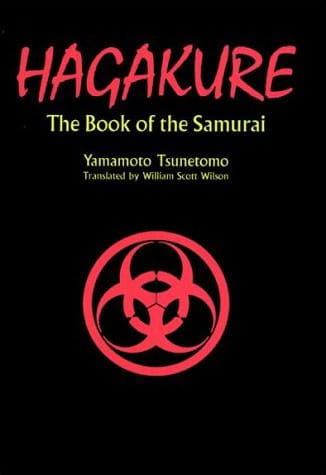
Hagakure

Author: Yamamoto Tsunetomo
Rating: 7/10
Last Read: August 2015

Quick Summary: A collection of notes from the early 1700s meant to serve as a guide for warriors.  The book summarizes the author’s view of the warrior code (in the context of bushido).  The book touches on many practical and spiritual points, as well as highlights many interesting facts of life for the time period.

There are many practical things that modern man can still draw from this historic work, assuming westerners can handle the fixation with death that flows through the work. (But really, you’re going to die too!)

My Highlights

To say that dying without reaching one’s aim is to die a dog’s death is the frivolous way of sophisticates. When pressed with the choice of life or death, it is not necessary to gain one’s aim. –loc 28

We all want to live. And in large part we make our logic according to what we like. But not having attained our aim and continuing to live is cowardice. –loc 29

If by setting one’s heart right every morning and evening, one is able to live as though his body were already dead, he pains freedom in the Way. His whole life will be without blame, and he will succeed in his calling. –loc 31

Having only wisdom and talent is the lowest tier of usefulness. –loc 37

According to their nature, there are both people who have quick intelligence, and those who must withdraw and take time to think things over. Looking into this thoroughly, if one thinks selflessly and adheres to the four vows of the Nabeshima samurai, surprising wisdom will occur regardless of the high or low points of one’s nature.’ People think that they can clear up profound matters if they consider them deeply, but they exercise perverse thoughts and come to no good because they do their reflecting with only self-interest at the center. –loc 38

Men of high position, low position, deep wisdom and artfulness all feel that they are the ones who are working righteously, but when it comes to the point of throwing away one’s life for his lord, all get weak in the knees. –loc 64

To discover the good and bad points of a person is an easy thing, and to give an opinion concerning them is easy, too. For the most part, people think that they are being kind by saying the things that others find distasteful or difficult to say. But if it is not received well, they think that there is nothing more to be done. This is completely worthless. It is the same as brining shame to a person by slandering him. It is nothing more than getting it off one’s chest. –loc 72

When I observed the application of men’s treatment to men, there was no result. Thus I knew that men’s spirit had weakened and that they had become the same as women, and the end of the world had come. –loc 101

The Way is in a higher place then righteousness. This is very difficult to discover, but it is the highest wisdom. When seen from this standpoint, things like righteousness are rather shallow. If one does not understand this on his own, it cannot be known. There is a method of getting to this Way, however, even if one cannot discover it by himself. This is found in consultation with others. Even a person who has not attained this Way sees others front the side. –loc 121

Listening to the old stories and reading books are for the purpose of sloughing off one’s own discrimination and attaching oneself to that of the ancients. –loc 126

Although all things are not to be judged in this manner, I mention it in the investigation of the Way of the Samurai. When the time comes, there is no moment for reasoning. And if you have not done your inquiring beforehand , there is most often shame. Reading books and listening to people’s talk are for the purpose of prior resolution. –loc 168

Above all, the Way of the Samurai should be in being aware that you do not know what is going to happen next, and in querying every item day and night. Victory and defeat are matters of the temporary force of circumstances. The way of avoiding shame is different. It is simply in death. –loc 171

Even if it seems certain that you will lose, retaliate. Neither wisdom nor technique has a place in this. A real man does not think of victory or defeat. He plunges recklessly towards an irrational death. By doing this, you will awaken from your dreams. –loc 173

It is not good to settle into a set of opinions. It is a mistake to put forth effort and obtain some understanding and then stop at that. –loc 184

Do not rely on following the degree of understanding that you have discovered, but simply think, “This is not enough.” –loc 186

How should a person respond when he is asked, “As a human being, what is essential in terms of purpose and discipline?” First, let us say, “It is to become of the mind that is right now pure and lacking complications.” People in general all seem to be dejected. When one has a pure and uncomplicated mind, his expression will be lively. When one is attending to matters, there is one thing that comes forth from his heart. That is, in terms of one’s lord, loyalty; in terms of one’s parents, filial piety; in martial affairs, bravery ; and apart from that, something that can be used by all the world. –loc 199

This is very difficult to discover. Once discovered, it is again difficult to keep in constant effect. There is nothing outside the thought of the immediate moment. –loc 203

Although it seems that taking special care of one’s appearance is similar to showiness, it is nothing akin to elegance. Even if you are aware that you may be struck down today and are firmly resolved to an inevitable death, if you are slain with an unseemly appearance, you will show your lack of previous resolve, will be despised by your enemy, and will appear unclean. For this reason it is said that both old and young should take care of their appearance. –loc 207

And if he thinks that this is not shameful, and feels that nothing else matters as long as he is comfortable, then his dissipate and discourteous actions will be repeatedly regrettable. –loc 214

What things a person should be able to accomplish if he had no haughtiness concerning his place in society! –loc 222

Look at the human condition. It is unseemly for a person to become prideful and extravagant when things are going well. Therefore, it is better to have some unhappiness while one is still young, for if a person does not experience some bitterness, his disposition will not settle down. –loc 241

There is surely nothing other than the single purpose of the present moment. A man’s whole life is a succession of moment after moment. If one fully understands the present moment, there will be nothing else to do, and nothing else to pursue. Live being true to the single purpose of the moment . –loc 267

Everyone lets the present moment slip by, then looks for it as though he thought it were somewhere else. No one seems to have noticed this fact. But grasping this firmly, one must pile experience upon experience. And once one has come to this understanding he will be a different person from that point on, though he may not always bear it in mind. –loc 270

As Yasuda Ukyo said about offering up the last wine cup, only the end of things is important. One’s whole life should be like this. When guests are leaving, the mood of being reluctant to say farewell is essential. If this mood is lacking, one will appear bored and the day and evening’s conversation will disappear. In all dealings with people it is essential to have a fresh approach. One should constantly give the impression that he is doing something exceptional. It is said that this is possible with but a little understanding. –loc 291

Whether people be of high or low birth, rich or poor, old or young, enlightened or confused, they are all alike in that they will one day die. It is not that we don’t know that we are going to die, but we grasp at straws. While knowing that we will die someday, we think that all the others will die before us and that we will be the last to go. Death seems a long way oft . –loc 343

insofar as death is always at one’s door, one should make sufficient effort and act quickly. –loc 347

One should think well and then speak. This is clear and firm, and one should learn it with no doubts. It is a matter of putting forth one’s whole effort and having the correct attitude previously. –loc 368

Human life is truly a short affair. It is better to live doing the things that you like. It is foolish to live within this dream of a world seeing unpleasantness and doing only things that you do not like. But it is important never to tell this to young people as it is something that would be harmful if incorrectly understood. –loc 371

What is done casually and freely will not work out well. It is a matter of attitude. –loc 399

People with intelligence will use it to fashion things both true and false and will try to push through whatever they want with their clever reasoning. This is injury from intelligence . Nothing you do will have effect if you do not use truth. –loc 418

To go without knowing whether the other party is busy, or when he has some particular anxiety, is awkward. There is nothing that surpasses not going where you have not been invited. –loc 427

The late Jin’emon said that it is better not to bring up daughters. They are a blemish to the family name and a shame to the parents. The eldest daughter is special, but it is better to disregard the others. –loc 432

The late Nakano Kazuma said that the original purpose of the Tea Ceremony is to cleanse the six senses. For the eyes there are the hanging scroll and flower arrangement. For the nose there is the incense. For the ears there is the sound of the hot water. For the mouth there is the taste of the tea. And for the hands and feet there is the correctness of term. When the five senses have thus been cleansed, the mind will of itself be purified. The Tea Ceremony will cleanse the mind when the mind is clogged up. –loc 436

A person who does not set himself in just one direction will be of no value at all. –loc 498

It is fine for retired old men to learn about Buddhism as a diversion, but if a warrior makes loyalty and filial piety one load, and courage and compassion another, and carries these twenty-four hours a day until his shoulders wear out, he will be a samurai. –loc 499

A man’s whole life should be like this. To exert oneself to a great extent when one is young and then to sleep when he is old or at the point of death is the way it should be. But to first sleep and then exert oneself . . . To exert oneself to the end, and to end one’s whole life in toil is regrettable.” –loc 629

“If a retainer will just think about what he is to do for the day at hand, he will be able to do anything. If it is a single day’s work, one should be able to put up with it. Tomorrow, too, is but a single day.” –loc 700

“To be prideful about your strength while your mettle is not yet established is likely to bring you shame in the midst of people. You are weaker than you look.” –loc 860

Everyone says that no masters of the arts will appear as the world comes to an end. This is something that I cannot claim to understand. Plants such as peonies, azaleas and camellias will be able to produce beautiful flowers, end of the world or not. If men would give some thought to this fact, they would understand. –loc 928

The basic meaning of etiquette is to be quick at both the beginning and end and tranquil in the middle. Mitani Chizaemon heard this and said, “That’s just like being a kaishaku. –loc 965

There was no goodness visible to Tesshu’s eyes. It is not a good idea to praise people carelessly. When praised, both wise and foolish become prideful. To praise is to do harm.” –loc 970

When there is something to be said, it is better if it is said right away. If it is said later, it will sound like an excuse. –loc 1098

How will a man who has doubts even in his own room achieve anything on the battlefield? There is a saying that goes, “No matter what the circumstances might be, one should be of the mind to win. One should be holding the first spear to strike.” –loc 1134

To ask when you already know is politeness. To ask when you don’t know is the rule. –loc 1156

The essentials of speaking are in not speaking at all. If you think that you can finish something without speaking, finish it without saying a single word. If there is something that cannot be accomplished without speaking, one should speak with few words, in a way that will accord well with reason –loc 1206

Meditation on inevitable death should be performed daily. Every day when one’s body and mind are at peace, one should meditate upon being ripped apart by arrows, rifles, spears and swords, being carried away by surging waves, being thrown into the midst of a great fire, being struck by lightning, being shaken to death by a great earthquake, falling from thousand-foot cliffs, dying of disease or committing seppuku at the death of one’s master. And every day without fail one should consider himself as dead. –loc 1226

People will become your enemies if you become eminent too quickly in life, and you will be ineffectual. Rising slowly in the world, people will be your allies and your happiness will he assured. –loc 1232

The Warrior Ethos

Author: Steven Pressfield
Rating: 6/10
Last Read: June 2014

Quick Summary: This is a quick read.  Pressfield examines the warrior values and mindset in a variety of cultures throughout history. This book is pretty quick and segmented, structured as almost a series of thoughts on various topics related to the warrior ethos.  

Mostly it’s a collection of statements with some anecdotes – it could have been more fully fleshed out to be really something good. There are still interesting precepts to mull over – that provides value to me, even if the overall text is weak.

My Highlights

The Spartans do not ask how many are the enemy but where are they. —Plutarch –loc 15

At a deeper level, the Warrior Ethos recognizes that each of us, as well, has enemies inside himself. Vices and weaknesses like envy and greed, laziness, selfishness, the capacity to lie and cheat and do harm to our brothers. The tenets of the Warrior Ethos, directed inward, inspire us to contend against and defeat those enemies within our own hearts. –loc 106

Be brave, my heart [wrote the poet and mercenary Archilochus]. Plant your feet and square your shoulders to the enemy. Meet him among the man-killing spears. Hold your ground. In victory, do not brag; in defeat, do not weep. –loc 118

The god who ruled the battlefield was Phobos. Fear. –loc 123

The Spartan king Agesilaus was once asked what was the supreme warrior virtue, from which all other virtues derived. He replied, “Contempt for death.” –loc 139

Courage—in particular, stalwartness in the face of death—must be considered the foremost warrior virtue. –loc 141

The dictionary defines ethos as: The moral character, nature, disposition and customs of a people or culture. –loc 145

“You’ve got the watches,” say the Taliban, “but we’ve got the time.” –loc 171

Individuals in a guilt-based culture internalize their society’s conceptions of right and wrong. The sinner feels his crime in his guts. He doesn’t need anyone to convict him and sentence him; he convicts and sentences himself. –loc 204

The West is a guilt-based culture. Since the Judeo-Christian God sees and knows our private deeds and innermost thoughts, we are always guilty of something, with no way out save some form of divine absolution, forgiveness or grace. –loc 206

A shame-based culture is the opposite. In a shame-based culture, “face” is everything. All that matters is what the community believes of us. –loc 208

The Japanese warrior culture of Bushido is shame-based; it compels those it deems cowards or traitors to commit ritual suicide. The tribal cultures of Pashtunistan are shame-based. The Marine Corps is shame-based. So were the Romans, Alexander’s Macedonians and the ancient Spartans. –loc 213

There’s a well-known gunnery sergeant in the Marine Corps who explains to his young Marines, when they complain about pay, that they get two kinds of salary—a financial salary and a psychological salary. The financial salary is indeed meager. But the psychological salary? Pride, honor, integrity, the chance to be part of a corps with a history of service, valor, glory; to have friends who would sacrifice their lives for you, as you would for them—and to know that you remain a part of this brotherhood as long as you live. How much is that worth? –loc 285

This is another key element of the Warrior Ethos: the willing and eager embracing of adversity. –loc 413

The payoff for a life of adversity is freedom. –loc 419

“You may defeat us,” said the tribal elders, “but you will never defeat our poverty.” –loc 423

For warrior cultures—from the Sioux and the Comanche to the Zulu and the mountain Pashtun—honor is a man’s most prized possession. Without it, life is not worth living. –loc 439

The American brand of honor is inculcated on the football field, in the locker room and in the street. Back down to no one, avenge every insult, never show fear, never display weakness. Play hurt, never quit. –loc 446

Honor is the psychological salary of any elite unit. Pride is the possession of honor. –loc 457

Honor is connected to many things, but one thing it’s not connected to is happiness. In honor cultures, happiness as we think of it—“life, liberty and the pursuit of happiness”—is not a recognized good. Happiness in honor cultures is the possession of unsullied honor. Everything else is secondary. –loc 458

Patton said, “Americans play to win at all times. I wouldn’t give a hoot in hell for a man who lost and laughed. That’s why Americans have never lost a war and never will lose one.” –loc 478

The will to fight, the passion to be great, is an indispensable element of the Warrior Ethos. It is also a primary quality of leadership, because it inspires men and fires their hearts with ambition and the passion to go beyond their own limits. –loc 480

Second, they don’t solve the problem. Neither remark offers hope or promises a happy ending. They’re not inspirational. The deliverers of these quips don’t point to glory or triumph—or seek to allay their comrades’ anxiety by holding out the prospect of some rosy outcome. The remarks confront reality. They say, “Some heavy shit is coming down, brothers, and we’re going to go through it.” –loc 527

For the warrior, all choices have consequences. His decisions have meaning; every act he takes is significant. What he says and does can save (or cost) his own life or the lives of his brothers. –loc 545

Selflessness is a virtue in a warrior culture. Civilian society gives lip service to this, while frequently acting as selfishly as it possibly can. –loc 570

Cyrus of Persia believed that the spoils of his victories were meant for one purpose—so that he could surpass his enemies in generosity. I contend against my foes in this arena only: the capacity to be of greater service to them than they are to me. –loc 617

Let us conduct ourselves so that all men wish to be our friends and all fear to be our enemies. –loc 622

The Bhagavad-Gita changes this. It takes the Warrior Ethos and elevates it to a loftier and nobler plane—the plane of the individual’s inner life, to his struggle to align himself with his own higher nature. –loc 641

In other words, by the interior exercise of his exterior Warrior Ethos. Arjuna’s divine instructor (one of whose titles in Sanskrit is “Lord of Discipline”) charges his disciple to: Fix your mind upon its object. Hold to this, unswerving, Disowning fear and hope, Advance only upon this goal. –loc 648

Collective Unconscious, meaning that part of the psyche that is common to all cultures in all eras and at all times. –loc 675

The Collective Unconscious, Jung said, contains the stored wisdom of the human race, accumulated over thousands of generations. –loc 676

The lieutenant pointed to Alexander and said to the yogi, “This man has conquered the world! What have you accomplished?”
The yogi looked up calmly and replied, “I have conquered the need to conquer the world.” –loc 704

What Alexander was acknowledging was that the yogi was a warrior too. An inner warrior. Alexander looked at him and thought, “This man was a fighter when he was my age. He has taken the lessons he learned as a warrior dueling external enemies and is turning them to use now as he fights internal foes to achieve mastery over himself.” –loc 709

The hardest thing in the world is to be ourselves. –loc 714

Let us be, then, warriors of the heart, and enlist in our inner cause the virtues we have acquired through blood and sweat in the sphere of conflict—courage, patience, selflessness, loyalty, fidelity, self-command, respect for elders, love of our comrades (and of the enemy), perseverance, cheerfulness in adversity and a sense of humor, however terse or dark. –loc 726

Tides of War

Author: Steven Pressfield
Rating: 9/10
Last Read: September 2014

Quick Summary: Another novel in Steven Pressfield’s historical series – this one focuses on the  Peloponnesian War and the historical figure Alcibiades.  The novel is again told through the eyes of a minor character, an Athenian soldier fighting in the war.  Other historical characters make an appearance, including Lysander, Socrates, and Pericles.  

Alcibiades is a prime example of an individual who was brought down by his own ego.  Ego is your enemy, remember that.

Further Reading: The Virtues of War, Gates of Fire

My Highlights

Men hate nothing worse than that mirror held before them whose reflection displays their own failure to prove worthy of themselves. –loc 273

“Banish all thought of retreat, brothers. No avenue remains but to advance, and no alternative save victory or death.” –loc 396

Experience teaches that however numerous the brigade or army, the work of war is performed by small units, and each must possess to be effective one man like Lion who is unacquainted with fear, who arises cheerful each morning despite all hardship, ready to shoulder another’s load with a laugh and turn his hand to all tasks, however mean or humble. A unit lacking a man like Lion will never endure, while one with such a mate may be beaten but never broken. –loc 449

A beautiful woman is in the same fix. She cannot but perceive herself as two creatures—the private soul known to her intimates and that external proxy presented to the world by her good looks. The attention she receives may be gratifying to her vanity, but it is empty and she knows it. –loc 538

They sought only the surface, and for reasons of their own vanity. –loc 543

As an actor you of all people should know that death takes many and far more evil forms than the physical. Isn’t that what tragedy is all about? –loc 550

“Note further, gentlemen, that this single quality by which we convict these women and sentence them to exile from humanity is one over which they themselves possess no authority, a quality thrust upon them willy-nilly at birth. This is the antithesis of freedom, is it not? It is the use one makes of a slave. We treat even our dogs and horses better, granting to them their subtleties and contradictions of character and esteeming or contemning them thereby.” Socrates drew up and inquired of the company if any found fault with his meditation thus far. He was endorsed by all and exhorted to continue. “And yet we who consider ourselves free men often act in this manner not only toward others but toward ourselves as well. We account and define our persons by qualities gifted to or deprived us at birth, to the exclusion of those earned or acquired thereafter, brought into being by enterprise and will. This to my mind is an evil greater than degradation. It is self-degradation.” –loc 575

Socrates resumed. “Pondering this state of self-slavery, I began to puzzle: what precisely are the qualities which make men free?”
“Our will, as you said,” put in Acumenus the physician.
“And the force to exercise it,” added Mantitheus.
–loc 584

“No doubt with my poor cloak and sword–barbered beard I am perceived throughout the camp as a figure of fun. Yet I maintain that, unfettered by the constraints of the mode, I am the most free of men.” –loc 600

“Which takes precedence, do we believe, man or law? To set a man above the law is to negate law entire, for if the laws do not apply equally to all, they apply to none. To install one man upon such a promontory founds that flight of steps by which another may later ascend. –loc 623

In fact I suspect, don’t you, brothers, that when our companion nominates myself as indispensable, his intent is to establish that precedent by which he may next anoint himself.” –loc 625

His Theory of Forms arises from that selfsame interpretation. As the material manifestation of an individual horse embodies the particular and the transitory, Plato suggested, so must there exist within some higher realm the ideal form of Horse, universal and immutable, of which all corporeal horses “partake” or “participate in.” –loc 864

Democracy is a sword which cuts two ways. It emancipates the individual, setting him free to shine as no other scheme of governance. But that blade possesses an under-edge. Its spawn is spite and envy. This is why Pericles bore himself with modesty, remote from the multitude, for fear of their jealousy.” –loc 1167

“You came this close, Alcibiades,” Lysander is said to have spoken.
In response his adversary quoted the proverb “Close captures no crowns.”
To which Lysander replied, “God grant that be your epitaph,” and, turning, spurred away. –loc 1700

What I fear has nothing to do with groves or vines, Callicles, but the virtues which cultivation of the land imparts: modesty, patience, reverence for the gods, of which this Alcibiades knows little and cares less. He is a product of the city and evinces all its vices: vanity, arrogance, impatience, and immodesty before heaven.” –loc 2041

You define yourselves not as who you are, but as who you may become, and hasten over oceans to this shore you can never reach. –loc 2133

“Hope is a dangerous liquor,” my savior Lysander had addressed the ephorate in a speech so notorious it had actually been written down and circulated, unheard-of in Lacedaemon. “War has unstoppered the flasket, and nothing may seal it again.” –loc 3768

“How does one lead free men?”
“By being better than they,” Alcibiades responded at once. –loc 4089

“A commander’s role is to model arete, excellence, before his men. One need not thrash them to greatness; only hold it out before them. They will be compelled by their own nature to emulate it.” –loc 4096

If force must be employed with a subordinate, take care that it be minimal. If I command you, “Pick up that bowl,” and set a swordpoint to your back, you will obey but no part will own the action. You will exculpate yourself, accounting, “He made me do it, I had no choice.” But if I only suggest and you comply, then you must own your compliance and, owning it, stand by it. –loc 4223

Corollary to the principle of minimal force was that of minimal supervision. When Alcibiades issued a combat assignment, he imparted the objective only, leaving the means to the officer himself. The more daunting the chore, the more informally he commanded it. I never saw him issue an order from behind a desk. –loc 4242

Always assign a man more than he believes himself capable of. Make him rise to the occasion. In this way you compel him to discover fresh resources, both in himself and others of his command, thus enlarging the capacity of each, while binding all beneath the exigencies of risk and glory. –loc 4245

As we seek to make our enemies own their defeats at our hands, so we must make our friends own their victories. The less you give a man, and have him succeed, the more he draws his achievement to his heart. Remember we may elevate the fleet in two ways only. By acquiring better men or making those we have better. Even were the former practicable I would disdain it, for a hired man may hire out to another master but a man who makes himself master stays loyal forever. There was an oarsman –loc 4248

Shit rolls downhill, soldiers say, but so does confidence. –loc 5327

Courage is born of obedience. It is the issue of selflessness, brotherhood, and love of freedom. Boldness, on the other hand, is spawned of defiance and disrespect; it is the bastard brat of irreverence and outlawry. –loc 5385

“Let me phrase the question differently. Do we believe that the law, even an unjust law, must be obeyed? Or may the individual take it on himself to decide which laws are just and which unjust, which worthy of obedience and which not?”
I protested that it was not justice which Socrates had received, and thus its disallowance was legitimate.
“Let us hear your opinion, Jason. Is it better to perish through injustice inflicted upon one by others, or to live, having inflicted injustice on them?” –loc 5964

“You forget one, Jason, upon whom I would be inflicting injustice. The Laws. Suppose the Laws sat among us now. Might they not say something like this: ‘Socrates, we have served you all your life. Beneath our protection you grew to manhood, married, and raised a family; you pursued your livelihood and studied philosophy. You accepted our boons and the security we provided. Yet now, when our verdict no longer suits your convenience, you wish to put us aside.’ How would we answer the Laws?”
“Some men must be set above the laws.”
“How can you strike this posture, my friend, who argued with such fervor, that day, the contravening course?” –loc 5970

The supreme mystery of existence is this: that, perceiving it for what it is, we yet cling to it. And existence, despite all, discovers measures to reanimate our despoliated hearts. –loc 6186

He would lecture me, I knew, on vices. Three he abhorred—fear, hope, and love of country. He abominated only one beyond these: contemplation of past or future. These were offenses against nature, Telamon maintained, as they bound one to aspiration, to a result whose issue was adjudicated by forces, above the earth and beneath, which mortals may neither alter nor apprehend. Alcibiades was guilty of these, my mate observed, and of another violation of heaven’s law. Alcibiades perceived war as a means. In truth it was an end. Where our commander claimed to honor only Necessity, Telamon served a divinity more primordial. –loc 6414

War waged for advantage yields only ruin. Yet one may not disown war, which abides as constant as the seasons and eternal as the tides. –loc 6424

“What world is it you seek, Pommo, that is ‘better’ than this? Do you imagine like Alcibiades that you, or Athens, may elevate yourselves or anyone to some loftier sphere? This world is the only one that exists. Learn its laws and obey them. This is true philosophy.” –loc 6426

what is nobility that a beast may own it as well as a man? Is it not that capacity of soul by which one donates himself to an object greater than his own self-interest? –loc 6662

How lead free men? Only by this means: the summoning of each to his nobility. –loc 6663

The Virtues of War

Author: Steven Pressfield
Rating: 9/10
Last Read: December 2013

Quick Summary: This book is told through the eyes of a scribe following Alexander on his conquering journey across Asia, leading to his ultimate demise.  The shortest summary can be pulled from the book itself: 

This is tragedy. For which of us can rise above what he is? Tragedy is the arrest of a man by his own nature. He is blind to it. He cannot transcend it. If he could, it would not be tragedy. And tragedy’s power derives from our own realization, commoner as well as king, that life truly is like that. We have fashioned our ruin with our own hands.

Further Reading: Gates of Fire, Tides of War

My Highlights

Those who do not understand war believe it contention between armies, friend against foe. No. Rather friend and foe duel as one against an unseen antagonist, whose name is Fear, and seek, even entwined in death, to mount to that promontory whose ensign is honor. –loc 234

There are further items, Telamon taught, which have no place in the soldier’s kit. Hope is one. Thought for future or past. Fear. Remorse. Hesitation. –loc 456

A warrior must not advance to battle hopeless—that is, devoid of hope. Rather let him set aside all baggage of expectation—of riches, celebrity, even death—and spur beneath extinction’s scythe lightened of all, save surrender to that outcome known only to the gods. –loc 464

“For the self-control of the warrior, which we observe and admire in his comportment, is but the outward manifestation of the inner perfection of the man. Such virtues as patience, courage, selflessness, which the soldier seems to have acquired for the purpose of defeating the foe, are in truth for use against enemies within himself—the eternal antagonists of inattention, greed, sloth, self-conceit, and so on. –loc 469

When each of us recognizes, as we must, that we too are engaged in this struggle, we find ourselves drawn to the warrior, as the acolyte to the seer. –loc 472

The true man-at-arms, in fact, can overcome his enemy without even striking a blow, simply by the example of his virtue. In fact he can not only defeat this foe but also make him his willing friend and ally, and even, if he wishes, his slave. –loc 473

Here, for your education, Itanes, I must address a question that causes all young officers consternation. I mean the experience of empathy for the foe. Never be ashamed to feel this. It is not unmanly. Indeed, I believe it the noblest demonstration of martial virtue. –loc 614

War is fear, let no man say otherwise. –loc 682

“Let me underscore this only, my friends, in regard to the foe. It is not our place to hate these men or to take pleasure in their slaughter. We fight today not to seize their lands or lives, but their preeminence among the Greeks. With luck, they will fight at our sides when Philip turns for Asia and marches against the Persian throne. –loc 778

No army ever won a battle when its elite unit was destroyed. –loc 782

I alone am master of my life! I vowed in that instant not only to dedicate myself to the study of horses and horsemanship, to make myself without peer as cavalryman and cavalry officer, but to educate myself in all things, to become my own tutor, selecting the subjects I needed to master and seeking instruction on my own. –loc 1328

Regret, Telamon had taught, has no place in the soldier’s kit of war. I know this is true. But I know, as well, that no act comes without a price. All men must answer for their crimes. I shall for mine. –loc 1362

The sarissas know their work is war. They are sorry for this. They cry for the suffering they cause. –loc 1844

He is dead. I weep, not only out of respect for the brilliant Rhodian, though I feel that in abundance, but for the role of chance and luck in the affairs of men, and the knowledge of how tenuous is our hold, all of us, upon this thing we call life. –loc 1852

Because a thing has never been done, gentlemen, is no reason to say it cannot be. And, in my view, no reason not to try. –loc 1915

Do you know what faculty I claim in myself as preeminent beyond all rivals? Not warcraft or conquest. Certainly not politics. Imagination. –loc 1964

The life of peace is fitting for a mule or an ass. I would be a lion! –loc 2701

One cannot be a philosopher and a warrior at the same time, as Parmenio has said. And one cannot be a man and a king. –loc 2783

Always attack. Even in defense, attack. The attacking arm possesses the initiative and thus commands the action. To attack makes men brave; to defend makes them timorous. If I learn that an officer of mine has assumed a defensive posture in the field, that officer will never hold command under me again. –loc 2822

When deliberating, think in campaigns and not battles; in wars and not campaigns; in ultimate conquest and not wars. –loc 2826

Seek the decisive battle. What good does it do us to win ten scraps of no consequence if we lose the one that counts? I want to fight battles that decide the fate of empires. –loc 2828

It is as important to win morally as to win militarily. By which I mean our victories must break the foe’s heart and tear from him all hope of contesting us again. I do not wish to fight war upon war, but by war to produce such a peace as will admit of no insurrection. –loc 2831

The object of campaign is to bring about a battle that will prove decisive. We feint; we maneuver; we provoke to one end: to compel the foe to face us in the field. –loc 2835

The object of pursuit after victory is not only to prevent the enemy from re-forming in the instance (this goes without saying), but to burn such fear into his vitals that he will never think of re-forming again. –loc 2843

As commanders, we must save our supreme ruthlessness for ourselves. Before we make any move in the face of the enemy, we must ask ourselves, free of vanity and self-deception, how the foe will counter. Unearth every stroke and have an answer for it. Even when you think you have thought of everything, there will be more work to do. Be merciless with yourself, for every careless act is paid for in our own blood and the blood of our countrymen. –loc 2849

Let us conduct ourselves in such a fashion that all nations wish to be our friends and all fear to be our enemies. –loc 2862

No advantage in war is greater than speed. To appear suddenly in strength where the enemy least expects you overawes him and throws him into consternation. –loc 2864

Be conservative until the crucial moment. Then strike with all the violence you possess. –loc 2873

Remember: We need win at only one point on the field, so long as that point is decisive. –loc 2874

Don’t punch; counterpunch. The purpose of an initial evolution—a feint or draw—is to provoke the enemy into committing himself prematurely. Once he moves, we countermove. –loc 2883

An officer must lead from the front. How can we ask our soldiers to risk death if we ourselves shrink from hazard? –loc 2888

Leverage of position means the occupation of that site which compels the enemy to move. When we face an enemy marshaled in a defensive posture, our first thought must be: What post can we seize that will make him withdraw? –loc 2890

Here is something the instructors of war do not teach: the art of confronting the irrational, of disarming the groundless and the unknown. –loc 3076

Pick one way and don’t look back. Nothing is worse than indecision. Be wrong, but be wrong decisively. –loc 3139

Can you please your constituents? Never let me hear that word! The men are never happy with anything. The march is always too long, the way always too rough. –loc 3140

Hardship. Give your men something that can’t be done, not something that can. Then place yourself at first hazard. –loc 3141

Rationality is superstition by another name. –loc 3147

Great commanders do not temper their measures to What Is; they bring forth What May Be. –loc 3148

Nothing is harder in war than to stand fast. –loc 3185

Sweat, speed, action—these are the antidotes to fear. –loc 3231

The material a commander manipulates is the human heart. –loc 3310

His art lies in producing courage in his own men and terror in the foe. –loc 3311

The general produces courage by discipline, training, and fitness; by fairness and order; superior pay, armament, tactics, and supply; by his dispositions in the field; and by the genius of his own presence and actions. –loc 3311

When men know they will be attacked, they feel fear; when they know they will attack, they feel strength. –loc 3340

To contend chivalrously against the chivalrous foe refines us, as gold in the crucible. –loc 3359

The ordeal of command consists in this: that one makes decisions of fatal consequence based on ludicrously inadequate intelligence. –loc 3675

“Success,” says Telamon, “is the weightiest burden of all. We are victors now. All our dreams have come true.” –loc 4394

When they were starving, your officers were a corps of comrades. But now each has grown touchy and quick to take insult. They are no longer mates, but rivals. You give them so much money, you make them independent of you. –loc 4452

Gold buys adherents; it turns good men arrogant and bad men ungovernable. –loc 4454

No man speaks the truth to a king. –loc 4484

“To be royal,” Sisygambis has said, “is to tread barefoot upon the razor’s edge. –loc 4538

“This man has conquered the world! What have you done?”
The philosopher replied without an instant’s hesitation, “I have conquered the need to conquer the world.”
–loc 4773

This is tragedy. For which of us can rise above what he is? Tragedy is the arrest of a man by his own nature. He is blind to it. He cannot transcend it. If he could, it would not be tragedy. And tragedy’s power derives from our own realization, commoner as well as king, that life truly is like that. We have fashioned our ruin with our own hands. –loc 4819

For have you not noticed of these sages, my friends, that they are the consummate soldiers? Inured to pain, oblivious to hardship, each takes up his post at dawn and does not relinquish it for thirst, hunger, heat, cold, fatigue. He is cheerful in all weathers, self-motivated, self-governed, self-commended. –loc 4854

“But there is one thing to which you are indeed attached, to your soul’s detriment.”
“And what is that, my friend?”
“Your victories. You remain proud of them. This is not good for you.”

–loc 4863

“You should be able to walk away from all this now, this night. Get up! Take nothing! Can you? –loc 4866

I schooled you as a boy, Alexander, to be superior to fear and to anger. You learned eagerly. You vanquished hardship and hunger and cold and fatigue. But you have not learned to master your victories. These hold you. You are their slave. –loc 4875

War is a crime, Alexander. In the end it is but butchery. For all the poets’ anthems, war’s object is nothing nobler than the imposition of one nation’s will upon another by means of force and threat of force. –loc 4951