Best of Robert E. Howard, Vol 1

Author: Robert E Howard
Rating: 8/10
Last Read: March 2014

Quick Summary: Collection of short stories and poems by Robert E. Howard. He created many different characters, the most notable being Conan the Barbarian.  Much of his work is in the “pulp fiction” style, and he includes many elements of horror in his writings (think of Lovecraft).

Pick this up if you like quick fantasy reads – especially nice before bed.  He is one of my favorite fantasy & pulp writers.

My Highlights

“You are young,” said the palaces and the temples and the shrines, “but we are old. The world was wild with youth when we were reared. You and your tribe shall pass, but we are invincible, indestructible. We towered above a strange world, ere Atlantis and Lemuria rose from the sea; we still shall reign when the green waters sigh for many a restless fathom above the spires of Lemuria and the hills of Atlantis and when the isles of the Western Men are the mountains of a strange land. “How many kings have we watched ride down these streets before Kull of Atlantis was even a dream in the mind of Ka, bird of Creation? Ride on, Kull of Atlantis; greater shall follow you; greater came before you. They are dust; they are forgotten; we stand; we know; we are. Ride, –loc 473

and man, the jest of the gods, the blind, wisdomless striver from dust to dust, following the long bloody trail of his destiny, knowing not why, bestial, blundering, like a great murderous child, yet feeling somewhere a spark of divine fire…. –loc 657

Thus far I was prepared; from now on we must trust to our luck and our craft. –loc 688

And what, mused Kull, were the realities of life? Ambition, power, pride? The friendship of man, the love of women–which Kull had never known–battle, plunder, what? Was it the real Kull who sat upon the throne or was it the real Kull who had scaled the hills of Atlantis, harried the far isles of the sunset, and laughed upon the green roaring tides of the Atlantean sea? How could a man be so many different men in a lifetime? For Kull knew that there were many Kulls and he wondered which was the real Kull. –loc 742

“Man, are you mad?” she asked, “that in your madness you come seeking that from which strong men fled screaming in old times?” “I seek a vengeance,” he answered, “that can be accomplished only by Them I seek.” She shook her head. “You have listened to a bird singing; you have dreamed empty dreams.” “I have heard a viper hiss,” he growled, “and I do not dream. Enough of this weaving of words. –loc 4190

“Barbarism is the natural state of mankind,” the borderer said, still staring somberly at the Cimmerian. “Civilization is unnatural. It is a whim of circumstance. And barbarism must always ultimately triumph.” –loc 8337

“Nobody writes realistic realism, and if they did, nobody would read it. The writers that think they write it just give their own ideas about things they think they see. The sort of man who could write realism is the fellow who never reads or writes anything.” –loc 9766

He understood that selling window blinds, or drilling holes in sheet metal all week, or working at the rent-a-car counter at the airport is not enough to fill a man’s heart. –loc 9838

“There was pageantry and high illusion and vanity, and the beloved tinsel of glory without which life is not worth living,” wrote Howard concerning times gone by: “All empty show and the smoke of conceit and arrogance, but what a drab thing life would be without them.” For him, there is no meaning or beauty in life other than what we dream into it. –loc 9845

Wool (Silo Series)

Author: Hugh Howry
Rating: 8/10
Last Read: March 2016

Quick Summary: The world is in ruin.  Humanity is kept alive in a silo.  Punishment? People get sent to die in the harsh outer environment.  But the new sheriff senses there’s something fishy going on and investigates.

This is an excellent read.  The story ends on a solid note, if you are not interested in continuing the series (I haven’t).

My Highlights

“The days pile up and weigh small decisions down, don’t they? That decision not to visit. The first few days slide by easy enough; anger and youth power them along. But then they pile up like unrecycled trash. Isn’t that right?” –loc 1413

One of the last things Mayor Jahns had told her had proved truer than she could imagine: people were like machines. They broke down. They rattled. They could burn you or maim you if you weren’t careful. Her job was not only to figure out why this happened and who was to blame, but also to listen for the signs of it coming. Being sheriff, like being a mechanic, was as much the fine art of preventive maintenance as it was the cleaning up after a breakdown. –loc 1772

But then, the lowering of the body and the plucking of ripe fruit just above the graves was meant to hammer this home: the cycle of life is here; it is inescapable; it is to be embraced, cherished, appreciated. One departs and leaves behind the gift of sustenance, of life. They make room for the next generation. We are born, we are shadows, we cast shadows of our own, and then we are gone. All anyone can hope for is to be remembered two shadows deep. –loc 2209

Killing a man should be harder than waving a length of pipe in their direction. It should take long enough for one’s conscience to get in the way. –loc 4142

“What always happens. People go crazy. It only needs to happen once.” He smiled. “We get no credit for being sane, do we? I get no credit. Even from me. From myself. I hold it together and hold it together and I make it another day, another year, and there’s no reward. Nothing great about me being normal. About not being crazy.” He frowned. “Then you have one bad day, and you worry for yourself, you know? It only takes one.” –loc 4359

Once guns were made, who would unmake them? Barrels rested on shoulders and bristled like pincushions above the crowd. There were things, like spoken ideas, that were almost impossible to take back. –loc 4469

“None of us asked to be where we are,” she reminded him coolly. This gave Lukas pause, thinking of where she was, what she’d been through to get there. “What we control,” Juliette said, “is our actions once fate puts us there.” –loc 5417

“We can’t control where we are right now,” he mumbled, “just what we do going forward.” –loc 6297

The Trial

Author: Franz Kafka
Rating: 8/10
Last Read: January 2016

Quick Summary: A man is put on trial in a secret court and attempts to prove his innocence without knowing what the charges are.  As any of us would, he descends into madness. 

Key Takeaways

It turns out if you read old books, you can see the risks of your current situations quite clearly.  Secret trials?  Special courts?  Unable to fight the battles on your own, especially when you don’t have all of the information?  Yeah.  We live in that reality.

I, too, would go mad if I was on trial, didn’t know why, and couldn’t defend myself.

My Highlights

How are we to avoid those in office becoming deeply corrupt when everything is devoid of meaning? –loc 644

K.’s uncle was always in a hurry, as he suffered from the unfortunate belief that he had a number things to do while he was in the big city and had to settle all of them in one day –loc 1226

The only right thing to do is to learn how to deal with the situation as it is. –loc 1625

How is it even possible for someone to be guilty. We’re all human beings here, one like the other.” –loc 2853

“That is true,” said the priest, “but that is how the guilty speak.” –loc 2853

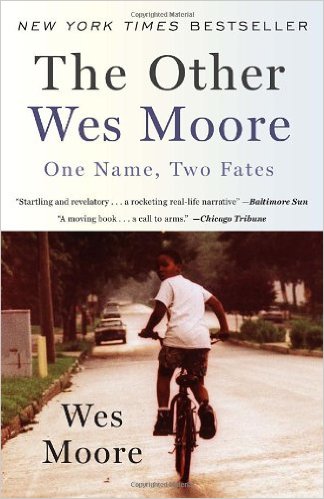
The Other Wes Moore

Author: Wes Moore
Rating: 7/10
Last Read: 2014

Quick Summary: A military officer analyzes the lives and actions of himself and an inmate sharing his name to try to determine what would have caused their lives to deviate in such a way.

Key Takeaways

Don’t forget how much of an effect environment, family, and birth lottery have on your life.

It made me think deeply about the way privilege and preference work in the world, and how many kids who didn’t have “luck” like mine in this instance would find themselves forever outside the ring of power and prestige. So many opportunities in this country are apportioned in this arbitrary and miserly way, distributed to those who already have the benefit of a privileged legacy.

My Highlights

But even the worst decisions we make don’t necessarily remove us from the circle of humanity.

life and death, freedom and bondage, hang in the balance of every action we take.

Watende, a Shona word that means “revenge will not be sought,”

“I guess it’s hard sometimes to distinguish between second chances and last chances.”

I decided not to respond directly to this latest protest of his innocence. Instead, I asked a question: “Do you think we’re all just products of our environments?” His smile dissolved into a smirk, with the left side of his face resting at ease. “I think so, or maybe products of our expectations.” “Others’ expectations of us or our expectations for ourselves?” “I mean others’ expectations that you take on as your own.” I realized then how difficult it is to separate the two. The expectations that others place on us help us form our expectations of ourselves.

He also taught me an important lesson about leadership: it always comes with having to make tough decisions.

They believed that excuses were tools of the incompetent and forced every cadet to believe the same.

“When it is time for you to leave this school, leave your job, or even leave this earth, you make sure you have worked hard to make sure it mattered you were ever here.”

Life’s impermanence, I realized, is what makes every single day so precious. It’s what shapes our time here. It’s what makes it so important that not a single moment be wasted.

It made me think deeply about the way privilege and preference work in the world, and how many kids who didn’t have “luck” like mine in this instance would find themselves forever outside the ring of power and prestige. So many opportunities in this country are apportioned in this arbitrary and miserly way, distributed to those who already have the benefit of a privileged legacy.

The common bond of humanity and decency that we share is stronger than any conflict, any adversity, any challenge. Fighting for your convictions is important. But finding peace is paramount. Knowing when to fight and when to seek peace is wisdom.

“I hear you, but it’s not the process you should focus on; it’s the joy you will feel after you go through the process.”

… the incredible power of stories to change people’s lives. By establishing himself as the protagonist of his own story, he inspired me and countless other young people to see ourselves as capable of taking control of our own destinies, and to realize how each decision we make determines the course of our life stories.

A Sailor’s Guide to Earth

Sturgill Simpson may be the most interesting country artist, and this album certainly keeps him going in that direction.

Would I call this country?  No.  But this album is excellent and heartfelt and odd (and took a few listens for me to appreciate).  Framed as a letter from a sailor to his wife and son, there are many times I dig into the lyrics and catch the feels.  Plus, the unexpected cover of In Bloom manages to surprise me each time I play the album.

Check out a live performance of one of the new songs and give the album a listen.  It’s worth it.

Strange Trails by Lord Huron

Strange Trails is hands down the best album of 2015.

Since adding it to my collection in April 2015, iTunes tells me I’ve listened to the whole album about 50 times – not including the extra plays from adding individual songs to my playlists.  Five of the songs from the album made it into my Top 25 Most Played songs, and all of them made the Top 50 list.

The magic of Strange Trails is that it’s a collection of excellent songs which flow brilliantly into each other. You can get lost in the sound of the music, but if you listen you can also enjoy the story and adventure in each song.  Since the songs flow into each other so smoothly, you often get lost in the middle of the album, only to shocked back to reality as the “The Night We Met” signifies the end of the adventure.

This album managed to revive (for me) the idea of the album as an art form.  We live in a world obsessed by singles, and many laud the new models of purchasing music since they can buy only the songs we like.  But when that happens, we also forget that many musicians craft an album as an author does a book – and it should be consumed in its entirety.

Tribe: On Homecoming and Belonging

Author: Sebastian Junger
Rating: 10/10
Last Read: June 2016
Recommended Reading? Yes!

Quick Summary: Our societal “advances” have been robbing us of the needs we have as social human animals, and this manifests many ways in our society today.  We all miss being part of a tribe.

Related Books: On Killing, Sapiens

Key Takeaways

That nagging feeling inside of you, saying that you feel lonely even surrounded by people constantly? That’s a real feeling – a product of the systems we have created and surround ourselves with.

Real human connection flourishes when there is a dependency and shared experience.

The modern world is a psychically dangerous place for us.

My Highlights

I wanted the chance to prove my worth to my community and my peers, but I lived in a time and a place where nothing dangerous ever really happened. Surely this was new in the human experience, I thought. How do you become an adult in a society that doesn’t ask for sacrifice? How do you become a man in a world that doesn’t require courage? –Loc 43

Humans don’t mind hardship, in fact they thrive on it; what they mind is not feeling necessary. Modern society has perfected the art of making people not feel necessary. –Loc 72

First agriculture, and then industry, changed two fundamental things about the human experience. The accumulation of personal property allowed people to make more and more individualistic choices about their lives, and those choices unavoidably diminished group efforts toward a common good. And as society modernized, people found themselves able to live independently from any communal group. A person living in a modern city or a suburb can, for the first time in history, go through an entire day—or an entire life—mostly encountering complete strangers. They can be surrounded by others and yet feel deeply, dangerously alone. –Loc 221

A wealthy person who has never had to rely on help and resources from his community is leading a privileged life that falls way outside more than a million years of human experience. –Loc 245

Financial independence can lead to isolation, and isolation can put people at a greatly increased risk of depression and suicide. This might be a fair trade for a generally wealthier society—but a trade it –Loc 247

self-determination theory, which holds that human beings need three basic things in order to be content: they need to feel competent at what they do; they need to feel authentic in their lives; and they need to feel connected to others. –Loc 252

Bluntly put, modern society seems to emphasize extrinsic values over intrinsic ones, and as a result, mental health issues refuse to decline with growing wealth. –Loc 255

“The economic and marketing forces of modern society have engineered an environment… that maximize[s] consumption at the long-term cost of well-being,” a study in the Journal of Affective Disorders concluded in 2012. “In effect, humans have dragged a body with a long hominid history into an overfed, malnourished, sedentary, sunlight-deficient, sleep-deprived, competitive, inequitable, and socially-isolating environment with dire consequences.” –Loc 261

Northern European societies, including America, are the only ones in history to make very young children sleep alone in such numbers. The isolation is thought to make many children bond intensely with stuffed animals for reassurance. –Loc 274
In 2007, anthropologist Christopher Boehm published an analysis of 154 foraging societies that were deemed to be representative of our ancestral past, and one of their most common traits was the absence of major wealth disparities between individuals. Another was the absence of arbitrary authority. “Social life is politically egalitarian in that there is always a low tolerance by a group’s mature males for one of their number dominating, bossing, or denigrating the others,” Boehm observed. –Loc 286

Modern society, on the other hand, is a sprawling and anonymous mess where people can get away with incredible levels of dishonesty without getting caught. What tribal people would consider a profound betrayal of the group, modern society simply dismisses as fraud. –Loc 308

Fraud in the insurance industry is calculated to be $100 billion to $300 billion a year, a cost that gets passed directly to consumers in the form of higher premiums. All told, combined public- and private-sector fraud costs every household in the United States probably around $5,000 a year—or roughly the equivalent of working four months at a minimum-wage job. –Loc 314
The FBI reports that since the economic recession of 2008, securities and commodities fraud in the United States has gone up by more than 50 percent. In the decade prior, almost 90 percent of corporate fraud cases—insider trading, kickbacks and bribes, false accounting—implicated the company’s chief executive officer and/or chief financial officer. –Loc 321

Dishonest bankers and welfare or insurance cheats are the modern equivalent of tribe members who quietly steal more than their fair share of meat or other resources. That is very different from alpha males who bully others and openly steal resources. –Loc 331

That is ironic, because the political origins of the United States lay in confronting precisely this kind of resource seizure by people in power. –Loc 347

“An earthquake achieves what the law promises but does not in practice maintain,” one of the survivors wrote. “The equality of all men.” –Loc 434

Communities that have been devastated by natural or man-made disasters almost never lapse into chaos and disorder; if anything, they become more just, more egalitarian, and more deliberately fair to individuals. –Loc 437

He was unable to find a single instance where communities that had been hit by catastrophic events lapsed into sustained panic, much less anything approaching anarchy. If anything, he found that social bonds were reinforced during disasters, and that people overwhelmingly devoted their energies toward the good of the community rather than just themselves. –Loc 509

Men perform the vast majority of bystander rescues, and children, the elderly, and women are the most common recipients of them. Children are helped regardless of gender, as are the elderly, but women of reproductive age are twice as likely to be helped by a stranger than men are. Men have to wait, on average, until age seventy-five before they can expect the same kind of assistance in a life-threatening situation that women get their whole lives. –Loc 539

The beauty and the tragedy of the modern world is that it eliminates many situations that require people to demonstrate a commitment to the collective good. Protected by police and fire departments and relieved of most of the challenges of survival, an urban man might go through his entire life without having to come to the aid of someone in danger—or even give up his dinner. Likewise, a woman in a society that has codified its moral behavior into a set of laws and penalties might never have to make a choice that puts her very life at risk. What would you risk dying for—and for whom—is perhaps the most profound question a person can ask themselves. The vast majority of people in modern society are able to pass their whole lives without ever having to answer that question, which is both an enormous blessing and a significant loss. It is a loss because having to face that question has, for tens of millennia, been one of the ways that we have defined ourselves as people. And it is a blessing because life has gotten far less difficult and traumatic than it was for most people even a century ago. –Loc 567

“The miners’ code of rescue meant that each trapped miner had the knowledge that he would never be buried alive if it were humanly possible for his friends to reach him,” a 1960 study called Individual and Group Behavior in a Coal Mine Disaster explained. “At the same time, the code was not rigid enough to ostracize those who could not face the rescue role.” –Loc 596

Canadian psychologists who interviewed the miners after their rescue determined that these early leaders tended to lack empathy and emotional control, that they were not concerned with the opinions of others, that they associated with only one or two other men in the group, and that their physical abilities far exceeded their verbal abilities. But all of these traits allowed them to take forceful, life-saving action where many other men might not. –Loc 608

Once the escape attempts failed, different kinds of leaders emerged. In what researchers termed the “survival period,” the ability to wait in complete darkness without giving up hope or succumbing to panic became crucial. Researchers determined that the leaders during this period were entirely focused on group morale and used skills that were diametrically opposed to those of the men who had led the escape attempts. They were highly sensitive to people’s moods, they intellectualized things in order to meet group needs, they reassured the men who were starting to give up hope, and they worked hard to be accepted by the entire group. –Loc 612

If women aren’t present to provide the empathic leadership that every group needs, certain men will do it. If men aren’t present to take immediate action in an emergency, women will step in. –Loc 619

To some degree the sexes are interchangeable—meaning they can easily be substituted for one another—but gender roles aren’t. Both are necessary for the healthy functioning of society, and those roles will always be filled regardless of whether both sexes are available to do it. –Loc 621

“In every upheaval we rediscover humanity and regain freedoms,” one sociologist wrote about England’s reaction to the war. “We relearn some old truths about the connection between happiness, unselfishness, and the simplification of living.” –Loc 628

Self-interest gets subsumed into group interest because there is no survival outside group survival, and that creates a social bond that many people sorely miss. –Loc 631

But I also believe that the world we are living in—and the peace that we have—is very fucked up if somebody is missing war. And many people do.” –Loc 638

What I had was classic short-term PTSD. From an evolutionary perspective, it’s exactly the response you want to have when your life is in danger: you want to be vigilant, you want to avoid situations where you are not in control, you want to react to strange noises, you want to sleep lightly and wake easily, you want to have flashbacks and nightmares that remind you of specific threats to your life, and you want to be, by turns, angry and depressed. Anger keeps you ready to fight, and depression keeps you from being too active and putting yourself in more danger. Flashbacks also serve to remind you of the danger that’s out there—a “highly efficient single-event survival-learning mechanism,” as one researcher termed it. All humans react to trauma in this way, and most mammals do as well. It may be unpleasant, but it’s preferable to getting killed. –Loc 694

I had a much older friend named Joanna who was very concerned about how I was faring psychologically after the wars I’d covered. Joanna died soon after I came back from one particularly long stint overseas, and I had almost no reaction to the news until I started talking to her nephew about the trips she’d taken during the early 1960s to register black voters in the South. People were getting killed for doing that, and I remember Joanna telling me that she and her husband, Ellis, never knew if she would make it back alive when she left on those trips. After a year of covering combat there was something about her willingness to die for others—for human dignity—that completely undid me. Stories about soldiers had the same effect on me: completely divorced from any sense of patriotism, accounts of great bravery could emotionally annihilate me. The human concern for others would seem to be the one story that, adequately told, no person can fully bear to hear. –Loc 707

Given the profound alienation of modern society, when combat vets say that they miss the war, they might be having an entirely healthy response to life back home. –Loc 734

Killing seems to traumatize people regardless of the danger they’re in or the perceived righteousness of their cause. –Loc 787

The discrepancy might be due to the fact that intensive training and danger create what is known as unit cohesion—strong emotional bonds within the company or the platoon—and high unit cohesion is correlated with lower rates of psychiatric breakdown. –Loc 793

Studies from around the world show that recovery from war—from any trauma—is heavily influenced by the society one belongs to, and there are societies that make that process relatively easy. Modern society does not seem to be one of them. Among American vets, if one weeds out obviously exaggerated trauma on the one hand and deep trauma on the other, there are still enormous numbers of people who had utterly ordinary wartime experiences and yet feel dangerously alienated back home. Clinically speaking, such alienation is not the same as PTSD—and maybe deserves its own diagnostic term—but both result from military service abroad, so it’s understandable that vets and clinicians alike are prone to conflating them. Either way, it makes one wonder exactly what it is about modern society that is so mortally dispiriting to come home to. –Loc 838

“For the first time in [our] lives… we were in a tribal sort of situation where we could help each other without fear,” a former gunner in the 62nd Coast Artillery –Loc 847

“There were fifteen men to a gun. You had fifteen guys who for the first time in their lives were not living in a competitive society. We had no hopes of becoming officers. I liked that feeling very much… It was the absence of competition and boundaries and all those phony standards that created the thing I loved about the Army.” –Loc 850

What people miss presumably isn’t danger or loss but the unity that these things often engender. There are obvious stresses on a person in a group, but there may be even greater stresses on a person in isolation, so during disasters there is a net gain in well-being. –Loc 858

Even if he or she is part of a family, that is not the same as belonging to a group that shares resources and experiences almost everything collectively. –Loc 863

“We are not good to each other. Our tribalism is to an extremely narrow group of people: our children, our spouse, maybe our parents. Our society is alienating, technical, cold, and mystifying. Our fundamental desire, as human beings, is to be close to others, and our society does not allow for that.” –Loc 868

First, cohesive and egalitarian tribal societies do a very good job at mitigating the effects of trauma, but by their very nature, many modern societies are exactly the opposite: hierarchical and alienating. –Loc 930

Secondly, ex-combatants shouldn’t be seen—or be encouraged to see themselves—as victims. One can be deeply traumatized, as firemen are by the deaths of both colleagues and civilians, without being viewed through the lens of victimhood. –Loc 933

The one way that soldiers are never allowed to see themselves during deployment is as victims, because the passivity of victimhood can get them killed. It’s yelled, beaten, and drilled out of them long before they get close to the battlefield. But when they come home they find themselves being viewed so sympathetically that they’re often excused from having to fully function in society. Some of them truly can’t function, and those people should be taken care of immediately; but imagine how confusing it must be to the rest of them. –Loc 937

What I liked about the encounter was that it showed how very close the energy of male conflict and male closeness can be. –Loc 982

There seemed to be a great human potential out there, organized around the idea of belonging, and the trick was to convince people that their interests had more in common than they had in conflict. I once asked a combat vet if he’d rather have an enemy in his life or another close friend. He looked at me like I was crazy. “Oh, an enemy, a hundred percent,” he said. “Not even close. I already got a lot of friends.” He thought about it a little longer. “Anyway, all my best friends I’ve gotten into fights with—knock-down, drag-out fights. Granted we were always drunk when it happened, but think about that.” –Loc 984

There are many costs to modern society, starting with its toll on the global ecosystem and working one’s way down to its toll on the human psyche, but the most dangerous loss may be to community. –Loc 995

If the human race is under threat in some way that we don’t yet understand, it will probably be at a community level that we either solve the problem or fail to. If the future of the planet depends on, say, rationing water, communities of neighbors will be able to enforce new rules far more effectively than even local government. It’s how we evolved to exist, and it obviously works. –Loc 997

The earliest and most basic definition of community—of tribe—would be the group of people that you would both help feed and help defend. –Loc 1001

A society that doesn’t offer its members the chance to act selflessly in these ways isn’t a society in any tribal sense of the word; it’s just a political entity that, lacking enemies, will probably fall apart on its own. –Loc 1002

The public is often accused of being disconnected from its military, but frankly it’s disconnected from just about everything. Farming, mineral extraction, gas and oil production, bulk cargo transport, logging, fishing, infrastructure construction—all the industries that keep the nation going are mostly unacknowledged by the people who depend on them most. –Loc 1012

This fundamental lack of connectedness allows people to act in trivial but incredibly selfish ways. Rachel Yehuda pointed to littering as the perfect example of an everyday symbol of disunity in society. “It’s a horrible thing to see because it sort of encapsulates this idea that you’re in it alone, that there isn’t a shared ethos of trying to protect something shared,” she told me. “It’s the embodiment of every man for himself. It’s the opposite of the military.” –Loc 1020

In this sense, littering is an exceedingly petty version of claiming a billion-dollar bank bailout or fraudulently claiming disability payments. When you throw trash on the ground, you apparently don’t see yourself as truly belonging to the world that you’re walking around in. And when you fraudulently claim money from the government, you are ultimately stealing from your friends, family, and neighbors—or somebody else’s friends, family, and neighbors. That diminishes you morally far more than it diminishes your country financially. –Loc 1023

The myth addresses a fundamental fear in human society: that you can defend against external enemies but still remain vulnerable to one lone madman in your midst. –Loc 1039

Contempt is one of four behaviors that, statistically, can predict divorce in married couples. People who speak with contempt for one another will probably not remain united for long. –Loc 1142

“If you want to make a society work, then you don’t keep underscoring the places where you’re different—you underscore your shared humanity,” she told me. “I’m appalled by how much people focus on differences. Why are you focusing on how different you are from one another, and not on the things that unite us?” –Loc 1154

Bauman obviously felt that true leadership—the kind that lives depend on—may require powerful people to put themselves last, and that he was one of those people. –Loc 1195

He didn’t understand the greed. He didn’t understand if you have a hundred million dollars, why do you need another million?” –Loc 1198

He clearly understood that belonging to society requires sacrifice, and that sacrifice gives back way more than it costs. –Loc 1200

Siddhartha

Author: Herman Hesse
Rating: 10/10
Last Read: June 2016
Recommended Reading? Yes!

Quick Summary: Siddhartha is a Brahman seeking enlightenment in the time of the Buddha.  He walks many paths in order to find the elusive secret to enlightenment.

Key Takeaways

Even after straying from the path, Siddhartha still manages to find enlightenment.  You can learn from your failures, and in the end perhaps they even open the doorways you need to reach your goal.

Teachers can be dangerous – sometimes the secret is that you must search for the answers on your own, rather than buying into dogma too readily.

Business, property, and the sense-dulling enjoyments of the world stole Siddhartha from the path.  Make sure they don’t do the same to you – treat it as Siddhartha originally did, like a game.

My Highlights

Siddhartha was thus loved by everyone. He was a source of joy for everybody, he was a delight for them all. But he, Siddhartha, was not a source of joy for himself, he found no delight in himself. –loc. 35

“Your soul is the whole world”, –loc. 58

Marvellous wisdom was in these verses, all knowledge of the wisest ones had been collected here in magic words, pure as honey collected by bees. –loc. 59

all of this was not worthy of one look from his eye, it all lied, it all stank, it all stank of lies, it all pretended to be meaningful and joyful and beautiful, and it all was just concealed putrefaction. –loc. 139

A goal stood before Siddhartha, a single goal: to become empty, empty of thirst, empty of wishing, empty of dreams, empty of joy and sorrow. Dead to himself, not to be a self any more, to find tranquility with an emptied heard, to be open to miracles in unselfish thoughts, that was his goal. –loc. 141

Thus Gotama walked towards the town, to collect alms, and the two Samanas recognised him solely by the perfection of his calm, by the quietness of his appearance, in which there was no searching, no desire, no imitation, no effort to be seen, only light and peace. –loc. 301

Whether it may be good or bad, whether living according to it would be suffering or joy, I do not wish to discuss, possibly this is not essential—but the uniformity of the world, that everything which happens is connected, that the great and the small things are all encompassed by the same forces of time, by the same law of causes, of coming into being and of dying, this is what shines brightly out of your exalted teachings, oh perfected one. –loc. 356

“You’ve heard the teachings, oh son of a Brahman, and good for you that you’ve thought about it thus deeply. You’ve found a gap in it, an error. You should think about this further. But be warned, oh seeker of knowledge, of the thicket of opinions and of arguing about words. There is nothing to opinions, they may be beautiful or ugly, smart or foolish, everyone can support them or discard them. But the teachings, you’ve heard from me, are no opinion, and their goal is not to explain the world to those who seek knowledge. They have a different goal; their goal is salvation from suffering. This is what Gotama teaches, nothing else.” –loc. 366

It is not my place to judge another person’s life. Only for myself, for myself alone, I must decide, I must chose, I must refuse. –loc. 385

He realized that one thing had left him, as a snake is left by its old skin, that one thing no longer existed in him, which had accompanied him throughout his youth and used to be a part of him: the wish to have teachers and to listen to teachings. He had also left the last teacher who had appeared on his path, even him, the highest and wisest teacher, the most holy one, Buddha, he had left him, had to part with him, was not able to accept his teachings. –loc. 407

I want to learn from myself, want to be my student, want to get to know myself, the secret of Siddhartha.” –loc. 425

The purpose and the essential properties were not somewhere behind the things, they were in them, in everything. –loc. 433

Because suddenly, he had also become aware of this: He, who was indeed like someone who had just woken up or like a new-born baby, he had to start his life anew and start again at the very beginning. –loc. 440

Beautiful was this world, looking at it thus, without searching, thus simply, thus childlike. Beautiful were the moon and the stars, beautiful was the stream and the banks, the forest and the rocks, the goat and the gold-beetle, the flower and the butterfly. Beautiful and lovely it was, thus to walk through the world, thus childlike, thus awoken, thus open to what is near, thus without distrust. Differently the sun burnt the head, differently the shade of the forest cooled him down, differently the stream and the cistern, the pumpkin and the banana tasted. Short were the days, short the nights, every hour sped swiftly away like a sail on the sea, and under the sail was a ship full of treasures, full of joy. –loc. 472

“Surely. This too, I have learned from the river: everything is coming back! –loc. 513

All are thankful, though they are the ones who would have a right to receive thanks. All are submissive, all would like to be friends, like to obey, think little. Like children are all people.” –loc. 516

You are learning easily, Siddhartha, thus you should also learn this: love can be obtained by begging, buying, receiving it as a gift, finding it in the street, but it cannot be stolen. –loc. 588

Everyone can perform magic, everyone can reach his goals, if he is able to think, if he is able to wait, if he is able to fast.” –loc. 653

“I am without possessions,” said Siddhartha, “if this is what you mean. Surely, I am without possessions. But I am so voluntarily, and therefore I am not destitute.” –loc. 667

“So it seems to be indeed. Everyone takes, everyone gives, such is life.” –loc. 674

“But if you don’t mind me asking: being without possessions, what would you like to give?” “Everyone gives what he has. The warrior gives strength, the merchant gives merchandise, the teacher teachings, the farmer rice, the fisher fish.” “Yes indeed. And what is it now what you’ve got to give? What is it that you’ve learned, what you’re able to do?” “I can think. I can wait. I can fast.” –loc. 674

But like this, Siddhartha can wait calmly, he knows no impatience, he knows no emergency, for a long time he can allow hunger to besiege him and can laugh about it. This, sir, is what fasting is good for.” –loc. 682

“This Brahman,” he said to a friend, “is no proper merchant and will never be one, there is never any passion in his soul when he conducts our business. But he has that mysterious quality of those people to whom success comes all by itself, whether this may be a good star of his birth, magic, or something he has learned among Samanas. He always seems to be merely playing with out business-affairs, they never fully become a part of him, they never rule over him, he is never afraid of failure, he is never upset by a loss.” –loc. 709

Kamaswami held against him that he had not turned back right away, that he had wasted time and money. Siddhartha answered: “Stop scolding, dear friend! Nothing was ever achieved by scolding. If a loss has occurred, let me bear that loss. I am very satisfied with this trip. I have gotten to know many kinds of people, a Brahman has become my friend, children have sat on my knees, farmers have shown me their fields, nobody knew that I was a merchant.” –loc. 719

Besides from this, Siddhartha’s interest and curiosity was only concerned with the people, whose businesses, crafts, worries, pleasures, and acts of foolishness used to be as alien and distant to him as the moon. However easily he succeeded in talking to all of them, in living with all of them, in learning from all of them, he was still aware that there was something which separated him from them and this separating factor was him being a Samana. –loc. 740

He saw mankind going through life in a childlike or animallike manner, which he loved and also despised at the same time. He saw them toiling, saw them suffering, and becoming gray for the sake of things which seemed to him to entirely unworthy of this price, for money, for little pleasures, for being slightly honoured, he saw them scolding and insulting each other, he saw them complaining about pain at which a Samana would only smile, and suffering because of deprivations which a Samana would not feel. –loc. 743

The source ran somewhere, far away from him, ran and ran invisibly, had nothing to do with his life any more. And at several times he suddenly became scared on account of such thoughts and wished that he would also be gifted with the ability to participate in all of this childlike-naive occupations of the daytime with passion and with his heart, really to live, really to act, really to enjoy and to live instead of just standing by as a spectator. –loc. 759

“You are like me, you are different from most people. You are Kamala, nothing else, and inside of you, there is a peace and refuge, to which you can go at every hour of the day and be at home at yourself, as I can also do. Few people have this, and yet all could have it.” “Not all people are smart,” said Kamala. “No,” said Siddhartha, “that’s not the reason why. Kamaswami is just as smart as I, and still has no refuge in himself. Others have it, who are small children with respect to their mind. Most people, Kamala, are like a falling leaf, which is blown and is turning around through the air, and wavers, and tumbles to the ground. But others, a few, are like stars, they go on a fixed course, no wind reaches them, in themselves they have their law and their course. –loc. 765

It is that Gotama, the exalted one, who is spreading that teachings. Thousands of followers are listening to his teachings every day, follow his instructions every hour, but they are all falling leaves, not in themselves they have teachings and a law.” –loc. 772

“It might very well be so,” Siddhartha said tiredly. “I am like you. You also do not love—how else could you practise love as a craft? Perhaps, people of our kind can’t love. The childlike people can; that’s their secret.” –loc. 782

It was still the art of thinking, of waiting, of fasting, which guided his life; still the people of the world, the childlike people, had remained alien to him as he was alien to them. –loc. 788

And yet, he envied them, envied them just the more, the more similar he became to them. He envied them for the one thing that was missing from him and that they had, the importance they were able to attach to their lives, the amount of passion in their joys and fears, the fearful but sweet happiness of being constantly in love. These people were all of the time in love with themselves, with women, with their children, with honours or money, with plans or hopes. But he did not learn this from them, this out of all things, this joy of a child and this foolishness of a child; he learned from them out of all things the unpleasant ones, which he himself despised. –loc. 812

It happened more and more often that, in the morning after having had company the night before, he stayed in bed for a long time, felt unable to think and tired. It happened that he became angry and impatient, when Kamaswami bored him with his worries. It happened that he laughed just too loud, when he lost a game of dice. His face was still smarter and more spiritual than others, but it rarely laughed, and assumed, one after another, those features which are so often found in the faces of rich people, those features of discontent, of sickliness, of ill-humour, of sloth, of a lack of love. Slowly the disease of the soul, which rich people have, grabbed hold of him. –loc. 816

He had been captured by the world, by lust, covetousness, sloth, and finally also by that vice which he had used to despise and mock the most as the most foolish one of all vices: greed. Property, possessions, and riches also had finally captured him; they were no longer a game and trifles to him, had become a shackle and a burden. –loc. 827

And whenever he woke up from this ugly spell, whenever he found his face in the mirror at the bedroom’s wall to have aged and become more ugly, whenever embarrassment and disgust came over him, he continued fleeing, fleeing into a new game, fleeing into a numbing of his mind brought on by sex, by wine, and from there he fled back into the urge to pile up and obtain possessions. In this pointless cycle he ran, growing tired, growing old, growing ill. –loc. 843

Tiredness was written on Kamala’s beautiful face, tiredness from walking a long path, which has no happy destination, tiredness and the beginning of withering, and concealed, still unsaid, perhaps not even conscious anxiety: fear of old age, fear of the autumn, fear of having to die. –loc. 856

But out of all secrets of the river, he today only saw one, this one touched his soul. He saw: this water ran and ran, incessantly it ran, and was nevertheless always there, was always at all times the same and yet new in every moment! Great be he who would grasp this, understand this! He understood and grasped it not, only felt some idea of it stirring, a distant memory, divine voices. –loc. 1082

“It must be beautiful to live by this water every day and to cruise on it.” With a smile, the man at the oar moved from side to side: “It is beautiful, sir, it is as you say. But isn’t every life, isn’t every work beautiful?” –loc. 1090

This was among the ferryman’s virtues one of the greatest: like only a few, he knew how to listen. –loc. 1115

See, you’ve already learned this from the water too, that it is good to strive downwards, to sink, to seek depth. –loc. 1127

Most of all, he learned from it to listen, to pay close attention with a quiet heart, with a waiting, opened soul, without passion, without a wish, without judgement, without an opinion. –loc. 1142

Oh, was not all suffering time, were not all forms of tormenting oneself and being afraid time, was not everything hard, everything hostile in the world gone and overcome as soon as one had overcome time, as soon as time would have been put out of existence by one’s thoughts? –loc. 1153

“Pardon me.” he said, “from a friendly heart, I’m talking to you. –loc. 1269

Would you think, my dear, anybody might perhaps be spared from taking this path? That perhaps your little son would be spared, because you love him, because you would like to keep him from suffering and pain and disappointment? But even if you would die ten times for him, you would not be able to take the slightest part of his destiny upon yourself.” –loc. 1302

This he had learned by the river, this one thing: waiting, having patience, listening attentively. –loc. 1371

Worthy of love and admiration were these people in their blind loyalty, their blind strength and tenacity. They lacked nothing, there was nothing the knowledgeable one, the thinker, had to put him above them except for one little thing, a single, tiny, small thing: the consciousness, the conscious thought of the oneness of all life. –loc. 1398

Slowly blossomed, slowly ripened in Siddhartha the realisation, the knowledge, what wisdom actually was, what the goal of his long search was. It was nothing but a readiness of the soul, an ability, a secret art, to think every moment, while living his life, the thought of oneness, to be able to feel and inhale the oneness. Slowly this blossomed in him, was shining back at him from Vasudeva’s old, childlike face: harmony, knowledge of the eternal perfection of the world, smiling, oneness. –loc. 1403

When he had finished talking, Vasudeva turned his friendly eyes, which had grown slightly weak, at him, said nothing, let his silent love and cheerfulness, understanding and knowledge, shine at him. –loc. 1439

The river sang with a voice of suffering, longingly it sang, longingly, it flowed towards its goal, lamentingly its voice sang. –loc. 1446

In this hour, Siddhartha stopped fighting his fate, stopped suffering. On his face flourished the cheerfulness of a knowledge, which is no longer opposed by any will, which knows perfection, which is in agreement with the flow of events, with the current of life, full of sympathy for the pain of others, full of sympathy for the pleasure of others, devoted to the flow, belonging to the oneness. –loc. 1469

“What should I possibly have to tell you, oh venerable one? Perhaps that you’re searching far too much? That in all that searching, you don’t find the time for finding?” –loc. 1492

“When someone is searching,” said Siddhartha, “then it might easily happen that the only thing his eyes still see is that what he searches for, that he is unable to find anything, to let anything enter his mind, because he always thinks of nothing but the object of his search, because he has a goal, because he is obsessed by the goal. Searching means: having a goal. But finding means: being free, being open, having no goal. You, oh venerable one, are perhaps indeed a searcher, because, striving for your goal, there are many things you don’t see, which are directly in front of your eyes.” –loc. 1494

“A ferryman, yes. Many people, Govinda, have to change a lot, have to wear many a robe, I am one of those, my dear. –loc. 1505

Look, my dear Govinda, this is one of my thoughts, which I have found: wisdom cannot be passed on. Wisdom which a wise man tries to pass on to someone always sounds like foolishness.” –loc. 1522

Knowledge can be conveyed, but not wisdom. It can be found, it can be lived, it is possible to be carried by it, miracles can be performed with it, but it cannot be expressed in words and taught. –loc. 1524

That’s like this: any truth can only be expressed and put into words when it is one-sided. Everything is one-sided which can be thought with thoughts and said with words, it’s all one-sided, all just one half, all lacks completeness, roundness, oneness. –loc. 1528

But the world itself, what exists around us and inside of us, is never one-sided. –loc. 1531

The words are not good for the secret meaning, everything always becomes a bit different, as soon as it is put into words, gets distorted a bit, a bit silly—yes, and this is also very good, and I like it a lot, I also very much agree with this, that this what is one man’s treasure and wisdom always sounds like foolishness to another person.” –loc. 1560

I can love a stone, Govinda, and also a tree or a piece of bark. This are things, and things can be loved. But I cannot love words. Therefore, teachings are no good for me, they have no hardness, no softness, no colours, no edges, no smell, no taste, they have nothing but words. Perhaps it are these which keep you from finding peace, perhaps it are the many words. Because salvation and virtue as well, Sansara and Nirvana as well, are mere words, Govinda. There is no thing which would be Nirvana; there is just the word Nirvana.” –loc. 1566

love, oh Govinda, seems to me to be the most important thing of all. To thoroughly understand the world, to explain it, to despise it, may be the thing great thinkers do. But I’m only interested in being able to love the world, not to despise it, not to hate it and me, to be able to look upon it and me and all beings with love and admiration and great respect.” –loc. 1581

Pandora’s Star

Author: Peter Hamilton
Rating: 7/10
Last Read: June 2016
Recommended Reading? If you’re looking for a good sci-fi read and have lots of time on your hands.

Quick Summary:  Excellent universe building and a great sci-fi plot.  Very long book, could definitely have been shortened – but enjoyable nonetheless.

Note – While this book was good, I will not be reading the sequel.

My Highlights

I can sit here at night and look where we’re going. You look at the stars, Dudley, you know what marvels there are to be seen out here. And those cretins behind us, they never look. Where we are now, this was what our ancestors thought was heaven. Now I can look out from their heaven and see where our future lies. Do you not think that’s a thing of glory?” (Loc 478)
 

This was where the real rot set in, the despair and dead ends, where human lives were wasted, sacrificed to the god of economics. (Loc 568)
 

“He’s a creature of habit. They might be good habits, but any routine will betray you in the end.” (Loc 961)
 

“They can evolve,” Ozzie said quickly. “They can throw off all their primitive instincts. After all, we leave a lot of our shit behind us.” “You also generate a great deal of new ‘shit,’ ” the SI said. “All of which is depressingly similar to your old ‘shit.’ (Loc 1377)
 

These days he was a fully paid-up member of the establishment, and finally at ease with himself and his role. (Loc 317)
 

“Because now is where we are. This should be faced, whatever it is.” (Loc 3840)
 

“All paths are one, Ozzie, they lead to themselves. To start is to finish.” (Loc 4300)
 

An ideal kept alive in the darkness can flourish if it has the chance, no matter how long the night lasts. Don’t give up on your ideals, Adam, not ever.” (Loc 4435)
 

Our company was doing well, it was taking up more and more of his time. Men are like that, always obsessing about the wrong things in life. (Loc 4593)
 

“How you humans survive so much experience is something I shall never understand. To do so much and react to it all in the way you do is as much a curse as a blessing. You never take time to digest and appreciate what happens to you.” (Loc 5827)
 

Wake up and smell the coffee, Kaz, you’re not going to live forever. And it’s such a beautiful life in the meantime, especially when it’s got breasts that size in it.” (Loc 6675)
 

You have to know what’s awful in the world before you can appreciate what’s good.” (Loc 11016)
 

Wonder begats not only the joy but the sorrow. Both must be for the other to live for ultimately they are twined into the one. (Loc 12876)
 

“Cast aside your numbers and your coarse voice and learn how to sing, sweet Ozzie. Song is the destiny of all who live who love to live.” (Loc 12884)
 

“The path we walk and love goes round and round, and thus it can never end, Ozzie,” the Silfen woman said. She sounded profoundly sad, as if she was telling him about death. “It begins when you begin. It ends as you end.” (Loc 12895)
 

“I believe that intelligence and rationality will always be primary no matter what shape sentient creatures take. To not think that would be to doubt the value of life itself.” (Loc 14405)
 

That was the trouble with freethinkers, they had overactive imaginations that made them uncertain. Maybe that’s why they’re always men, the Foundation just amplified their natural inability to make a commitment. (Loc 14591)
 

“It would appear to be a paradox only because as yet we don’t have all the information.” (Loc 14657)
 

“Ignore the time factor, it is an unknown you cannot outguess. (Loc 14670)