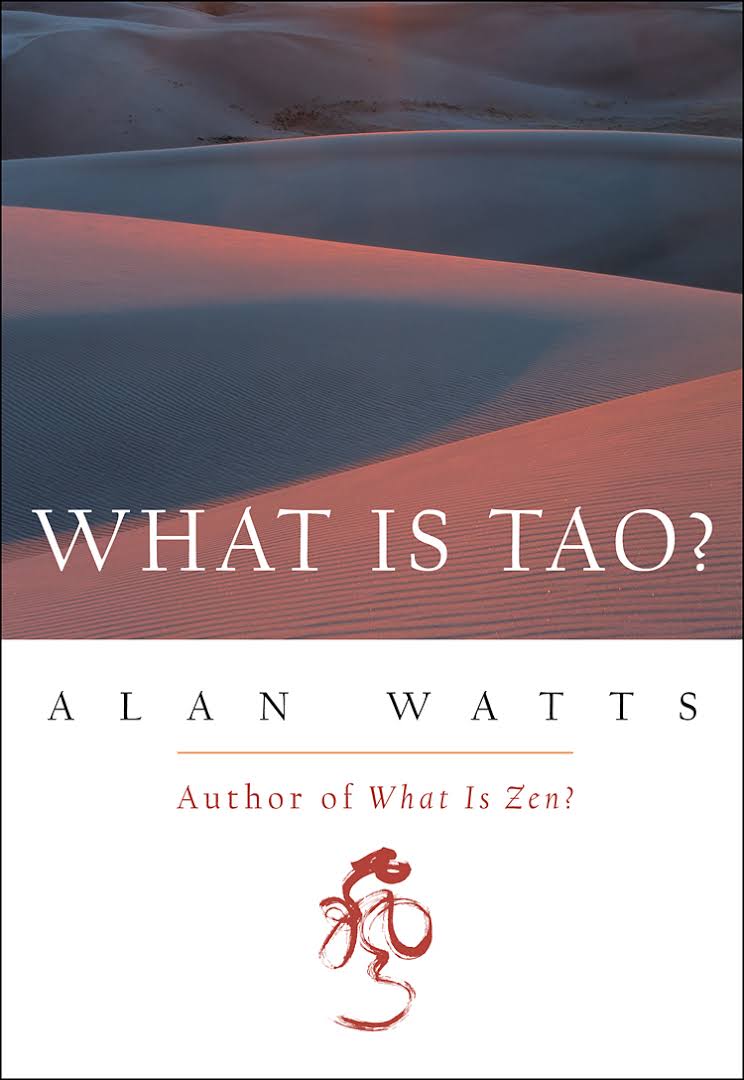
Watts writes this book to fill a void, one left by the lack of wonder in our lives. Even our religions no longer align with the modern human experience:
Instead, Watts seeks to fill us with the spirit of the Tao and the interconnectedness of our experience. He seeks to correct us of the common illusion:
I for one would say he makes a great case. Read The Book and rediscover the wonder of being alive.
Nevertheless, wonder is not a disease. Wonder, and its expression in poetry and the arts, are among the most important things which seem to distinguish men from other animals, and intelligent and sensitive people from morons. –loc 88
The root of the matter is the way in which we feel and conceive ourselves as human beings, our sensation of being alive, of individual existence and identity. We suffer from a hallucination, from a false and distorted sensation of our own existence as living organisms. Most of us have the sensation that “I myself” is a separate center of feeling and action, living inside and bounded by the physical body—a center which “confronts” an “external” world of people and things, making contact through the senses with a universe both alien and strange. Everyday figures of speech reflect this illusion. “I came into this world.” “You must face reality.” “The conquest of nature.” –loc 104
This feeling of being lonely and very temporary visitors in the universe is in flat contradiction to everything known about man (and all other living organisms) in the sciences. We do not “come into” this world; we come out of it, as leaves from a tree. As the ocean “waves,” the universe “peoples.” Every individual is an expression of the whole realm of nature, a unique action of the total universe. This fact is rarely, if ever, experienced by most individuals. Even those who know it to be true in theory do not sense or feel it, but continue to be aware of themselves as isolated “egos” inside bags of skin. –loc 109
The first result of this illusion is that our attitude to the world “outside” us is largely hostile. We are forever “conquering” nature, space, mountains, deserts, bacteria, and insects instead of learning to cooperate with them in a harmonious order. –loc 114
The second result of feeling that we are separate minds in an alien, and mostly stupid, universe is that we have no common sense, no way of making sense of the world upon which we are agreed in common. It’s just my opinion against yours, and therefore the most aggressive and violent (and thus insensitive) propagandist makes the decisions. A muddle of conflicting opinions united by force of propaganda is the worst possible source of control for a powerful technology. –loc 123
Furthermore, as systems of doctrine, symbolism, and behavior, religions harden into institutions that must command loyalty, be defended and kept “pure,” and—because all belief is fervent hope, and thus a cover-up for doubt and uncertainty—religions must make converts. The more people who agree with us, the less nagging insecurity about our position. –loc 131
Irrevocable commitment to any religion is not only intellectual suicide; it is positive unfaith because it closes the mind to any new vision of the world. Faith is, above all, open-ness—an act of trust in the unknown. –loc 136
An ardent Jehovah’s Witness once tried to convince me that if there were a God of love, he would certainly provide mankind with a reliable and infallible textbook for the guidance of conduct. I replied that no considerate God would destroy the human mind by making it so rigid and unadaptable as to depend upon one book, the Bible, for all the answers. For the use of words, and thus of a book, is to point beyond themselves to a world of life and experience that is not mere words or even ideas. Just as money is not real, consumable wealth, books are not life. To idolize scriptures is like eating paper currency. –loc 138
The most strongly enforced of all known taboos is the taboo against knowing who or what you really are behind the mask of your apparently separate, independent, and isolated ego. –loc 148
As is so often the way, what we have suppressed and overlooked is something startlingly obvious. The difficulty is that it is so obvious and basic that one can hardly find the words for it. –loc 153
The sensation of “I” as a lonely and isolated center of being is so powerful and commonsensical, and so fundamental to our modes of speech and thought, to our laws and social institutions, that we cannot experience selfhood except as something superficial in the scheme of the universe. I seem to be a brief light that flashes but once in all the aeons of time—a rare, complicated, and all-too-delicate organism on the fringe of biological evolution, where the wave of life bursts into individual, sparkling, and multicolored drops that gleam for a moment only to vanish forever. Under such conditioning it seems impossible and even absurd to realize that myself does not reside in the drop alone, but in the whole surge of energy which ranges from the galaxies to the nuclear fields in my body. –loc 155
Myth, then, is the form in which I try to answer when children ask me those fundamental metaphysical questions which come so readily to their minds: “Where did the world come from?” “Why did God make the world?” “Where was I before I was born?” “Where do people go when they die?” Again and again I have found that they seem to be satisfied with a simple and very ancient story, –loc 171
The social hierarchies of the past, where some boss above you always punished any error, conditioned men to feel a chain of harsh authority reaching all the way “up there.” We don’t feel this bond in today’s egalitarian freedom. We don’t even have, since Dr. Spock, many Jehovah-like fathers in the human family. So the average unconscious no longer learns to seek forgiveness from a wrathful God above. –loc 213
Our generation knows a cold hell, solitary confinement in this life, without a God to damn or save it. Until man figures out the trap and hunts … “the Ultimate Ground of Being,” he has no reason at all for his existence. Empty, finite, he knows only that he will soon die. Since this life has no meaning, and he sees no future life, he is not really a person but a victim of self-extinction. –loc 217
In the Vedanta philosophy, nothing exists except God. There seem to be other things than God, but only because he is dreaming them up and making them his disguises to play hide-and-seek with himself. The universe of seemingly separate things is therefore real only for a while, not eternally real, for it comes and goes as the Self hides and seeks itself. –loc 239
Genuine love comes from knowledge, not from a sense of duty or guilt. –loc 265
You cannot teach an ego to be anything but egotistic, even though egos have the subtlest ways of pretending to be reformed. –loc 268
The basic thing is therefore to dispel, by experiment and experience, the illusion of oneself as a separate ego. The consequences may not be behavior along the lines of conventional morality. –loc 268
Furthermore, on seeing through the illusion of the ego, it is impossible to think of oneself as better than, or superior to, others for having done so. In every direction there is just the one Self playing its myriad games of hide-and-seek. –loc 271
Birds are not better than the eggs from which they have broken. Indeed, it could be said that a bird is one egg’s way of becoming other eggs. Egg is ego, and bird is the liberated Self. There is a Hindu myth of the Self as a divine swan which laid the egg from which the world was hatched. Thus I am not even saying that you ought to break out of your shell. Sometime, somehow, you (the real you, the Self) will do it anyhow, but it is not impossible that the play of the Self will be to remain unawakened in most of its human disguises, and so bring the drama of life on earth to its close in a vast explosion. –loc 273
Because of this habit of ignoring space-intervals, we do not realize that just a sound is a vibration of sound/silence, the whole universe (that is, existence) is a vibration of solid/space. For solids and spaces go together as inseparably as insides and outsides. Space is the relationship between bodies, and without it there can be neither energy nor motion. –loc 328
The narrow slit in the fence is much like the way in which we look at life by conscious attention, for when we attend to something we ignore everything else. Attention is narrowed perception. It is a way of looking at life bit by bit, using memory to string the bits together—as when examining a dark room with a flashlight having a very narrow beam. Perception thus narrowed has the advantage of being sharp and bright, but it has to focus on one area of the world after another, and one feature after another. And where there are no features, only space or uniform surfaces, it somehow gets bored and searches about for more features. Attention is therefore something like a scanning mechanism in radar or television, and Norbert Wiener and his colleagues found some evidence that there is a similar process in the brain. –loc 372
But a scanning process that observes the world bit by bit soon persuades its user that the world is a great collection of bits, and these he calls separate things or events. We often say that you can only think of one thing at a time. The truth is that in looking at the world bit by bit we convince ourselves that it consists of separate things, and so give ourselves the problem of how these things are connected and how they cause and effect each other. The problem would never have arisen if we had been aware that it was just our way of looking at the world which had chopped it up into separate bits, things, events, causes, and effects. We do not see that the world is all of a piece like the head-tailed cat. –loc 378
We also speak of attention as noticing. To notice is to select, to regard some bits of perception, or some features of the world, as more noteworthy, more significant, than others. To these we attend, and the rest we ignore—for which reason conscious attention is at the same time ignore-ance (i.e., ignorance) despite the fact that it gives us a vividly clear picture of whatever we choose to notice. Physically, we see, hear, smell, taste, and touch innumerable features that we never notice. You can drive thirty miles, talking all the time to a friend. What you noticed, and remembered, was the conversation, but somehow you responded to the road, the other cars, the traffic lights, and heaven knows what else, without really noticing, or focussing your mental spotlight upon them. So too, you can talk to someone at a party without remembering, for immediate recall, what clothes he or she was wearing, because they were not noteworthy or significant to you. Yet certainly your eyes and nerves responded to those clothes. You saw, but did not really look. –loc 383
What governs what we choose to notice? The first (which we shall have to qualify later) is whatever seems advantageous or disadvantageous for our survival, our social status, and the security of our egos. The second, again working simultaneously with the first, is the pattern and the logic of all the notation symbols which we have learned from others, from our society and our culture. –loc 397
It is hard indeed to notice anything for which the languages available to us (whether verbal, mathematical, or musical) have no description. This is why we borrow words from foreign languages. There is no English word for a type of feeling which the Japanese call yugen, and we can only understand by opening our minds to situations in which Japanese people use the word. –loc 399
We must, however, be careful of taking animals as models of “perfectly natural” behavior. If “natural” means “good” or “wise,” human beings can improve on animals, though they do not always do so. –loc 425
(Perpetual leaves are, as we know, made of plastic, and there may come a time when surgeons will be able to replace all our organs with plastic substitutes, so that you will achieve immortality by becoming a plastic model of yourself.) –loc 454
The sole means now for the saving of the beings of the planet Earth would be to implant again into their presences a new organ … of such properties that every one of these unfortunates during the process of existence should constantly sense and be cognizant of the inevitability of his own death as well as the death of everyone upon whom his eyes or attention rests. Only such a sensation and such a cognizance can now destroy the egoism completely crystallized in them. –loc 469
the constant awareness of death shows the world to be as flowing and diaphanous as the filmy patterns of blue smoke in the air—that there really is nothing to clutch and no one to clutch it. This is depressing only so long as there remains a notion that there might be some way of fixing it, of putting it off just once more, or hoping that one has, or is, some kind of ego-soul that will survive bodily dissolution. –loc 474
Suppressing the fear of death makes it all the stronger. The point is only to know, beyond any shadow of doubt, that “I” and all other “things” now present will vanish, until this knowledge compels you to release them—to know it now as surely as if you had just fallen off the rim of the Grand Canyon. –loc 478
Just try taking a stroll after dark in a nice American residential area. If you can penetrate the wire fences along the highways, and then wander along a pleasant lane, you may well be challenged from a police car: “Where are you going?” Aimless strolling is suspicious and irrational. You are probably a vagrant or burglar. You are not even walking the dog! “How much money are you carrying?” Surely, you could have afforded to take the bus and if you have little or no cash, you are clearly a bum and a nuisance. –loc 520
Orderly travel now means going at the maximum speed for safety from point to point, but most reachable points are increasingly cluttered with people and parked cars, and so less worth going to see, and for similar reasons it is ever more inconvenient to do business in the centers of our great cities. Real travel requires a maximum of unscheduled wandering, for there is no other way of discovering surprises and marvels, which, as I see it, is the only good reason for not staying at home. As already suggested, fast intercommunication between points is making all points the same point. –loc 524
Despite the fact that more accidents happen in the home than elsewhere, increasing efficiency of communication and of controlling human behavior can, instead of liberating us into the air like birds, fix us to the ground like toadstools. All information will come in by super-realistic television and other electronic devices as yet in the planning stage or barely imagined. In one way this will enable the individual to extend himself anywhere without moving his body—even to distant regions of space. But this will be a new kind of individual—an individual with a colossal external nervous system reaching out and out into infinity. And this electronic nervous system will be so interconnected that all individuals plugged in will tend to share the same thoughts, the same feelings, and the same experiences. There may be specialized types, just as there are specialized cells and organs in our bodies. For the tendency will be for all individuals to coalesce into a single bio-electronic body. –loc 529
Consider the astonishing means now being made for snooping, the devices already used in offices, factories, stores, and on various lines of communication such as the mail and the telephone. Through the transistor and miniaturization techniques, these devices become ever more invisible and ever more sensitive to faint electrical impulses. The trend of all this is towards the end of individual privacy, to an extent where it may even be impossible to conceal one’s thoughts. At the end of the line, no one is left with a mind of his own: there is just a vast and complex community-mind, endowed, perhaps, with such fantastic powers of control and prediction that it will already know its own future for years and years to come. –loc 536
The science-fiction in which we have just been indulging has, then, two important morals. The first is that if the game of order-versus-chance is to continue as a game, order must not win. As prediction and control increase, so, in proportion, the game ceases to be worth the candle. We look for a new game with an uncertain result. In other words, we have to hide again, perhaps in a new way, and then seek in new ways, since the two together make up the dance and the wonder of existence. Contrariwise, chance must not win, and probably cannot, because the order/chance polarity appears to be of the same kind as the on/off and up/down. –loc 561
In solving problems, technology creates new problems, and we seem, as in Through the Looking-Glass, to have to keep running faster and faster to stay where we are. The question is then whether technical progress actually “gets anywhere” in the sense of increasing the delight and happiness of life. –loc 599
We seem to use “I” for something in the body but not really of the body, for much of what goes on in the body seems to happen to “I” in the same way as external events. “I” is used as the center of voluntary behavior and conscious attention, but not consistently. Breathing is only partially voluntary, and we say “I was sick” or “I dreamed” or “I fell asleep” as if the verbs were not passive but active. –loc 642
This controlling officer “sees” sights, “hears” sounds, “feels” feelings, and “has” experiences. These are common but redundant ways of talking, for seeing a sight is just seeing, hearing a sound is just hearing, feeling a feeling is just feeling, and having an experience is just experiencing. But that these redundant phrases are so commonly used shows that most people think of themselves as separate from their thoughts and experiences. All this can get marvelously complicated when we begin to wonder whether our officer has another officer inside his head, and so ad infinitum! –loc 651
There was a young man who said, “Though It seems that I know that I know, What I would like to see Is the ‘I’ that knows ‘me’ When I know that I know that I know.” –loc 656
However much we divide, count, sort, or classify this wiggling into particular things and events, this is no more than a way of thinking about the world: it is never actually divided. –loc 705
Problems that remain persistently insoluble should always be suspected as questions asked in the wrong way, like the problem of cause and effect. –loc 711
According to the deists, the Lord had made this machine and set it going, but then went to sleep or off on a vacation. But according to the atheists, naturalists, and agnostics, the world was fully automatic. –loc 753
In one form or another, the myth of the Fully Automatic Model has become extremely plausible, and in some scientific and academic disciplines it is as much a sacrosanct dogma as any theological doctrine of the past—despite contrary trends in physics and biology. For there are fashions in myth, and the world-conquering West of the nineteenth century needed a philosophy of life in which realpolitik—victory for the tough people who face the bleak facts—was the guiding principle. Thus the bleaker the facts you face, the tougher you seem to be. So we vied with each other to make the Fully Automatic Model of the universe as bleak as possible. –loc 768
If, then, the definition of a thing or event must include definition of its environment, we realize that any given thing goes with a given environment so intimately and inseparably that it is more difficult to draw a clear boundary between the thing and its surroundings. –loc 809
Thus the soul is not in the body, but the body in the soul, and the soul is the entire network of relationships and processes which make up your environment, and apart from which you are nothing. –loc 815
the individual is separate from his universal environment only in name. When this is not recognized, you have been fooled by your name. Confusing names with nature, you come to believe that having a separate name makes you a separate being. This is—rather literally—to be spellbound. –loc 826
Other people teach us who we are. Their attitudes to us are the mirror in which we learn to see ourselves, but the mirror is distorted. We are, perhaps, rather dimly aware of the immense power of our social environment. We seldom realize, for example, that our most private thoughts and emotions are not actually our own. For we think in terms of languages and images which we did not invent, but which were given to us by our society. We copy emotional reactions from our parents, learning from them that excrement is supposed to have a disgusting smell and that vomiting is supposed to be an unpleasant sensation. The dread of death is also learned from their anxieties about sickness and from their attitudes to funerals and corpses. Our social environment has this power just because we do not exist apart from a society. Society is our extended mind and body. –loc 830
Children are in no position to see the contradictions in these demands, and even if some prodigy were to point them out, he would be told summarily not to “answer back,” and that he lacked respect for his “elders and betters.” Instead of giving our children clear and explicit explanations of the game-rules of the community, we befuddle them hopelessly because we—as adults—were once so befuddled, and, remaining so, do not understand the game we are playing. –loc 864
The social double-bind game can be phrased in several ways: The first rule of this game is that it is not a game. Everyone must play. You must love us. You must go on living. Be yourself, but play a consistent and acceptable role. Control yourself and be natural. Try to be sincere. –loc 870
Life and love generate effort, but effort will not generate them. –loc 878
Faith—in life, in other people, and in oneself—is the attitude of allowing the spontaneous to be spontaneous, in its own way and in its own time. This is, of course, risky because life and other people do not always respond to faith as we might wish. Faith is always a gamble because life itself is a gambling game with what must appear, in the hiding aspect of the game, to be colossal stakes. But to take the gamble out of the game, to try to make winning a dead certainty, is to achieve a certainty which is indeed dead. –loc 879
The Arthashastra does not forget to warn the tyrant that he can never win. He may rise to eminence through ambition or the call of duty, but the more absolute his power, the more he is hated, and the more he is the prisoner of his own trap. The web catches the spider. He cannot wander at leisure in the streets and parks of his own capital, or sit on a lonely beach listening to the waves and watching the gulls. Through enslaving others he himself becomes the most miserable of slaves. –loc 895
We must learn to include ourselves in the round of cooperations and conflicts, of symbiosis and preying, which constitutes the balance of nature, for a permanently victorious species destroys, not only itself, but all other life in its environment. –loc 914
We do not realize that our so-called love and concern for the individual is simply the other face of our own fear of death or rejection. In his exaggerated valuation of separate identity, the personal ego is sawing off the branch on which he is sitting, and then getting more and more anxious about the coming crash! –loc 940
The point, which can hardly be repeated too often, is that differentiation is not separation. The head and the feet are different, but not separate, and though man is not connected to the universe by exactly the same physical relation as branch to tree or feet to head, he is nonetheless connected—and by physical relations of fascinating complexity. –loc 946
Thus bamboozled, the individual—instead of fulfilling his unique function in the world—is exhausted and frustrated in efforts to accomplish self-contradictory goals. Because he is now so largely defined as a separate person caught up in a mindless and alien universe, his principal task is to get one-up on the universe and to conquer nature. This is palpably absurd, and since the task is never achieved, the individual is taught to live and work for some future in which the impossible will at last happen, if not for him, then at least for his children. –loc 954
For unless one is able to live fully in the present, the future is a hoax. There is no point whatever in making plans for a future which you will never be able to enjoy. When your plans mature, you will still be living for some other future beyond. You will never, never be able to sit back with full contentment and say, “Now, I’ve arrived!” Your entire education has deprived you of this capacity because it was preparing you for the future, instead of showing you how to be alive now. –loc 958
Money alone cannot buy pleasure, though it can help. For enjoyment is an art and a skill for which we have little talent or energy. –loc 977
We have untold stacks of recorded music from every age and culture, and the most superb means of playing it. But who actually listens? Maybe a few pot-smokers. –loc 986
we are superb materialists when it comes to the construction of jet aircraft, but when we decorate the inside of these magnificent monsters for the comfort of passengers it is nothing but frippery. High-heeled, narrow-hipped, doll-type girls serving imitation, warmed-over meals. For our pleasures are not material pleasures but symbols of pleasure—attractively packaged but inferior in content. The explanation is simple: most of our products are being made by people who do not enjoy making them, whether as owners or workers. Their aim in the enterprise is not the product but money, and therefore every trick is used to cut the cost of production and hoodwink the buyer, by coloring and packaging chicanery, into the belief that the product is well and truly made. The only exceptions are those products which simply must be excellent for reasons of safety or high cost of purchase—aircraft, computers, space-rockets, scientific instruments, and so forth. –loc 989
when you have made the money what will you buy with it? Other pretentious fakes made by other money-mad manufacturers. The few real luxuries on the market are imports from “backward” countries where peasants and craftsmen still take pride in their work. –loc 997
The poets and sages have, indeed, been saying for centuries that success in this world is vanity. “The worldly hope men set their hearts upon turns ashes,” or, as we might put it in a more up-to-date idiom, just when our mouth was watering for the ultimate goodies, it turns out to be a mixture of plaster-of-paris, papier-mâché, and plastic glue. Comes in any flavor. I have thought of putting this on the market as a universal substance, a prima materia, for making anything and everything—houses, furniture, flowers, bread (they use it already), apples, and even people. –loc 1003
We have now found out that many things which we felt to be basic realities of nature are social fictions, arising from commonly accepted or traditional ways of thinking about the world. These fictions have included: 1. The notion that the world is made up or composed of separate bits or things. 2. That things are differing forms of some basic stuff. 3. That individual organisms are such things, and that they are inhabited and partially controlled by independent egos. 4. That the opposite poles of relationships, such as light/darkness and solid/space, are in actual conflict which may result in the permanent victory of one of the poles. 5. That death is evil, and that life must be a constant war against it. 6. That man, individually and collectively, should aspire to be top species and put himself in control of nature. –loc 1036
Remember that Aristotle’s and Newton’s preoccupation with causal determinism was that they were trying to explain how one thing or event was influenced by others, forgetting that the division of the world into separate things and events was a fiction. To say that certain events are causally connected is only a clumsy way of saying that they are features of the same event, like the head and tail of the cat. –loc 1058
Our practical projects have run into confusion again and again through failure to see that individual people, nations, animals, insects, and plants do not exist in or by themselves. This is not to say only that things exist in relation to one another, but that what we call “things” are no more than glimpses of a unified process. Certainly, this process has distinct features which catch our attention, but we must remember that distinction is not separation. –loc 1063
the movement of any feature of the world cannot be ascribed to the outside alone or to the inside alone. Both move together. –loc 1081
Everything labeled with a noun is demonstrably a process or action, but language is full of spooks, like the “it” in “It is raining,” which are the supposed causes of action. –loc 1128
As the Chinese say, the various features of a situation “arise mutually” or imply one another as back implies front, and as chickens imply eggs—and vice versa. They exist in relation to each other like the poles of the magnet, only more complexly patterned. –loc 1139
We can never, never describe all features of the total situation, not only because every situation is infinitely complex, but also because the total situation is the universe. –loc 1152
Fortunately, we do not have to describe any situation exhaustively, because some of its features appear to be much more important than others for understanding the behavior of the various organisms within it. We never get more than a sketch of the situation, yet this is enough to show that actions (or processes) must be understood, or explained, in terms of situations just as words must be understood in the context of sentences, paragraphs, chapters, books, libraries, and … life itself. –loc 1154
To sum up: just as no thing or organism exists on its own, it does not act on its own. Furthermore, every organism is a process: thus the organism is not other than its actions. To put it clumsily: it is what it does. More precisely, the organism, including its behavior, is a process which is to be understood only in relation to the larger and longer process of its environment. For what we mean by “understanding” or “comprehension” is seeing how parts fit into a whole, and then realizing that they don’t compose the whole, as one assembles a jigsaw puzzle, but that the whole is a pattern, a complex wiggliness, which has no separate parts. Parts are fictions of language, of the calculus of looking at the world through a net which seems to chop it up into bits. Parts exist only for purposes of figuring and describing, and as we figure the world out we become confused if we do not remember this all the time. –loc 1157
It is easy enough to see that an intelligent human being implies an intelligent human society, for thinking is a social activity—a mutual interchange of messages and ideas based on such social institutions as languages, sciences, libraries, universities, and museums. But what about the non-human environment in which human society flourishes? –loc 1167
Somehow the first set of conditions seems to preserve the reality of the rainbow apart from an observer. But the second set, by eliminating a good, solid “external reality,” seems to make it an indisputable fact that, under such conditions, there is no rainbow. The reason is only that it supports our current mythology to assert that things exist on their own, whether there is an observer or not. It supports the fantasy that man is not really involved in the world, that he makes no real difference to it, and that he can observe reality independently without changing it. –loc 1223
Is it possible that all geological and astronomical history is a mere extrapolation—that it is talking about what would have happened if it had been observed? Perhaps. But I will venture a more cautious idea. The fact that every organism evokes its own environment must be corrected with the polar or opposite fact that the total environment evokes the organism. Furthermore, the total environment (or situation) is both spatial and temporal—both larger and longer than the organisms contained in its field. The organism evokes knowledge of a past before it began, and of a future beyond its death. At the other pole, the universe would not have started, or manifested itself, unless it was at some time going to include organisms—just as current will not begin to flow from the positive end of a wire until the negative terminal is secure. –loc 1240
In the same measure, we have lacked the proper self-respect of recognizing that I, the individual organism, am a structure of such fabulous ingenuity that it calls the whole universe into being. In the act of putting everything at a distance so as to describe and control it, we have orphaned ourselves both from the surrounding world and from our own bodies—leaving “I” as a discontented and alienated spook, anxious, guilty, unrelated, and alone. –loc 1252
Erwin Schrödinger: It is not possible that this unity of knowledge, feeling and choice which you call your own should have sprung into being from nothingness at a given moment not so long ago; rather this knowledge, feeling and choice are essentially eternal and unchangeable and numerically one in all men, nay in all sensitive beings. But not in this sense—that you are a part, a piece, of an eternal, infinite being, an aspect or modification of it, as in Spinoza’s pantheism. For we should have the same baffling question: which part, which aspect are you? What, objectively, differentiates it from the others? No, but inconceivable as it seems to ordinary reason, you—and all other conscious beings as such—are all in all. Hence this life of yours which you are living is not merely a piece of the entire existence, but is in a certain sense the whole; only this whole is not so constituted that it can be surveyed in one single glance. –loc 1275
Schrödinger goes on to suggest: Thus you can throw yourself flat on the ground, stretched out upon Mother Earth, with the certain conviction that you are one with her and she with you. You are as firmly established, as invulnerable as she, indeed a thousand times firmer and more invulnerable. As surely as she will engulf you tomorrow, so surely will she bring you forth anew to new striving and suffering. And not merely ‘some day’: now, today, every day she is bringing you forth, not once but thousands upon thousands of times, just as every day she engulfs you a thousand times over. For eternally and always there is only now, one and the same now; the present is the only thing that has no end.4 1For this illustration I am indebted to Owen Barfield, Saving the Appearances. –loc 1285
For if you know what you want, and will be content with it, you can be trusted. But if you do not know, your desires are limitless and no one can tell how to deal with you. Nothing satisfies an individual incapable of enjoyment. –loc 1324
But peace can be made only by those who are peaceful, and love can be shown only by those who love. No work of love will flourish out of guilt, fear, or hollowness of heart, just as no valid plans for the future can be made by those who have no capacity for living now. –loc 1339
The separate person is without content, in both senses of the word. He lives perpetually on hope, on looking forward to tomorrow, having been brought up this way from childhood, when his uncomprehending rage at double-binds was propitiated with toys. –loc 1341
The reason is not just that we are too much in a hurry and have no sense of the present; not just that we cannot afford the type of labor that such things would now involve, nor just that we prefer money to materials. The reason is that we have scrubbed the world clean of magic. We have lost even the vision of paradise, so that our artists and craftsmen can no longer discern its forms. This is the price that must be paid for attempting to control the world from the standpoint of an “I” for whom everything that can be experienced is a foreign object and a nothing-but. –loc 1371
If, then, after understanding, at least in theory, that the ego-trick is a hoax and that, beneath everything, “I” and “universe” are one, you ask, “So what? What is the next step, the practical application?”—I will answer that the absolutely vital thing is to consolidate your understanding, to become capable of enjoyment, of living in the present, and of the discipline which this involves. Without this you have nothing to give—to the cause of peace or of racial integration, to starving Hindus and Chinese, or even to your closest friends. Without this, all social concern will be muddlesome meddling, and all work for the future will be planned disaster. –loc 1377
But as I pursue these games—as I become more conscious of being conscious, more aware that I am unable to define myself as being up without you (or something other than myself) being down—I see vividly that I depend on your being down for my being up. I would never be able to know that I belong to the in-group of “nice” or “saved” people without the assistance of an out-group of “nasty” or “damned” people. –loc 1398
How can any in-group maintain its collective ego without relishing dinner-table discussions about the ghastly conduct of outsiders? –loc 1402
All winners need losers; all saints need sinners; all sages need fools—that is, so long as the major kick in life is to “amount to something” or to “be someone” as a particular and separate godlet. –loc 1407
There it is, a theoretically undeniable fact. But the question is how to get over the sensation of being locked out from everything “other,” of being only oneself—an organism flung into unavoidable competition and conflict with almost every “object” in its experience. There are innumerable recipes for this project, almost all of which have something to recommend them. There are the practices of yoga meditation, dervish dancing, psychotherapy, Zen Buddhism, Ignatian, Salesian, and Hesychast methods of “prayer,” the use of consciousness-changing chemicals such as LSD and mescaline, psychodrama, group dynamics, sensory-awareness techniques, Quakerism, Gurdjieff exercises, relaxation therapies, the Alexander method, autogenic training, and self-hypnosis. The difficulty with every one of these disciplines is that the moment you are seriously involved, you find yourself boxed in some special in-group which defines itself, often with the most elegant subtlety, by the exclusion of an out-group. –loc 1413
In the same way, the more resolutely you plumb the question “Who or what am I?”—the more unavoidable is the realization that you are nothing at all apart from everything else. Yet again, the more you strive for some kind of perfection or mastery—in morals, in art, or in spirituality—the more you see that you are playing a rarified and lofty form of the old ego-game, and that your attainment of any height is apparent to yourself and to others only by contrast with someone else’s depth or failure. –loc 1434
Don’t try to get rid of the ego-sensation. Take it, so long as it lasts, as a feature or play of the total process—like a cloud or wave, or like feeling warm or cold, or anything else that happens of itself. Getting rid of one’s ego is the last resort of invincible egoism! It simply confirms and strengthens the reality of the feeling. But when this feeling of separateness is approached and accepted like any other sensation, it evaporates like the mirage that it is. –loc 1455
This is why I am not overly enthusiastic about the various “spiritual exercises” in meditation or yoga which some consider essential for release from the ego. For when practiced in order to “get” some kind of spiritual illumination or awakening, they strengthen the fallacy that the ego can toss itself away by a tug at its own bootstraps. But there is nothing wrong with meditating just to meditate, in the same way that you listen to music just for the music. If you go to concerts to “get culture” or to improve your mind, you will sit there as deaf as a doorpost. –loc 1459
Understanding this, you will see that the ego is exactly what it pretends it isn’t. Far from being the free center of personality, it is an automatic mechanism implanted since childhood by social authority, with—perhaps—a touch of heredity thrown in. This may give you the temporary feeling of being a zombie or a puppet dancing irresponsibly on strings that lead away to unknown forces. At this point, the ego may reassert itself with the insidious “I-can’t-help-myself” play in which the ego splits itself in two and pretends that it is its own victim. “See, I’m only a bundle of conditioned reflexes, so you mustn’t get angry with me for acting just as I feel.” (To which the answer could be, “Well, we’re just zombies too, so you shouldn’t complain if we get angry.”) –loc 1468
What happens is neither automatic nor arbitrary: it just happens, and all happenings are mutually interdependent in a way that seems unbelievably harmonious. Every this goes with every that. Without others there is no self, and without somewhere else there is no here, so that—in this sense—self is other and here is there. –loc 1489
Yet you soon discover that you are able to go ahead with ordinary activities—to work and make decisions as ever, though somehow this is less of a drag. Your body is no longer a corpse which the ego has to animate and lug around. There is a feeling of the ground holding you up, and of hills lifting you when you climb them. Air breathes itself in and out of your lungs, and instead of looking and listening, light and sound come to you on their own. Eyes see and ears hear as wind blows and water flows. All space becomes your mind. Time carries you along like a river, but never flows out of the present: the more it goes, the more it stays, and you no longer have to fight or kill it. –loc 1497
A Chinese philosophical work called The Secret of the Golden Flower says that “when purpose has been used to achieve purposelessness, the thing has been grasped.” –loc 1512
To play so as to be relaxed and refreshed for work is not to play, and no work is well and finely done unless it, too, is a form of play. –loc 1516
The point is that “spectacle is so fascinating.” For the world is a spell (in Latin, fascinum), an enchantment (being thrilled by a chant), an amazement (being lost in a maze), an arabesque of such stunning rhythm and a plot so intriguing that we are drawn by its web into a state of involvement where we forget that it is a game. –loc 1552
The only real “you” is the one that comes and goes, manifests and withdraws itself eternally in and as every conscious being. For “you” is the universe looking at itself from billions of points of view, points that come and go so that the vision is forever new. What we see as death, empty space, or nothingness is only the trough between the crests of this endlessly waving ocean. It is all part of the illusion that there should seem to be something to be gained in the future, and that there is an urgent necessity to go on and on until we get it. Yet just as there is no time but the present, and no one except the all-and-everything, there is never anything to be gained—though the zest of the game is to pretend that there is. –loc 1568
And do not suppose that this understanding will transform you all at once into a model of virtue. I have never yet met a saint or sage who did not have some human frailties. For so long as you manifest yourself in human or animal form, you must eat at the expense of other life and accept the limitations of your particular organism, which fire will still burn and wherein danger will still secrete adrenalin. –loc 1580
The morality that goes with this understanding is, above all, the frank recognition of your dependence upon enemies, underlings, out-groups, and, indeed, upon all other forms of life whatsoever. Involved as you may be in the conflicts and competitive games of practical life, you will never again be able to indulge in the illusion that the “offensive other” is all in the wrong, and could or should be wiped out. This will give you the priceless ability of being able to contain conflicts so that they do not get out-of-hand, of being willing to compromise and adapt, of playing, yes, but playing it cool. –loc 1582
If we want justice for minorities and cooled wars with our natural enemies, whether human or nonhuman, we must first come to terms with the minority and the enemy in ourselves and in our own hearts, for the rascal is there as much as anywhere in the “external” world—especially when you realize that the world outside your skin is as much yourself as the world inside. –loc 1604
If this is cynicism, it is at least loving cynicism—an attitude and an atmosphere that cools off human conflicts more effectively than any amount of physical or moral violence. For it recognizes that the real goodness of human nature is its peculiar balance of love and selfishness, reason and passion, spirituality and sensuality, mysticism and materialism, in which the positive pole has always a slight edge over the negative. –loc 1617
It comes, then, to this: that to be “viable,” livable, or merely practical, life must be lived as a game—and the “must” here expresses a condition, not a commandment. It must be lived in the spirit of play rather than work, and the conflicts which it involves must be carried on in the realization that no species, or party to a game, can survive without its natural antagonists, its beloved enemies, its indispensable opponents. –loc 1624
Finally, the game of life as Western man has been “playing” it for the past century needs less emphasis on practicality, results, progress, and aggression. –loc 1645
Whatever may be true for the Chinese and the Hindus, it is timely for us to recognize that the future is an ever-retreating mirage, and to switch our immense energy and technical skill to contemplation instead of action. However much we may now disagree with Aristotle’s logic and his metaphors, he must still be respected for reminding us that the goal of action is always contemplation—knowing and being rather than seeking and becoming. –loc 1647
The people we are tempted to call clods and boors are just those who seem to find nothing fascinating in being human; their humanity is incomplete, for it has never astonished them. There is also something incomplete about those who find nothing fascinating in being. –loc 1674
Frankly, the image of God the Father has become ridiculous—that is, unless you read Saint Thomas Aquinas or Martin Buber or Paul Tillich, and realize that you can be a devout Jew or Christian without having to believe, literally, in the Cosmic Male Parent. –loc 1813
In the words of a Chinese Zen master, “Nothing is left to you at this moment but to have a good laugh!” –loc 1858
Thus we do not trust the universe to repeat what it has already done—to “I” itself again and again. We see it as an eternal arena in which the individual is no more than a temporary stranger—a visitor who hardly belongs—for the thin ray of consciousness does not shine upon its own source. In looking out upon the world, we forget that the world is looking at itself—through our eyes and IT’s. –loc 1893