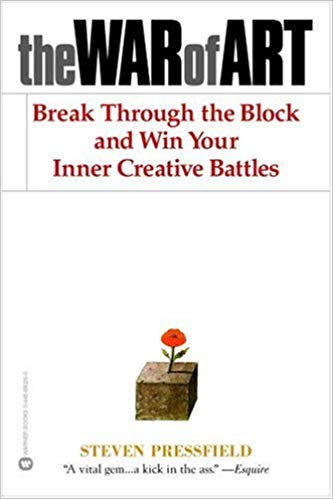
The War of Art

Author: Steven Pressfield
Recommended for: Anyone working on a creative or entrepreneurial endeavor
Read: November 2014, October 2019

Quick Summary:

The War of Art is an essential book for anyone working on a creative or entrepreneurial endeavor. In The War of Art, Steven Pressfield identifies the force that opposes our creative efforts as Resistance. Pressfield points out the different forms that Resistance takes and methods that it uses to undermine us every step of the way. Pressfield also provides strategies for overcoming Resistance, primarily by focusing on mastering our craft and showing up every single day.

If you enjoyed The War of Art, you can follow the book with Do the Work, a short follow-up read that focuses on overcoming and defeating Resistance.

There’s a secret that real writers know that wannabe writers don’t, and the secret is this: It’s not the writing part that’s hard. What’s hard is sitting down to write. What keeps us from sitting down is Resistance. 

What does it tell us about the architecture of our psyches that, without our exerting effort or even thinking about it, some voice in our head pipes up to counsel us (and counsel us wisely) on how to do our work and live our lives? Whose voice is it? What software is grinding away, scanning gigabytes, while we, our mainstream selves, are otherwise occupied? 

Key Lessons:

  • That feeling that I feel inside – the one that attempts to block me at every turn – that is real, and not something I made up. All creative individuals must wrestle with it.
  • We can defeat Resistance by simply dedicating ourselves to our work at the same time every day. Treat your work professionally. Show up, no matter what.

My Highlights

Italicized sub-bullet comments are mine.

  • When inspiration touches talent, she gives birth to truth and beauty. 
  • How many pages have I produced? I don’t care. Are they any good? I don’t even think about it. All that matters is I’ve put in my time and hit it with all I’ve got. 
    • Eventually, once you’ve put in enough time, you’ll come up with something good!
  • There’s a secret that real writers know that wannabe writers don’t, and the secret is this: It’s not the writing part that’s hard. What’s hard is sitting down to write. What keeps us from sitting down is Resistance. 
  • Most of us have two lives. The life we live, and the unlived life within us. Between the two stands Resistance. 
  • One night I was layin’ down, I heard Papa talkin’ to Mama. I heard Papa say, to let that boy boogie-woogie. ‘Cause it’s in him and it’s got to come out. — John Lee Hooker, “Boogie Chillen”
  • How many of us have become drunks and drug addicts, developed tumors and neuroses, succumbed to painkillers, gossip, and compulsive cell-phone use, simply because we don’t do that thing that our hearts, our inner genius, is calling us to? Resistance defeats us. 
  • The enemy is a very good teacher. — the Dalai Lama 
  • Resistance is not a peripheral opponent. Resistance arises from within. It is self-generated and self-perpetuated. Resistance is the enemy within. 
  • Rule of thumb: The more important a call or action is to our soul’s evolution, the more Resistance we will feel toward pursuing it. 
  • We’re wrong if we think we’re the only ones struggling with Resistance. Everyone who has a body experiences Resistance. 
  • The warrior and the artist live by the same code of necessity, which dictates that the battle must be fought anew every day. 
  • Resistance has no strength of its own. Every ounce of juice it possesses comes from us. We feed it with power by our fear of it. Master that fear and we conquer Resistance. 
  • RESISTANCE IS MOST POWERFUL AT THE FINISH LINE 
  • Odysseus almost got home years before his actual homecoming. Ithaca was in sight, close enough that the sailors could see the smoke of their families’ fires on shore. Odysseus was so certain he was safe, he actually lay down for a snooze. It was then that his men, believing there was gold in an ox-hide sack among their commander’s possessions, snatched this prize and cut it open. The bag contained the adverse Winds, which King Aeolus had bottled up for Odysseus when the wanderer had touched earlier at his blessed isle. The winds burst forth now in one mad blow, driving Odysseus’ ships back across every league of ocean they had with such difficulty traversed, making him endure further trials and sufferings before, at last and alone, he reached home for good. 
  • The danger is greatest when the finish line is in sight. At this point, Resistance knows we’re about to beat it. It hits the panic button. It marshals one last assault and slams us with everything it’s got. 
  • The professional must be alert for this counterattack. Be wary at the end. Don’t open that bag of wind. 
  • The reason is that they are struggling, consciously or unconsciously, against their own Resistance. The awakening writer’s success becomes a reproach to them. If she can beat these demons, why can’t they? 
  • Often couples or close friends, even entire families, will enter into tacit compacts whereby each individual pledges (unconsciously) to remain mired in the same slough in which she and all her cronies have become so comfortable. 
  • The highest treason a crab can commit is to make a leap for the rim of the bucket. 
  • The awakening artist must be ruthless, not only with herself but with others. Once you make your break, you can’t turn around for your buddy who catches his trouser leg on the barbed wire. The best thing you can do for that friend (and he’d tell you this himself, if he really is your friend) is to get over the wall and keep motating. 
  • The best and only thing that one artist can do for another is to serve as an example and an inspiration. 
  • The most pernicious aspect of procrastination is that it can become a habit. We don’t just put off our lives today; we put them off till our deathbed. 
  • Never forget: This very moment, we can change our lives. There never was a moment, and never will be, when we are without the power to alter our destiny. This second, we can turn the tables on Resistance. 
  • We get ourselves in trouble because it’s a cheap way to get attention. Trouble is a faux form of fame. It’s easier to get busted in the bedroom with the faculty chairman’s wife than it is to finish that dissertation on the metaphysics of motley in the novellas of Joseph Conrad. 
  • Ill health is a form of trouble, as are alcoholism and drug addiction, proneness to accidents, all neurosis including compulsive screwing-up, and such seemingly benign foibles as jealousy, chronic lateness, and the blasting of rap music at 110 dB from your smoked-glass ’95 Supra. Anything that draws attention to ourselves through pain-free or artificial means is a manifestation of Resistance. 
    • I have certainly been guilty here. For years at a time.
  • The working artist will not tolerate trouble in her life because she knows trouble prevents her from doing her work. The working artist banishes from her world all sources of trouble. She harnesses the urge for trouble and transforms it in her work. 
    • And this is my cure
  • When we drug ourselves to blot out our soul’s call, we are being good Americans and exemplary consumers. We’re doing exactly what TV commercials and pop materialist culture have been brainwashing us to do from birth. Instead of applying self-knowledge, self-discipline, delayed gratification and hard work, we simply consume a product. 
  • What finally convinced me to go ahead was simply that I was so unhappy not going ahead. I was developing symptoms. As soon as I sat down and began, I was okay. 
  • John Lennon once wrote: Well, you think you’re so clever and classless and free / But you’re all fucking peasants / As far as I can see 
  • We unplug ourselves from the grid by recognizing that we will never cure our restlessness by contributing our disposable income to the bottom line of Bullshit, Inc., but only by doing our work. 
  • We’re wired tribally, to act as part of a group. Our psyches are programmed by millions of years of hunter-gatherer evolution. We know what the clan is; we know how to fit into the band and the tribe. What we don’t know is how to be alone. We don’t know how to be free individuals. 
  • The artist and the fundamentalist arise from societies at differing stages of development. The artist is the advanced model. His culture possesses affluence, stability, enough excess of resource to permit the luxury of self-examination. The artist is grounded in freedom. He is not afraid of it. He is lucky. He was born in the right place. He has a core of self- confidence, of hope for the future. He believes in progress and evolution. His faith is that humankind is advancing, however haltingly and imperfectly, toward a better world. 
  • Fundamentalism is the philosophy of the powerless, the conquered, the displaced and the dispossessed. Its spawning ground is the wreckage of political and military defeat, as Hebrew fundamentalism arose during the Babylonian captivity, as white Christian fundamentalism appeared in the American South during Reconstruction, as the notion of the Master Race evolved in Germany following World War I. In such desperate times, the vanquished race would perish without a doctrine that restored hope and pride. 
  • The humanist believes that humankind, as individuals, is called upon to co-create the world with God. This is why he values human life so highly. In his view, things do progress, life does evolve; each individual has value, at least potentially, in advancing this cause. 
  • The paradox seems to be, as Socrates demonstrated long ago, that the truly free individual is free only to the extent of his own self-mastery. While those who will not govern themselves are condemned to find masters to govern over them. 
  • If you find yourself criticizing other people, you’re probably doing it out of Resistance. When we see others beginning to live their authentic selves, it drives us crazy if we have not lived out our own. 
  • Individuals who are realized in their own lives almost never criticize others. If they speak at all, it is to offer encouragement. 
  • Remember our rule of thumb: The more scared we are of a work or calling, the more sure we can be that we have to do it. 
  • The professional tackles the project that will make him stretch. He takes on the assignment that will bear him into uncharted waters, compel him to explore unconscious parts of himself. 
  • (Conversely, the professional turns down roles that he’s done before. He’s not afraid of them anymore. Why waste his time?) 
  • If you didn’t love the project that is terrifying you, you wouldn’t feel anything. 
  • Grandiose fantasies are a symptom of Resistance. They’re the sign of an amateur. The professional has learned that success, like happiness, comes as a by-product of work. 
  • The professional concentrates on the work and allows rewards to come or not come, whatever they like. 
  • What are we trying to heal, anyway? The athlete knows the day will never come when he wakes up pain-free. He has to play hurt. 
  • Have you ever been to a workshop? These boondoggles are colleges of Resistance. They ought to give out Ph.D.’s in Resistance. What better way of avoiding work than going to a workshop? But what I hate even worse is the word support. 
    • Pressfield’s view certainly makes me feel less guilty about holding this view as well!
  • It is one thing to study war and another to live the warrior’s life. — Telamon of Arcadia, mercenary of the fifth century B.C. 
  • Someone once asked Somerset Maugham if he wrote on a schedule or only when struck by inspiration. “I write only when inspiration strikes,” he replied. “Fortunately it strikes every morning at nine o’clock sharp.” That’s a pro. 
  • I’m keenly aware of the Principle of Priority, which states (a) you must know the difference between what is urgent and what is important, and (b) you must do what’s important first. 
  • The artist committing himself to his calling has volunteered for hell, whether he knows it or not. He will be dining for the duration on a diet of isolation, rejection, self-doubt, despair, ridicule, contempt, and humiliation. 
  • Remember, the Muse favors working stiffs. She hates prima donnas. To the gods the supreme sin is not rape or murder, but pride. To think of yourself as a mercenary, a gun for hire, implants the proper humility. It purges pride and preciousness. 
  • Resistance loves pride and preciousness. Resistance says, “Show me a writer who’s too good to take Job X or Assignment Y and I’ll show you a guy I can crack like a walnut.”
  • The professional arms himself with patience, not only to give the stars time to align in his career, but to keep himself from flaming out in each individual work. He knows that any job, whether it’s a novel or a kitchen remodel, takes twice as long as he thinks and costs twice as much. He accepts that. He recognizes it as reality. 
  • A pro views her work as craft, not art. Not because she believes art is devoid of a mystical dimension. On the contrary. She understands that all creative endeavor is holy, but she doesn’t dwell on it. She knows if she thinks about that too much, it will paralyze her. So she concentrates on technique. The professional masters how, and leaves what and why to the gods. Like Somerset Maugham she doesn’t wait for inspiration, she acts in anticipation of its apparition. The professional is acutely aware of the intangibles that go into inspiration. Out of respect for them, she lets them work. She grants them their sphere while she concentrates on hers. 
  • The professional shuts up. She doesn’t talk about it. She does her work. 
  • The amateur believes he must first overcome his fear; then he can do his work. The professional knows that fear can never be overcome. He knows there is no such thing as a fearless warrior or a dread-free artist. 
  • The professional conducts his business in the real world. Adversity, injustice, bad hops and rotten calls, even good breaks and lucky bounces all comprise the ground over which the campaign must be waged. The field is level, the professional understands, only in heaven. 
  • A PROFESSIONAL DEDICATES HIMSELF TO MASTERING TECHNIQUE 
  • The professional respects his craft. He does not consider himself superior to it. He recognizes the contributions of those who have gone before him. He apprentices himself to them. 
  • The professional dedicates himself to mastering technique not because he believes technique is a substitute for inspiration but because he wants to be in possession of the full arsenal of skills when inspiration does come. The professional is sly. He knows that by toiling beside the front door of technique, he leaves room for genius to enter by the back. 
  • A PROFESSIONAL DOES NOT HESITATE TO ASK FOR HELP 
  • Tiger Woods is the consummate professional. It would never occur to him, as it would to an amateur, that he knows everything, or can figure everything out on his own. On the contrary, he seeks out the most knowledgeable teacher and listens with both ears. The student of the game knows that the levels of revelation that can unfold in golf, as in any art, are inexhaustible. 
  • The professional cannot take rejection personally because to do so reinforces Resistance. Editors are not the enemy; critics are not the enemy. Resistance is the enemy. The battle is inside our own heads. We cannot let external criticism, even if it’s true, fortify our internal foe. That foe is strong enough already. 
  • A professional schools herself to stand apart from her performance, even as she gives herself to it heart and soul. The Bhagavad-Gita tells us we have a right only to our labor, not to the fruits of our labor. All the warrior can give is his life; all the athlete can do is leave everything on the field. 
  • The professional loves her work. She is invested in it wholeheartedly. But she does not forget that the work is not her. Her artistic self contains many works and many performances. Already the next is percolating inside her. The next will be better, and the one after that better still. 
  • The professional cannot let himself take humiliation personally. Humiliation, like rejection and criticism, is the external reflection of internal Resistance. 
  • First, he didn’t react reflexively. He didn’t allow an act that by all rights should have provoked an automatic response of rage to actually produce that rage. He controlled his reaction. He governed his emotion. 
  • What he did do was maintain his sovereignty over the moment. He understood that, no matter what blow had befallen him from an outside agency, he himself still had his job to do, the shot he needed to hit right here, right now. And he knew that it remained within his power to produce that shot. Nothing stood in his way except whatever emotional upset he himself chose to hold on to. Tiger’s mother, Kultida, is a Buddhist. Perhaps from her he had learned compassion, to let go of fury at the heedlessness of an overzealous shutter- clicker. In any event Tiger Woods, the ultimate professional, vented his anger quickly with a look, then recomposed himself and returned to the task at hand. 
  • The professional cannot allow the actions of others to define his reality. 
  • Tomorrow morning the critic will be gone, but the writer will still be there facing the blank page. Nothing matters but that he keep working. 
  • Tomorrow morning the critic will be gone, but the writer will still be there facing the blank page. Nothing matters but that he keep working. Short of a family crisis or the outbreak of World War III, the professional shows up, ready to serve the gods. 
  • Remember, Resistance wants us to cede sovereignty to others. It wants us to stake our self-worth, our identity, our reason-for-being, on the response of others to our work. Resistance knows we can’t take this. No one can. 
  • The professional learns to recognize envy-driven criticism and to take it for what it is: the supreme compliment. The critic hates most that which he would have done himself if he had had the guts. 
  • A PROFESSIONAL RECOGNIZES HER LIMITATIONS She gets an agent, she gets a lawyer, she gets an accountant. She knows she can only be a professional at one thing. She brings in other pros and treats them with respect. 
  • A PROFESSIONAL REINVENTS HIMSELF 
  • The professional does not permit himself to become hidebound within one incarnation, however comfortable or successful. Like a transmigrating soul, he shucks his outworn body and dons a new one. He continues his journey. 
  • Making yourself a corporation (or just thinking of yourself in that way) reinforces the idea of professionalism because it separates the artist-doing-the-work from the will-and- consciousness-running-the-show. No matter how much abuse is heaped on the head of the former, the latter takes it in stride and keeps on trucking. Conversely with success: You-the-writer may get a swelled head, but you-the-boss remember how to take yourself down a peg. 
  • Have you ever worked in an office? Then you know about Monday morning status meetings. The group assembles in the conference room and the boss goes over what assignments each team member is responsible for in the coming week. When the meeting breaks up, an assistant prepares a work sheet and distributes it. When this hits your desk an hour later, you know exactly what you have to do that week. I have one of those meetings with myself every Monday. I sit down and go over my assignments. Then I type it up and distribute it to myself. I have corporate stationery and corporate business cards and a corporate checkbook. I write off corporate expenses and pay corporate taxes. I have different credit cards for myself and my corporation. 
  • If we think of ourselves as a corporation, it gives us a healthy distance on ourselves. We’re less subjective. We don’t take blows as personally. We’re more cold-blooded; we can price our wares more realistically. Sometimes, as Joe Blow himself, I’m too mild-mannered to go out and sell. But as Joe Blow, Inc., I can pimp the hell out of myself. I’m not me anymore. I’m Me, Inc. 
  • The first duty is to sacrifice to the gods and pray them to grant you the thoughts, words, and deeds likely to render your command most pleasing to the gods and to bring yourself, your friends, and your city the fullest measure of affection and glory and advantage. –Xenophon, The Cavalry Commander 
  • If it does, you have my permission to think of angels in the abstract. Consider these forces as being impersonal as gravity. Maybe they are. It’s not hard to believe, is it, that a force exists in every grain and seed to make it grow? Or that in every kitten or colt is an instinct that impels it to run and play and learn. 
  • Here’s Socrates, in Plato’s Phaedrus, on the “noble effect of heaven-sent madness”: The third type of possession and madness is possession by the Muses. When this seizes upon a gentle and virgin soul it rouses it to inspired expression in lyric and other sorts of poetry, and glorifies countless deeds of the heroes of old for the instruction of posterity. But if a man comes to the door of poetry untouched by the madness of the Muses, believing that technique alone will make him a good poet, he and his sane compositions never reach perfection, but are utterly eclipsed by the performances of the inspired madman. 
  • Our ancestors were keenly cognizant of forces and energies whose seat was not in this material sphere but in a loftier, more mysterious one. What did they believe about this higher reality? First, they believed that death did not exist there. The gods are immortal. The gods, though not unlike humans, are infinitely more powerful. To defy their will is futile. To act toward heaven with pride is to call down calamity. Time and space display an altered existence in this higher dimension. The gods travel “swift as thought.” They can tell the future, some of them, and though the playwright Agathon tells us, This alone is denied to God: the power to undo the past yet the immortals can play tricks with time, as we ourselves may sometimes, in dreams or visions. The universe, the Greeks believed, was not indifferent. The gods take an interest in human affairs, and intercede for good or ill in our designs. The contemporary view is that all this is charming but preposterous. Is it? Then answer this. Where did Hamlet come from? Where did the Parthenon come from? Where did Nude Descending a Staircase come from? 
  • I’ll take Xenophon at his word; before I sit down to work, I’ll take a minute and show respect to this unseen Power who can make or break me. 
  • Artists have invoked the Muse since time immemorial. There is great wisdom to this. There is magic to effacing our human arrogance and humbly entreating help from a source we cannot see, hear, touch, or smell. 
    • A good habit to build
  • Sustain for me. Homer doesn’t ask for brilliance or success. He just wants to keep this thing going. This song. That about covers it. From The Brothers Karamazov to your new venture in the plumbing-supply business. 
  • I admire particularly the warning against the second crime, to destroy for meat the oxen of the most exalted Sun. That’s the felony that calls down soul-destruction: the employment of the sacred for profane means. Prostitution. Selling out. 
  • Concerning all acts of initiative (and creation) there is one elementary truth, the ignorance of which kills countless ideas and splendid plans: that the moment one definitely commits oneself, then providence moves too. All sorts of things occur to help one that would not otherwise have occurred. A whole stream of events issues from the decision, raising in one’s favour all manner of unforeseen incidents and meetings and material assistance which no man would have dreamed would come his way. I have learned a deep respect for one of Goethe’s couplets: “Whatever you can do, or dream you can, begin it. Boldness has genius, magic, and power in it. Begin it now.” — W. H. Murray, The Scottish Himalayan Expedition 
  • When I finish a day’s work, I head up into the hills for a hike. I take a pocket tape recorder because I know that as my surface mind empties with the walk, another part of me will chime in and start talking. 
  • What does it tell us about the architecture of our psyches that, without our exerting effort or even thinking about it, some voice in our head pipes up to counsel us (and counsel us wisely) on how to do our work and live our lives? Whose voice is it? What software is grinding away, scanning gigabytes, while we, our mainstream selves, are otherwise occupied? 
  • The principle of organization is built into nature. Chaos itself is self-organizing. Out of primordial disorder, stars find their orbits; rivers make their way to the sea. 
  • How do we experience this? By having ideas. Insights pop into our heads while we’re shaving or taking a shower or even, amazingly, while we’re actually working. The elves behind this are smart. If we forget something, they remind us. If we veer off-course, they trim the tabs and steer us back. 
  • What can we conclude from this? Clearly some intelligence is at work, independent of our conscious mind and yet in alliance with it, processing our material for us and alongside us. 
  • The power to take charge was in my hands; all I had to do was believe it. 
  • You’re supposed to learn that things that you think are nothing, as weightless as air, are actually powerful substantial forces, as real and as solid as earth. 
  • The moment a person learns he’s got terminal cancer, a profound shift takes place in his psyche. At one stroke in the doctor’s office he becomes aware of what really matters to him. Things that sixty seconds earlier had seemed all- important suddenly appear meaningless, while people and concerns that he had till then dismissed at once take on supreme importance. 
  • Other thoughts occur to the patient diagnosed as terminal. What about that gift he had for music? What became of the passion he once felt to work with the sick and the homeless? Why do these unlived lives return now with such power and poignancy? 
  • Faced with our imminent extinction, Tom Laughlin believes, all assumptions are called into question. What does our life mean? Have we lived it right? Are there vital acts we’ve left unperformed, crucial words unspoken? Is it too late? 
  • The Ego, Jung tells us, is that part of the psyche that we think of as “I.” Our conscious intelligence. Our everyday brain that thinks, plans and runs the show of our day-to-day life. The Self, as Jung defined it, is a greater entity, which includes the Ego but also incorporates the Personal and Collective Unconscious. Dreams and intuitions come from the Self. The archetypes of the unconscious dwell there. It is, Jung believed, the sphere of the soul. 
  • Have you ever wondered why the slang terms for intoxication are so demolition-oriented? Stoned, smashed, hammered. It’s because they’re talking about the Ego. It’s the Ego that gets blasted, waxed, plastered. We demolish the Ego to get to the Self. 
  • The instinct that pulls us toward art is the impulse to evolve, to learn, to heighten and elevate our consciousness. The Ego hates this. Because the more awake we become, the less we need the Ego. 
  • These are serious fears. But they’re not the real fear. Not the Master Fear, the Mother of all Fears that’s so close to us that even when we verbalize it we don’t believe it. Fear That We Will Succeed. 
  • We know that if we embrace our ideals, we must prove worthy of them. And that scares the hell out of us. What will become of us? We will lose our friends and family, who will no longer recognize us. We will wind up alone, in the cold void of starry space, with nothing and no one to hold on to. 
  • Personally I’m with Wordsworth: Our birth is but a sleep and a forgetting: The soul that rises with us, our life’s star, Hath had elsewhere its setting, And cometh from afar: Not in entire forgetfulness, And not in utter nakedness, But trailing clouds of glory do we come, From God who is our home. 
  • Our job in this lifetime is not to shape ourselves into some ideal we imagine we ought to be, but to find out who we already are and become it. 
  • In the animal kingdom, individuals define themselves in one of two ways — by their rank within a hierarchy (a hen in a pecking order, a wolf in a pack) or by their connection to a territory (a home base, a hunting ground, a turf). 
  • We thrash around, flashing our badges of status (Hey, how do you like my Lincoln Navigator?) and wondering why nobody gives a shit. 
  • We have entered Mass Society. The hierarchy is too big. It doesn’t work anymore. 
  • But the artist cannot look to others to validate his efforts or his calling. If you don’t believe me, ask Van Gogh, who produced masterpiece after masterpiece and never found a buyer in his whole life. 
  • In other words, the hack writes hierarchically. He writes what he imagines will play well in the eyes of others. He does not ask himself, What do I myself want to write? What do I think is important? Instead he asks, What’s hot, what can I make a deal for? 
  • The artist and the mother are vehicles, not originators. They don’t create the new life, they only bear it. This is why birth is such a humbling experience. The new mom weeps in awe at the little miracle in her arms. She knows it came out of her but not from her, through her but not of her. 
  • Instead let’s ask ourselves like that new mother: What do I feel growing inside me? Let me bring that forth, if I can, for its own sake and not for what it can do for me or how it can advance my standing. 
  • Here’s another test. Of any activity you do, ask yourself: If I were the last person on earth, would I still do it? 
  • Someone once asked the Spartan king Leonidas to identify the supreme warrior virtue from which all others flowed. He replied: “Contempt for death.” For us as artists, read “failure.” Contempt for failure is our cardinal virtue. By confining our attention territorially to our own thoughts and actions — in other words, to the work and its demands — we cut the earth from beneath the blue-painted, shield-banging, spear-brandishing foe. 
  • When Krishna instructed Arjuna that we have a right to our labor but not to the fruits of our labor, he was counseling the warrior to act territorially, not hierarchically. We must do our work for its own sake, not for fortune or attention or applause. 
  • Then there’s the third way proffered by the Lord of Discipline, which is beyond both hierarchy and territory. That is to do the work and give it to Him. Do it as an offering to God. Give the act to me. Purged of hope and ego, Fix your attention on the soul. Act and do for me. The work comes from heaven anyway. Why not give it back? 
  • Creative work is not a selfish act or a bid for attention on the part of the actor. It’s a gift to the world and every being in it. Don’t cheat us of your contribution. Give us what you’ve got. 
    • Put this somewhere that you can see it.

Into Africa: The Epic Adventures of Stanley and Livingstone

Author: Martin Dugard
Rating: 3/5 (Good and enjoyable book, but not life changing)
Last Read: November 2014
Who Should Read: Those who enjoy lightweight historical books; those interested in the 1800s age of exploration and the exploration of Africa by Europeans

I picked up Into Africa during an Amazon Kindle book sale. I didn’t really have any reason to read about Stanley and Livingstone, other than the fact that they were two famous names that I knew very little about. 

This book primarily covers the exploration for the source fo the Nile river. Great Britain asked Dr. Livingstone to explore and find the source. Only a few weeks after embarking, his expedition vanished without a trace. Stanley, a journalist, was sent into Africa in search of Livingstone as part of a plan to capitalize on the world’s obsession over Livingstone’s disappearance. The book’s chapters alternate between Stanley and Livingstone, and we see how the story unfolded for both.

Into Africa: The Epic Adventures of Stanley and Livingstone is an engrossing lightweight nonfiction read about two historic men. The author also does a great job at painting the scene and us a glimpse into the time period. I learned quite a bit while reading this book, especially about the Arab slave trade (something I had never heard about before).

My Highlights

“The effect of travel on a man whose heart is in the right place is that the mind is made more self-reliant: It becomes more confident of its own resources—there is greater presence of mind.

“No one,” he once wrote, “can truly appreciate the charm of repose unless he has undergone severe exertion.”

“We also rejoice in our sufferings,” Paul had written in his letter to the Romans in the middle of the first century, “because suffering produces perseverance; perseverance, character; and character hope. And hope does not disappoint us.”

Not only did Livingstone achieve more through kindness than Stanley had through rage, but by the time Livingstone had negotiated their way out of one problem or another, a hostile tribe or recalcitrant porter was often a new ally.

Buy the Book

If you are interested in purchasing this book, you can support the website by using our Amazon affiliate link.


Astrophysics for People in a Hurry

Author: Neil de Grasse Tyson
Rating: 4/5
Last Read: November 2018
Who Should Read: Amateur physicists and people who are interested in the wonders of our universe

Last Updated: 2018-11-24

I’ve always been interested in physics, but I wasn’t able to keep up with the mathematics and crazy problems during college. Over the past two years I’ve started picking up friendlier physics books to try to catch up on modern developments (“modern” as in “after the 1920s”). Astrophysics for People in a Hurry falls into this category – something I can ready to learn more about our world without having to break my brain by learning crazy mathematics.

NDT starts the book off by exploring the formation of the universe after the big bang. He reaches far and wide in his astrophysics summary, teaching us about dark matter, Einstein’s “biggest blunder”, and how post-apocalyptic scientists won’t even be able to tell that there are other galaxies. His tour of astrophysics is fast-paced and dizzying, and he keeps the reader engaged throughout the book.

Astrophysics for People in a Hurry is excellent for a brief taste of cosmic perspective. The universe is a grand spectacle, and it is such a blessing to be a part of it. We are the universe figuring itself out in a distant corner of the universe. While highly educational, the book is worth reading just for that brief feeling of wonder and joy in being alive.

We are stardust brought to life, then empowered by the universe to figure itself out—and we have only just begun.

My Highlights

The universe is under no obligation to make sense to you. —NDT

The world has persisted many a long year, having once been set going in the appropriate motions. From these everything else follows. LUCRETIUS, C. 50 BC

One thing quarks do have going for them: all their names are simple—something chemists, biologists, and especially geologists seem incapable of achieving when naming their own stuff.

As the universe continued to cool, the amount of energy available for the spontaneous creation of basic particles dropped. During the hadron era, ambient photons could no longer invoke E = mc2 to manufacture quark–antiquark pairs. Not only that, the photons that emerged from all the remaining annihilations lost energy to the ever-expanding universe, dropping below the threshold required to create hadron–antihadron pairs. For every billion annihilations—leaving a billion photons in their wake—a single hadron survived. Those loners would ultimately get to have all the fun: serving as the ultimate source of matter to create galaxies, stars, planets, and petunias. Without the billion-and-one to a billion imbalance between matter and antimatter, all mass in the universe would have self-annihilated, leaving a cosmos made of photons and nothing else—the ultimate let-there-be-light scenario.

People who believe they are ignorant of nothing have neither looked for, nor stumbled upon, the boundary between what is known and unknown in the universe.

We are stardust brought to life, then empowered by the universe to figure itself out—and we have only just begun.

For household lamps that still use glowing metal filaments, the bulbs all peak in the infrared, which is the single greatest contributor to their inefficiency as a source of visible light. Our senses detect infrared only in the form of warmth on our skin. The LED revolution in advanced lighting technology creates pure visible light without wasting wattage on invisible parts of the spectrum. That’s how you can get crazy-sounding sentences like: “7 Watts LED replaces 60 Watts Incandescent” on the packaging.

Albert Einstein hardly ever set foot in the laboratory; he didn’t test phenomena or use elaborate equipment. He was a theorist who perfected the “thought experiment,” in which you engage nature through your imagination, by inventing a situation or model and then working out the consequences of some physical principle. In Germany before World War II, laboratory-based physics far outranked theoretical physics in the minds of most Aryan scientists. Jewish physicists were all relegated to the lowly theorists’ sandbox and left to fend for themselves. And what a sandbox that would become.

Copernicus’s basic idea was correct, and that’s what mattered most. It simply required some tweaking to make it more accurate. Yet, in the case of Einstein’s relativity, the founding principles of the entire theory require that everything must happen exactly as predicted. Einstein had, in effect, built what looks on the outside like a house of cards, with only two or three simple postulates holding up the entire structure. Indeed, upon learning of a 1931 book entitled One Hundred Authors Against Einstein, he responded that if he were wrong, then only one would have been enough.

GR regards gravity as the response of a mass to the local curvature of space and time caused by some other mass or field of energy. In other words, concentrations of mass cause distortions—dimples, really—in the fabric of space and time. These distortions guide the moving masses along straight-line geodesics, though they look to us like the curved trajectories we call orbits. The twentieth-century American theoretical physicist John Archibald Wheeler said it best, summing up Einstein’s concept as, “Matter tells space how to curve; space tells matter how to move.”

Lambda preserved what Einstein and every other physicist of his day had strongly presumed to be true: the status quo of a static universe—an unstable static universe. To invoke an unstable condition as the natural state of a physical system violates scientific credo. You cannot assert that the entire universe is a special case that happens to be balanced forever and ever. Nothing ever seen, measured, or imagined has behaved this way in the history of science, which makes for powerful precedent.

The most accurate measurements to date reveal dark energy as the most prominent thing in town, currently responsible for 68 percent of all the mass-energy in the universe; dark matter comprises 27 percent, with regular matter comprising a mere 5 percent.

Without a doubt, Einstein’s greatest blunder was having declared that lambda was his greatest blunder.

A remarkable feature of lambda and the accelerating universe is that the repulsive force arises from within the vacuum, not from anything material. As the vacuum grows, the density of matter and (familiar) energy within the universe diminishes, and the greater becomes lambda’s relative influence on the cosmic state of affairs. With greater repulsive pressure comes more vacuum, and with more vacuum comes greater repulsive pressure, forcing an endless and exponential acceleration of the cosmic expansion. As a consequence, anything not gravitationally bound to the neighborhood of the Milky Way galaxy will recede at ever-increasing speed, as part of the accelerating expansion of the fabric of space-time. Distant galaxies now visible in the night sky will ultimately disappear beyond an unreachable horizon, receding from us faster than the speed of light. A feat allowed, not because they’re moving through space at such speeds, but because the fabric of the universe itself carries them at such speeds. No law of physics prevents this. In a trillion or so years, anyone alive in our own galaxy may know nothing of other galaxies. Our observable universe will merely comprise a system of nearby, long-lived stars within the Milky Way. And beyond this starry night will lie an endless void—darkness in the face of the deep. Dark energy, a fundamental property of the cosmos, will, in the end, undermine the ability of future generations to comprehend the universe they’ve been dealt. Unless contemporary astrophysicists across the galaxy keep remarkable records and bury an awesome, trillion-year time capsule, postapocaplyptic scientists will know nothing of galaxies—the principal form of organization for matter in our cosmos—and will thus be denied access to key pages from the cosmic drama that is our universe. Behold my recurring nightmare: Are we, too, missing some basic pieces of the universe that once were? What part of the cosmic history book has been marked “access denied”? What remains absent from our theories and equations that ought to be there, leaving us groping for answers we may never find?

While many objects have peculiar shapes, the list of round things is practically endless and ranges from simple soap bubbles to the entire observable universe. Of all shapes, spheres are favored by the action of simple physical laws. So prevalent is this tendency that often we assume something is spherical in a mental experiment just to glean basic insight even when we know that the object is decidedly non-spherical. In short, if you do not understand the spherical case, then you cannot claim to understand the basic physics of the object.

Using freshman-level calculus you can show that the one and only shape that has the smallest surface area for an enclosed volume is a perfect sphere. In fact, billions of dollars could be saved annually on packaging materials if all shipping boxes and all packages of food in the supermarket were spheres.

the weaker the gravity on the surface of an object, the higher its mountains can reach. Mount Everest is about as tall as a mountain on Earth can grow before the lower rock layers succumb to their own plasticity under the mountain’s weight.

In space, surface tension always forces a small blob of liquid to form a sphere. Whenever you see a small solid object that is suspiciously spherical, you can assume it formed in a molten state. If the blob has very high mass, then it could be composed of almost anything and gravity will ensure that it forms a sphere.

The stars of the Milky Way galaxy trace a big, flat circle. With a diameter-to-thickness ratio of one hundred to one, our galaxy is flatter than the flattest flapjacks ever made. In fact, its proportions are better represented by a crépe or a tortilla. No, the Milky Way’s disk is not a sphere, but it probably began as one.

If we had eyes that could see magnetic fields, Jupiter would look five times larger than the full Moon in the sky.

Whether you prefer to sprint, swim, walk, or crawl from one place to another on Earth, you can enjoy close-up views of our planet’s unlimited supply of things to notice. You might see a vein of pink limestone on the wall of a canyon, a ladybug eating an aphid on the stem of a rose, a clamshell poking out from the sand. All you have to do is look.

Of all the sciences cultivated by mankind, Astronomy is acknowledged to be, and undoubtedly is, the most sublime, the most interesting, and the most useful. For, by knowledge derived from this science, not only the bulk of the Earth is discovered . . . ; but our very faculties are enlarged with the grandeur of the ideas it conveys, our minds exalted above [their] low contracted prejudices. JAMES FERGUSON, 1757

Yet the cosmic view comes with a hidden cost. When I travel thousands of miles to spend a few moments in the fast-moving shadow of the Moon during a total solar eclipse, sometimes I lose sight of Earth. When I pause and reflect on our expanding universe, with its galaxies hurtling away from one another, embedded within the ever-stretching, four-dimensional fabric of space and time, sometimes I forget that uncounted people walk this Earth without food or shelter, and that children are disproportionately represented among them.

If small genetic differences between us and our fellow apes account for what appears to be a vast difference in intelligence, then maybe that difference in intelligence is not so vast after all. Imagine a life-form whose brainpower is to ours as ours is to a chimpanzee’s. To such a species, our highest mental achievements would be trivial. Their toddlers, instead of learning their ABCs on Sesame Street, would learn multivariable calculus on Boolean Boulevard.††† Our most complex theorems, our deepest philosophies, the cherished works of our most creative artists, would be projects their schoolkids bring home for Mom and Dad to display on the refrigerator door with a magnet.

If a huge genetic gap separated us from our closest relative in the animal kingdom, we could justifiably celebrate our brilliance. We might be entitled to walk around thinking we’re distant and distinct from our fellow creatures. But no such gap exists. Instead, we are one with the rest of nature, fitting neither above nor below, but within.

We do not simply live in this universe. The universe lives within us.

The cosmic perspective enables us to grasp, in the same thought, the large and the small. The cosmic perspective opens our minds to extraordinary ideas but does not leave them so open that our brains spill out, making us susceptible to believing anything we’re told. The cosmic perspective opens our eyes to the universe, not as a benevolent cradle designed to nurture life but as a cold, lonely, hazardous place, forcing us to reassess the value of all humans to one another. The cosmic perspective shows Earth to be a mote. But it’s a precious mote and, for the moment, it’s the only home we have.

Buy the Book

If you are interested in purchasing this book, you can support the website by using our Amazon affiliate link.


Astrophysics for People in a Hurry

By Neil deGrasse Tyson


The Art of Fermentation

Author: Sandor Katz
Rating: 5/5
Last Read: September 2018
Who Should Read: Cooks, experimenters, and those interested in traditional food practices from around the world

Reading Deep Nutrition reinvigorated my interest in fermentation. I kept a sourdough starter alive for many years, but never branched out much beyond making my own bread. My starter died during one of my frequent trips to China while working at Apple, and I let the venture rest for a few years.

I searched around to find books about fermentation and came across the work of Sandor Katz. I started with The Art of Fermentation, his survey of fermentation techniques from around the world, rather than Wild Fermentation, his book of recipes.

If you are a creative cook or an experimentalist,The Art of Fermentation is definitely the place to start. Rather than provide recipes and proscriptions, Katz shares methods, guidelines, and inspiration. The central theme of the book is essentially, “you can’t go wrong” and “it’s all fine”. Got some mold on top of your vegetable ferment? Scrape it off, remove discolored layers, and keep going. Don’t like salty pickles? Scale it back. Ferment whatever vegetables you like. Mix and match flavors. Try new approaches and flavor combinations – the worst thing that could happen is some of your pickles are destined for the compost pile. Katz’s style is comforting and encouraging – it’s impossible to read the book without being inspired to start some fermentation experiments of your own.

Since reading The Art of Fermentation, we’ve been fermenting food on a regular basis. Every week I refresh two heirloom yogurt cultures (Bulgarian + Greek) and a cultured buttermilk. We have a beautiful German pickling crock on the counter which is kept full of Chinese pao cai. We finish breakfast and dinner with a small glass of beet kvass. I’ve always got a batch or two of sauerkraut in progress, along with other vegetable fermentation experiments: brussels sprouts, beet greens, carrot greens, cilantro stems, asparagus trimmings. My first batch of pickles for hot sauce is tucked away for the next three months. We have a home-style chili paste that tastes infinitely better than packaged pastes. Soon I’ll gather the courage to ferment my own fish sauce, which involves allowing whole fish with their organs intact to ferment and liquify over a few months.

The Art of Fermentation enabled me to be a more creative cook. And the best part of all is that it feels like I am always cooking while lovingly tending to my many projects.

“Between fresh and rotten, there is a creative space in which some of the most compelling flavors arise.”

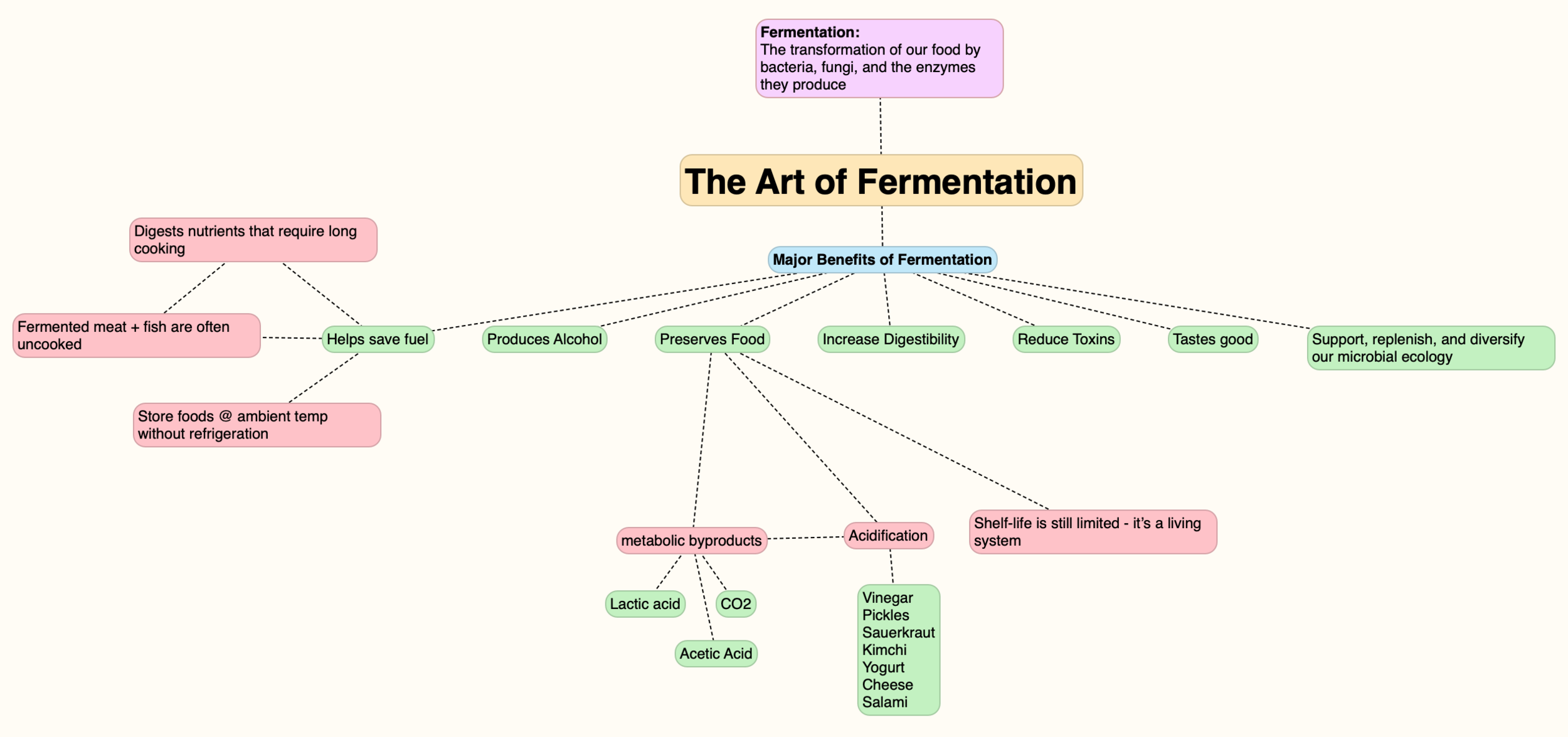
Mind Map

I didn’t end up making the mind map as I normally would… But I did capture these notes.

My Highlights

This is one of the few physical books I’ve purchased in the past few years, so this is a smaller set of quotes than usual. The majority of the highlights below come from the introduction, as the rest of the book is focused on methods for fermentation.

“Is it possible that, rather than humans “discovering” alcohol and mastering its production, we evolved always already knowing it? Anthropologist Mikal John Ansvel (check name) points out that “all vertebrate species are equipped with a hepatic enzyme system with which to metabolize alcohol.” Many animals have been documented consuming alcohol in their natural habitats.

[Food storage] primarily consists of keeping foods dry but not too dry, cold but not too cold, and dark. But it is not easy, with limited technology, to create ideal conditions for storage.

What is fascinating about the concept of coevolution is the recognition that the processes of becoming are infinitely interconnected.

One of the most interesting points raised early on by Katz is that refrigeration can be viewed as a historical bubble:

  • Has been available for only a few generations
  • Predominantly available in affluent regions of the world with readily available electricity
  • Has powerfully distorted our perspectives on food perishability
  • We fear the absence of refrigeration
  • High energy requirements – will it remain affordable + highly available in years to come?

We must safeguard the living legacy of traditional food preservation techniques.

Benefits of acid food fermentation:

  1. Render food resistant to microbial spoilage + development of food toxins
  2. Make food less likely to transfer pathogenic organisms
  3. Generally preserve food b/w harvest + consumption
  4. Modify flavor + improve nutritional value

Traditional preservation:

  • Keep food in cool and dry spot
  • Actively dry (microbial activity is suspended w/o adequate water) using sun, and/or gentle heat or smoke, and/or salt
  • Fermentation

Botulism is primarily associated with canning – a new technique (19th century, developed in Napoleonic France).

Live cultures from lactic acid fermentation are only viable in foods kept @ < 115F/47C

Eat a variety of fermented foods, some with live cultures, and while you’re at it, eat a variety of plants. Make sure that at least some of the plants and bacteria are wild.

The range of plants and microbes under active cultivation is really quite limited. More different interactions – with varied phytochemical bacteria – and the compounds bacteria produce – stimulate us in functional ways. Diversity is its own reward.

“Between fresh and rotten, there is a creative space in which some of the most compelling flavors arise.”

Buy the Book

If you are interested in purchasing this book, you can support the website by using our Amazon affiliate link.


Timeless Laws of Software Development

This article was originally posted on Embedded Artistry.


I am always seeking the wisdom and insights of those who have spent decades working in software development. The experiences of those who came before us is a rich source of wisdom, information, and techniques.

Only a few problems in our field are truly new. Most of the solutions we seek have been written about time-and-time-again over the past 50 years. Rather than continually seeking new technology as the panacea to our problems, we should focus ourselves on applying the tried and tested basic principles of our field.

Given my point of view, it’s no surprise that I was immediately drawn to a book titled Timeless Laws of Software Development.

The author, Jerry Fitzpatrick, is a software instructor and consultant who has worked in a variety of industries: biomedical, fitness, oil and gas, telecommunications, and manufacturing. Even more impressive for someone writing about the Timeless Laws of Software Development, Jerry was originally an electrical engineer. He worked with Bob Martin and James Grenning at Teradyne, where he developed the hardware for Teradyne’s early voice response system.

Jerry has spent his career dealing with the same problems we are currently dealing with. It would be criminal not to steal and apply his hard-earned knowledge.

I recommend this invaluable book equally to developers, team leads, architects, and project managers.

Table of Contents:

  1. Structure of the Book
  2. The Timeless Laws
  3. What I Learned
  4. Selected Quotes
  5. Buy the Book

Structure of the Book

The book is short, weighing in at a total of 180 pages, including the appendices, glossary, and index. Do not be fooled by its small stature, for there is much wisdom packed into these pages.

Jerry opens with an introductory chapter and dedicates an entire chapter to each of his six Timeless Laws (discussed below). Each law is broken down into sub-axioms, paired with examples, and annotated with quotes and primary sources.

Aside from the always-useful glossary and index, Jerry ends the book with three appendices, each valuable in its own right:

  • “About Software Metrics”, which covers metrics including lines of code, cyclomatic complexity, software size, and Jerry’s own “ABC” metric
  • “Exploring Old Problems”, which covers symptoms of the software crisis, the cost to develop software, project factors and struggles, software maintenance costs, superhuman developers, and software renovation.
  • “Redesigning a Procedure”, where Jerry walks readers through a real-life refactoring exercise

“Exploring Old Problems” was an exemplary chapter. I highly recommended it to project managers and team leads.

My only real critique of the book is that the information is not partitioned in a way that makes it easily accessible to different roles – project managers may miss valuable lessons while glossing over programming details. Don’t give in to the temptation to skip: each chapter has valuable advice no matter your role.

The Timeless Laws

Jerry proposes six Timeless Laws of software development:

  1. Plan before implementing
  2. Keep the program small
  3. Write clearly
  4. Prevent bugs
  5. Make the program robust
  6. Prevent excess coupling

At first glance, these six laws are so broadly stated that the natural reaction is, “Duh”. Where the book shines is in the breakdown of these laws into sub-axioms and methods for achieving the intent of the law.

Breakdown of the Timeless Laws

  1. Plan before implementing
    1. Understand the requirements
    2. Reconcile conflicting requirements
    3. Check the feasibility of key requirements
    4. Convert assumptions to requirements
    5. Create a development plan
  2. Keep the program small
    1. Limit project features
    2. Avoid complicated designs
    3. Avoid needless concurrency
    4. Avoid repetition
    5. Avoid unnecessary code
    6. Minimize error logging
    7. Buy, don’t build
    8. Strive for Reuse
  3. Write clearly
    1. Use names that denote purpose
    2. Use clear expressions
    3. Improve readability using whitespace
    4. Use suitable comments
    5. Use symmetry
    6. Postpone optimization
    7. Improve what you have written
  4. Prevent bugs
    1. Pace yourself
    2. Don’t tolerate build warnings
    3. Manage Program Inputs
    4. Avoid using primitive types for physical quantities
    5. Reduce conditional logic
    6. Validity checks
    7. Context and polymorphism
    8. Compare floating point values correctly
  5. Make the program robust
    1. Don’t let bugs accumulate
    2. Use assertions to expose bugs
    3. Design by contract
    4. Simplify exception handling
    5. Use automated testing
    6. Invite improvements
  6. Prevent excess coupling
    1. Discussion of coupling
    2. Flexibility
    3. Decoupling
    4. Abstractions (functional, data, OO)
    5. Use black boxes
    6. Prefer cohesive abstractions
    7. Minimize scope
    8. Create barriers to coupling
    9. Use atomic initialization
    10. Prefer immutable instances

What I Learned

I’ve regularly referred to this book over the past year. My hard-copy is dog-eared and many pages are covered in notes, circles, and arrows.

I’ve incorporated many aspects of the book into my development process. I’ve created checklists that I use for design reviews and code reviews, helping to ensure that I catch problems as early as possible. I’ve created additional documentation for my projects, as well as templates to facilitate ease of reuse.

Even experienced developers and teams can benefit from a review of this book. Some of the concepts may be familiar to you, but we all benefit from a refresher. There is also the chance that you will find one valuable gem to improve your practice, and isn’t that worth the small price of a book?

The odds are high that you’ll find more than one knowledge gem while reading Timeless Laws.

Here are some of the lessons I took away from the book:

  1. Create a development plan
  2. Avoid the “what if” game
  3. Logging is harmful
  4. Defensive programming is harmful
  5. Utilize symmetry in interface design

Create a Development Plan

We are all familiar with the lack of documentation for software projects. I’m repeatedly stunned by teams which provide no written guidance or setup instructions for new members. Jerry points out the importance of maintaining documentation:

Documentation is the only way to transfer knowledge without describing things in person.

One such method that I pulled from the book is the idea of the “Development Plan”. The plan serves as a guide for developers working on the project. The plan describes the development tools, project, goals, and priorities.

As with all documentation, start simple and grow the development plan as new information becomes available or required. Rather than having a large document, it’s easy to break the it up into smaller, standalone files. Having separate documents will help developers easily find the information they need. The development plan should be kept within the repository so developers can easily find and update it.

Topics to cover in your development plan include:

  • List of development priorities
  • Code organization
  • How to set up the development environment
  • Minimum requirements for hardware, OS, compute power, etc.
  • Glossary of project terms
  • Uniform strategy for bug prevention, detection, and repair
  • Uniform strategy for program robustness
  • Coding style guidelines (if applicable)
  • Programming languages to be used, and where they are used
  • Tools to be used for source control, builds, integration, testing, and deployment
  • High-level organization: projects, components, file locations, and naming conventions
  • High-level logical architecture: major sub-systems and frameworks

Development plans are most useful for new team members, since they can refer to the document and become productive without taking much time from other developers. However, your entire team will benefit from having a uniform set of guidelines that can be easily located and referenced.

Avoid the “What If” Game

Many of us, myself included, are guilty of participating in the “what if” game. The “what if” game is prevalent among developers, especially when new ideas are proposed. The easiest way to shoot a hole in a new idea is to ask a “what if” question: “This architecture looks ok, but what if we need to support 100,000,000 connections at once?”

The “what if” game is adversarial and can occur because:

  • Humans have a natural resistance to change
  • Some people enjoy showing off their knowledge
  • Some people enjoy being adversarial
  • The dissenter dislikes the person who proposed the idea
  • The dissenter does not want to take on additional work

“What if” questions are difficult to refute, as they are often irrational. We should always account for realistic possibilities, but objections should be considered only if the person can explain why the proposal is disruptive now or is going to be disruptive in the future.

Aside from keeping conversations focused on realistic possibilities, we can mitigate the ability to ask “what if” with clear and well-defined requirements.

Logging is Harmful

I have been a long-time proponent of error logging, and I’ve written many embedded logging libraries over the past decade.

While I initially was skeptical of Fitzpatrick’s attitude toward error logging, I started paying closer attention to the log files I was working with as well as the use of logging in my own code. I noticed the points that Jerry highlighted: my code was cluttered, logs were increasingly useless, and it was always a struggle to remove outdated logging statements.

You can read more about my thoughts on error logging in my article: The Dark Side of Error Logging.

Defensive Programming is Harmful

Somewhere along the way in my career, the idea of defensive programming was drilled into me. Many of my old libraries and programs are layered with unnecessary conditional statements and error-code returns. These checks contribute to code bloat, since they are often repeated at multiple levels in the stack.

Jerry points out that in conventional product design, designs are based on working parts, not defective ones. As such, designing our software systems based on the assumption that all modules are potentially defective leads us down the path of over-engineering.

Trust lies at the heart of defensive programming. If no module can be trusted, then defensive programming is imperative. If all modules can be trusted, then defensive programming is irrelevant.

Like conventional products, software should be based on working parts, not defective ones. Modules should be presumed to work until proven otherwise. This is not to say that we don’t do any form of checking: inputs from outside of the program need to be validated.

Assertions and contracts should be used to enforce preconditions and postconditions. Creating hard failure points helps us to catch bugs as quickly as possible. Modules inside of the system should be trusted to do their job and to enforce their own requirements.

Since I’ve transitioned toward the design-by-contract style, my code is much smaller and easier to read.

Utilize Symmetry in Interface Design

Using symmetry in interface design is one of those points that seemed obvious on the surface. Upon further inspection, I found I regularly violated symmetry rules in my interfaces.

Symmetry helps us to manage the complexity of our programs and reduce the amount of knowledge we need to keep in mind at once. Since we have existing associations with naming pairs, we can easily predict function names without needing to look them up.

Universal naming pairs should be used in public interfaces whenever possible:

  • on/off
  • start/stop
  • enable/disable
  • up/down
  • left/right
  • get/set
  • empty/full
  • push/pop
  • create/destroy

Our APIs should also be written in a consistent manner:

  • Motor::Start() / Motor::Stop()
  • motor_start() / motor_stop()
  • StartMotor() / StopMotor()

Avoid creating (and fix!) inconsistent APIs:

  • Motor::Start() / Motor::disable()
  • startMotor / stop_motor
  • start_motor / Stop_motor

Naming symmetry may be obvious, but where I am most guilty is in parameter order symmetry. Our procedures should utilize the same parameter ordering rules whenever possible.

For example, consider the C standard library functions defined in string.h. In all but one procedure (strlen), the first parameter is the destination string, and the second parameter is the source string. The parameter order also matches the normal assignment order semantics (dest = src).

The standard library isn’t the holy grail of symmetry, however. The stdio.h header showcases some bad symmetry by changing the location of the FILE pointer:

int fprintf ( FILE * stream, const char * format, ... );
int fscanf ( FILE * stream, const char * format, ... );

// Better design: FILE is first!
int fputs ( const char * str, FILE * stream );
char * fgets ( char * str, int num, FILE * stream );

Keeping symmetry in mind will improve the interfaces we create.

Selected Quotes

I pulled hundreds of quotes from this book, and you will be seeing many of them pop up on our Twitter Feed over the next year. A small selection of my highlights are included below.

Any quotes without attribution come directly from Jerry.

Intentionally hiding a bug is the greatest sin a developer can commit.

Failure is de rigueur in our industry. Odds are, you’re working on a project that will fail right now.
— Jeff Atwood, How to Stop Sucking and Be Awesome

Writing specs is like flossing: everybody agrees that it’s a good thing, but nobody does.
— Joel Spolsky

Documentation is the only way to transfer knowledge without describing things in person.

Robustness must be a goal and up front priority.

Disorder is the natural state of all things. Software tends to get larger and more complicated unless the developers push back and make it smaller and simpler. If the developers don’t push back, the battle against growth is lost by default.

YAGNI (You ain’t gonna need it):
Always implement things when you actually need them, never when you just foresee that you need them. The best way to implement code quickly is to implement less of it. The best way to have fewer bugs is to implement less code.

— Ron Jeffries

Most developers write code that reflects their immediate thoughts, but never return to make it smaller or clearer.

The answer is to clear our heads of clutter. Clear thinking becomes clear writing; one can’t exist without the other.
— William Zinsser

Plan for tomorrow but implement only for today.

Code that expresses its purpose clearly – without surprises – is easier to understand and less likely to contain bugs.

Most developers realize that excess coupling is harmful but they don’t resist it aggressively enough. Believe me: if you don’t manage coupling, coupling will manage you.

Few people realize how badly they write.
— William Zinsser

To help prevent bugs, concurrency should only be used when needed. When it is needed, the design and implementation should be handled carefully.

Sometimes problems are poorly understood until a solution is implemented and found lacking. For this reason, it’s often best to implement a basic solution before attempting a more complete and complicated one. Adequate solution are usually less costly than optimal ones.

I’ve worked with many developers who didn’t seem to grasp the incredible speed at which program instructions execute. They worried about things that would have a tiny effect on performance or efficiency. They should have been worried about bug prevention and better-written code.

Most sponsors would rather have a stable program delivered on-time than a slightly faster and more efficient program delivered late.

It’s better to implement features directly and clearly, then optimize any that affect users negatively.

Efficiency and performance are only problems if the requirements haven’t been met. Optimization usually reduces source code clarity, so it isn’t justified for small gains in efficiency or performance. Our first priorities should be correctness, clarity, and modest flexibility.

Implementation is necessarily incremental, but a good architecture is usually holistic. It requires a thorough understanding of all requirements.

Buy the Book

If you are interested in purchasing Timeless Laws of Software Development, you can support the website by using our Amazon affiliate link:


Deep Nutrition

Author: Catherine Shanahan
Rating: 10/10
Last Read: July 2018

Deep Nutrition is a book which explains the negative effects that our modern diets are having on our bodies. Dr. Shanahan provides background and reasoning for the traditional “human diet”, which is as close as we can get to the way our great-great-great grandparents ate. She explains why the traditional diet is essential and walks through the damage that vegetable oils and sugars are causing. She also discusses the modern diet’s impact on fetal/childhood development and modern diseases.

Much of the book is dedicated to the link between our nutrition and our health, as well as making the argument that the modern diet of highly processed foods is harming us and destroying our genetic momentum. The book also contains recipes, meal planning guides, and a FAQ section to help you transition as easily as possible.

We completely changed our eating habits as a result of reading Deep Nutrition, and we have never felt better. We’ve replaced all of our cooking oils and condiments, reduced our carb intake to < 50g on most days, started fermenting food, improved the quality of our food purchases, and started eating in a more nose-to-tail style. We’ve also found ourselves less interested in eating out at restaurants, especially since most of them use cheap and highly processed cooking oils (canola, cottonseed, soy, corn, safflower, etc.).

I can’t deny it. We are believers.

My Highlights

I am still working on processing our book highlights. We thought this book was so important that we needed to share our recommendation right away.

Buy the Book

If you are interested in purchasing this book, you can support the website by using our Amazon affiliate link.


Wabi-Sabi: Further Thoughts

Author: Leonard Koren
Rating: 9/10
Last Read: 11/2017

Wabi-Sabi: Further Thoughts seeks to expand upon Koren’s previous work Wabi-Sabi: For Artists, Designers, Poets & Philosophers. Koren seeks to clarify some of the concepts that were introduced in his first work, and provide more context to the interested mind. He also discusses some interesting topics, such as whether digital art can ever express wabi-sabi.

If you liked the first book and want to further refine your understanding of wabi-sabi, read Wabi-Sabi: Further Thoughts.

My Highlights

wabi-sabi =

The aesthetic other.

  • a contrast/differentiation from the dominant aesthetic convention.
  • bulwark against sameness
  • rejection of the Chinese-derived taste for smooth, symmetrical perfection
  • Wabi taste: irregular and rough-textured objects, aka the aesthetic other in that historical context

The transfiguration of the commonplace.

  • Beauty of wabi-sabi is a perpetual event; it is not an inherent property of things
  • Wabi-sabi “happens” when conditioned and habituated ways of looking at things fall away, when things are defamiliarized
  • The beauty of wabi-sabi involves perceiving something extraordinary in something that might otherwise be regarded as quite ordinary, undistinguished or barely there.

Beauty at the edge of nothingness

  • Infinite potentiality of nothingness
  • Distinctiveness comes from something which is so faint, tentative, delicate, and subtle that it may be overlooked – or mistaken as trivial or insignificant.

Elegant Poverty

  • “Poverty” in this meaning as the mindset of non-attachment, I.e. not holding onto fixed ideas or material things.
  • “Elegant” refers to a graceful acceptance of restraint, inconvenience, and uncertainty.

Imperfection

  • Represented by entropic processes of nature made visible
  • Chaos and unpredictability, producing variety and interest
  • Under the right conditions, imperfection-embodied things can arouse a sense of empathy.

In the era of wabi-tea, the Japanese telling of the creation process: “things spontaneously appear beyond the technical and conceptual intervention” of artists or designers. An egoless point of view. wabi-sabi “occurs”, it is not “created” or “made”

Reluctance to make wabi-ness a mode of agency

Anonymously made objects taken from other contexts and used in new ways. Broken things, both common and special, are fixed, leaving scars of repair, and put back into service.

Never up to the fabricator to decide whether or not something is wabi: it’s up to the individual beholder.

“According to Rikyu, a preoccupation with things in and of themselves is tantamount to a spiritual failing”

“Sloppiness, whether by design or accident, is the result of thoughtlessness. Thoughtlessness has no place in the wabi-sabi concept.”

The modern project:

  • Reason is superior to all other forms of cognition
  • Science offers the ultimate solutions to mankind’s problems
  • The world is “broken”, but in the future things will be better.
  • It is necessary for humans to master nature
  • Look for universal solutions to fit all instances and circumstances

Wabi-sabi:

  • Reason is only one of many equally important modes of cognition
  • Science can only solve a limited range of mankind’s problems
  • The world simply “is”, and always will be so
  • Humans and nature are one; there is no master, there is no slave
  • Look for specific solutions for particular instances and circumstances

“Wabi-sabi is based on effortless, uninterrupted interactions with real (actual) things in the real (actual) world. The real world is dependent only on a consciousness to perceive it.”

“Digital reality, on the other hand, requires the effort of someone (the encoder, the device maker) to exist, and is dependent upon machinery and an external power source. When either the will of the maker, the machinery, or the power fails, digital reality ceases to be.”

Buy the Book

If you are interested in purchasing this book, you can support the website by using our Amazon affiliate link:


Wabi-Sabi: For Artists, Designers, Poets & Philosophers

Author: Leonard Koren
Rating: 10/10
Last Read: 11/2017

I’ve recently found myself immersed in Japanese topics. I have been listening to Zen lectures by Alan Watts, working at the Japanese Tea Garden, and learning more about bonsai. I’ve also recently read Shogun, Samurai William, and Taiko, each focused on the end of the Sengoku period.

Wabi-Sabi: For Artists, Designers, Poets & Philosophers also fits into the same Japanese theme. Wabi-sabi is an aesthetic aspect that permeates much of Japanese culture. Leonard Koren has created a beautiful (and short) work that seeks to demystify wabi-sabi so it can be more accessible to interested minds. Koren avoids using absolute terms to describe wabi-sabi, instead giving us a general picture of the feelings, attitudes, and qualities that imbune wabi-sabi. The books is designed, printed, and arranged in such a way to highlight these same characteristics. I appreciate Koren’s thoughtfulness in creating this work, and I find myself reviewing it on a regular basis.

If you’re looking for some artistic inspiration, have a fond love of natural processes, or are just curious about an essential element of Japanese culture, check out Wabi-Sabi: For Artists, Designers, Poets & Philosophers.

My Highlights

wabi refers to:

  • a way of life, a spiritual path
  • the inward, the subjective
  • a philosophical construct
  • spacial events

sabi refers to:

  • material objects, art and literature
  • the outward, the objective
  • an aesthetic ideal
  • temporal events

Similarities between modernism and wabi-sabi:

  • Both apply to all manner of manmade objects, spaces, and designs.
  • Botha re strong reactions against the dominant, established sensibilities of their time. Modernism was a radical departure from 19th-century classicism and eclecticism. Wabi-sabi was a radical departure from the Chinese perfection and gorgeousness of the 16h-century and earlier.
  • Both eschew any decoration that is not integral to structure.
  • Both are abstract, nonrepresentational ideals of beauty.
  • Both have readily identifiable surface characteristics. Modernism is seamless, polished, and smooth. Wabi-sabi is earthy, imperfect, and variegated.

Differences between the Modernism and wabi-sabi

Modernism:

  • Primarily expressed in the public domain
  • implies a logical, rational worldview
  • absolute
  • looks for universal, prototypical solutions
  • Mass-produced/modular
  • Expresses faith in progress
  • Future-oriented
  • Believes in the control of nature
  • Romanticizes technology
  • People adapting to machines
  • Geometric organization of form (sharp, precise, definite shapes and edges)
  • The box as metaphor (rectilinear, precise, contained)
  • Manmade materials
  • Ostensibly slick
  • needs to be well-maintained
  • purity makes its expression richer
  • solicits the reduction of sensory information
  • Is intolerant of ambiguity and contradiction
  • Cool
  • Generally light and bright
  • Function and utility are primary values
  • Perfect materiality is an ideal
  • Everlasting

wabi-sabi:

  • Primarily expressed in the private domain
  • Implies an intuitive worldview
  • Relative
  • Looks for personal, idiosyncratic solutions
  • One-of-a-kind/variable
  • There is no progress
  • Present-oriented
  • Believes in the fundamental uncontrollability of nature
  • Romanticizes nature
  • People adapting to nature
  • Organic organization of form (soft, vague shapes and edges)
  • The bowl as a metaphor (free shape, open at top)
  • Natural materials
  • Ostensibly crude
  • Accomodates to degradation and attrition
  • Corrosion and contamination make its expression richer
  • Solicits the expansion of sensory information
  • Is comfortable with ambiguity and contradiction
  • Warm
  • Generally dark and dim
  • Function and utility are not so important
  • Perfect immateriality is an ideal
  • To every thing there is a season

The Wabi-Sabi Universe

Metaphysical basis: Things are either devolving toward, or evolving from, nothingness

Spiritual Values:

  • Truth comes from the observation of nature
  • “Greatness” exists in the inconspicuous and overlooked details
  • Beauty can be coaxed out of ugliness

State of mind:

  • Acceptance of the inevitable
  • Appreciation of the cosmic order

Moral Precepts:

  • Get rid of all that is unnecessary
  • Focus on the intrinsic and ignore material hierarchy

Material Qualities:

  • The suggestion of natural process
  • Irregular
  • Intimate
  • Unpretentious
  • Earthy
  • Murky
  • Simple

What are the lessons of the universe?

  1. All things are impermanent
  2. All things are imperfect
  3. All things are incomplete

The simplicity of wabi-sabi is probably best described as the state of grace arrived at by a sober, modest, heartfelt intelligence. The main strategy of this intelligence is economy of means. Pare down to the essence, but don’t remove the poetry. Keep things clean and unencumbered, but don’t sterilize. (Things wabi-sabi are emotionally warm, never cold.) Usually this implies a limited palette of materials. It also means keeping conspicuous features to a minimum. But it doesn’t mean removing the invisible connective tissue that somehow binds the elements into meaningful whole. It also doesn’t mean in any way diminishing something’s “interestingness,” the quality that compels us to look at that something over, and over, and over again.

Buy the Book

If you are interested in purchasing this book, you can support the website by using our Amazon affiliate link:


The Book: On the Taboo Against Knowing Who You Are

Author: Alan Watts
Rating: 9/10
Last Read: April 2017

Quick Summary:  In The Book, Alan Watts seeks out to provide his children (and other learners) with a “Bible-like” replacement. The Book draws heavily from the Taoist writings and lectures that Watts gave in his later years – if you are familiar with other works where he discusses Taoism, much of this material will be familiar to you. 

Watts writes this book to fill a void, one left by the lack of wonder in our lives. Even our religions no longer align with the modern human experience:

The standard-brand religions, whether Jewish, Christian, Mohammedan, Hindu, or Buddhist, are—as now practiced—like exhausted mines: very hard to dig. With some exceptions not too easily found, their ideas about man and the world, their imagery, their rites, and their notions of the good life don’t seem to fit in with the universe as we now know it, or with a human world that is changing so rapidly that much of what one learns in school is already obsolete on graduation day.

Instead, Watts seeks to fill us with the spirit of the Tao and the interconnectedness of our experience. He seeks to correct us of the common illusion:

This feeling of being lonely and very temporary visitors in the universe is in flat contradiction to everything known about man (and all other living organisms) in the sciences. We do not “come into” this world; we come out of it, as leaves from a tree. As the ocean “waves,” the universe “peoples.” Every individual is an expression of the whole realm of nature, a unique action of the total universe. This fact is rarely, if ever, experienced by most individuals. Even those who know it to be true in theory do not sense or feel it, but continue to be aware of themselves as isolated “egos” inside bags of skin.

I for one would say he makes a great case. Read The Book and rediscover the wonder of being alive.

My Highlights

Nevertheless, wonder is not a disease. Wonder, and its expression in poetry and the arts, are among the most important things which seem to distinguish men from other animals, and intelligent and sensitive people from morons. –loc 88

The root of the matter is the way in which we feel and conceive ourselves as human beings, our sensation of being alive, of individual existence and identity. We suffer from a hallucination, from a false and distorted sensation of our own existence as living organisms. Most of us have the sensation that “I myself” is a separate center of feeling and action, living inside and bounded by the physical body—a center which “confronts” an “external” world of people and things, making contact through the senses with a universe both alien and strange. Everyday figures of speech reflect this illusion. “I came into this world.” “You must face reality.” “The conquest of nature.” –loc 104

This feeling of being lonely and very temporary visitors in the universe is in flat contradiction to everything known about man (and all other living organisms) in the sciences. We do not “come into” this world; we come out of it, as leaves from a tree. As the ocean “waves,” the universe “peoples.” Every individual is an expression of the whole realm of nature, a unique action of the total universe. This fact is rarely, if ever, experienced by most individuals. Even those who know it to be true in theory do not sense or feel it, but continue to be aware of themselves as isolated “egos” inside bags of skin. –loc 109

The first result of this illusion is that our attitude to the world “outside” us is largely hostile. We are forever “conquering” nature, space, mountains, deserts, bacteria, and insects instead of learning to cooperate with them in a harmonious order. –loc 114

The second result of feeling that we are separate minds in an alien, and mostly stupid, universe is that we have no common sense, no way of making sense of the world upon which we are agreed in common. It’s just my opinion against yours, and therefore the most aggressive and violent (and thus insensitive) propagandist makes the decisions. A muddle of conflicting opinions united by force of propaganda is the worst possible source of control for a powerful technology. –loc 123

Furthermore, as systems of doctrine, symbolism, and behavior, religions harden into institutions that must command loyalty, be defended and kept “pure,” and—because all belief is fervent hope, and thus a cover-up for doubt and uncertainty—religions must make converts. The more people who agree with us, the less nagging insecurity about our position. –loc 131

Irrevocable commitment to any religion is not only intellectual suicide; it is positive unfaith because it closes the mind to any new vision of the world. Faith is, above all, open-ness—an act of trust in the unknown. –loc 136

An ardent Jehovah’s Witness once tried to convince me that if there were a God of love, he would certainly provide mankind with a reliable and infallible textbook for the guidance of conduct. I replied that no considerate God would destroy the human mind by making it so rigid and unadaptable as to depend upon one book, the Bible, for all the answers. For the use of words, and thus of a book, is to point beyond themselves to a world of life and experience that is not mere words or even ideas. Just as money is not real, consumable wealth, books are not life. To idolize scriptures is like eating paper currency. –loc 138

The most strongly enforced of all known taboos is the taboo against knowing who or what you really are behind the mask of your apparently separate, independent, and isolated ego. –loc 148

As is so often the way, what we have suppressed and overlooked is something startlingly obvious. The difficulty is that it is so obvious and basic that one can hardly find the words for it. –loc 153

The sensation of “I” as a lonely and isolated center of being is so powerful and commonsensical, and so fundamental to our modes of speech and thought, to our laws and social institutions, that we cannot experience selfhood except as something superficial in the scheme of the universe. I seem to be a brief light that flashes but once in all the aeons of time—a rare, complicated, and all-too-delicate organism on the fringe of biological evolution, where the wave of life bursts into individual, sparkling, and multicolored drops that gleam for a moment only to vanish forever. Under such conditioning it seems impossible and even absurd to realize that myself does not reside in the drop alone, but in the whole surge of energy which ranges from the galaxies to the nuclear fields in my body. –loc 155

Myth, then, is the form in which I try to answer when children ask me those fundamental metaphysical questions which come so readily to their minds: “Where did the world come from?” “Why did God make the world?” “Where was I before I was born?” “Where do people go when they die?” Again and again I have found that they seem to be satisfied with a simple and very ancient story, –loc 171

The social hierarchies of the past, where some boss above you always punished any error, conditioned men to feel a chain of harsh authority reaching all the way “up there.” We don’t feel this bond in today’s egalitarian freedom. We don’t even have, since Dr. Spock, many Jehovah-like fathers in the human family. So the average unconscious no longer learns to seek forgiveness from a wrathful God above. –loc 213

Our generation knows a cold hell, solitary confinement in this life, without a God to damn or save it. Until man figures out the trap and hunts … “the Ultimate Ground of Being,” he has no reason at all for his existence. Empty, finite, he knows only that he will soon die. Since this life has no meaning, and he sees no future life, he is not really a person but a victim of self-extinction. –loc 217

In the Vedanta philosophy, nothing exists except God. There seem to be other things than God, but only because he is dreaming them up and making them his disguises to play hide-and-seek with himself. The universe of seemingly separate things is therefore real only for a while, not eternally real, for it comes and goes as the Self hides and seeks itself. –loc 239

Genuine love comes from knowledge, not from a sense of duty or guilt. –loc 265

You cannot teach an ego to be anything but egotistic, even though egos have the subtlest ways of pretending to be reformed. –loc 268

The basic thing is therefore to dispel, by experiment and experience, the illusion of oneself as a separate ego. The consequences may not be behavior along the lines of conventional morality. –loc 268

Furthermore, on seeing through the illusion of the ego, it is impossible to think of oneself as better than, or superior to, others for having done so. In every direction there is just the one Self playing its myriad games of hide-and-seek. –loc 271

Birds are not better than the eggs from which they have broken. Indeed, it could be said that a bird is one egg’s way of becoming other eggs. Egg is ego, and bird is the liberated Self. There is a Hindu myth of the Self as a divine swan which laid the egg from which the world was hatched. Thus I am not even saying that you ought to break out of your shell. Sometime, somehow, you (the real you, the Self) will do it anyhow, but it is not impossible that the play of the Self will be to remain unawakened in most of its human disguises, and so bring the drama of life on earth to its close in a vast explosion. –loc 273

Because of this habit of ignoring space-intervals, we do not realize that just a sound is a vibration of sound/silence, the whole universe (that is, existence) is a vibration of solid/space. For solids and spaces go together as inseparably as insides and outsides. Space is the relationship between bodies, and without it there can be neither energy nor motion. –loc 328

The narrow slit in the fence is much like the way in which we look at life by conscious attention, for when we attend to something we ignore everything else. Attention is narrowed perception. It is a way of looking at life bit by bit, using memory to string the bits together—as when examining a dark room with a flashlight having a very narrow beam. Perception thus narrowed has the advantage of being sharp and bright, but it has to focus on one area of the world after another, and one feature after another. And where there are no features, only space or uniform surfaces, it somehow gets bored and searches about for more features. Attention is therefore something like a scanning mechanism in radar or television, and Norbert Wiener and his colleagues found some evidence that there is a similar process in the brain. –loc 372

But a scanning process that observes the world bit by bit soon persuades its user that the world is a great collection of bits, and these he calls separate things or events. We often say that you can only think of one thing at a time. The truth is that in looking at the world bit by bit we convince ourselves that it consists of separate things, and so give ourselves the problem of how these things are connected and how they cause and effect each other. The problem would never have arisen if we had been aware that it was just our way of looking at the world which had chopped it up into separate bits, things, events, causes, and effects. We do not see that the world is all of a piece like the head-tailed cat. –loc 378

We also speak of attention as noticing. To notice is to select, to regard some bits of perception, or some features of the world, as more noteworthy, more significant, than others. To these we attend, and the rest we ignore—for which reason conscious attention is at the same time ignore-ance (i.e., ignorance) despite the fact that it gives us a vividly clear picture of whatever we choose to notice. Physically, we see, hear, smell, taste, and touch innumerable features that we never notice. You can drive thirty miles, talking all the time to a friend. What you noticed, and remembered, was the conversation, but somehow you responded to the road, the other cars, the traffic lights, and heaven knows what else, without really noticing, or focussing your mental spotlight upon them. So too, you can talk to someone at a party without remembering, for immediate recall, what clothes he or she was wearing, because they were not noteworthy or significant to you. Yet certainly your eyes and nerves responded to those clothes. You saw, but did not really look. –loc 383

What governs what we choose to notice? The first (which we shall have to qualify later) is whatever seems advantageous or disadvantageous for our survival, our social status, and the security of our egos. The second, again working simultaneously with the first, is the pattern and the logic of all the notation symbols which we have learned from others, from our society and our culture. –loc 397

It is hard indeed to notice anything for which the languages available to us (whether verbal, mathematical, or musical) have no description. This is why we borrow words from foreign languages. There is no English word for a type of feeling which the Japanese call yugen, and we can only understand by opening our minds to situations in which Japanese people use the word. –loc 399

We must, however, be careful of taking animals as models of “perfectly natural” behavior. If “natural” means “good” or “wise,” human beings can improve on animals, though they do not always do so. –loc 425

(Perpetual leaves are, as we know, made of plastic, and there may come a time when surgeons will be able to replace all our organs with plastic substitutes, so that you will achieve immortality by becoming a plastic model of yourself.) –loc 454

The sole means now for the saving of the beings of the planet Earth would be to implant again into their presences a new organ … of such properties that every one of these unfortunates during the process of existence should constantly sense and be cognizant of the inevitability of his own death as well as the death of everyone upon whom his eyes or attention rests. Only such a sensation and such a cognizance can now destroy the egoism completely crystallized in them. –loc 469

the constant awareness of death shows the world to be as flowing and diaphanous as the filmy patterns of blue smoke in the air—that there really is nothing to clutch and no one to clutch it. This is depressing only so long as there remains a notion that there might be some way of fixing it, of putting it off just once more, or hoping that one has, or is, some kind of ego-soul that will survive bodily dissolution. –loc 474

Suppressing the fear of death makes it all the stronger. The point is only to know, beyond any shadow of doubt, that “I” and all other “things” now present will vanish, until this knowledge compels you to release them—to know it now as surely as if you had just fallen off the rim of the Grand Canyon. –loc 478

Just try taking a stroll after dark in a nice American residential area. If you can penetrate the wire fences along the highways, and then wander along a pleasant lane, you may well be challenged from a police car: “Where are you going?” Aimless strolling is suspicious and irrational. You are probably a vagrant or burglar. You are not even walking the dog! “How much money are you carrying?” Surely, you could have afforded to take the bus and if you have little or no cash, you are clearly a bum and a nuisance. –loc 520

Orderly travel now means going at the maximum speed for safety from point to point, but most reachable points are increasingly cluttered with people and parked cars, and so less worth going to see, and for similar reasons it is ever more inconvenient to do business in the centers of our great cities. Real travel requires a maximum of unscheduled wandering, for there is no other way of discovering surprises and marvels, which, as I see it, is the only good reason for not staying at home. As already suggested, fast intercommunication between points is making all points the same point. –loc 524

Despite the fact that more accidents happen in the home than elsewhere, increasing efficiency of communication and of controlling human behavior can, instead of liberating us into the air like birds, fix us to the ground like toadstools. All information will come in by super-realistic television and other electronic devices as yet in the planning stage or barely imagined. In one way this will enable the individual to extend himself anywhere without moving his body—even to distant regions of space. But this will be a new kind of individual—an individual with a colossal external nervous system reaching out and out into infinity. And this electronic nervous system will be so interconnected that all individuals plugged in will tend to share the same thoughts, the same feelings, and the same experiences. There may be specialized types, just as there are specialized cells and organs in our bodies. For the tendency will be for all individuals to coalesce into a single bio-electronic body. –loc 529

Consider the astonishing means now being made for snooping, the devices already used in offices, factories, stores, and on various lines of communication such as the mail and the telephone. Through the transistor and miniaturization techniques, these devices become ever more invisible and ever more sensitive to faint electrical impulses. The trend of all this is towards the end of individual privacy, to an extent where it may even be impossible to conceal one’s thoughts. At the end of the line, no one is left with a mind of his own: there is just a vast and complex community-mind, endowed, perhaps, with such fantastic powers of control and prediction that it will already know its own future for years and years to come. –loc 536

The science-fiction in which we have just been indulging has, then, two important morals. The first is that if the game of order-versus-chance is to continue as a game, order must not win. As prediction and control increase, so, in proportion, the game ceases to be worth the candle. We look for a new game with an uncertain result. In other words, we have to hide again, perhaps in a new way, and then seek in new ways, since the two together make up the dance and the wonder of existence. Contrariwise, chance must not win, and probably cannot, because the order/chance polarity appears to be of the same kind as the on/off and up/down. –loc 561

In solving problems, technology creates new problems, and we seem, as in Through the Looking-Glass, to have to keep running faster and faster to stay where we are. The question is then whether technical progress actually “gets anywhere” in the sense of increasing the delight and happiness of life. –loc 599

We seem to use “I” for something in the body but not really of the body, for much of what goes on in the body seems to happen to “I” in the same way as external events. “I” is used as the center of voluntary behavior and conscious attention, but not consistently. Breathing is only partially voluntary, and we say “I was sick” or “I dreamed” or “I fell asleep” as if the verbs were not passive but active. –loc 642

This controlling officer “sees” sights, “hears” sounds, “feels” feelings, and “has” experiences. These are common but redundant ways of talking, for seeing a sight is just seeing, hearing a sound is just hearing, feeling a feeling is just feeling, and having an experience is just experiencing. But that these redundant phrases are so commonly used shows that most people think of themselves as separate from their thoughts and experiences. All this can get marvelously complicated when we begin to wonder whether our officer has another officer inside his head, and so ad infinitum! –loc 651

There was a young man who said, “Though It seems that I know that I know, What I would like to see Is the ‘I’ that knows ‘me’ When I know that I know that I know.” –loc 656

However much we divide, count, sort, or classify this wiggling into particular things and events, this is no more than a way of thinking about the world: it is never actually divided. –loc 705

Problems that remain persistently insoluble should always be suspected as questions asked in the wrong way, like the problem of cause and effect. –loc 711

According to the deists, the Lord had made this machine and set it going, but then went to sleep or off on a vacation. But according to the atheists, naturalists, and agnostics, the world was fully automatic. –loc 753

In one form or another, the myth of the Fully Automatic Model has become extremely plausible, and in some scientific and academic disciplines it is as much a sacrosanct dogma as any theological doctrine of the past—despite contrary trends in physics and biology. For there are fashions in myth, and the world-conquering West of the nineteenth century needed a philosophy of life in which realpolitik—victory for the tough people who face the bleak facts—was the guiding principle. Thus the bleaker the facts you face, the tougher you seem to be. So we vied with each other to make the Fully Automatic Model of the universe as bleak as possible. –loc 768

If, then, the definition of a thing or event must include definition of its environment, we realize that any given thing goes with a given environment so intimately and inseparably that it is more difficult to draw a clear boundary between the thing and its surroundings. –loc 809

Thus the soul is not in the body, but the body in the soul, and the soul is the entire network of relationships and processes which make up your environment, and apart from which you are nothing. –loc 815

the individual is separate from his universal environment only in name. When this is not recognized, you have been fooled by your name. Confusing names with nature, you come to believe that having a separate name makes you a separate being. This is—rather literally—to be spellbound. –loc 826

Other people teach us who we are. Their attitudes to us are the mirror in which we learn to see ourselves, but the mirror is distorted. We are, perhaps, rather dimly aware of the immense power of our social environment. We seldom realize, for example, that our most private thoughts and emotions are not actually our own. For we think in terms of languages and images which we did not invent, but which were given to us by our society. We copy emotional reactions from our parents, learning from them that excrement is supposed to have a disgusting smell and that vomiting is supposed to be an unpleasant sensation. The dread of death is also learned from their anxieties about sickness and from their attitudes to funerals and corpses. Our social environment has this power just because we do not exist apart from a society. Society is our extended mind and body. –loc 830

Children are in no position to see the contradictions in these demands, and even if some prodigy were to point them out, he would be told summarily not to “answer back,” and that he lacked respect for his “elders and betters.” Instead of giving our children clear and explicit explanations of the game-rules of the community, we befuddle them hopelessly because we—as adults—were once so befuddled, and, remaining so, do not understand the game we are playing. –loc 864

The social double-bind game can be phrased in several ways: The first rule of this game is that it is not a game. Everyone must play. You must love us. You must go on living. Be yourself, but play a consistent and acceptable role. Control yourself and be natural. Try to be sincere. –loc 870

Life and love generate effort, but effort will not generate them. –loc 878

Faith—in life, in other people, and in oneself—is the attitude of allowing the spontaneous to be spontaneous, in its own way and in its own time. This is, of course, risky because life and other people do not always respond to faith as we might wish. Faith is always a gamble because life itself is a gambling game with what must appear, in the hiding aspect of the game, to be colossal stakes. But to take the gamble out of the game, to try to make winning a dead certainty, is to achieve a certainty which is indeed dead. –loc 879

The Arthashastra does not forget to warn the tyrant that he can never win. He may rise to eminence through ambition or the call of duty, but the more absolute his power, the more he is hated, and the more he is the prisoner of his own trap. The web catches the spider. He cannot wander at leisure in the streets and parks of his own capital, or sit on a lonely beach listening to the waves and watching the gulls. Through enslaving others he himself becomes the most miserable of slaves. –loc 895

We must learn to include ourselves in the round of cooperations and conflicts, of symbiosis and preying, which constitutes the balance of nature, for a permanently victorious species destroys, not only itself, but all other life in its environment. –loc 914

We do not realize that our so-called love and concern for the individual is simply the other face of our own fear of death or rejection. In his exaggerated valuation of separate identity, the personal ego is sawing off the branch on which he is sitting, and then getting more and more anxious about the coming crash! –loc 940

The point, which can hardly be repeated too often, is that differentiation is not separation. The head and the feet are different, but not separate, and though man is not connected to the universe by exactly the same physical relation as branch to tree or feet to head, he is nonetheless connected—and by physical relations of fascinating complexity. –loc 946

Thus bamboozled, the individual—instead of fulfilling his unique function in the world—is exhausted and frustrated in efforts to accomplish self-contradictory goals. Because he is now so largely defined as a separate person caught up in a mindless and alien universe, his principal task is to get one-up on the universe and to conquer nature. This is palpably absurd, and since the task is never achieved, the individual is taught to live and work for some future in which the impossible will at last happen, if not for him, then at least for his children. –loc 954

For unless one is able to live fully in the present, the future is a hoax. There is no point whatever in making plans for a future which you will never be able to enjoy. When your plans mature, you will still be living for some other future beyond. You will never, never be able to sit back with full contentment and say, “Now, I’ve arrived!” Your entire education has deprived you of this capacity because it was preparing you for the future, instead of showing you how to be alive now. –loc 958

Money alone cannot buy pleasure, though it can help. For enjoyment is an art and a skill for which we have little talent or energy. –loc 977

We have untold stacks of recorded music from every age and culture, and the most superb means of playing it. But who actually listens? Maybe a few pot-smokers. –loc 986

we are superb materialists when it comes to the construction of jet aircraft, but when we decorate the inside of these magnificent monsters for the comfort of passengers it is nothing but frippery. High-heeled, narrow-hipped, doll-type girls serving imitation, warmed-over meals. For our pleasures are not material pleasures but symbols of pleasure—attractively packaged but inferior in content. The explanation is simple: most of our products are being made by people who do not enjoy making them, whether as owners or workers. Their aim in the enterprise is not the product but money, and therefore every trick is used to cut the cost of production and hoodwink the buyer, by coloring and packaging chicanery, into the belief that the product is well and truly made. The only exceptions are those products which simply must be excellent for reasons of safety or high cost of purchase—aircraft, computers, space-rockets, scientific instruments, and so forth. –loc 989

when you have made the money what will you buy with it? Other pretentious fakes made by other money-mad manufacturers. The few real luxuries on the market are imports from “backward” countries where peasants and craftsmen still take pride in their work. –loc 997

The poets and sages have, indeed, been saying for centuries that success in this world is vanity. “The worldly hope men set their hearts upon turns ashes,” or, as we might put it in a more up-to-date idiom, just when our mouth was watering for the ultimate goodies, it turns out to be a mixture of plaster-of-paris, papier-mâché, and plastic glue. Comes in any flavor. I have thought of putting this on the market as a universal substance, a prima materia, for making anything and everything—houses, furniture, flowers, bread (they use it already), apples, and even people. –loc 1003

We have now found out that many things which we felt to be basic realities of nature are social fictions, arising from commonly accepted or traditional ways of thinking about the world. These fictions have included: 1. The notion that the world is made up or composed of separate bits or things. 2. That things are differing forms of some basic stuff. 3. That individual organisms are such things, and that they are inhabited and partially controlled by independent egos. 4. That the opposite poles of relationships, such as light/darkness and solid/space, are in actual conflict which may result in the permanent victory of one of the poles. 5. That death is evil, and that life must be a constant war against it. 6. That man, individually and collectively, should aspire to be top species and put himself in control of nature. –loc 1036

Remember that Aristotle’s and Newton’s preoccupation with causal determinism was that they were trying to explain how one thing or event was influenced by others, forgetting that the division of the world into separate things and events was a fiction. To say that certain events are causally connected is only a clumsy way of saying that they are features of the same event, like the head and tail of the cat. –loc 1058

Our practical projects have run into confusion again and again through failure to see that individual people, nations, animals, insects, and plants do not exist in or by themselves. This is not to say only that things exist in relation to one another, but that what we call “things” are no more than glimpses of a unified process. Certainly, this process has distinct features which catch our attention, but we must remember that distinction is not separation. –loc 1063

the movement of any feature of the world cannot be ascribed to the outside alone or to the inside alone. Both move together. –loc 1081

Everything labeled with a noun is demonstrably a process or action, but language is full of spooks, like the “it” in “It is raining,” which are the supposed causes of action. –loc 1128

As the Chinese say, the various features of a situation “arise mutually” or imply one another as back implies front, and as chickens imply eggs—and vice versa. They exist in relation to each other like the poles of the magnet, only more complexly patterned. –loc 1139

We can never, never describe all features of the total situation, not only because every situation is infinitely complex, but also because the total situation is the universe. –loc 1152

Fortunately, we do not have to describe any situation exhaustively, because some of its features appear to be much more important than others for understanding the behavior of the various organisms within it. We never get more than a sketch of the situation, yet this is enough to show that actions (or processes) must be understood, or explained, in terms of situations just as words must be understood in the context of sentences, paragraphs, chapters, books, libraries, and … life itself. –loc 1154

To sum up: just as no thing or organism exists on its own, it does not act on its own. Furthermore, every organism is a process: thus the organism is not other than its actions. To put it clumsily: it is what it does. More precisely, the organism, including its behavior, is a process which is to be understood only in relation to the larger and longer process of its environment. For what we mean by “understanding” or “comprehension” is seeing how parts fit into a whole, and then realizing that they don’t compose the whole, as one assembles a jigsaw puzzle, but that the whole is a pattern, a complex wiggliness, which has no separate parts. Parts are fictions of language, of the calculus of looking at the world through a net which seems to chop it up into bits. Parts exist only for purposes of figuring and describing, and as we figure the world out we become confused if we do not remember this all the time. –loc 1157

It is easy enough to see that an intelligent human being implies an intelligent human society, for thinking is a social activity—a mutual interchange of messages and ideas based on such social institutions as languages, sciences, libraries, universities, and museums. But what about the non-human environment in which human society flourishes? –loc 1167

Somehow the first set of conditions seems to preserve the reality of the rainbow apart from an observer. But the second set, by eliminating a good, solid “external reality,” seems to make it an indisputable fact that, under such conditions, there is no rainbow. The reason is only that it supports our current mythology to assert that things exist on their own, whether there is an observer or not. It supports the fantasy that man is not really involved in the world, that he makes no real difference to it, and that he can observe reality independently without changing it. –loc 1223

Is it possible that all geological and astronomical history is a mere extrapolation—that it is talking about what would have happened if it had been observed? Perhaps. But I will venture a more cautious idea. The fact that every organism evokes its own environment must be corrected with the polar or opposite fact that the total environment evokes the organism. Furthermore, the total environment (or situation) is both spatial and temporal—both larger and longer than the organisms contained in its field. The organism evokes knowledge of a past before it began, and of a future beyond its death. At the other pole, the universe would not have started, or manifested itself, unless it was at some time going to include organisms—just as current will not begin to flow from the positive end of a wire until the negative terminal is secure. –loc 1240

In the same measure, we have lacked the proper self-respect of recognizing that I, the individual organism, am a structure of such fabulous ingenuity that it calls the whole universe into being. In the act of putting everything at a distance so as to describe and control it, we have orphaned ourselves both from the surrounding world and from our own bodies—leaving “I” as a discontented and alienated spook, anxious, guilty, unrelated, and alone. –loc 1252

Erwin Schrödinger: It is not possible that this unity of knowledge, feeling and choice which you call your own should have sprung into being from nothingness at a given moment not so long ago; rather this knowledge, feeling and choice are essentially eternal and unchangeable and numerically one in all men, nay in all sensitive beings. But not in this sense—that you are a part, a piece, of an eternal, infinite being, an aspect or modification of it, as in Spinoza’s pantheism. For we should have the same baffling question: which part, which aspect are you? What, objectively, differentiates it from the others? No, but inconceivable as it seems to ordinary reason, you—and all other conscious beings as such—are all in all. Hence this life of yours which you are living is not merely a piece of the entire existence, but is in a certain sense the whole; only this whole is not so constituted that it can be surveyed in one single glance. –loc 1275

Schrödinger goes on to suggest: Thus you can throw yourself flat on the ground, stretched out upon Mother Earth, with the certain conviction that you are one with her and she with you. You are as firmly established, as invulnerable as she, indeed a thousand times firmer and more invulnerable. As surely as she will engulf you tomorrow, so surely will she bring you forth anew to new striving and suffering. And not merely ‘some day’: now, today, every day she is bringing you forth, not once but thousands upon thousands of times, just as every day she engulfs you a thousand times over. For eternally and always there is only now, one and the same now; the present is the only thing that has no end.4 1For this illustration I am indebted to Owen Barfield, Saving the Appearances. –loc 1285

For if you know what you want, and will be content with it, you can be trusted. But if you do not know, your desires are limitless and no one can tell how to deal with you. Nothing satisfies an individual incapable of enjoyment. –loc 1324

But peace can be made only by those who are peaceful, and love can be shown only by those who love. No work of love will flourish out of guilt, fear, or hollowness of heart, just as no valid plans for the future can be made by those who have no capacity for living now. –loc 1339

The separate person is without content, in both senses of the word. He lives perpetually on hope, on looking forward to tomorrow, having been brought up this way from childhood, when his uncomprehending rage at double-binds was propitiated with toys. –loc 1341

The reason is not just that we are too much in a hurry and have no sense of the present; not just that we cannot afford the type of labor that such things would now involve, nor just that we prefer money to materials. The reason is that we have scrubbed the world clean of magic. We have lost even the vision of paradise, so that our artists and craftsmen can no longer discern its forms. This is the price that must be paid for attempting to control the world from the standpoint of an “I” for whom everything that can be experienced is a foreign object and a nothing-but. –loc 1371

If, then, after understanding, at least in theory, that the ego-trick is a hoax and that, beneath everything, “I” and “universe” are one, you ask, “So what? What is the next step, the practical application?”—I will answer that the absolutely vital thing is to consolidate your understanding, to become capable of enjoyment, of living in the present, and of the discipline which this involves. Without this you have nothing to give—to the cause of peace or of racial integration, to starving Hindus and Chinese, or even to your closest friends. Without this, all social concern will be muddlesome meddling, and all work for the future will be planned disaster. –loc 1377

But as I pursue these games—as I become more conscious of being conscious, more aware that I am unable to define myself as being up without you (or something other than myself) being down—I see vividly that I depend on your being down for my being up. I would never be able to know that I belong to the in-group of “nice” or “saved” people without the assistance of an out-group of “nasty” or “damned” people. –loc 1398

How can any in-group maintain its collective ego without relishing dinner-table discussions about the ghastly conduct of outsiders? –loc 1402

All winners need losers; all saints need sinners; all sages need fools—that is, so long as the major kick in life is to “amount to something” or to “be someone” as a particular and separate godlet. –loc 1407

There it is, a theoretically undeniable fact. But the question is how to get over the sensation of being locked out from everything “other,” of being only oneself—an organism flung into unavoidable competition and conflict with almost every “object” in its experience. There are innumerable recipes for this project, almost all of which have something to recommend them. There are the practices of yoga meditation, dervish dancing, psychotherapy, Zen Buddhism, Ignatian, Salesian, and Hesychast methods of “prayer,” the use of consciousness-changing chemicals such as LSD and mescaline, psychodrama, group dynamics, sensory-awareness techniques, Quakerism, Gurdjieff exercises, relaxation therapies, the Alexander method, autogenic training, and self-hypnosis. The difficulty with every one of these disciplines is that the moment you are seriously involved, you find yourself boxed in some special in-group which defines itself, often with the most elegant subtlety, by the exclusion of an out-group. –loc 1413

In the same way, the more resolutely you plumb the question “Who or what am I?”—the more unavoidable is the realization that you are nothing at all apart from everything else. Yet again, the more you strive for some kind of perfection or mastery—in morals, in art, or in spirituality—the more you see that you are playing a rarified and lofty form of the old ego-game, and that your attainment of any height is apparent to yourself and to others only by contrast with someone else’s depth or failure. –loc 1434

Don’t try to get rid of the ego-sensation. Take it, so long as it lasts, as a feature or play of the total process—like a cloud or wave, or like feeling warm or cold, or anything else that happens of itself. Getting rid of one’s ego is the last resort of invincible egoism! It simply confirms and strengthens the reality of the feeling. But when this feeling of separateness is approached and accepted like any other sensation, it evaporates like the mirage that it is. –loc 1455

This is why I am not overly enthusiastic about the various “spiritual exercises” in meditation or yoga which some consider essential for release from the ego. For when practiced in order to “get” some kind of spiritual illumination or awakening, they strengthen the fallacy that the ego can toss itself away by a tug at its own bootstraps. But there is nothing wrong with meditating just to meditate, in the same way that you listen to music just for the music. If you go to concerts to “get culture” or to improve your mind, you will sit there as deaf as a doorpost. –loc 1459

Understanding this, you will see that the ego is exactly what it pretends it isn’t. Far from being the free center of personality, it is an automatic mechanism implanted since childhood by social authority, with—perhaps—a touch of heredity thrown in. This may give you the temporary feeling of being a zombie or a puppet dancing irresponsibly on strings that lead away to unknown forces. At this point, the ego may reassert itself with the insidious “I-can’t-help-myself” play in which the ego splits itself in two and pretends that it is its own victim. “See, I’m only a bundle of conditioned reflexes, so you mustn’t get angry with me for acting just as I feel.” (To which the answer could be, “Well, we’re just zombies too, so you shouldn’t complain if we get angry.”) –loc 1468

What happens is neither automatic nor arbitrary: it just happens, and all happenings are mutually interdependent in a way that seems unbelievably harmonious. Every this goes with every that. Without others there is no self, and without somewhere else there is no here, so that—in this sense—self is other and here is there. –loc 1489

Yet you soon discover that you are able to go ahead with ordinary activities—to work and make decisions as ever, though somehow this is less of a drag. Your body is no longer a corpse which the ego has to animate and lug around. There is a feeling of the ground holding you up, and of hills lifting you when you climb them. Air breathes itself in and out of your lungs, and instead of looking and listening, light and sound come to you on their own. Eyes see and ears hear as wind blows and water flows. All space becomes your mind. Time carries you along like a river, but never flows out of the present: the more it goes, the more it stays, and you no longer have to fight or kill it. –loc 1497

A Chinese philosophical work called The Secret of the Golden Flower says that “when purpose has been used to achieve purposelessness, the thing has been grasped.” –loc 1512

To play so as to be relaxed and refreshed for work is not to play, and no work is well and finely done unless it, too, is a form of play. –loc 1516

The point is that “spectacle is so fascinating.” For the world is a spell (in Latin, fascinum), an enchantment (being thrilled by a chant), an amazement (being lost in a maze), an arabesque of such stunning rhythm and a plot so intriguing that we are drawn by its web into a state of involvement where we forget that it is a game. –loc 1552

The only real “you” is the one that comes and goes, manifests and withdraws itself eternally in and as every conscious being. For “you” is the universe looking at itself from billions of points of view, points that come and go so that the vision is forever new. What we see as death, empty space, or nothingness is only the trough between the crests of this endlessly waving ocean. It is all part of the illusion that there should seem to be something to be gained in the future, and that there is an urgent necessity to go on and on until we get it. Yet just as there is no time but the present, and no one except the all-and-everything, there is never anything to be gained—though the zest of the game is to pretend that there is. –loc 1568

And do not suppose that this understanding will transform you all at once into a model of virtue. I have never yet met a saint or sage who did not have some human frailties. For so long as you manifest yourself in human or animal form, you must eat at the expense of other life and accept the limitations of your particular organism, which fire will still burn and wherein danger will still secrete adrenalin. –loc 1580

The morality that goes with this understanding is, above all, the frank recognition of your dependence upon enemies, underlings, out-groups, and, indeed, upon all other forms of life whatsoever. Involved as you may be in the conflicts and competitive games of practical life, you will never again be able to indulge in the illusion that the “offensive other” is all in the wrong, and could or should be wiped out. This will give you the priceless ability of being able to contain conflicts so that they do not get out-of-hand, of being willing to compromise and adapt, of playing, yes, but playing it cool. –loc 1582

If we want justice for minorities and cooled wars with our natural enemies, whether human or nonhuman, we must first come to terms with the minority and the enemy in ourselves and in our own hearts, for the rascal is there as much as anywhere in the “external” world—especially when you realize that the world outside your skin is as much yourself as the world inside. –loc 1604

If this is cynicism, it is at least loving cynicism—an attitude and an atmosphere that cools off human conflicts more effectively than any amount of physical or moral violence. For it recognizes that the real goodness of human nature is its peculiar balance of love and selfishness, reason and passion, spirituality and sensuality, mysticism and materialism, in which the positive pole has always a slight edge over the negative. –loc 1617

It comes, then, to this: that to be “viable,” livable, or merely practical, life must be lived as a game—and the “must” here expresses a condition, not a commandment. It must be lived in the spirit of play rather than work, and the conflicts which it involves must be carried on in the realization that no species, or party to a game, can survive without its natural antagonists, its beloved enemies, its indispensable opponents. –loc 1624

Finally, the game of life as Western man has been “playing” it for the past century needs less emphasis on practicality, results, progress, and aggression. –loc 1645

Whatever may be true for the Chinese and the Hindus, it is timely for us to recognize that the future is an ever-retreating mirage, and to switch our immense energy and technical skill to contemplation instead of action. However much we may now disagree with Aristotle’s logic and his metaphors, he must still be respected for reminding us that the goal of action is always contemplation—knowing and being rather than seeking and becoming. –loc 1647

The people we are tempted to call clods and boors are just those who seem to find nothing fascinating in being human; their humanity is incomplete, for it has never astonished them. There is also something incomplete about those who find nothing fascinating in being. –loc 1674

Frankly, the image of God the Father has become ridiculous—that is, unless you read Saint Thomas Aquinas or Martin Buber or Paul Tillich, and realize that you can be a devout Jew or Christian without having to believe, literally, in the Cosmic Male Parent. –loc 1813

In the words of a Chinese Zen master, “Nothing is left to you at this moment but to have a good laugh!” –loc 1858

Thus we do not trust the universe to repeat what it has already done—to “I” itself again and again. We see it as an eternal arena in which the individual is no more than a temporary stranger—a visitor who hardly belongs—for the thin ray of consciousness does not shine upon its own source. In looking out upon the world, we forget that the world is looking at itself—through our eyes and IT’s. –loc 1893

Darwin: Portrait of a Genius

Author: Paul Johnson
Rating: 7/10
Last Read: May 2017

Quick Summary:  I read Darwin: Portrait of a Genius based on Ryan Holiday’s recommendation. This biography is short and taken from a historian’s perspective. Johnson spends less time focusing on the specific details and facts of Darwin’s life, instead focusing on how Darwin fit in with the world and his contemporary scientists. Johnson also provides some analysis to the social consequences of Darwin’s work.

Overall, I am glad I read this biography and learned more about Darwin. He has certainly been elevated to the status of a scientific saint, and Johnson helps straighten the story out for us. 

My Highlights

All his life, Charles Darwin believed that inheritance was much more important in shaping a man or woman than education or environment. Nature rather than nurture was formative, in his view. –loc 56

He had a maxim: “Any man who never conducts an experiment is a fool.” –loc 66

His chief passions, however, were botany and animal life. As he prospered, he bought a plot of land and planted an eight-acre experimental garden. He wrote and published a two-part didactic poem, The Botanic Garden, covering “The Economy of Vegetation” and “The Loves of the Plants.” It was highly successful, much praised by the fastidious Horace Walpole, and translated into French, Italian, and Portuguese. He expanded the lore of his poem in a prose work, Phytologia; or, The Philosophy of Agriculture and Gardening (1799), which contains much speculation about the generative life of plants. –loc 69

There seem to be two types of genius, the purely cerebral and the intuitive-cerebral, Galileo being an example of the first and Newton of the second. –loc 92

In his superb essay on Newton, J. M. Keynes, another genius, pointed out that Newton always took a major step forward by an intuitive leap, but then held his discovery tightly by his “strong, intellectual muscle-power,” until in due course, satisfied by its veracity, he proceeded to prove it by reason. –loc 93

In addition, he never learned human anatomy. Hatred of this essential but dull, difficult, and exhausting business is the biggest single reason why medical students give up or fail their course, today as then. –loc 222

As Galileo observed: The universe cannot be read until we have learned the language and have become familiar with the characters in which it has been written. It is written in mathematical language, and the letters are triangles, circles and other mathematical figures, without which means it is humanly impossible to comprehend a single word. –loc 233

William Paley’s View of the Evidences of Christianity. This work was and still is remarkable not so much because it “proves” that nature is the work of a Supreme Being but because it is a model of deductive logic, step-by-step argument, and not least, clarity of exposition. There is no doubt at all that Darwin learned a great deal from Paley about how exactly to put a lucid, cogent, and sustained case, and that if he had not read and absorbed it, The Origin of Species would have been a much less effective book. –loc 246

Finally, and most important, these sojourns in high places of learning were vital because of the scholars he met and the relationships he formed with them. It is not considered quite proper to suggest that scientists often progress as much by personal charm as by intellect. But it is so. Darwin is an example. –loc 249

This had disadvantages, as we shall see. But the overwhelming advantage was to give the twenty-seven-year-old complete freedom to pursue lines of inquiry he thought most likely to produce worthwhile knowledge, especially about “the mystery of mysteries,” for as long as they might require. He had no one to report to except his own conscience and no institution or body to fit in with except the confraternity of learned men. Was ever a scientist more fortunate or more happy? –loc 398

Ever since he became a systematic naturalist, Darwin had been an evolutionist. That is, he dismissed the account in Genesis of the separate creation of species by Yahweh as symbolic and not to be taken literally. They had, in some way, evolved. There was nothing new, surprising, or alarming in this view. His grandfather had been an evolutionist. So had his French mentors, Buffon and Lamarck. So had other, more distant, thinkers. It was arguable that Francis Bacon had posited some form of evolution, and even that it went back to the pre-Socratic Greeks. Moreover, by the late 1830s, evolution, as opposed to revolution, was a commonplace of philosophers, political and economic, as a natural and desirable way of proceeding in the development of institutions, societies, and much else. The German philosophical heavyweights, Kant and, still more, Hegel, had shown evolution to be inherent in many disciplines and in religion itself. Art, architecture, music, and literature evolved. The English constitution, seen as perfect by many Englishmen and widely admired all over the world, was regarded as a model instance of evolution. The principle was constantly invoked by Goethe. The word comes from classical times and denotes the motion of unrolling a scroll. As set out in Buffon’s evolutionary theory of 1762, what happens in nature is that the embryo or germ, instead of being brought into existence by the process of fecundation, is a development or expansion of a preexisting form, which contains the rudiments of all the parts of the future organism. –loc 434

He saw, in short, that evolution had occurred. What he wanted to discover was why it had occurred, as a prelude to finding out how it had occurred. –loc 449

Life was a ferocious struggle not only between species but within them. This was because the fecundity of production in life forms greatly exceeded any increase in their food supplies. And the struggle itself was the engine of evolution, for it meant that only those forms whose variations gave them an edge over their competitors survived, and the process produced not only improved species but also new ones. –loc 453

That natural selection was and is a remarkable explanation of evolution is not to be doubted. What is more questionable is the horror scenario with which Darwin accompanied it, treating this as not merely occasional and often accidental but as essential and inveterate. To him the horror was unavoidable, which was why he averted his gaze from the spectacle of heavily armed soldiers exterminating Indians. It was nature’s way. But was it? –loc 469

In fact, Malthus’s law was nonsense. He did not prove it. He stated it. What strikes one reading Malthus is the lack of hard evidence throughout. Why did this not strike Darwin? A mystery. –loc 488

Malthus’s only “proof” was the population expansion of the United States. In 1750 the total white population was 1 million. In 1775 it was 2 million. In 1800 it was 4.3 million. Here was his evidence of population doubling every twenty-five years, with annual rates reaching 3 percent. But this did not take into account immigration, still less the reason for mass immigration, the opening up of the Midwest, the largest and richest uncultivated arable region in the world, capable of producing grain and livestock for the entire planet. –loc 490

If Malthus had troubled to inquire further, he would have discovered that the food consumption of the United States had been, and was, increasing per capita all the time, in quantity and quality. –loc 493

There was no point at which Malthus’s geometrical/arithmetical rule could be made to square with the known facts. And he had no reason whatsoever to extrapolate from the high American rates to give a doubling effect every twenty-five years everywhere and in perpetuity. –loc 504

But Darwin did not think about these things. He swallowed Malthusianism because it fitted his emotional need; he did not apply the tests and deploy the skepticism that a scientist should. It was a rare lapse from the discipline of his profession. –loc 515

May not the habit in scientific pursuits of believing nothing until it is proved, influence your mind too much in other things which cannot be proved in the same way, & which if true are likely to be above our comprehension. –loc 585

He very likely would have concluded the illnesses were psychosomatic in origin, provoked by Darwin’s worry about his work, the widening breach between natural selection and religion, and the fear of distressing Emma. –loc 621

Like many other scholars of all times, Darwin accumulated more material than he could ever possibly have needed. He never acquired the basic economic theory of research: an overprovision of material and evidence is not only unnecessary but a positive hindrance to a completed work. –loc 697

No scientific innovator has ever taken more trouble to smooth the way for lay readers without descending into vulgarity. What is almost miraculous about the book is Darwin’s generosity in sharing his thought processes, his lack of condescension. There is no talking down, but no hauteur, either. It is a gentlemanly book. –loc 868

It is clear, from the first week Origin was published, that everyone concluded man was inevitably part of the theory. It was their first reaction on finishing the book. But Darwin nowhere says that man was descended from apes. What he does say, in his last two paragraphs, is designed to be reassuring and uplifting. We can all “look with some confidence to a secure future.” Natural selection, he insists, “works solely by and for the good of each being” and “all mental endowments will tend to progress towards perfection.” That was exactly what the Victorian public, with its love of reform and improvement, wished to hear. –loc 882

This last point is a reminder that one of Darwin’s intellectual weaknesses was to accept the Lamarckian doctrine that acquired characteristics could be inherited, later shown conclusively to be baseless. He thought the lesson applied particularly to women, who should be encouraged to learn things and read widely before they had children, so as to be sure to pass on what they had acquired. –loc 1130

In 1860 he switched to orchids, and after he built his new orchid house at Down, he devoted six months entirely to the project, finishing in April 1862 the book he called The Fertilisation of Orchids. Orchids are beautiful things, and the pleasure Darwin got in finding out their secret history and how insects served them conveys itself to the reader, so it is highly enjoyable even to nongardeners and completely convincing. –loc 1196

The truth is, he did not always use his ample financial resources to the best effect. He might build new greenhouses and recruit an extra gardener or two, but he held back on employing trained scientific assistants. A young man with language and mathematical skills, with specific instructions to comb through foreign scientific publications for news of work relevant to Darwin’s particular interest, would have been invaluable to him. Such an assistant would almost certainly have drawn his attention to Mendel’s work and given him a digest in English. –loc 1276

One has the feeling that Darwin was often inclined to avoid the hard cerebral activity of thinking through fundamental scientific principles, taking comfortable refuge in minute observations. –loc 1296

By 1920 fifteen states had sterilization laws. The U.S. Supreme Court ruled most of them unconstitutional until 1927, when in Buck v. Bell, it decided that Virginia could sterilize Carrie Buck, a feeble-minded epileptic, daughter of another low-mentality woman and already the mother of a child judged “an imbecile.” Passing judgement, Justice Oliver Wendell Holmes ruled, “Three generations of imbeciles are enough.” In the quarter century up to 1935, U.S. states passed over a hundred sterilization laws and sterilized over a hundred thousand people with subnormal mental faculties. Virginia went on sterilizing up to the 1970s. –loc 1391

Except for Canada, the British Empire rejected sterilization, thanks largely to a vigorous campaign conducted by G. K. Chesterton, who wrote a fierce book on the subject. He was helped by a brilliant satire written by Aldous Huxley in 1932, Brave New World, which pictured a “dark Utopia” in which science was used in innumerable ways to create a hygienically perfect but docile and submissive population. –loc 1398

He held that “so long as there are true Germanen in the world so long can and will we have confidence in the future of the human family.” But the entrance of the Jews into European history was the intrusion of “an element foreign to everything that Europe had hitherto been, and achieved.” Darwin used phrases like “as rich as Jews” and blamed “a primitive Jewish God” for much that was wrong with Judeo-Christianity, especially the doctrine of eternal punishment, which he thought positively evil. But he was not anti-Semitic. What made his teaching so destructive in Germany was his emphasis on the constant violence involved in natural selection. It is doubtful if Adolf Hitler actually read the Origin, but he certainly absorbed its arguments and the psychology of strife seen as necessary for the emergence of higher forms. Hitler was fond of dwelling on the awful prospect (which Thomas Carlyle had made into a joke) of mankind evolving backward or downward. He said: –loc 1410

If we do not respect the law of nature, imposing our will by the might of the stronger, a day will come when the wild animals will again devour us – when the insects will eat the wild animals, and finally nothing will exist except the microbes. By means of the struggle the elites are continually renewed. The law of selection justifies this incessant struggle by allowing the survival of the fittest. Christianity is a rebellion against natural law, a protest against nature. –loc 1417

sustaining and often destructive careers in history. The emotional stew that built up inside Darwin’s mind from seeing the Fuegans, looking at beaks in the Galápagos, and reading Malthus—a stew that permeated with its verbal odors almost every page of Origin—became for some a vicious poison. Darwin’s fondness for the word struggle—he used it dozens of times—was particularly unfortunate. Hitler adopted it and made it the title of his book, which was both autobiography and political program, Mein Kampf. Struggle was healthy; it was nature’s way. And under the cover and darkness of war, it became easy to resort to another much-used word of Darwin’s, extermination. –loc 1421

It is important to note that Hitler was not a solitary figure in his peculiar version of Darwinismus. In his ascent to power, he always polled better among the university population, professors and students, than among the German electorate as a whole. German biologists who held academic status were almost unanimously behind the eugenics program, and over 50 percent of them were members of the Nazi party, the highest percentage in any professional group. Both Himmler, head of the SS, and Goebbels, the propaganda chief, were students of Darwin. –loc 1429

The delight with which Engels and Marx pounced upon the Origin the week of its appearance was succeeded by a continuing interest among leading Communists, from Lenin and Trotsky to Stalin and Mao Tse-tung, in Darwin’s theory of natural selection as justification for the class struggle. It was essential to the self-respect of Communists to believe that their ideology was scientific, and Darwin provided stiffening to the scaffold of laws and dialectic they erected around their seizure and retention of power. –loc 1434

Mao Tse-tung, who had his own view of Darwin, saw the “struggle” in terms of his Cultural Revolution, in which one embodiment of Communist culture replaced an outmoded and unfit predecessor. –loc 1439

Pol Pot, introduced by his professor Jean-Paul Sartre to the idea of evolution to higher forms, translated the theory in terms of Cambodia into an urban-rural struggle in which one fourth of the population died. –loc 1441

In the twentieth century, it is likely that over 100 million people were killed or starved to death as a result of totalitarian regimes infected with varieties of social Darwinism. –loc 1442

But he did not think about God or the possibility of an afterlife. He closed his mind to speculation about the infinite and concentrated on worms. –loc 1521

If Darwin was ambivalent about the fact of cruelty, he was also confused about its motivation. How could impersonal nature be, as he said, “horribly cruel”? Judgments of value about nature’s actions, design, efficiency, and success or failure often slipped into his narratives. He found it no easier than anyone else to imagine an existence without object, where, in Thomas Hobbes’s bleak phrase, “there is no contentment but in proceeding.” –loc 1530

Once this is grasped, it is hard to see any moral purpose in nature or indeed any purpose at all. We come under exactly the same fundamental rules as a piece of rock. Nature grinds on but without object or purpose or rationale, long- or short-term. There is no point whatsoever in existence. Nonexistence is just as significant. Or rather, nothing whatsoever signifies. The result is nihilism. –loc 1556

And then, having proved it, he averted his eyes from the consequence—the colossal vacuum that swallows the universe in pointlessness. –loc 1564

That knowledge will expand we can be certain, and at an accelerating pace and in directions we cannot possibly predict. This book is written from the viewpoint of a historian, and while all theories of history are vainglorious absurdities, doomed to eventual oblivion, history does teach certain lessons, one of which is that science, like everything else, becomes out of date. –loc 1597