For years I’ve been reducing slowly my social media presence. I do not like the weaponization of attention. I do not like the unending impulse to cultivate and display my “best self” just to impress people whose opinions I don’t actually care about. I do not like the fact that my own human psychology is being used to control my opinions and feelings for someone else’s benefit.
Twitter was my last holdout. I was able to interact with interesting people and to find countless new ideas. I had a pretty good set of filters which allowed me to avoid too much detritus.
But now everything I see is negative. No filtering can save me from the constant flow of verbal violence.
Virtue signaling. Direct attacks. Racism. Sexism. Pick any side, hate will spew from the fingers of its members. The platform force feeds us negativity, plays our emotions, and keeps us enthralled in its poisonous grasp.
I am exhausted. The question is: for what? Why am I tolerating any of this?
When I look around at my life in the real world, none of this outrage is manifested. There is joy and light and pleasurable interactions with random strangers.
I can’t stand the negativity anymore. It steals my life force away.
If you want to talk to me, write me a letter or send me an email.
Here’s Jordan Peterson on concentration camps, from Maps of Meaning pg. 343-345:
The invention, establishment and perfection of the concentration camp, the efficient genocidal machine, might be regarded as the crowning achievement of human technological and cultural endeavor, motivated by resentment and loathing for life. Invented by the English, rendered efficient by the Germans, applied on a massive scale by the Soviets and the Chinese, revivified by the Balkan conflict – perfection of the factory whose sole product is death has required truly multinational enterprise. Such enterprise constitutes, perhaps, the prime accomplishment of the cooperative bureaucratization of hatred, cowardice and deceit. Tens of millions of innocent people have been dehumanized, enslaved and sacrificed in these efficient disassembly lines, in the course of the last century, to help their oppressors maintain pathological stability and consistency of moral presumption, enforced through terror, motivated by adherence to the lie.
The very name has an uncanny aspect: horrifying, ironical, allegorical. Camp – that is summer sun and holiday, satirical comedy and masquerade, military rule, obedience and efficiency; death camp – the very devil’s idea of a joke, of comp; black humor and vacation paradise; the dystopian state induced in reality by diligent pursuit of fantastic ideal, ideological purity, statist heaven on earth. Concentration camp – that is concentration of people in arbitrary association, restriction of movement and thought to a particular area; concentration of the processes of human life, distillation, reduction to essence, forcing attention to, concentration on, the central values underlying human endeavor.
The extreme nature of camp conditions appears merely to augment tendencies for behavior always present, under normal conditions; appears merely to exaggerate the expression of possibilities innately characteristic of the human soul.
Camp incarceration, in the typical case, begins with the fall, with arrest: unexpected, unjust, arbitrary, implacable and terrifying. The prisoner-to-be starts his involuntary descent into the underworld with his historically determined defenses intact, firmly embedded in his cultural context, entrenched in his persona – identified with his job, his social status, his view of the present, his hopes for the future. The initial intrusion of fate into this self-deceptive security occurs at night. Arrest takes place without warning, in the early hours of the morning, when people are easily frightened, dazed and less likely to offer resistance, more willing to cooperate, in their fear and naive hope – afraid for the security of their nervously gathered family, standing helpless in their household, at the mercy of state authority, in its most contemptible and repressive incarnation.
Arrest means instantaneous depersonalization, isolation from family, friends and social position. This forcibly induced shift of context removes, by design, all concrete reminders of group identity, all hallmarks of social hierarchy, destroys all previous ideals, undermines all goal-directed activity – exposes essential human vulnerability and subjects it to ruthless exploitation. The arrested individual is brutally stripped of every reminder of previous identity, his predictable environment, his conditional hope – left bereft even of his clothes and hair. He is treated with utmost contempt and derision, regardless of his previous social status. This complete destruction of social context, of social identity, heightens the newly arrested individual’s sense of self-consciousness, of nakedness and vulnerability. This leaves him unbearably anxious, tremendously uncertain, miserably subject to a new and uncertain world – or underworld.
To prepare the chile peppers, step them and shake the seeds into a small bowl. Tear the peppers into pieces and set aside.
12 dried mulato chiles (poblano)
12 dried guajillo chiles
12 dried ancho or pasilla (chile negro) chiles
2 chipotles in adobo, seeded and chopped
Toast in a cast iron skillet over medium heat, stirring occasionally, until lightly brown (~2min). Once toasted, transfer to a mortar or spice grinder.
4 T reserved chile seeds
4 T sesame seeds
Add to the cast iron skillet and toast until fragrant (~1min). Once toasted, add to the toasted seeds.
1 t whole aniseed (or 2 star anise)
1 t black peppercorns
2 t cumin seed
1 t fennel seed
1/2 t whole cloves
2 t coriander seed
5 allspice berries
Add to the toasted nut and spice mixture, grind into a find powder, and transfer to a large bowl.
1 t dried thyme
1/2 t dried marjoram
1 t dried Mexican oregano
3 dried bay leaves, crumbled
1 (1 1/2-inch) stick cinnamon, broken into pieces
1/4 fresh whole nutmeg, grated on a microplane
Stage 2: Prepare the Chile Purée
Heat 2 cups peanut oil or lard in a medium skillet to 350°F over medium-high heat. Working in batches, fry the dried chiles until slightly darkened, about 20-45 seconds per batch. Transfer chiles to a plate lined with paper towels as each batch is finished.
When the frying is done, remove the skillet from the heat, but do not discard the oil. Transfer chiles to a large bowl and cover with boiling water. Let the peppers steep for 30 minutes.
Then strain the chiles and reserve the soaking liquid.
Prepare a large bowl and fine mesh strainer. Working in 3 batches, place into a blender and purée until as smooth as possible. Strain each batch, using a rubber spatula to push through as much mixture as possible.
1/3 of soaked chiles
1/3 cup soaking liquid
1/4 cup chicken stock
Stage 3: Fry Ingredients
Return skillet with oil to 350°F over medium-high heat. One at a time, fry each ingredient and transfer to a plate lined with paper towels.
1/2 cup skin-on almonds, fried for ~1 minute
1/2 cup raw shelled peanuts, fried for ~45 seconds
1/3 cup hulled pumpkin seeds (pepitas), fried for ~20 seconds
1/3 cup raisins, fried for ~15 seconds
2 tortillas, preferably stale, fried ~1 minute per side, then broken into small pieces
Transfer fried ingredients to the bowl with the spice mixture.
Stage 4: Prepare Aromatic Base
Set a fine mesh strainer over a small bowl and strain the oil from the skillet. Place 2 T strained oil into an empty skillet (you can use the same one you used to toast spices, if sufficiently large). Heat over medium-high heat until the oil is shimmering.
Add and cook until browned (~10min), stirring occasionally:
1 medium onion, thinly sliced (about 1 cup)
Stir in and cook until fragrant (~1 min):
10 medium cloves garlic, minced (about 10 teaspoons)
Transfer onions and garlic to bowl with spice mixture, leaving as much oil in the pan as possible. Return the skillet to medium-high heat until oil is shimmering.
Add and cook until softened (~10min), stirring occasionally:
2 large tomatillos, husked, rinsed, and quartered
1 large tomato, quartered (or 1 can of diced tomatoes)
Transfer tomatoes and tomatillos to a bowl with spice mixture.
Stage 5: Blend Spice Mixture and Aromatics
Add to the spice mixture bowl:
2.5 cups chicken stock
Working in two batches, purée spice mixture in blender until as smooth as possible. Set a fine mesh strainer over a large bowl and strain spice mixture, using a rubber spatula to push through as much spice mixture as possible. Discard solids and set spice mixture aside.
Step 6: Cook the Sauce
In a large dutch oven or pot, heat 3 tablespoons of reserved strained oil over medium-high heat until shimmering. Add in chile purée and cook, stirring constantly, until mixture has thickened to consistency of tomato paste (~10 minutes). Use a splatter screen so the sauce doesn’t make a mess.
Stir in spice mixture, bring to a boil, then reduce heat to low and simmer, stirring frequently, for 30 minutes.
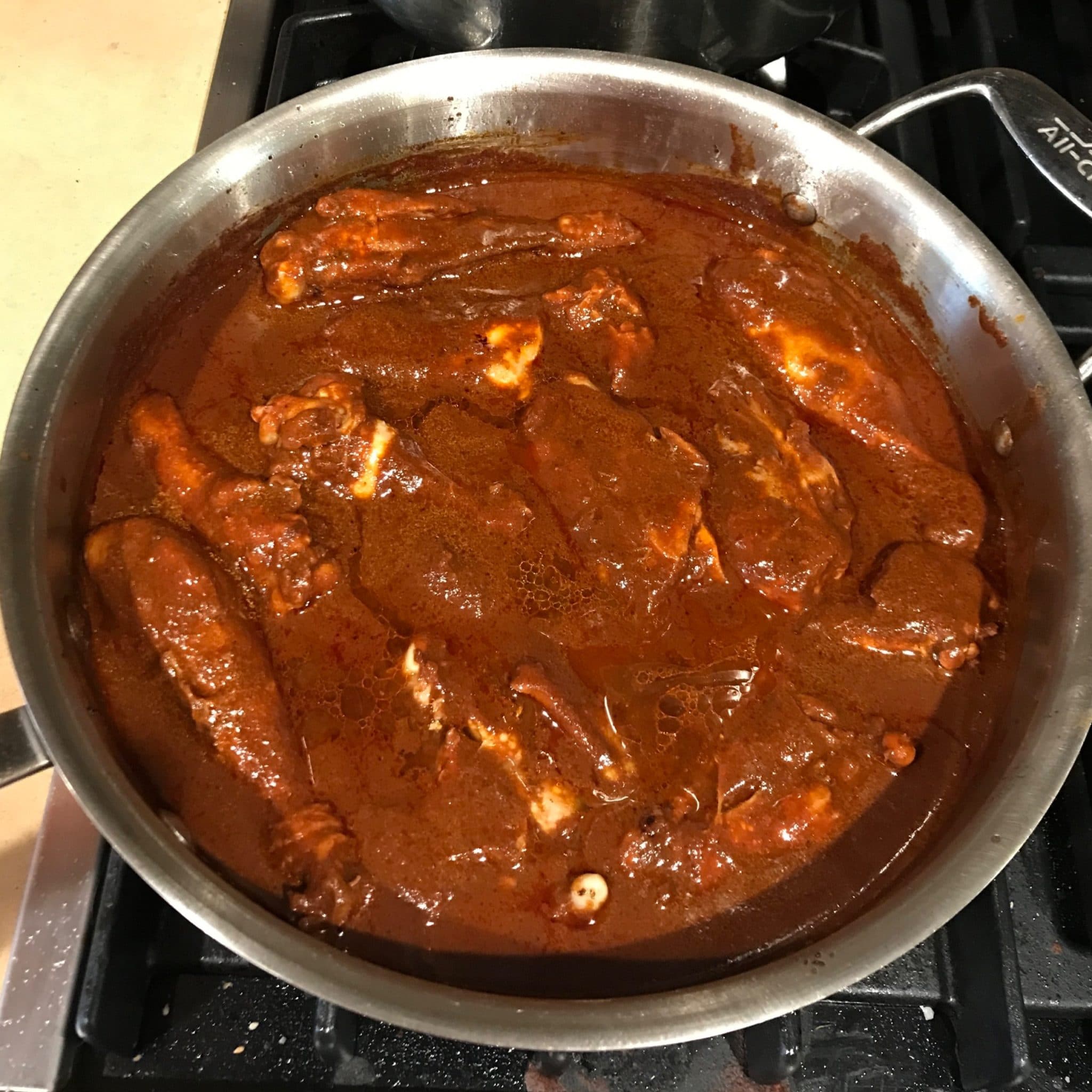
Stir in 4 cups chicken stock and 1 cup finely chopped Mexican chocolate. Simmer, partially covered, for 1 hour, stirring occasionally. Season mole with salt (and optionally sugar) to taste.
Remove from heat, use immediately or transfer to airtight container and store in refrigerator for up to a month. The sauce freezes well.
Notes
The chocolate in this recipe will yield a complex sauce that is not identified as chocolate-y. You may add more chocolate to suit your preferences.
Less oil works for a shallow fry
If the components are too thick to pass through your strainer, try a food mill
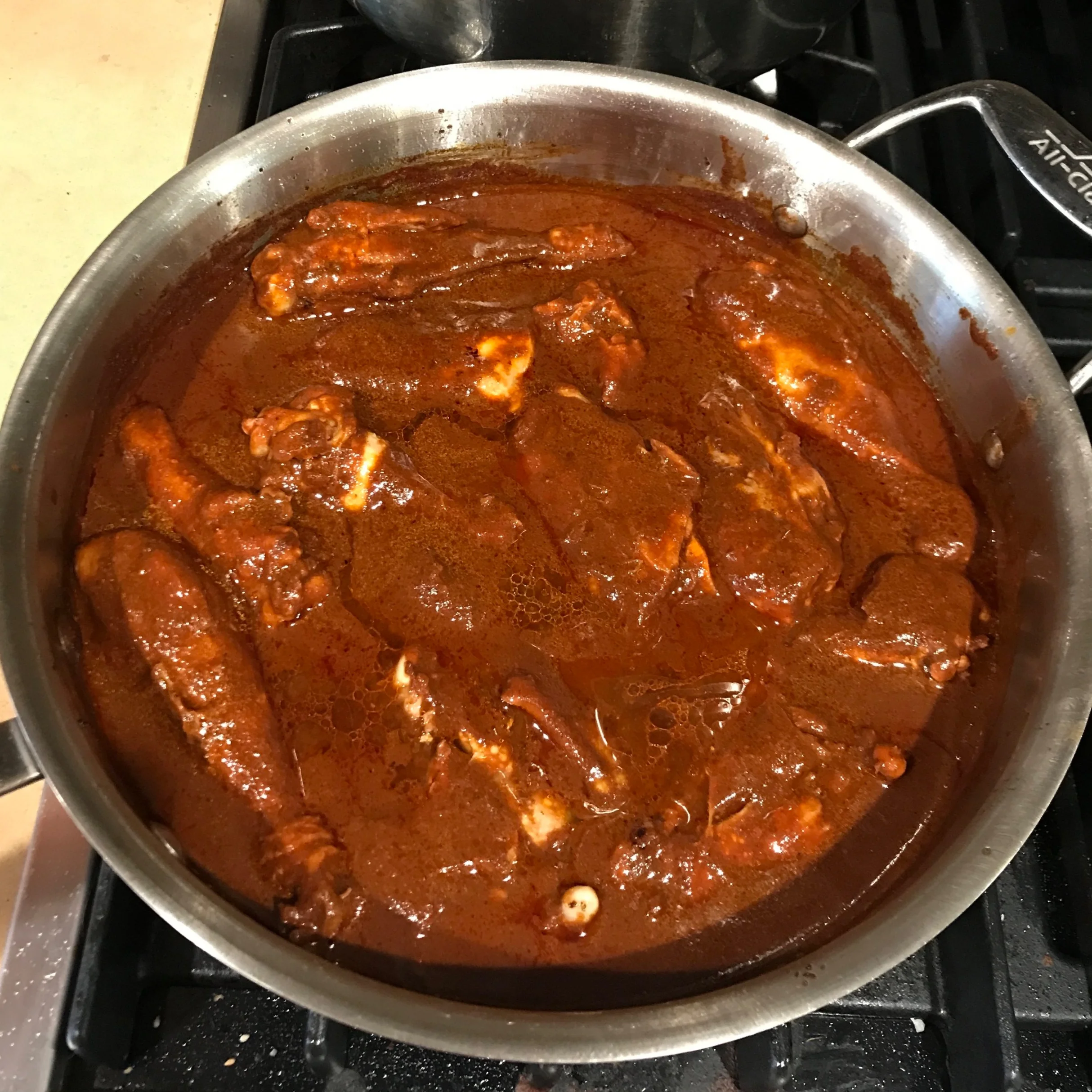
The sauce should be the consistency of heavy cream. If it’s too thick, thin it with a little broth.
A blender works better than a food processor
Don’t purée more than half a blender full at a time.
Don’t add more liquid than is necessary to keep the mixture moving through the blades; if it’s too thin, the entire mixture won’t be drawn through the blades.
Stir the ingredients, blend on low until everything is uniformly chopped, and then blend on high until the purée is smooth when rubbed between your fingers.
If the sauce looks coarse or gritty after simmering, re-blend it until smooth.
Always strain the mixture
Spread the mole making out over three days for maximum flavor (and ease)
Before starting mole: make stock, if there is none on hand
Day 1 – Prepare ingredients and make the purées
Day 2 – sear the purée and combine to complete the sauce
Day 3 – cook the meat in the sauce
Pairings
Serve mole over:
Turkey (traditional)
Chicken
Pork
Lamb
Leftover mole sauce is excellent for making enchiladas, tamales, brunch eggs, or using as a condiment for rice, eggs, and other foods.
You can garnish mole dishes with:
toasted sesame seeds
chopped mint
chopped cilantro
chopped scallions
Variations
Chiles that work well in mole (use 6-12 of each):
chipotle meco
mulato (poblano)
Technically, it distinguishes mole poblano from most other moles
ancho
pasila (chile negro)
chipotle
New Mexico
California
Easy-to-find pepper mix:
12 dried ancho-pasilla chiles
12 dried guajillo chiles
6 dried california chiles
2 chipotles in adobo, seeded and chopped
Kenji’s pepper mix:
12 dried ancho chiles
12 dried guajillo chiles
6 dried pasilla chiles (also called chile negro)
Other ingredients to try:
1/4 cup Walnuts – toasted
1/4 cup Pecans – toasted
1/4 cup pine nuts – toasted
1/2 small ripe (brown or black) plantain, peeled and cut crosswise into 1/2-inch slices
Fry the plantain slices, turning over once, until golden, about 3 minutes.
2 avocado leaves, dried
Shallots (instead of onions)
Variants for ingredient preparation:
You can toast the ingredients instead of frying
Tomato and Tomatillo
Broil or roast at 500F in an oven.
Core the tomato and cut a small “X” through the skin on the opposite end. Roast the tomato, cored side up, and tomatillos on a foil-lined pan, turning the tomatillos over once halfway through, until their tops and bottoms have blackened and they are a khaki-green color and cooked to the core, 20 to 30 minutes
The tomato (without turning) should be cooked until its top is blackened and it’s cooked to the core, 20 to 30 minutes total.
Slip the skin off the tomato.
Using tongs, hold the tortilla directly over a burner set to medium, turning it over frequently, until it’s dark, golden brown, and some burned spots appear on both sides. Crumble it into the soaking fried chiles.
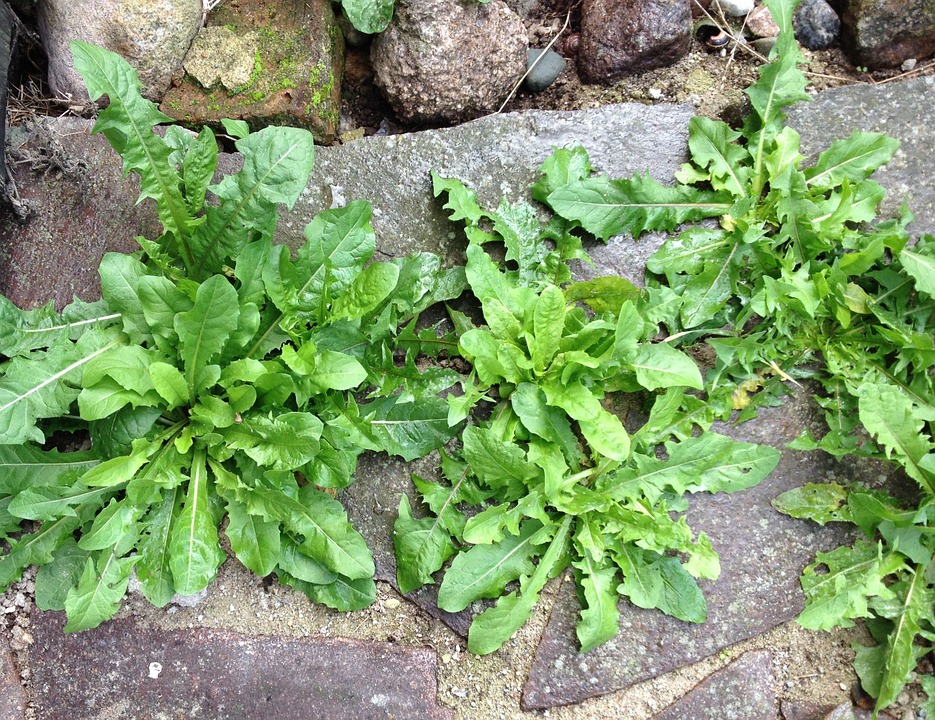
Long live the weeds that overwhelm My narrow vegetable realm! The bitter rock, the barren soil That force the son of man to toil; All things unholy, marked by curse, The ugly of the universe. The rough, the wicked and the wild That keep the spirit undefiled. With these I match my little wit And earn the right to stand or sit, Hope, look, create, or drink and die: These shape the creature that is I.
Once there was a man who filmed his vacation. He went flying down the river in his boat with his video camera to his eye, making a moving picture of the moving river upon which his sleek boat moved swiftly toward the end of his vacation. He showed his vacation to his camera, which pictured it, preserving it forever: the river, the trees, the sky, the light, the bow of his rushing boat behind which he stood with his camera preserving his vacation even as he was having it so that after he had had it he would still have it. It would be there. With a flick of a switch, there it would be. But he would not be in it. He would never be in it.
Drink your tea slowly and reverently, as if it is the axis on which the world earth revolves – slowly, evenly, without rushing toward the future; Live the actual moment. Only this moment is life.
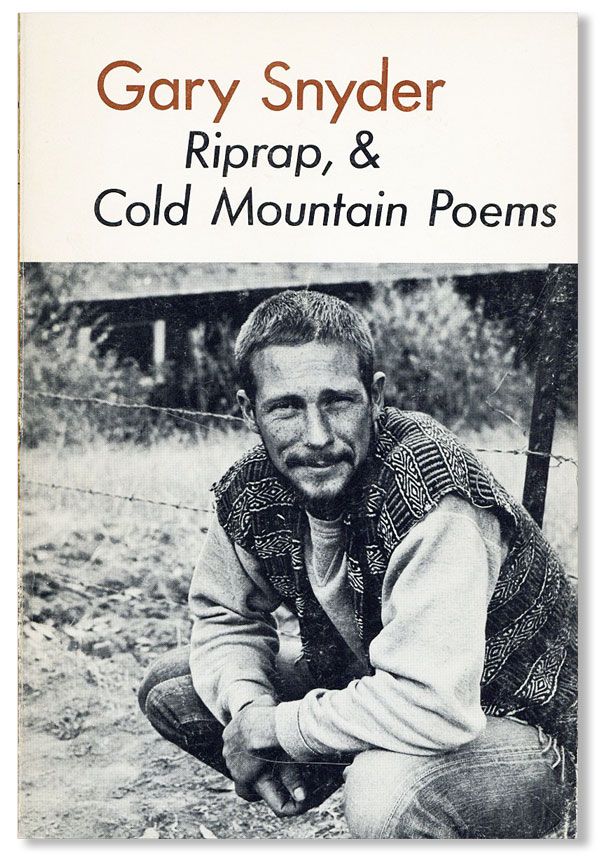
Author: Gary Snyder Rating: 4/5 Read: 4/18, 2/19 Who Should Read: People interested in Zen, poetry, Chinese thought
Hanshan, or “Cold Mountain”, is one of my favorite Chinese poets (alongside Stonehouse). Hahshan was (supposedly) a Chinese Buddhist monk who lived in isolation in the wilderness. The poems attributed to him sparkle with a disdain for civilized life and carry a Zen and Taoist bent.
Cold Mountain Poems is a small collection poems translated by Gary Snyder, who does a wonderful job translating Hanshan’s words and feelings. Included are some of my favorite poems from this collection.
My Highlights
Gary Snyder on why he was qualified to translate Cold Mountain’s poems:
I had been a mountaineer and forestry laborer as well as a bookish scholar for several years already, and simply could draw on a wide experience of events and words and observations in finding ways to represent the Han-shan imagery. I also regularly made a practice of internalizing and visualizing the taste of the whole scene – cold, wet, rocky, lonely, or whatever was called for – to the point that I could write it out with some sense of presence. This doesn’t always work by any means, but it is exciting when it does. It reaches across time and space.
On the interest in such poetry:
At least for non–East Asians, they touch us not because of the invocation of a hermetic ideal or solitary asceticism, but because of the almost joyful rejection of materialism and the absolute pleasure in being in the great world “with a sky for a blanket,” aware of living a life apart from the value-assumptions of mainstream people.
There is a deep strain of non-ideological dubiousness about the large materialistic goals that are the official “dream” of developed-world people and certain others worldwide.
Selected Poems
Here are some of my favorite poems from this collection.
2
In a tangle of cliffs I chose a place – Bird-paths, but no trails for men. What’s beyond the yard? White clouds clinging to vague rocks. Now I’ve lived here – how many years – Again and again, spring and winter pass. Go tell families with silverware and cars “What’s the use of all that noise and money?”
6
Men ask the way to Cold Mountain Cold Mountain: There’s no through trail. In summer, ice doesn’t melt The rising sun blurs in swirling fog How did I make it? My heart’s not the same as yours. If your heart was like mine You’d get it and be right here.
8
Clambering up the Cold Mountain Path, The Cold Mountain Trail goes on and on: The long gorge choked with scree and boulders, The wide cree, the mist-blurred grass. The moss is slippery, though there’s been no rain. The pine sings, but there’s no wind. Who can leap the world’s ties and sit with me among the white clouds?
11
Spring-water in the green creek is clear Moonlight on Cold Mountain is white Silent knowledge – the spirit is enlightened of itself Contemplate the void: this world exceeds stillness
16
Cold Mountain is a house Without beams or walls. The six doors left and right are open The hall is blue sky. The rooms all vacant and vague The east wall beats on the west wall At the center nothing. Borrowers don’t bother me In the cold I build a little fire When I’m hungry I boil up some greens. I’ve got no use for the Kulak With his big barn and pasture – He just sets up a prison for himself. Once in he can’t get out. Think it over – You know it might happen to you.
17
If I hide out at Cold Mountain Living off mountain plants and berries – All my lifetime, why worry? One follows his karma through. Days and months slip by like water, Time is like sparks knocked off flint. Go ahead and let the world change – I’m happy to sit among these cliffs.
20
Some critic tried to put me down – “Your poems lack the basic truth of Tao” And I recall the old-timers Who were poor and didn’t care. I have to laugh at him, He misses the point entirely, Men like that Ought to stick to making money.
Buy the book
If you are interested in purchasing this book, you can support the website by using our Amazon affiliate link.
How many have set themselves up as gatekeepers over the years? They can be found blocking access wherever you turn: God, education, business, sports.
Beware of everything which puts an obstacle between you and God. — Leo Tolstoy
The best approach is to avoid the gate altogether, if you can. There aren’t many truly fixed rules in this game of Life. Why go through the gatekeeper if you can just go around the gate?
You must remain alert as you tread this path. Gatekeeping is a form of power, and the gatekeepers are not keen on losing control.
Most importantly, make sure that you do not act as your own gatekeeper, blocking your own path to success. It’s easy to think that we are not ready, not worthy, not able. We easily hide from direct experience and attainment, preferring to read about what we want in a book instead.
Feel yourself talking to God. Don’t read the book – read your soul. — Ralph Waldeo Emerson