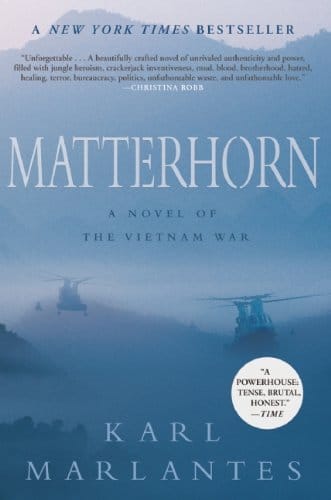
Matterhorn

Author: Karl Marlantes
Rating: 8/10
Last Read: March 2015

Quick Summary: This book follows a young Marine officer and his platoon as they build a firebase and then get sent on various clusterfuck missions through the jungle of Vietnam.

This is called out as a novel, but the author is a decorated Marine officer whose commendation notes read very similarly to the story presented here.  This is a dark picture of what the war was like for many people – and how ego cost the lives of many young men.  The book also paints a stark picture of race relations at the time, and documents struggles between the black and white troops in Vietnam.

The book took a while to get rolling for me, but I think it was worth the read to get insight into this very dark time in our country’s history.

My Highlights

Just speaking about the recent near-encounter with an enemy Mellas had not yet seen started his insides humming again, the vibration of fear that was like a strong electric potential with no place to discharge. –loc 67

Hawke had learned long ago that what really mattered in combat was what people were like when they were exhausted. –loc 199

How could you get mad at someone who neither needed to attack nor was at all worried about being able to defend? –loc 955

“Hey, cool it down.” Hawke looked sideways at Mellas.
“You really do have a temper, don’t you?”
“I’m just tired. I usually don’t.”
“You mean you don’t usually show it.
–loc 1014

Shit, Mellas, drink this. It cures all ills, even vainglory and ambition. The only thing that hurts about a rebuke is the truth.” Mellas took the coffee and smiled. –loc 1599

“How much does it weigh?” Cortell, the leader of the second fire team, who was sitting next to his friend Williams, chuckled.
“Man,” Cortell said, “you can’t carry nothin’ lighter than music.”
–loc 2111

He knew he shouldn’t drink so much, especially alone. But he was alone a lot. After all, he was the battalion commander. It was supposed to be lonely at the top. –loc 3225

But he’s not a good company commander in this kind of war. He got on Simpson’s bad side because he got his picture in the paper too often and never gave Simpson credit, which by the way he doesn’t deserve, but that’s the point. The smart guy gives the guy with the power the credit, whether he deserves it or not. That way the smart guy is dangling something the boss wants. So the smart guy now has power over the boss.” –loc 3844

“Shit, Mellas, don’t get your feelings hurt. I didn’t say I didn’t like you, for Christ’s sake, or you’re some sort of bad person. Although I will grant you the company you’ll keep is going to be sleazier than average. Just accept that you’re a fucking politician. So was Abraham Lincoln, and Winston Churchill. So was Dwight Eisenhower.” He paused. “It ain’t like they’re bad people. And they all ran a pretty good war.” –loc 3855

Coates turned to Mellas, his eyes dancing with deep humor. “Cool down, Lieutenant Mellas. Colonel Mulvaney will never let him near the place. You don’t commit an entire battalion to an area covered by enemy artillery that we can’t go after because of political reasons. Add to that uncertain air support because of the weather. That’s why Mulvaney pulled us out in the first place. Return to Matterhorn? Nevah hoppin.”
Mellas was surprised. “Here I thought you were a lifer,” he said, smiling.
“I am, Lieutenant Mellas. But I ain’t stupid. And I also know how to keep my mouth shut.” –loc 4793

“May you be ten minutes in heaven before the devil knows you’re gone,” Simpson said, raising his glass and gulping a large swallow. Blakely was aware that Simpson prided himself on knowing many different toasts in different languages. He smiled appropriately and drank. Simpson drank some more. “Good fucking stuff,” he said. –loc 4915

Now, seeing the Marines run across the landing zone, Mellas knew he could never join that cynical laughter again. Something had changed. People he loved were going to die to give meaning and life to what he’d always thought of as meaningless words in a dead language. –loc 5160

“Does it mean Meaker will die?” Sheller looked over at the two kids he’d picked for death. He didn’t want to answer Merritt’s question. He wanted to lie, even to himself.
“I think you’ll all make it,” he said.
“Don’t fucking lie to me, Squid. I don’t have time for it.”
Again Merritt took a quivering breath, biting back the scream that wanted to erupt whenever he filled his lungs. “If I’m going to live because of Meaker, I want to know it. And I want to live.”
Sheller put his hand on Merritt’s uniform. “The thing is, we might be wasting plasma on Meaker. He keeps bleeding inside and I can’t stop it. You’re not bleeding as fast as he is.”
Merritt looked at Sheller. “I’ll never forget it, Squid. I fucking promise.” Then he turned his head toward Meaker’s unconscious body. “Meaker, you dumb son of a bitch,” he whispered. “I ain’t never going to forget it.”
Meaker died three hours later. Sheller and Fredrickson dragged him out of the bunker and stacked him on the foggy landing zone with the rest of the bodies. –loc 5783

He remembered a lecture about how mortars are fairly ineffective against troops that are dug in. But the lecturer hadn’t mentioned the psychological effect on the troops. –loc 6074

What bothered Mulvaney was that he knew the NVA felt they were buying something worth the price: their country. –loc 6161

And it was his worth that was the joke. He was nothing but a collection of empty events that would end as a faded photograph above his parents’ fireplace. They too would die, and relatives who didn’t know who was in the picture would throw it away. Mellas knew, in his rational mind, that if there was no afterlife, death was no different from sleep. But this cruel flood was not from his rational mind. It had none of the ephemerality of thought. It was as real as the mud he sat in. Thought was just more of the nothing that he had done all his life. The fact of his eventual death shook him like a terrier shaking a rat. He could only squeal in pain. –loc 6310

And then? A career in law? A little prestige? A little money? Perhaps a political office? And then, dead. Dead. The laughter turned him inside out, exposing his most secret parts. He lay before God as a woman opens herself to a man, with legs apart, stomach exposed, arms open. But unlike some women, he did not have the inner strength that allowed them to do such a thing without fear. There was no woman’s strength in Mellas at all. –loc 6317

Mellas’s new insight didn’t change anything, at least on the outside, but Mellas knew he wouldn’t play dead. He’d been playing dead all his life. He would not slip into the jungle and save himself, because that self didn’t look like anything worth saving. He’d choose to stay on the hill and do what he could to save those around him. The choice comforted him and calmed him down. –loc 6324

Dying this way was a better way to die because living this way was a better way to live. –loc 6327

Resting it against a log, he settled in to watch and wait. An hour passed. Goodwin had the patience of a born hunter. He lived in no-time, leaving it only briefly to shift his body. –loc 6346

The lecture from the Basic School floated into his memory. “A Marine never surrenders as long as he has the means to resist. And we teach you fucking numbies hand-to-hand combat. So if your hands are blown off, you can surrender—only you’ll have to raise your legs.” They had laughed. –loc 6668

“Next to Column in the Defense, the Funnel Breakaway could be my greatest contribution to military science yet,” –loc 6751

“I always thought deep down we were the same,” he said. “We are the same. Hell, I got two white great-grandpas, just like you. It’s just that we seen things differently so long we ain’t able to talk about it much.” –loc 6780

“You think someone’s going to understand how you feel about being in the bush? I mean even if they’re like you in every way, you really think they’re going to understand what it’s like out here? Really understand?” “Probably not.” “Well, it’s like that being black. Unless you’ve been there, ain’t no way.” –loc 6783

“Look. The colonel’s an asshole. The Three’s an asshole. Fine. I agree. All I’m saying, Mellas, is don’t you ever wonder why they’re assholes? Do you think they enjoy spending every minute of their tiny lives worried that someone’s going to shit on them because one of their companies didn’t make a checkpoint on time? I’m not saying to forget that they’re assholes. I’m just saying when you call someone a name, have some compassion. Label the shit out of them, but who they are and who you are is as much about luck as anything else.” –loc 7183

“You’ve got brains, you know where you’re going, how to get there. You call that nothing?” –loc 7192

Being human was the best he could do. Without man there would be no evil. But there was also no good, nothing moral built over the world of fact. Humans were responsible for it all. He laughed at the cosmic joke, but he felt heartsick. –loc 7900

There were white girls in Sydney. Round-eyes. Maybe he’d go to the outback. A quiet farm with sheep. Maybe he’d fall in love there. Maybe he’d save his eye. Everything seemed to be part of a cycle as he stared into the gray nothingness above him, hearing the wash of distant waves on a warm beach, feeling the sun pulling his body upward like evaporating rain. –loc 7920

“Between the emotion and the response, the desire and the spasm, falls the shadow,” –loc 8004

Emotion constricted Hawke’s throat. He suddenly understood why the victims of concentration camps had walked quietly to the gas chambers. In the face of horror and insanity, it was the one human thing to do. Not the noble thing, not the heroic thing—the human thing. To live, succumbing to the insanity, was the ultimate loss of pride. –loc 8285

Dead people ain’t worth shit. They just big nothins. –loc 8436

He also knew that although Henry’s image had taken a hit, power always trumped image—and, he was beginning to learn, ideology. Power was the ability to reward and punish. Henry could reward with money and drugs. He could punish by withholding money and drugs. A nice combination. Ultimately, however, Henry wielded the power of punishment held only by a self-selected few. He was willing to murder. China knew that if a man could kill someone, everyone knew that he could kill anyone. The only way to stand up to that kind of power was to be willing to –loc 8469

Revenge would heal nothing. Revenge had no past. It only started things. It only created more waste, more loss, and he knew that the waste and loss of this night could never be redeemed. There was no filling the holes of death. The emptiness might be filled up by other things over the years—new friends, children, new tasks—but the holes would remain. –loc 8875

He knew that there could be no meaning to someone who was dead. Meaning came out of living. Meaning could come only from his choices and actions. Meaning was made, not discovered. He saw that he alone could make Hawke’s death meaningful by choosing what Hawke had chosen, the company. The things he’d wanted before—power, prestige—now seemed empty, and their pursuit endless. What he did and thought in the present would give him the answer, so he would not look for answers in the past or future. Painful events would always be painful. The dead are dead, forever. –loc 8890

Each of the names evoked a remembered face, an outstretched hand reaching down from a rock or across a rushing stream—or a look of fear as a friend realized that death had come for him. –loc 8918

The chanting went on, the musicians giving in to the rhythm of their own being, finding healing in touching that rhythm, and healing in chanting about death, the only real god they knew. –loc 8921

He knew that all of them were shadows: the chanters, the dead, the living. All shadows, moving across this landscape of mountains and valleys, changing the pattern of things as they moved but leaving nothing changed when they left. Only the shadows themselves could change. –loc 8926

Hagakure

Author: Yamamoto Tsunetomo
Rating: 7/10
Last Read: August 2015

Quick Summary: A collection of notes from the early 1700s meant to serve as a guide for warriors.  The book summarizes the author’s view of the warrior code (in the context of bushido).  The book touches on many practical and spiritual points, as well as highlights many interesting facts of life for the time period.

There are many practical things that modern man can still draw from this historic work, assuming westerners can handle the fixation with death that flows through the work. (But really, you’re going to die too!)

My Highlights

To say that dying without reaching one’s aim is to die a dog’s death is the frivolous way of sophisticates. When pressed with the choice of life or death, it is not necessary to gain one’s aim. –loc 28

We all want to live. And in large part we make our logic according to what we like. But not having attained our aim and continuing to live is cowardice. –loc 29

If by setting one’s heart right every morning and evening, one is able to live as though his body were already dead, he pains freedom in the Way. His whole life will be without blame, and he will succeed in his calling. –loc 31

Having only wisdom and talent is the lowest tier of usefulness. –loc 37

According to their nature, there are both people who have quick intelligence, and those who must withdraw and take time to think things over. Looking into this thoroughly, if one thinks selflessly and adheres to the four vows of the Nabeshima samurai, surprising wisdom will occur regardless of the high or low points of one’s nature.’ People think that they can clear up profound matters if they consider them deeply, but they exercise perverse thoughts and come to no good because they do their reflecting with only self-interest at the center. –loc 38

Men of high position, low position, deep wisdom and artfulness all feel that they are the ones who are working righteously, but when it comes to the point of throwing away one’s life for his lord, all get weak in the knees. –loc 64

To discover the good and bad points of a person is an easy thing, and to give an opinion concerning them is easy, too. For the most part, people think that they are being kind by saying the things that others find distasteful or difficult to say. But if it is not received well, they think that there is nothing more to be done. This is completely worthless. It is the same as brining shame to a person by slandering him. It is nothing more than getting it off one’s chest. –loc 72

When I observed the application of men’s treatment to men, there was no result. Thus I knew that men’s spirit had weakened and that they had become the same as women, and the end of the world had come. –loc 101

The Way is in a higher place then righteousness. This is very difficult to discover, but it is the highest wisdom. When seen from this standpoint, things like righteousness are rather shallow. If one does not understand this on his own, it cannot be known. There is a method of getting to this Way, however, even if one cannot discover it by himself. This is found in consultation with others. Even a person who has not attained this Way sees others front the side. –loc 121

Listening to the old stories and reading books are for the purpose of sloughing off one’s own discrimination and attaching oneself to that of the ancients. –loc 126

Although all things are not to be judged in this manner, I mention it in the investigation of the Way of the Samurai. When the time comes, there is no moment for reasoning. And if you have not done your inquiring beforehand , there is most often shame. Reading books and listening to people’s talk are for the purpose of prior resolution. –loc 168

Above all, the Way of the Samurai should be in being aware that you do not know what is going to happen next, and in querying every item day and night. Victory and defeat are matters of the temporary force of circumstances. The way of avoiding shame is different. It is simply in death. –loc 171

Even if it seems certain that you will lose, retaliate. Neither wisdom nor technique has a place in this. A real man does not think of victory or defeat. He plunges recklessly towards an irrational death. By doing this, you will awaken from your dreams. –loc 173

It is not good to settle into a set of opinions. It is a mistake to put forth effort and obtain some understanding and then stop at that. –loc 184

Do not rely on following the degree of understanding that you have discovered, but simply think, “This is not enough.” –loc 186

How should a person respond when he is asked, “As a human being, what is essential in terms of purpose and discipline?” First, let us say, “It is to become of the mind that is right now pure and lacking complications.” People in general all seem to be dejected. When one has a pure and uncomplicated mind, his expression will be lively. When one is attending to matters, there is one thing that comes forth from his heart. That is, in terms of one’s lord, loyalty; in terms of one’s parents, filial piety; in martial affairs, bravery ; and apart from that, something that can be used by all the world. –loc 199

This is very difficult to discover. Once discovered, it is again difficult to keep in constant effect. There is nothing outside the thought of the immediate moment. –loc 203

Although it seems that taking special care of one’s appearance is similar to showiness, it is nothing akin to elegance. Even if you are aware that you may be struck down today and are firmly resolved to an inevitable death, if you are slain with an unseemly appearance, you will show your lack of previous resolve, will be despised by your enemy, and will appear unclean. For this reason it is said that both old and young should take care of their appearance. –loc 207

And if he thinks that this is not shameful, and feels that nothing else matters as long as he is comfortable, then his dissipate and discourteous actions will be repeatedly regrettable. –loc 214

What things a person should be able to accomplish if he had no haughtiness concerning his place in society! –loc 222

Look at the human condition. It is unseemly for a person to become prideful and extravagant when things are going well. Therefore, it is better to have some unhappiness while one is still young, for if a person does not experience some bitterness, his disposition will not settle down. –loc 241

There is surely nothing other than the single purpose of the present moment. A man’s whole life is a succession of moment after moment. If one fully understands the present moment, there will be nothing else to do, and nothing else to pursue. Live being true to the single purpose of the moment . –loc 267

Everyone lets the present moment slip by, then looks for it as though he thought it were somewhere else. No one seems to have noticed this fact. But grasping this firmly, one must pile experience upon experience. And once one has come to this understanding he will be a different person from that point on, though he may not always bear it in mind. –loc 270

As Yasuda Ukyo said about offering up the last wine cup, only the end of things is important. One’s whole life should be like this. When guests are leaving, the mood of being reluctant to say farewell is essential. If this mood is lacking, one will appear bored and the day and evening’s conversation will disappear. In all dealings with people it is essential to have a fresh approach. One should constantly give the impression that he is doing something exceptional. It is said that this is possible with but a little understanding. –loc 291

Whether people be of high or low birth, rich or poor, old or young, enlightened or confused, they are all alike in that they will one day die. It is not that we don’t know that we are going to die, but we grasp at straws. While knowing that we will die someday, we think that all the others will die before us and that we will be the last to go. Death seems a long way oft . –loc 343

insofar as death is always at one’s door, one should make sufficient effort and act quickly. –loc 347

One should think well and then speak. This is clear and firm, and one should learn it with no doubts. It is a matter of putting forth one’s whole effort and having the correct attitude previously. –loc 368

Human life is truly a short affair. It is better to live doing the things that you like. It is foolish to live within this dream of a world seeing unpleasantness and doing only things that you do not like. But it is important never to tell this to young people as it is something that would be harmful if incorrectly understood. –loc 371

What is done casually and freely will not work out well. It is a matter of attitude. –loc 399

People with intelligence will use it to fashion things both true and false and will try to push through whatever they want with their clever reasoning. This is injury from intelligence . Nothing you do will have effect if you do not use truth. –loc 418

To go without knowing whether the other party is busy, or when he has some particular anxiety, is awkward. There is nothing that surpasses not going where you have not been invited. –loc 427

The late Jin’emon said that it is better not to bring up daughters. They are a blemish to the family name and a shame to the parents. The eldest daughter is special, but it is better to disregard the others. –loc 432

The late Nakano Kazuma said that the original purpose of the Tea Ceremony is to cleanse the six senses. For the eyes there are the hanging scroll and flower arrangement. For the nose there is the incense. For the ears there is the sound of the hot water. For the mouth there is the taste of the tea. And for the hands and feet there is the correctness of term. When the five senses have thus been cleansed, the mind will of itself be purified. The Tea Ceremony will cleanse the mind when the mind is clogged up. –loc 436

A person who does not set himself in just one direction will be of no value at all. –loc 498

It is fine for retired old men to learn about Buddhism as a diversion, but if a warrior makes loyalty and filial piety one load, and courage and compassion another, and carries these twenty-four hours a day until his shoulders wear out, he will be a samurai. –loc 499

A man’s whole life should be like this. To exert oneself to a great extent when one is young and then to sleep when he is old or at the point of death is the way it should be. But to first sleep and then exert oneself . . . To exert oneself to the end, and to end one’s whole life in toil is regrettable.” –loc 629

“If a retainer will just think about what he is to do for the day at hand, he will be able to do anything. If it is a single day’s work, one should be able to put up with it. Tomorrow, too, is but a single day.” –loc 700

“To be prideful about your strength while your mettle is not yet established is likely to bring you shame in the midst of people. You are weaker than you look.” –loc 860

Everyone says that no masters of the arts will appear as the world comes to an end. This is something that I cannot claim to understand. Plants such as peonies, azaleas and camellias will be able to produce beautiful flowers, end of the world or not. If men would give some thought to this fact, they would understand. –loc 928

The basic meaning of etiquette is to be quick at both the beginning and end and tranquil in the middle. Mitani Chizaemon heard this and said, “That’s just like being a kaishaku. –loc 965

There was no goodness visible to Tesshu’s eyes. It is not a good idea to praise people carelessly. When praised, both wise and foolish become prideful. To praise is to do harm.” –loc 970

When there is something to be said, it is better if it is said right away. If it is said later, it will sound like an excuse. –loc 1098

How will a man who has doubts even in his own room achieve anything on the battlefield? There is a saying that goes, “No matter what the circumstances might be, one should be of the mind to win. One should be holding the first spear to strike.” –loc 1134

To ask when you already know is politeness. To ask when you don’t know is the rule. –loc 1156

The essentials of speaking are in not speaking at all. If you think that you can finish something without speaking, finish it without saying a single word. If there is something that cannot be accomplished without speaking, one should speak with few words, in a way that will accord well with reason –loc 1206

Meditation on inevitable death should be performed daily. Every day when one’s body and mind are at peace, one should meditate upon being ripped apart by arrows, rifles, spears and swords, being carried away by surging waves, being thrown into the midst of a great fire, being struck by lightning, being shaken to death by a great earthquake, falling from thousand-foot cliffs, dying of disease or committing seppuku at the death of one’s master. And every day without fail one should consider himself as dead. –loc 1226

People will become your enemies if you become eminent too quickly in life, and you will be ineffectual. Rising slowly in the world, people will be your allies and your happiness will he assured. –loc 1232

The Warrior Ethos

Author: Steven Pressfield
Rating: 6/10
Last Read: June 2014

Quick Summary: This is a quick read.  Pressfield examines the warrior values and mindset in a variety of cultures throughout history. This book is pretty quick and segmented, structured as almost a series of thoughts on various topics related to the warrior ethos.  

Mostly it’s a collection of statements with some anecdotes – it could have been more fully fleshed out to be really something good. There are still interesting precepts to mull over – that provides value to me, even if the overall text is weak.

My Highlights

The Spartans do not ask how many are the enemy but where are they. —Plutarch –loc 15

At a deeper level, the Warrior Ethos recognizes that each of us, as well, has enemies inside himself. Vices and weaknesses like envy and greed, laziness, selfishness, the capacity to lie and cheat and do harm to our brothers. The tenets of the Warrior Ethos, directed inward, inspire us to contend against and defeat those enemies within our own hearts. –loc 106

Be brave, my heart [wrote the poet and mercenary Archilochus]. Plant your feet and square your shoulders to the enemy. Meet him among the man-killing spears. Hold your ground. In victory, do not brag; in defeat, do not weep. –loc 118

The god who ruled the battlefield was Phobos. Fear. –loc 123

The Spartan king Agesilaus was once asked what was the supreme warrior virtue, from which all other virtues derived. He replied, “Contempt for death.” –loc 139

Courage—in particular, stalwartness in the face of death—must be considered the foremost warrior virtue. –loc 141

The dictionary defines ethos as: The moral character, nature, disposition and customs of a people or culture. –loc 145

“You’ve got the watches,” say the Taliban, “but we’ve got the time.” –loc 171

Individuals in a guilt-based culture internalize their society’s conceptions of right and wrong. The sinner feels his crime in his guts. He doesn’t need anyone to convict him and sentence him; he convicts and sentences himself. –loc 204

The West is a guilt-based culture. Since the Judeo-Christian God sees and knows our private deeds and innermost thoughts, we are always guilty of something, with no way out save some form of divine absolution, forgiveness or grace. –loc 206

A shame-based culture is the opposite. In a shame-based culture, “face” is everything. All that matters is what the community believes of us. –loc 208

The Japanese warrior culture of Bushido is shame-based; it compels those it deems cowards or traitors to commit ritual suicide. The tribal cultures of Pashtunistan are shame-based. The Marine Corps is shame-based. So were the Romans, Alexander’s Macedonians and the ancient Spartans. –loc 213

There’s a well-known gunnery sergeant in the Marine Corps who explains to his young Marines, when they complain about pay, that they get two kinds of salary—a financial salary and a psychological salary. The financial salary is indeed meager. But the psychological salary? Pride, honor, integrity, the chance to be part of a corps with a history of service, valor, glory; to have friends who would sacrifice their lives for you, as you would for them—and to know that you remain a part of this brotherhood as long as you live. How much is that worth? –loc 285

This is another key element of the Warrior Ethos: the willing and eager embracing of adversity. –loc 413

The payoff for a life of adversity is freedom. –loc 419

“You may defeat us,” said the tribal elders, “but you will never defeat our poverty.” –loc 423

For warrior cultures—from the Sioux and the Comanche to the Zulu and the mountain Pashtun—honor is a man’s most prized possession. Without it, life is not worth living. –loc 439

The American brand of honor is inculcated on the football field, in the locker room and in the street. Back down to no one, avenge every insult, never show fear, never display weakness. Play hurt, never quit. –loc 446

Honor is the psychological salary of any elite unit. Pride is the possession of honor. –loc 457

Honor is connected to many things, but one thing it’s not connected to is happiness. In honor cultures, happiness as we think of it—“life, liberty and the pursuit of happiness”—is not a recognized good. Happiness in honor cultures is the possession of unsullied honor. Everything else is secondary. –loc 458

Patton said, “Americans play to win at all times. I wouldn’t give a hoot in hell for a man who lost and laughed. That’s why Americans have never lost a war and never will lose one.” –loc 478

The will to fight, the passion to be great, is an indispensable element of the Warrior Ethos. It is also a primary quality of leadership, because it inspires men and fires their hearts with ambition and the passion to go beyond their own limits. –loc 480

Second, they don’t solve the problem. Neither remark offers hope or promises a happy ending. They’re not inspirational. The deliverers of these quips don’t point to glory or triumph—or seek to allay their comrades’ anxiety by holding out the prospect of some rosy outcome. The remarks confront reality. They say, “Some heavy shit is coming down, brothers, and we’re going to go through it.” –loc 527

For the warrior, all choices have consequences. His decisions have meaning; every act he takes is significant. What he says and does can save (or cost) his own life or the lives of his brothers. –loc 545

Selflessness is a virtue in a warrior culture. Civilian society gives lip service to this, while frequently acting as selfishly as it possibly can. –loc 570

Cyrus of Persia believed that the spoils of his victories were meant for one purpose—so that he could surpass his enemies in generosity. I contend against my foes in this arena only: the capacity to be of greater service to them than they are to me. –loc 617

Let us conduct ourselves so that all men wish to be our friends and all fear to be our enemies. –loc 622

The Bhagavad-Gita changes this. It takes the Warrior Ethos and elevates it to a loftier and nobler plane—the plane of the individual’s inner life, to his struggle to align himself with his own higher nature. –loc 641

In other words, by the interior exercise of his exterior Warrior Ethos. Arjuna’s divine instructor (one of whose titles in Sanskrit is “Lord of Discipline”) charges his disciple to: Fix your mind upon its object. Hold to this, unswerving, Disowning fear and hope, Advance only upon this goal. –loc 648

Collective Unconscious, meaning that part of the psyche that is common to all cultures in all eras and at all times. –loc 675

The Collective Unconscious, Jung said, contains the stored wisdom of the human race, accumulated over thousands of generations. –loc 676

The lieutenant pointed to Alexander and said to the yogi, “This man has conquered the world! What have you accomplished?”
The yogi looked up calmly and replied, “I have conquered the need to conquer the world.” –loc 704

What Alexander was acknowledging was that the yogi was a warrior too. An inner warrior. Alexander looked at him and thought, “This man was a fighter when he was my age. He has taken the lessons he learned as a warrior dueling external enemies and is turning them to use now as he fights internal foes to achieve mastery over himself.” –loc 709

The hardest thing in the world is to be ourselves. –loc 714

Let us be, then, warriors of the heart, and enlist in our inner cause the virtues we have acquired through blood and sweat in the sphere of conflict—courage, patience, selflessness, loyalty, fidelity, self-command, respect for elders, love of our comrades (and of the enemy), perseverance, cheerfulness in adversity and a sense of humor, however terse or dark. –loc 726

Tides of War

Author: Steven Pressfield
Rating: 9/10
Last Read: September 2014

Quick Summary: Another novel in Steven Pressfield’s historical series – this one focuses on the  Peloponnesian War and the historical figure Alcibiades.  The novel is again told through the eyes of a minor character, an Athenian soldier fighting in the war.  Other historical characters make an appearance, including Lysander, Socrates, and Pericles.  

Alcibiades is a prime example of an individual who was brought down by his own ego.  Ego is your enemy, remember that.

Further Reading: The Virtues of War, Gates of Fire

My Highlights

Men hate nothing worse than that mirror held before them whose reflection displays their own failure to prove worthy of themselves. –loc 273

“Banish all thought of retreat, brothers. No avenue remains but to advance, and no alternative save victory or death.” –loc 396

Experience teaches that however numerous the brigade or army, the work of war is performed by small units, and each must possess to be effective one man like Lion who is unacquainted with fear, who arises cheerful each morning despite all hardship, ready to shoulder another’s load with a laugh and turn his hand to all tasks, however mean or humble. A unit lacking a man like Lion will never endure, while one with such a mate may be beaten but never broken. –loc 449

A beautiful woman is in the same fix. She cannot but perceive herself as two creatures—the private soul known to her intimates and that external proxy presented to the world by her good looks. The attention she receives may be gratifying to her vanity, but it is empty and she knows it. –loc 538

They sought only the surface, and for reasons of their own vanity. –loc 543

As an actor you of all people should know that death takes many and far more evil forms than the physical. Isn’t that what tragedy is all about? –loc 550

“Note further, gentlemen, that this single quality by which we convict these women and sentence them to exile from humanity is one over which they themselves possess no authority, a quality thrust upon them willy-nilly at birth. This is the antithesis of freedom, is it not? It is the use one makes of a slave. We treat even our dogs and horses better, granting to them their subtleties and contradictions of character and esteeming or contemning them thereby.” Socrates drew up and inquired of the company if any found fault with his meditation thus far. He was endorsed by all and exhorted to continue. “And yet we who consider ourselves free men often act in this manner not only toward others but toward ourselves as well. We account and define our persons by qualities gifted to or deprived us at birth, to the exclusion of those earned or acquired thereafter, brought into being by enterprise and will. This to my mind is an evil greater than degradation. It is self-degradation.” –loc 575

Socrates resumed. “Pondering this state of self-slavery, I began to puzzle: what precisely are the qualities which make men free?”
“Our will, as you said,” put in Acumenus the physician.
“And the force to exercise it,” added Mantitheus.
–loc 584

“No doubt with my poor cloak and sword–barbered beard I am perceived throughout the camp as a figure of fun. Yet I maintain that, unfettered by the constraints of the mode, I am the most free of men.” –loc 600

“Which takes precedence, do we believe, man or law? To set a man above the law is to negate law entire, for if the laws do not apply equally to all, they apply to none. To install one man upon such a promontory founds that flight of steps by which another may later ascend. –loc 623

In fact I suspect, don’t you, brothers, that when our companion nominates myself as indispensable, his intent is to establish that precedent by which he may next anoint himself.” –loc 625

His Theory of Forms arises from that selfsame interpretation. As the material manifestation of an individual horse embodies the particular and the transitory, Plato suggested, so must there exist within some higher realm the ideal form of Horse, universal and immutable, of which all corporeal horses “partake” or “participate in.” –loc 864

Democracy is a sword which cuts two ways. It emancipates the individual, setting him free to shine as no other scheme of governance. But that blade possesses an under-edge. Its spawn is spite and envy. This is why Pericles bore himself with modesty, remote from the multitude, for fear of their jealousy.” –loc 1167

“You came this close, Alcibiades,” Lysander is said to have spoken.
In response his adversary quoted the proverb “Close captures no crowns.”
To which Lysander replied, “God grant that be your epitaph,” and, turning, spurred away. –loc 1700

What I fear has nothing to do with groves or vines, Callicles, but the virtues which cultivation of the land imparts: modesty, patience, reverence for the gods, of which this Alcibiades knows little and cares less. He is a product of the city and evinces all its vices: vanity, arrogance, impatience, and immodesty before heaven.” –loc 2041

You define yourselves not as who you are, but as who you may become, and hasten over oceans to this shore you can never reach. –loc 2133

“Hope is a dangerous liquor,” my savior Lysander had addressed the ephorate in a speech so notorious it had actually been written down and circulated, unheard-of in Lacedaemon. “War has unstoppered the flasket, and nothing may seal it again.” –loc 3768

“How does one lead free men?”
“By being better than they,” Alcibiades responded at once. –loc 4089

“A commander’s role is to model arete, excellence, before his men. One need not thrash them to greatness; only hold it out before them. They will be compelled by their own nature to emulate it.” –loc 4096

If force must be employed with a subordinate, take care that it be minimal. If I command you, “Pick up that bowl,” and set a swordpoint to your back, you will obey but no part will own the action. You will exculpate yourself, accounting, “He made me do it, I had no choice.” But if I only suggest and you comply, then you must own your compliance and, owning it, stand by it. –loc 4223

Corollary to the principle of minimal force was that of minimal supervision. When Alcibiades issued a combat assignment, he imparted the objective only, leaving the means to the officer himself. The more daunting the chore, the more informally he commanded it. I never saw him issue an order from behind a desk. –loc 4242

Always assign a man more than he believes himself capable of. Make him rise to the occasion. In this way you compel him to discover fresh resources, both in himself and others of his command, thus enlarging the capacity of each, while binding all beneath the exigencies of risk and glory. –loc 4245

As we seek to make our enemies own their defeats at our hands, so we must make our friends own their victories. The less you give a man, and have him succeed, the more he draws his achievement to his heart. Remember we may elevate the fleet in two ways only. By acquiring better men or making those we have better. Even were the former practicable I would disdain it, for a hired man may hire out to another master but a man who makes himself master stays loyal forever. There was an oarsman –loc 4248

Shit rolls downhill, soldiers say, but so does confidence. –loc 5327

Courage is born of obedience. It is the issue of selflessness, brotherhood, and love of freedom. Boldness, on the other hand, is spawned of defiance and disrespect; it is the bastard brat of irreverence and outlawry. –loc 5385

“Let me phrase the question differently. Do we believe that the law, even an unjust law, must be obeyed? Or may the individual take it on himself to decide which laws are just and which unjust, which worthy of obedience and which not?”
I protested that it was not justice which Socrates had received, and thus its disallowance was legitimate.
“Let us hear your opinion, Jason. Is it better to perish through injustice inflicted upon one by others, or to live, having inflicted injustice on them?” –loc 5964

“You forget one, Jason, upon whom I would be inflicting injustice. The Laws. Suppose the Laws sat among us now. Might they not say something like this: ‘Socrates, we have served you all your life. Beneath our protection you grew to manhood, married, and raised a family; you pursued your livelihood and studied philosophy. You accepted our boons and the security we provided. Yet now, when our verdict no longer suits your convenience, you wish to put us aside.’ How would we answer the Laws?”
“Some men must be set above the laws.”
“How can you strike this posture, my friend, who argued with such fervor, that day, the contravening course?” –loc 5970

The supreme mystery of existence is this: that, perceiving it for what it is, we yet cling to it. And existence, despite all, discovers measures to reanimate our despoliated hearts. –loc 6186

He would lecture me, I knew, on vices. Three he abhorred—fear, hope, and love of country. He abominated only one beyond these: contemplation of past or future. These were offenses against nature, Telamon maintained, as they bound one to aspiration, to a result whose issue was adjudicated by forces, above the earth and beneath, which mortals may neither alter nor apprehend. Alcibiades was guilty of these, my mate observed, and of another violation of heaven’s law. Alcibiades perceived war as a means. In truth it was an end. Where our commander claimed to honor only Necessity, Telamon served a divinity more primordial. –loc 6414

War waged for advantage yields only ruin. Yet one may not disown war, which abides as constant as the seasons and eternal as the tides. –loc 6424

“What world is it you seek, Pommo, that is ‘better’ than this? Do you imagine like Alcibiades that you, or Athens, may elevate yourselves or anyone to some loftier sphere? This world is the only one that exists. Learn its laws and obey them. This is true philosophy.” –loc 6426

what is nobility that a beast may own it as well as a man? Is it not that capacity of soul by which one donates himself to an object greater than his own self-interest? –loc 6662

How lead free men? Only by this means: the summoning of each to his nobility. –loc 6663

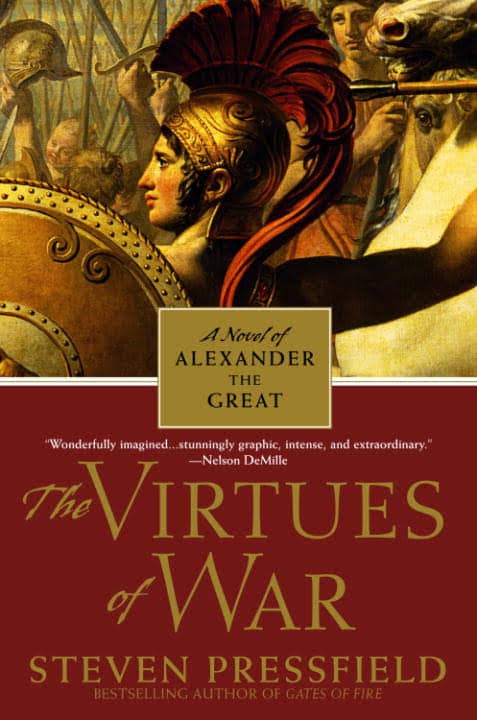
The Virtues of War

Author: Steven Pressfield
Rating: 9/10
Last Read: December 2013

Quick Summary: This book is told through the eyes of a scribe following Alexander on his conquering journey across Asia, leading to his ultimate demise.  The shortest summary can be pulled from the book itself: 

This is tragedy. For which of us can rise above what he is? Tragedy is the arrest of a man by his own nature. He is blind to it. He cannot transcend it. If he could, it would not be tragedy. And tragedy’s power derives from our own realization, commoner as well as king, that life truly is like that. We have fashioned our ruin with our own hands.

Further Reading: Gates of Fire, Tides of War

My Highlights

Those who do not understand war believe it contention between armies, friend against foe. No. Rather friend and foe duel as one against an unseen antagonist, whose name is Fear, and seek, even entwined in death, to mount to that promontory whose ensign is honor. –loc 234

There are further items, Telamon taught, which have no place in the soldier’s kit. Hope is one. Thought for future or past. Fear. Remorse. Hesitation. –loc 456

A warrior must not advance to battle hopeless—that is, devoid of hope. Rather let him set aside all baggage of expectation—of riches, celebrity, even death—and spur beneath extinction’s scythe lightened of all, save surrender to that outcome known only to the gods. –loc 464

“For the self-control of the warrior, which we observe and admire in his comportment, is but the outward manifestation of the inner perfection of the man. Such virtues as patience, courage, selflessness, which the soldier seems to have acquired for the purpose of defeating the foe, are in truth for use against enemies within himself—the eternal antagonists of inattention, greed, sloth, self-conceit, and so on. –loc 469

When each of us recognizes, as we must, that we too are engaged in this struggle, we find ourselves drawn to the warrior, as the acolyte to the seer. –loc 472

The true man-at-arms, in fact, can overcome his enemy without even striking a blow, simply by the example of his virtue. In fact he can not only defeat this foe but also make him his willing friend and ally, and even, if he wishes, his slave. –loc 473

Here, for your education, Itanes, I must address a question that causes all young officers consternation. I mean the experience of empathy for the foe. Never be ashamed to feel this. It is not unmanly. Indeed, I believe it the noblest demonstration of martial virtue. –loc 614

War is fear, let no man say otherwise. –loc 682

“Let me underscore this only, my friends, in regard to the foe. It is not our place to hate these men or to take pleasure in their slaughter. We fight today not to seize their lands or lives, but their preeminence among the Greeks. With luck, they will fight at our sides when Philip turns for Asia and marches against the Persian throne. –loc 778

No army ever won a battle when its elite unit was destroyed. –loc 782

I alone am master of my life! I vowed in that instant not only to dedicate myself to the study of horses and horsemanship, to make myself without peer as cavalryman and cavalry officer, but to educate myself in all things, to become my own tutor, selecting the subjects I needed to master and seeking instruction on my own. –loc 1328

Regret, Telamon had taught, has no place in the soldier’s kit of war. I know this is true. But I know, as well, that no act comes without a price. All men must answer for their crimes. I shall for mine. –loc 1362

The sarissas know their work is war. They are sorry for this. They cry for the suffering they cause. –loc 1844

He is dead. I weep, not only out of respect for the brilliant Rhodian, though I feel that in abundance, but for the role of chance and luck in the affairs of men, and the knowledge of how tenuous is our hold, all of us, upon this thing we call life. –loc 1852

Because a thing has never been done, gentlemen, is no reason to say it cannot be. And, in my view, no reason not to try. –loc 1915

Do you know what faculty I claim in myself as preeminent beyond all rivals? Not warcraft or conquest. Certainly not politics. Imagination. –loc 1964

The life of peace is fitting for a mule or an ass. I would be a lion! –loc 2701

One cannot be a philosopher and a warrior at the same time, as Parmenio has said. And one cannot be a man and a king. –loc 2783

Always attack. Even in defense, attack. The attacking arm possesses the initiative and thus commands the action. To attack makes men brave; to defend makes them timorous. If I learn that an officer of mine has assumed a defensive posture in the field, that officer will never hold command under me again. –loc 2822

When deliberating, think in campaigns and not battles; in wars and not campaigns; in ultimate conquest and not wars. –loc 2826

Seek the decisive battle. What good does it do us to win ten scraps of no consequence if we lose the one that counts? I want to fight battles that decide the fate of empires. –loc 2828

It is as important to win morally as to win militarily. By which I mean our victories must break the foe’s heart and tear from him all hope of contesting us again. I do not wish to fight war upon war, but by war to produce such a peace as will admit of no insurrection. –loc 2831

The object of campaign is to bring about a battle that will prove decisive. We feint; we maneuver; we provoke to one end: to compel the foe to face us in the field. –loc 2835

The object of pursuit after victory is not only to prevent the enemy from re-forming in the instance (this goes without saying), but to burn such fear into his vitals that he will never think of re-forming again. –loc 2843

As commanders, we must save our supreme ruthlessness for ourselves. Before we make any move in the face of the enemy, we must ask ourselves, free of vanity and self-deception, how the foe will counter. Unearth every stroke and have an answer for it. Even when you think you have thought of everything, there will be more work to do. Be merciless with yourself, for every careless act is paid for in our own blood and the blood of our countrymen. –loc 2849

Let us conduct ourselves in such a fashion that all nations wish to be our friends and all fear to be our enemies. –loc 2862

No advantage in war is greater than speed. To appear suddenly in strength where the enemy least expects you overawes him and throws him into consternation. –loc 2864

Be conservative until the crucial moment. Then strike with all the violence you possess. –loc 2873

Remember: We need win at only one point on the field, so long as that point is decisive. –loc 2874

Don’t punch; counterpunch. The purpose of an initial evolution—a feint or draw—is to provoke the enemy into committing himself prematurely. Once he moves, we countermove. –loc 2883

An officer must lead from the front. How can we ask our soldiers to risk death if we ourselves shrink from hazard? –loc 2888

Leverage of position means the occupation of that site which compels the enemy to move. When we face an enemy marshaled in a defensive posture, our first thought must be: What post can we seize that will make him withdraw? –loc 2890

Here is something the instructors of war do not teach: the art of confronting the irrational, of disarming the groundless and the unknown. –loc 3076

Pick one way and don’t look back. Nothing is worse than indecision. Be wrong, but be wrong decisively. –loc 3139

Can you please your constituents? Never let me hear that word! The men are never happy with anything. The march is always too long, the way always too rough. –loc 3140

Hardship. Give your men something that can’t be done, not something that can. Then place yourself at first hazard. –loc 3141

Rationality is superstition by another name. –loc 3147

Great commanders do not temper their measures to What Is; they bring forth What May Be. –loc 3148

Nothing is harder in war than to stand fast. –loc 3185

Sweat, speed, action—these are the antidotes to fear. –loc 3231

The material a commander manipulates is the human heart. –loc 3310

His art lies in producing courage in his own men and terror in the foe. –loc 3311

The general produces courage by discipline, training, and fitness; by fairness and order; superior pay, armament, tactics, and supply; by his dispositions in the field; and by the genius of his own presence and actions. –loc 3311

When men know they will be attacked, they feel fear; when they know they will attack, they feel strength. –loc 3340

To contend chivalrously against the chivalrous foe refines us, as gold in the crucible. –loc 3359

The ordeal of command consists in this: that one makes decisions of fatal consequence based on ludicrously inadequate intelligence. –loc 3675

“Success,” says Telamon, “is the weightiest burden of all. We are victors now. All our dreams have come true.” –loc 4394

When they were starving, your officers were a corps of comrades. But now each has grown touchy and quick to take insult. They are no longer mates, but rivals. You give them so much money, you make them independent of you. –loc 4452

Gold buys adherents; it turns good men arrogant and bad men ungovernable. –loc 4454

No man speaks the truth to a king. –loc 4484

“To be royal,” Sisygambis has said, “is to tread barefoot upon the razor’s edge. –loc 4538

“This man has conquered the world! What have you done?”
The philosopher replied without an instant’s hesitation, “I have conquered the need to conquer the world.”
–loc 4773

This is tragedy. For which of us can rise above what he is? Tragedy is the arrest of a man by his own nature. He is blind to it. He cannot transcend it. If he could, it would not be tragedy. And tragedy’s power derives from our own realization, commoner as well as king, that life truly is like that. We have fashioned our ruin with our own hands. –loc 4819

For have you not noticed of these sages, my friends, that they are the consummate soldiers? Inured to pain, oblivious to hardship, each takes up his post at dawn and does not relinquish it for thirst, hunger, heat, cold, fatigue. He is cheerful in all weathers, self-motivated, self-governed, self-commended. –loc 4854

“But there is one thing to which you are indeed attached, to your soul’s detriment.”
“And what is that, my friend?”
“Your victories. You remain proud of them. This is not good for you.”

–loc 4863

“You should be able to walk away from all this now, this night. Get up! Take nothing! Can you? –loc 4866

I schooled you as a boy, Alexander, to be superior to fear and to anger. You learned eagerly. You vanquished hardship and hunger and cold and fatigue. But you have not learned to master your victories. These hold you. You are their slave. –loc 4875

War is a crime, Alexander. In the end it is but butchery. For all the poets’ anthems, war’s object is nothing nobler than the imposition of one nation’s will upon another by means of force and threat of force. –loc 4951

Gates of Fire

Author: Steven Pressfield
Rating: 9/10
Last Read: December 2013

Quick Summary: Most people are aware of the story of the Spartans at the Battle of Thermopylae, recently popularized by the movie 300.  This novel predates the movie, and is told from a different angle – that of a slave in service to the Spartans.  This novel expands upon the battle, discussing Spartan society, training, and follows exploits of various Spartans as the situation rushes closer toward war.

This is a book about war, and the warrior’s life.  It stresses many military themes: honor, duty, esprit de corps, and facing death in combat.  If you’re not into military things, skip this one.  Otherwise, this is an excellent read.

Recommended Reading: The Virtues of War, Tides of War

My Highlights

No one may expect valor from one cast out alone, cut off from the gods of his home. –loc 657

we have learned that which you Greeks have not. The wheel turns, and man must turn with it. To resist is not mere folly, but madness. –loc 863

“You have never tasted freedom, friend,” Dienekes spoke, “or you would know it is purchased not with gold, but steel. –loc 866

The Spartans say that any army may win while it still has its legs under it; the real test comes when all strength is fled and the men must produce victory on will alone. –loc 1122

“Dienekes says the mind is like a house with many rooms,” he said. “There are rooms one must not go into. To anticipate one’s death is one of those rooms. We must not allow ourselves even to think it. –loc 1497

Deflect defamation with a joke, the coarser the better. Laugh in its face. A mind which can maintain its lightness will not come undone in war. –loc 2162

Dienekes’ courage was different. His was the virtue of a man, a fallible mortal, who brought valor forth out of the understanding of his heart, by the force of some inner integrity which was unknown to Polynikes. –loc 2236

“War, not peace, produces virtue. War, not peace, purges vice. War, and preparation for war, call forth all that is noble and honorable in a man. It unites him with his brothers and binds them in selfless love, eradicating in the crucible of necessity all which is base and ignoble. –loc 2303

“Remember what I told you about the house with many rooms. There are rooms we must not enter. Anger. Fear. Any passion which leads the mind toward that ‘possession’ which undoes men in war. –loc 2334

Habit will be your champion. When you train the mind to think one way and one way only, when you refuse to allow it to think in another, that will produce great strength in battle. –loc 2336

“The gods make us love whom we will not,” the lady declared, “and disrequite whom we will. They slay those who should live and spare those who deserve to die. They give with one hand and take with the other, answerable only to their own unknowable laws. –loc 3481

Men’s pain is lightly borne and swiftly over. Our wounds are of the flesh, which is nothing; women’s is of the heart—sorrow unending, far more bitter to bear. –loc 3534

Where there is work to do, turn your hand to it first; the men will follow. Keep your men busy. If there is no work, make it up, for when soldiers have time to talk, their talk turns to fear. Action, on the other hand, produces the appetite for more action. –loc 3770

Leonidas sought to instill courage not by his words alone but by the calm and professional manner with which he spoke them. –loc 3776

War is work, not mystery. –loc 3777

“All my life,” Dienekes began, “one question has haunted me. What is the opposite of fear? –loc 3860

“Man’s courage, to give his life for his country, is great but unextraordinary. Is it not intrinsic to the nature of the male, beasts as well as men, to fight and to contend? –loc 3918

“Let neither of us pity the other,” my cousin spoke in parting. “We are where we must be, and we will do what we must. –loc 4933

“My mother’s religion teaches that those things alone are real which cannot be perceived by the senses. The soul. Mother love. Courage. These are closer to God, she taught, because they alone are the same on both sides of death, in front of the curtain and behind. –loc 5484

For what can be more noble than to slay oneself? Not literally. Not with a blade in the guts. But to extinguish the selfish self within, that part which looks only to its own preservation, to save its own skin. That, I saw, was the victory you Spartans had gained over yourselves. That was the glue. –loc 5508

When a warrior fights not for himself, but for his brothers, when his most passionately sought goal is neither glory nor his own life’s preservation, but to spend his substance for them, his comrades, not to abandon them, not to prove unworthy of them, then his heart truly has achieved contempt for death, and with that he transcends himself and his actions touch the sublime. –loc 5511

I believe they sense that the virtues are like music. They vibrate at a higher, nobler pitch. –loc 5522

“The opposite of fear,” Dienekes said, “is love.” –loc 5536

In one way only have the gods permitted mortals to surpass them. Man may give that which the gods cannot, all he possesses, his life. My own I set down with joy, for you, friends, who have become the brother I no longer possess. –loc 5866

Forget king. Forget wife and children and freedom. Forget every concept, however noble, that you imagine you fight for here today. Act for this alone: for the man who stands at your shoulder. He is everything, and everything is contained within him. That’s all I know. That’s all I can tell you. –loc 5891

I will tell His Majesty what a king is. A king does not abide within his tent while his men bleed and die upon the field. A king does not dine while his men go hungry, nor sleep when they stand at watch upon the wall. A king does not command his men’s loyalty through fear nor purchase it with gold; he earns their love by the sweat of his own back and the pains he endures for their sake. That which comprises the harshest burden, a king lifts first and sets down last. A king does not require service of those he leads but provides it to them. He serves them, not they him. –loc 5931

A king does not expend his substance to enslave men, but by his conduct and example makes them free. –loc 5946

I and every man there were never more free than when we gave freely obedience to those harsh laws which take life and give it back again. –loc 5950

Those were the last tears of mine, my lord, that the sun will ever see. –loc 6171

Hour of the Dragon

Author: Robert E. Howard
Rating: 6/10
Last Read: January 2013

Quick Summary:  Conan is king of Aquilonia, and people are plotting to depose him by reviving a long-dead wizard.  Conan is saved from death and travels the land seeking revenge and a way to regain his kingdom.

A decent fantasy read.  Nothing super spectacular to prioritize, but if you enjoy Conan it is a good story.

My Highlights

“These things are governed by immutable laws,” she said at last. “I can not make you understand; I do not altogether understand myself, though I have sought wisdom in the silences of the high places for more years than I can remember. I cannot save you, though I would if I might. Man must, at last, work out his own salvation. Yet perhaps wisdom may come to me in dreams, and in the morn I may be able to give you the clue to the enigma.”

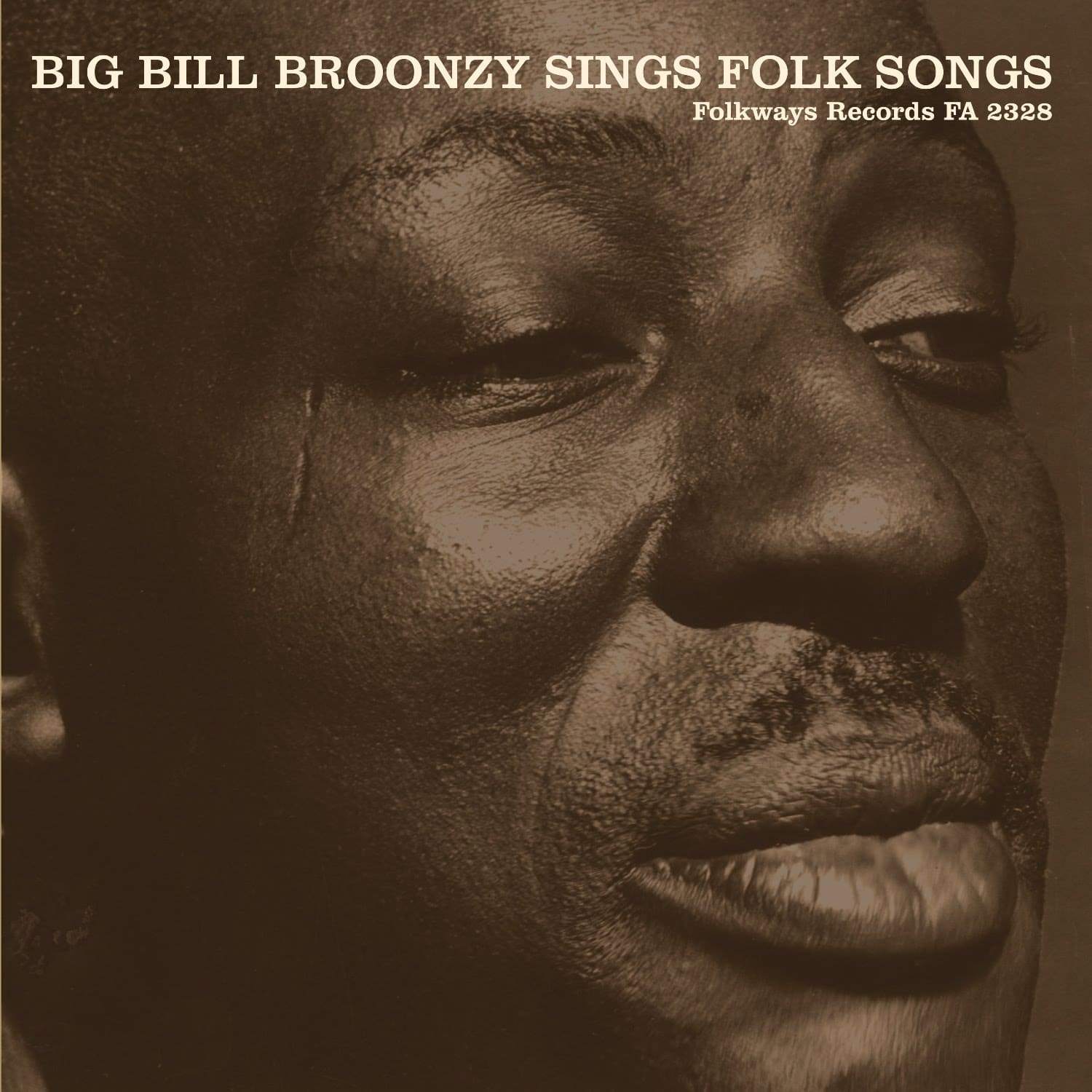
Big Bill Broonzy Sings Folk Songs

I was introduced to Big Bill Broonzy by way of Vinyl Me Please, who included Big Bill Broonzy Sings Folk Songs as one of their featured monthly releases.

I love the blues, but prior to getting this album I did not pay much attention to Big Bill. He was one of those names that I was familiar with, but I couldn’t quite identify any of his songs. After this album, I devoured everything of his that I could find (and I definitely recommend the Big Bill Broonzy Story as a next stop).

This album contains a selection of folk songs that are soulfully sung in a country blues style – nothing from the “standard rotation” is present. The album culminates in my favorite song on the album – “Glory of Love” – for a stellar ending to an enjoyable ride.

Check it out if you like the blues. It got me hooked.

Big Bill Broonzy Story

Big Bill Broonzy is my favorite blues singer – lucky for me he was quite the prolific artist.

This 3-disk collection was recorded in 1957, a year before his death. Big Bill is playing guitar and conducting an interview at the same time – questions are interspersed between songs. Big Bill provides honest answers, covering the backgrounds of other players, the meaning behind different songs, and what it takes to sing the blues.

As an avid blues fan, I love having this window into the experiences that went into this awesome music.

Love is a Mixtape

Author: Rob Sheffield
Rating: 10/10
Last Read: February 2015

Quick Summary:  A music journalist for the Rolling Stone writes a book about his relationship with the love of his life.  Each chapter has a playlist, and the songs that are picked are intertwined into his retelling of their life story.  

The book opens telling you that this is not a happy story – it’s the story of how he found love and then lost it due to a tragic death.  As he’s spinning the tale of their love, you manage to forget this fact – until the terrible event happens and you feel the deep pang of loss (“how could this happen to them?!”).

I have a deep appreciation for this book – music is equally important to me and equally intertwined in my life. Losing the music is a tragic thing.

My Highlights

It was a smashing time, and then it ended, because that’s what times do. –loc 141

Renée loved to do things. That was mysterious to me, since I was more comfortable talking about things and never doing them. –loc 149

Tonight, I feel like my whole body is made out of memories. I’m a mix tape, a cassette that’s been rewound so many times you can hear the fingerprints smudged on the tape. –loc 171

A song nobody likes is a sad thing. But a love song nobody likes is hardly a thing at all. –loc 188

There are millions of songs in the world, and millions of ways to connect them into mixes. Making the connections is part of the fun of being a fan. –loc 295

Walter Benjamin, in his prescient 1923 essay “One Way Street,” said a book was an outdated means of communication between two boxes of index cards. One professor goes through books, looking for tasty bits he can copy onto index cards. Then he types his index cards up into a book, so other professors can go through it and copy tasty bits onto their own index cards. Benjamin’s joke was: Why not just sell the index cards? –loc 301

I’d rather hear a Frank Sinatra song between Run-DMC and Bananarama than between two other Frank Sinatra songs. When you stick a song on a tape, you set it free. –loc 307

Every mix tape tells a story. Put them together, and they add up to the story of a life. –loc 335

It was a painful night, but I got the message: Let the dancing girls dance. That’s the one ironclad rule of pop muzik, whether in New York, London, Paris, or Munich, and I’m just lucky I learned it so early. I had always been taught to fear disco, and to fear the disco inside me. But by the second verse of “Bad Girls,” it was obvious everything I knew was wrong. “Toot toot, beep beep” was meaningful on a much deeper level than I could have fathomed. –loc 440

It’s this kind of syndrome—where if a guy sees his girlfriend likin’ somebody, that’s called ‘bitch power.’ Like Elvis Presley was hated by men, hated, ’cause he had bitch power. Teddy Pendergrass has bitch power. I just found out that I have a little bitch power. But beyond bitch power, I have something else, that men like—and that’s the truth, and the down-to-earth shit, OK? So men don’t mind bringin’ their women to see me, ’cause I have bitch power but it’s in another way. –loc 448

How do you turn down the volume on your personal-drama earphones and learn how to listen to other people? How do you jump off one moving train, marked Yourself, and jump onto a train moving in the opposite direction, marked Everybody Else? –loc 620

Sometimes you lie in a strange room, in a strange person’s home, and you feel yourself bending out of shape. –loc 765

Is there any scarier word than “irreversible”? It’s a hiss of a word, full of side effects and mutilations. Severe tire damage—no backing up. –loc 774

Girls take up a lot of room. –loc 792

I thought, There is nowhere else in the universe I would rather be at this moment. I could count the places I would not rather be. I’ve always wanted to see New Zealand, but I’d rather be here. The majestic ruins of Machu Picchu? I’d rather be here. A hillside in Cuenca, Spain, sipping coffee and watching leaves fall? Not even close. There is nowhere else I could imagine wanting to be besides here in this car, with this girl, on this road, listening to this song. If she breaks my heart, no matter what hell she puts me through, I can say it was worth it, just because of right now. Out the window is a blur and all I can really hear is this girl’s hair flapping in the wind, and maybe if we drive fast enough the universe will lose track of us and forget to stick us somewhere else. –loc 839

I kept thinking of an old Robert Mitchum cowboy movie where he goes back to see the farmhouse where he was born and finds the house falling apart and an old man living in it by himself. “Lonely place,” Robert Mitchum says. The old man says, “Nothing wrong with a lonely place as long as it’s private. That’s why I never married. Marriage is lonely, but it ain’t private.” –loc 946

Our lives were just beginning, our favorite moment was right now, our favorite songs were unwritten. –loc 1073

The songs were all either fast or sad, because all songs should be either fast or sad. Some of the fast ones were sad, too. –loc 1122

“Honey, is this song about us?” the strategic answer is, “Yes, but so is ‘Just Like Heaven.’” –loc 1250

“If it’s got tits or tires, it’s gonna cost you money.” –loc 1284

Chuck Berry the night he decided to mix country with the blues, –loc 1399

I suddenly realized how much being a husband was about fear: fear of not being able to keep somebody safe, of not being able to protect somebody from all the bad stuff you want to protect them from. Knowing they have more tears in them than you will be able to keep them from crying. –loc 1439

Every time I started to cry, I remembered how Renée used to say real life was a bad country song, except bad country songs are believable and real life isn’t. –loc 1747

I had no voice to talk with because she was my whole language. –loc 1825

You lose a certain kind of innocence when you experience this type of kindness. You lose your right to be a jaded cynic. You can no longer go back through the looking glass and pretend not to know what you know about kindness. It’s a defeat, in a way. –loc 1912

Human benevolence is totally unfair. We don’t live in a kind or generous world, yet we are kind and generous. We know the universe is out to burn us, and it gets us all the way it got Renée, but we don’t burn each other, not always. –loc 1944

One day, you’re in a physical landscape you share with this bizarre and fundamentally alien creature, not alien because she’s female but alien because you’re a fool in love and there’s nothing not alien about that. And then when she’s gone, you’re alone and all the strangeness and wonder have gone out of the landscape and you’re still a fool but now nobody notices how many days in a row you wear the same socks and cleaning the shower doesn’t make the girl smile anymore so everything smells a little worse and doesn’t get fixed when it breaks. –loc 2049

But all the things you want to learn from grief turn out to be the total opposite of what you actually learn. There are no revelations, no wisdoms as a trade-off for the things you have lost. You just get stupider, more selfish. Colder and grimmer. You forget your keys. You leave the house and panic that you won’t remember where you live. You know less than you ever did. You keep crossing thresholds of grief and you think, Maybe this one will unveil some sublime truth about life and death and pain. But on the other side, there’s just more grief. –loc 2181

It’s not human to let go of love, even when it’s dead. –loc 2187

Ralph Waldo Emerson knew the score: “I grieve that grief can teach me nothing.” That’s from “Experience,” his late essay about human loss and his son’s death. –loc 2195

It’s the same with people who say, “Whatever doesn’t kill you makes you stronger.” Even people who say this must realize that the exact opposite is true. What doesn’t kill you maims you, cripples you, leaves you weak, makes you whiny and full of yourself at the same time. The more pain, the more pompous you get. Whatever doesn’t kill you makes you incredibly annoying.

Sometimes great tunes happen to bad times, and when the bad time is over, not all the tunes get to move on with you. –loc 2294

It was strange to fall back in love with really old songs, or to hear them for the first time and not get to hear Renée sing along with them. –loc 2390

I realize that I will never fully understand the millions of bizarre ways that music brings people together. –loc 2438

After Renée died, I assumed the rest of my life would be just a consolation prize. I would keep living, and keep having new experiences, but none of them would compare to the old days. I would have to settle for a lonely life I didn’t want, which would always remind me of the life I couldn’t have anymore. But it didn’t turn out that way, and there’s something strange and upsetting about that. –loc 2450

sometimes I think, man, all the people I get to hear this song with, we’re going to miss each other when we die. When we die, we will turn into songs, and we will hear each other and remember each other. –loc 2504

But the rhythm of the mix tape is the rhythm of romance, the analog hum of a physical connection between two sloppy, human bodies. –loc 2511

The cassette is full of tape hiss and room tone; it’s full of wasted space, unnecessary noise. –loc 2511

But the answer is simple. Love is a mix tape. –loc 2533