Once a Hero

Author: Michael A. Stackpole
Rating: 9/10
Last Read: February 2014

Quick Summary:  A fantasy tale involving two separate story arcs across a 500 year time period – one in the past which involves the hero (Neal) and the other in the story’s present with an elf.  The story involves tensions between humans and elves, and their common enemy who Neal tried to vanquish in the past.

Excellent fantasy read – couldn’t put it down when I read through it the first time.  The story element is interesting (Similar to Talion: Revenant).

My Highlights

“without a scar, I might forget. I’m not thinking I suffer hurts so lightly that I’ll be wanting to be unmindful of them.”

“I have forced myself to be aware of everything on a battlefield. Awareness is the key to winning.”

If you are to be understood, you must speak to them in the manner which they will understand.

The island itself was deserted, and sitting there between two small rootlets of the grand tree, I managed a lot more thinking. I didn’t like all of it, but I’ve found that when you finally sit down to do the thinking that must be done, chances are there’s not much of it that will make you smile.

The hurt was in the hearing and because of what the words have made me think about. It is difficult to discover you have been deceiving yourself.

“You are forgiven if you wish, but I did not count it a fault against you.”

Puzzlement again knotted Berengar’s brow. “I don’t understand his choice.”
“Is that because it was a bad choice, or just the choice you would not have made in his place?”

Hatred is too strong an emotion to be wasted on harmless differences such as race.

Talion: Revenant

Author: Michael A. Stackpole
Rating: 9/10
Last Read: February 2014

Quick Summary:  An orphan becomes a Justice of the Talions – traveling the countryside, dispensing justice where there is no law (akin to the confessors from *The Sword of Truth* series).  Things get complicated with our Justice is tasked with defending the king of the country that invaded his homeland.

When I was done, I felt sad that this was just a standalone novel – I liked the character and the universe enough that I wanted more. (Stackpole says it’s the book for which he most often gets sequel requests)

My Highlights

“I will not wish you good luck, because a Talion does not depend upon luck. Have courage and trust yourself.”

Such a simple job did not annoy me as it did others because, for me, it provided a reference point within reality and reassured me that while I dealt with good and evil, and the vast gray area in between, there were jobs that could be finished and finished well. In its own small way it confirmed the possibility of progress, and how any task that could be started could also be completed.

I am merely a man who realizes he is capable of mistakes, but I am also a man who is willing to take responsibility for those errors.

Lothar grumbled. “But he died from my attack. That was stupid. He just helped Marana win as if he was just her second sword.” I frowned. “A tool is just a tool, unless it does the job by itself.

Remember that a stalemate is a stalemate as long as no one acts.

A man who you fear will kill you is often afraid of the same treatment at your hands. There are times when two men in such a position both defend to prevent injury and deny victory to themselves. The person to act in that situation, if he has the required skills, will break the stalemate and be the victor.”

But the anger was swallowed, in turn, by the pride I had in myself. I worked hard for everything, and if that threatened them, it also marked them as petty and small.

Justice must be tempered by mercy and common sense. Justice is your gift to the world, not your right or privilege. Remember this and live by it. In this you will serve well.

Ritual

Ritual is the only language we truly believe in:
tea steaming a glass mug on a table,
smoke from a cigarette filling the room with blue,
the way the sun falls across our face as we sleep.
These are our things, we say.

Abani, Chris (2013-06-07). Sanctificum (p. 46)

Source


Sanctificum

By Chris Abani


Sanctificum

Author: Chris Abani
Rating: 9/10
Last Read: February 2015

Quick Summary: Collected book of poems by one of my favorite poets – Chris Abani.  

Check out his two TED talks and fall in love with him.

My Highlights

A man once asked me in the street: Do you own your own bones?

The safety of doorways is an illusion. They lead nowhere. This is why we build houses.

Sometimes we find treasure. Sometimes something fills the mind, something at which we pause, stopped. The way a photograph cannot remember the living.

The more we promise to never leave our lovers, the faster the horizon arrives.

After six months in a hole in the ground, the prison is not the building, or the bars, or the beatings, or the denials, or the lies, or the forgetting, or the negotiating — It is the small door in your mind closing.

For fear of being loved we will kill the world

I drink tea in the shade and believe in poetry. –p. 60

If Zeno’s paradox reveals anything it is not that space and time can be divided into infinity infinitely, but simply this: That we can only approximate the object of our desire. That we are always on a train traveling to happiness. But what we do reach are coffee, biscotti, and Bob on the iPod.

It is easy to forget the decadence of glass. How some of us find it only in fragments. The glass between us and the world is often the measure of our wealth. Looking out at the world through it colors the hunger beyond.

This is a callout to Jack Gilbert’s “Forgotten Dialect of the Heart”:

Words mean only what you want them to.
You say sunshine and you mean hope.
You say food and you mean refuge.
You say sand and you mean play.
You say stone and you mean, I will never forget.
But you do, but you do and thank God, thank God.
–pp. 79-80

Your name is a hunger on my tongue.
Your eyes are the light that shelters me.
Your beauty makes me beautiful.
–p. 72

When we say love we mean, I want.
When we say sorry we mean, forgive me.
–p. 54

Ritual is the only language we truly believe in:
tea steaming a glass mug on a table,
smoke from a cigarette filling the room with blue,
the way the sun falls across our face as we sleep.
These are our things, we say.

–p. 46

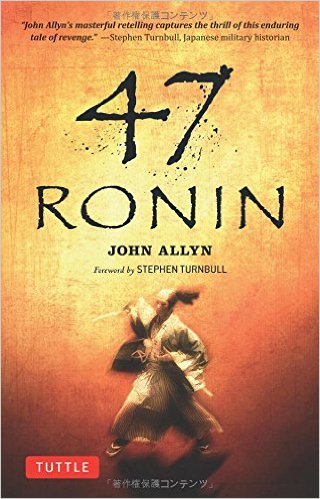
47 Ronin

Author: John Allyn
Rating: 7/10
Last Read: January 2014

Quick Summary: A retelling of the tale of the 47 Ronin. The samurai of Lord Asano spend months planning revenge for their disgraced master, who had been ordered to commit seppuku.  This story covers the downfall of Lord Asano, the disbandment of the samurai, the life led in the interim, and the long, careful planning spent to bring about their revenge.

Please don’t judge this novel by the movie – this is a much more realistic retelling of the tale of this historical legend.

My Highlights

The path of honor was easy to follow when it was easy to see.

When there were conflicts between choice of action, such as Hara had raised, the solutions could not be expected to satisfy everyone.

“You see,” he went on, “some people live all their lives without knowing which path is right. They’re buffeted by this wind or that and never really know where they’re going. That’s largely the fate of the commoners—those who have no choice over their destiny. For those of us born as samurai, life is something else. We know the path of duty and we follow it without question.”

Remember, there’s sacrifice involved in any kind of life. Even the man who chooses the safe way has to give up the thrill of combat. The point is that once you know what you want, you must be prepared to sacrifice everything to get.

In the end this was all that mattered, for a man will only be as long as his life but his name will be for all time.

The Sands of Mars

Author: Arthur C. Clarke
Rating: 8/10
Last Read: June 2014

Quick Summary: A famous sci-fi writer gets a chance to travel to mars (and takes lots of shit for how unrealistic his writings about sci-fi and space travel were). He meets the colonial leadership on Mars, eventually finding native creatures and falling in love with the planet.

Arthur C. Clarke is one of my favorite sci-fi writers, and this was his first published sci-fi novel.  The fact that he takes the chance to make his main character a writer, and has that writer get picked on for his wild and crazy predictions about the future of human space travel was quite enjoyable.  The story was a smooth read as well – highly recommended.

My Highlights

Well, this is it, thought Gibson. Down there is all my past life, and the lives of all my ancestors back to the first blob of jelly in the first primeval sea. No colonist or explorer setting sail from his native land ever left so much behind as I am leaving now. Down beneath those clouds lies the whole of human history; soon I shall be able to eclipse with my little finger what was, until a lifetime ago, all of Man’s dominion and everything that his art had saved from time.

This inexorable drawing away from the known into the unknown had almost the finality of death. Thus must the naked soul, leaving all its treasures behind it, go out at last into the darkness and the night.

Gibson had found it very hard to get his impressions of space down on paper; one could not very well say “space is awfully big” and leave it at that.

Only Hilton, who seemed to possess unlimited reserves of patience, took life easily and relaxed while the others fussed around him.

It’s always fatal to adapt oneself to one’s surroundings. The thing to do is to alter your surroundings to suit you.”

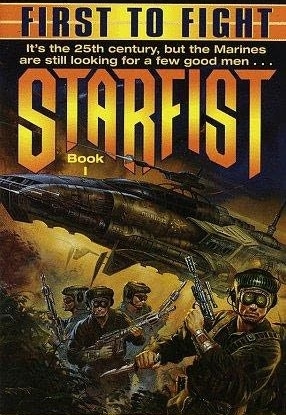
Starfist: First to Fight

Author: Dan Cragg & David Sherman
Rating: 6/10
Last Read: August 2010

Quick Summary: This follows the lives and experiences of marines in space during the 25th century – dealing with new recruits, old fuckups, and handling warlords on outer world.  Reads like a military novel in the future.

Looking for militaristic marine sci-fi novel of the future?  Check out Starship Troopers.

Looking for some relaxing junk militaristic sci-fi?  Not a bad pick.  I did not continue the series.

My Highlights

“All right, recruits,” Neeley announced one day during a classroom training session, “I’m gonna give you Neeley’s Thirteen Rules for Staying Alive in Combat. You listening?
“One: Incoming fire always has the right-of-way.
“Two: Keep it simple, stupid.
“Three: Keeping it simple is the hardest thing in the world.
“Four: Never stand next to anyone braver than you are.
“Five: If things are going too well, it’s an ambush.
“Six: The easiest way is mined.
“Seven: The one thing you never run out of is the enemy.
“Eight: Infrared works both ways.
“Nine: Professionals are always predictable.
“Ten: We always wind up fighting amateurs.
“Eleven: When the enemy’s in range, so are you.
“Twelve: When in doubt, shoot until your magazine is empty.”
Neeley placed his hands on his hips and smiled fiercely. “You remember those rules and you’ll be okay.”

I just made up a new rule: Never stand next to anyone dumber than you!

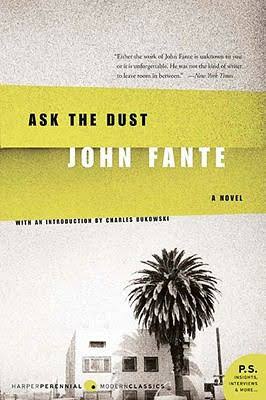
Ask the Dust

Author: John Fante
Rating: 6/10
Last Read: April 2014

Quick Summary: Arturo Bandini is a struggling writer in LA during the depression.  He’s convinced of his own greatness, but can’t seem to get the words onto the page correctly!  This follows his adventures (and madness) through the city, into love, and on a mad chase after his love into the desert.

I heard this book described as “The Great Gatsby of the West Coast.”  I’m not totally sure about that one – I like Gatsby much more.  I didn’t love the book, but it was still a decent read.  Perhaps I should give it a second chance one day.

I picked it up because one of my favorite poets – Charles Bukowski – loved this book.  One bonus for me was the fact that Bukowski wrote the foreword! What a surprise. 

My Takeaways

No matter how convinced you are of your own talent, if you cannot do the work and produce output, you are nothing.  Ego is your enemy.

My Highlights

But let me say that the way of his words and the way of his way are the same: strong and good and warm.

Almighty God, I am sorry I am now an atheist, but have You read Nietzsche? Ah, such a book!

“My advice to all young writers is quite simple. I would caution them never to evade a new experience. I would urge them to live life in the raw, to grapple with it bravely, to attack it with naked fists.”

every morning you’ll see the mighty sun, the eternal blue of the sky, and the streets will be full of sleek women you never will possess, and the hot semitropical nights will reek of romance you’ll never have, but you’ll still be in paradise, boys, in the land of sunshine.

You are nobody, and I might have been somebody, and the road to each of us is love.

God was such a dirty crook, such a contemptible skunk, that’s what he was for doing that thing to that woman. Come down out of the skies, you God, come on down and I’ll hammer your face all over the city of Los Angeles, you miserable unpardonable prankster. If it wasn’t for you, this woman would not be so maimed, and neither would the world

a Bandini with dynamite in his body and volcanic fire in his eyes, who goes to this Camilla Lopez and says: see here, young woman, I have been very patient with you, but now I have had enough of your impudence, and you will kindly oblige me by removing your clothes.

the world seemed a myth, a transparent plane, and all things upon it were here for only a little while; all of us, Bandini, and Hackmuth and Camilla and Vera, all of us were here for a little while, and then we were somewhere else; we were not alive at all; we approached living, but we never achieved it. We are going to die. Everybody was going to die.

The world was dust, and dust it would become.

What doth it profit a man if he gain the whole world and suffer the loss of his own soul?

“What’s the matter with him?”
“T. B.” she said.
“Tough.”
“He won’t live long.”
I didn’t give a damn. “We all have to die someday.”

He was going to die in a year, she said. He had left Los Angeles and gone to the edge of the Santa Ana desert. There he lived in a shack, writing feverishly. All his life he had wanted to write. Now, with such little time remaining, his chance had come.

There came over me a terrifying sense of understanding about the meaning and the pathetic destiny of men. The desert was always there, a patient white animal, waiting for men to die, for civilizations to flicker and pass into the darkness. Then men seemed brave to me, and I was proud to be numbered among them. All the evil of the world seemed not evil at all, but inevitable and good and part of that endless struggle to keep the desert down.

I looked southward in the direction of the big stars, and I knew that in that direction lay the Santa Ana desert, that under the big stars in a shack lay a man like myself, who would probably be swallowed by the desert sooner than I, and in my hand I held an effort of his, an expression of his struggle against the implacable silence toward which he was being hurled. Murderer or bartender or writer, it didn’t matter: his fate was the common fate of all, his finish my finish; and here tonight in this city of darkened windows were other millions like him and like me: as indistinguishable as dying blades of grass. Living was hard enough. Dying was a supreme task. And Sammy was soon to die.

To hell with that Hitler, this is more important than Hitler, this is about my book. It won’t shake the world, it won’t kill a soul, it won’t fire a gun, ah, but you’ll remember it to the day you die, you’ll lie there breathing your last, and you’ll smile as you remember the book.

This was the life for a man, to wander and stop and then go on, ever following the white line along the rambling coast, a time to relax at the wheel, light another cigaret, and grope stupidly for the meanings in that perplexing desert sky.

Alice’s Adventures in Wonderland

Author: Lewis Carroll
Rating: 8/10
Last Read: August 2010

Quick Summary: Truly a book of nonsense – Alice is a little girl who falls down a rabbit hole and wanders through a fantastic world.  Sometimes it feels like you’re in the middle of an acid trip, other times it just feels like weird nonsense. But there’s plenty of poetry, riddles, and interesting turns of language around.

My Highlights

‘How am I to get in?’ asked Alice again, in a louder tone. ‘Are you to get in at all?’ said the Footman. ‘That’s the first question, you know.’

And with that she began nursing her child again, singing a sort of lullaby to it as she did so, and giving it a violent shake at the end of every line: ‘Speak roughly to your little boy, And beat him when he sneezes: He only does it to annoy, Because he knows it teases.’

‘Would you tell me, please, which way I ought to go from here?’
‘That depends a good deal on where you want to get to,’ said the Cat.
‘I don’t much care where–‘ said Alice.
‘Then it doesn’t matter which way you go,’ said the Cat.
‘–so long as I get somewhere,’ Alice added as an explanation.
‘Oh, you’re sure to do that,’ said the Cat, ‘if you only walk long enough.’

She had quite forgotten the Duchess by this time, and was a little startled when she heard her voice close to her ear. ‘You’re thinking about something, my dear, and that makes you forget to talk. I can’t tell you just now what the moral of that is, but I shall remember it in a bit.’ ‘Perhaps it hasn’t one,’ Alice ventured to remark. ‘Tut, tut, child!’ said the Duchess. ‘Everything’s got a moral, if only you can find it.’

“Never imagine yourself not to be otherwise than what it might appear to others that what you were or might have been was not otherwise than what you had been would have appeared to them to be otherwise.”

‘That’s the reason they’re called lessons,’ the Gryphon remarked: ‘because they lessen from day to day.’

The White Rabbit put on his spectacles. ‘Where shall I begin, please your Majesty?’ he asked.
‘Begin at the beginning,’ the King said gravely, ‘and go on till you come to the end: then stop.

Now, here, you see, it takes all the running you can do, to keep in the same place. If you want to get somewhere else, you must run at least twice as fast as that!” ~ The Queen

The Postman

Author: David Brin
Rating: 8/10
Last Read: December 2012

Quick Summary:  In the post-apocalyptic wasteland of America, a man finds a postal worker’s uniform and uses it to spread the lie of restoring the United States – giving hope to people threatened with death and destruction, culminating in a struggle with the warlords around him.

My Highlights

“Short of Death itself, there is no such thing as a ‘total’ defeat.… There is never a disaster so devastating that a determined person cannot pull something out of the ashes—by risking all that he or she has left.… “Nothing in the world is more dangerous than a desperate man.”

The steely gray eyes were narrow and sad when next he looked up at Gordon. “I found out something, you know. I discovered that the big things don’t love you back. They take and take, and never give in return. They’ll drain your blood, your soul, if you let them, and never let go.

Men can be brilliant and strong, they whispered to one another. But men can be mad, as well. And the mad ones can ruin the world.

There is power there, slumbering below the surface. And there is magic.

“It’s said that ‘power corrupts,’ but actually it’s more true that power attracts the corruptible. The sane are usually attracted by other things than power. When they do act, they think of it as service, which has limits. The tyrant, though, seeks mastery, for which he is insatiable, implacable.

“The problem is one of balance,” the graying statesman-scientist said to his invention, ignoring Gordon as he contemplated the chessboard. “I’ve put some thought to it. How can we set up a system which encourages individuals to strive and excel, and yet which shows some compassion to the weak, and weeds out madmen and tyrants?”

Of course we can establish constitutional checks and balances, but those won’t mean a thing unless citizens make sure the safeguards are taken seriously. The greedy and the power-hungry will always look for ways to break the rules, or twist them to their advantage.