Silencing the Noise

Earlier this week, I deleted my personal Twitter account. This marks a further step on my fight to retrain my mind.

I’ve been without Facebook and Instagram for a few years now, and Twitter was the last major holdout. I justified keeping it because the quality of posts seemed to be higher than on the other platforms. I followed and interacted with interesting people and encountered plenty of new ideas.

But, there was still a cost. I noticed the addiction creeping in again. We cannot escape our programming – the red notification badges and slot machine effect will always capture us. The outrage that is so prevalent online creeped into my life. My mind and attention were being taken away from me.

Even the continual flow of ideas started getting to me. All Twitter thoughts are brief, without justification or explanation. Everything is spoken as a strong truth. There is no room for in depth discussion. For me, this is a non-starter: it’s just noise. I seek out quality information that I can dive into and incorporate into my life. I don’t need a sea of ideas from other people. I’d rather read a twenty-five page paper about a single point, rather than 180 characters which summarize a pithy complaint about human nature.

We take in too much information. We are always hungry for new ideas. But when I crowded my brain with everyone else’s ideas, I noticed that I no longer had room for my own.

So, I’m silencing the noise and continuing to reduce my media consumption. I need space for my own ideas to grow, develop, and integrate. I prefer the slow, high, winding mountain path to the veritable flood of never-ending information.

You will still find me in two places on the social interwebs: for now, I am keeping a LinkedIn Profile and Twitter account for my business. Both of those accounts are core marketing components. I feel much less temptation for checking these accounts, and much of my posting is automated through a third-party service.

But if these accounts continue to draw me away from useful work, they will have to go too. The best way to prevent addiction is to avoid the addictive substance entirely.

The Philip K Dick Anthology

Author: Philip K. Dick
Rating: 4/5
Last Read: December 2014
Who Should Read: Sci-fi fans, short story fans

The Philip K. Dick Anthology is a collection of thirteen short stories by the famed sci-fi writer Philip K. Dick. Many of his stories have been turned into movies such as Total Recall, Minority Report, and Blade Runner.

This collection contains a different list of stories than those in the Selected Stories of Philip K. Dick. The thirteen included stories are:

  • “The Eyes Have It”
  • “Beyond the Door”
  • “Beyond Lies the Wub”
  • “Mr. Spaceship”
  • “The Skull”
  • “The Crystal Crypt”
  • “The Defenders”
  • “The Hanging Stranger”
  • “The Gun”
  • “Tony and the Beetles”
  • “The Variable Man”
  • “Piper in the Woods”
  • “Second Variety”

My Highlights

Apparently in my first pass through I was only struck by a single passage, but it is a beautiful one:

find in your Odysseus a figure common to the mythology of most self-conscious races. As I interpret it, Odysseus wanders as an individual, aware of himself as such. This is the idea of separation, of separation from family and country. The process of individuation.”
“But Odysseus returns to his home.” Peterson looked out the port window, at the stars, endless stars, burning intently in the empty universe. “Finally he goes home.”
“As must all creatures. The moment of separation is a temporary period, a brief journey of the soul. It begins, it ends. The wanderer returns to land and race….”

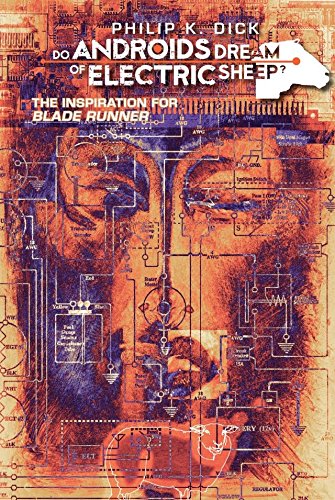
Do Androids Dream of Electric Sheep?

Author: Philip K. Dick
Rating: 4/5
Last Read: November 2014
Who Should Read: Sci-fi fans, people who liked the movie Blade Runner

Do Androids Dream of Electric Sheep?, like many other Philip K. Dick stories, inspired the movie Blade Runner. Unlike the other movies-inspired-by-stories, Do Androids Dream of Electric Sheep? is a full novel, though you might find yourself finishing it in a single sitting as if it were a short story.

The novel and the movie are markedly different, but do share similarities. The main plot still follows a bounty hunter, Rick Deckard, who is tasked with retiring escaped androids. As with most Philip K. Dick stories, there is an exploration of an underlying theme about what it means to be human.

Do Androids Dream of Electric Sheep? is an excellent entry point into the work of Philip K. Dick. You won’t be disappointed.

It is no good. I can’t do it. I can play the Thirteen Ways of Looking at a Trash Compactor Repairman Game, but I cannot turn it into a story at once puzzling, poignant, grotesque, philosophical, satirical, and fun. There is a very special way of doing this and the first step in its mastery involves being Philip K. Dick.

My Highlights

Empathy, evidently, existed only within the human community, whereas intelligence to some degree could be found throughout every phylum and order including the arachnida.

Because, ultimately, the empathic gift blurred the boundaries between hunter and victim, between the successful and the defeated. As in the fusion with Mercer, everyone ascended together

The tyranny of an object, he thought. It doesn’t know I exist. Like the androids, it had no ability to appreciate the existence of another.

But maybe she doesn’t know how to cook, he thought suddenly. Okay, I can do it; I’ll fix dinner for both of us. And I’ll show her how so she can do it in the future if she wants. She’ll probably want to, once I show her how; as near as I can make out, most women, even young ones like her, like to cook: it’s an instinct.

“I am your friend,” the old man said. “But you must go on as if I did not exist. Can you understand that?” He spread empty hands.
“No,” Rick said. “I can’t understand that. I need help.”
“How can I save you,” the old man said, “if I can’t save myself?” He smiled. “Don’t you see? There is no salvation.”

“You will be required to do wrong no matter where you go. It is the basic condition of life, to be required to violate your own identity. At some time, every creature which lives must do so. It is the ultimate shadow, the defeat of creation; this is the curse at work, the curse that feeds on all life. Everywhere in the universe.”

Do androids dream? Rick asked himself. Evidently; that’s why they occasionally kill their employers and flee here. A better life, without servitude.

Time and tide, he thought. The cycle of life. Ending in this, the last twilight. Before the silence of death. He perceived in this a micro-universe, complete.

She seemed more externally composed now. But still fundamentally frantic and tense. Yet, the dark fire waned; the life force oozed out of her, as he had so often witnessed before with other androids. The classic resignation. Mechanical, intellectual acceptance of that which a genuine organism—with two billion years of the pressure to live and evolve hagriding it—could never have reconciled itself to.

You have to be with other people, he thought. In order to live at all.

You can’t go back, he thought. You can’t go from people to nonpeople. In panic he thought, I’m dependent on them. Thank god they stayed.

“That’s because you’re a highly moral person. I’m not. I don’t judge, not even myself.”

Buy the Book

If you are interested in purchasing this book, you can support the website by using our Amazon affiliate link.


Total Recall

Author:  Philip K. Dick
Rating: 5/5 (A most excellent short story)
Last Read: December 2014
Who Should Read: Sci-fi fans, short story fans, Total Recall movie fans

Fans of the movie Total Recall may not realize that it is based on a short story by the science fiction writer Philip K. Dick. This book is actually just a single short-story publication of “We Can Remember It For You Wholesale,” the work that inspired the movie.

This story is included in the collection Selected Stories of Philip K. Dick. That collection contains some of the best stories written throughout his career.

My Highlights

Was this the answer? After all, an illusion, no matter how convincing, remained nothing more than an illusion. At least objectively. But subjectively—quite the opposite entirely.

“You’re not accepting second best. The actual memory, with all its vagueness, omissions, and ellipses, not to say distortions—that’s second best.”

Buy the Book

If you are interested in purchasing this book, you can support the website by using our Amazon affiliate link.


Selected Stories of Philip K. Dick

Author:  Philip K. Dick
Rating: 4/5
Last Read: December 2018
Who Should Read: Sci-fi fans, short story fans

My favorite form of science fiction is the short story. The short story format enables science fiction writers to paint a picture and separate us from our day-to-day reality, while simultaneously holding up a mirror and highlighting aspects of our human experience that we may not consciously consider.

Philip K. Dick is one of sci-fi’s short story masters. Somehow I avoided his writing for most of my sci-fi reading career, and I’ve been rectifying that by working through various collections. 

Selected Stories of Philip K. Dick is an excellent entry point into his work. Contained within are twenty-one of his best short stories, showcasing work spanning his entire career. Many of these stories are sci-fi classics and inspired films, such as Minority Report and Total Recall

My favorite stories in this collection are:

  • “The Minority Report”
  • “We Can Remember It For You Wholesale”
  • “The Exit Door Leads In”
  • “Rautavaara’s Case”

My Highlights

Kabir, the sixteenth-century Sufi poet, wrote, “If you have not lived through something, it is not true.” So live through it; I mean, go all the way to the end. Only then can it be understood, not along the way.

The existence of a majority logically implies a corresponding minority.

“But there can be no valid knowledge about the future. As soon as precognitive information is obtained, it cancels itself out. The assertion that this man will commit a future crime is paradoxical. The very act of possessing this data renders it spurious. In every case, without exception, the report of the three police precogs has invalidated their own data. If no arrests had been made, there would still have been no crimes committed.”

“There were three minority reports,” he told Witwer, enjoying the young man’s confusion. Someday, Witwer would learn not to wade into situations he didn’t fully understand. Satisfaction was Anderton’s final emotion. Old and worn out as he was, he had been the only one to grasp the real nature of the problem.

“Where would you like to go first? New York City? Broadway? To the night clubs and theaters and restaurants . . .”
“No, to Central Park. To sit on a bench.”
“But there is no more Central Park, Mr. Biskle. It was turned into a parking lot for government employees while you were on Mars.”
“I see,” Milt Biskle said. “Well, then Portsmouth Square in San Francisco will do.” He opened the door of the ’copter.
“That, too, has become a parking lot,” Miss Ableseth said, with a sad shake of her long, luminous red hair. “We’re so darn overpopulated. Try again, Mr. Biskle; there are a few parks left, one in Kansas, I believe, and two in Utah in the south part near St. George.”
“This is bad news,” Milt said. “May I stop at that amphetamine dispenser and put in my dime? I need a stimulant to cheer me up.”

Ironically, he had gotten exactly what he had asked Rekal, Incorporated for. Adventure, peril, Interplan police at work, a secret and dangerous trip to Mars in which his life was at stake—everything he had wanted as a false memory. The advantages of it being a memory—and nothing more—could now be appreciated.

DOCTRINES OF THE ABSOLUTE BENEFACTOR ANTICIPATED IN THE POETRY OF BAHA AD-DIN ZUHAYR OF THIRTEENTH-CENTURY ARABIA
Glancing down the initial pages of the essay, Chien saw a quatrain familiar to him; it was called “Death,” and he had known it most of his adult, educated life.
Once he will miss, twice he will miss,
He only chooses one of many hours;
For him nor deep nor hill there is,
But all’s one level plain he hunts for flowers.

“Don’t you see, Mr. Chien? You’ve learned something. The Leader is not the Leader; he is something else, but we can’t tell what. Not yet. Mr. Chien, with all due respect, have you ever had your drinking water analyzed? I know it sounds paranoiac, but have you?”
“No,” he said. “Of course not.”
Knowing what she was going to say. Miss Lee said briskly, “Our tests show that it’s saturated with hallucinogens. It is, has been, will continue to be. Not the ones used during the war; not the disorientating ones, but a synthetic quasi-ergot derivative called Datrox-3. You drink it here in the building from the time you get up; you drink it in restaurants and other apartments that you visit. You drink it at the Ministry; it’s all piped from a central, common source.” Her tone was bleak and ferocious. “We solved that problem; we knew, as soon as we discovered it, that any good phenothiazine would counter it. What we did not know, of course, was this—a variety of authentic experiences; that makes no sense, rationally. It’s the hallucination which should differ from person to person, and the reality experience which should be ubiquitous—it’s all turned around. We can’t even construct an ad hoc theory which accounts for that, and God knows we’ve tried. Twelve mutually exclusive hallucinations—that would be easily understood. But not one hallucination and twelve realities.”

But His Greatness, Chien thought, jolted. He did not appear, on the TV screen, to be Occidental. “On TV—” he began. “The image,” Tso-pin interrupted, “is subjected to a variegated assortment of skillful refinements. For ideological purposes. Most persons holding higher offices are aware of this.” He eyed Chien with hard criticism. So everyone agrees, Chien thought. What we see every night is not real. The question is, How unreal? Partially? Or—completely?

All this time, he thought. Hallucinogens in our water supply. Year after year. Decades. And not in wartime but in peacetime. And not to the enemy camp but here in our own. The evil bastards, he said to himself.

And—he was curious. A bad emotion, he knew. Curiosity was, especially in Party activities, often a terminal state careerwise.

“Did it ever occur to you,” Chien said, “that good and evil are names for the same thing? That God could be both good and evil at the same time?”

the computer found no programming circuit. Do I want to interfere with the reality tape? And if so, why? Because, he thought, if I control that, I control reality. At least so far as I’m concerned. My subjective reality . . . but that’s all there is. Objective reality is a synthetic construct, dealing with a hypothetical universalization of a multitude of subjective realities.

Maybe what I want to do, Poole thought, is die.

What I want, he realized, is ultimate and absolute reality, for one micro-second. After that it doesn’t matter, because all will be known; nothing will be left to understand or see.

“Addi has got more to live for than we do.” “Every man has more to live for than any other man. I don’t have a cute chick to sleep with, but I’d like to see the semis rolling along Riverside Freeway at sunset a few more times. It’s not what you have to live for; it’s that you want to live to see it, to be there—that’s what is so damn sad.”

Explanations—that’s what we need. Explanations for problems that don’t exist yet; we can develop the problems later.”

It was hell living in the twenty-first century. Information transfer had reached the velocity of light. Bibleman’s older brother had once fed a ten-word plot outline into a robot fiction machine, changed his mind as to the outcome, and found that the novel was already in print. He had had to program a sequel in order to make his correction.

To himself he thought, I was born in the wrong century. A hundred years ago this wouldn’t have happened and a hundred years from now it will be illegal. What I need is a lawyer.

The first pamphlet pointed out that it was a great honor to be admitted to the College. That was its name—the one word. How strange, he thought, puzzled. It’s like naming your cat Cat and your dog Dog. This is my mother, Mrs. Mother, and my father, Mr. Father. Are these people working right? he wondered. It had been a phobia of his for years that someday he would fall into the hands of madmen—in particular, madmen who seemed sane up until the last moment. To Bibleman this was the essence of horror.

“My point,” Major Casals said, “is simply that certain information such as architectural principles of long-standing—”
“Most architectural principles are long-standing,” Mary said. Major Casals paused. “Otherwise they’d serve no purpose,” Mary said.

Do you know yourself? But you’ll be getting into that when the College bombards you with early Greek thought. ‘Know thyself.’ Apollo’s motto at Delphi. It sums up half of Greek philosophy.”

“It is generally considered that Thales was the first rational man in history,” the terminal said.
“What about Ikhnaton?” Bibleman said.
“He was strange.”
“Moses?”
“Likewise strange.”
“Hammurabi?”
“How do you spell that?”
“I’m not sure. I’ve just heard the name.”
“Then we will discuss Anaximander,” the College terminal said. “And, in a cursory initial survey, Anaximenes, Xenophanes, Paramenides, Melissus—wait a minute; I forgot Heraclitus and Cratylus. And we will study Empedocles, Anaxagoras, Zeno—”
“Christ,” Bibleman said.
“That’s another program,” the College terminal said.

“Since you are so full of conflict, you should find Empedocles interesting. He was the first dialectical philosopher. Empedocles believed that the basis of reality was an antithetical conflict between the forces of Love and Strife. Under Love the whole cosmos is a duly proportioned mixture, called a krasis. This krasis is a spherical deity, a single perfect mind which spends all its time—”
“Is there any practical application to any of this?” Bibleman interrupted.
“The two antithetical forces of Love and Strife resemble the Taoist elements of Yang and Yin with their perpetual interaction from which all change takes place.”
“Practical application.”
“Twin mutually opposed constituents.” On the holoscreen a schematic diagram, very complex, formed. “The two-rotor Panther Engine.”

Blame is a mere cultural matter; it does not travel across species boundaries.

No wonder he loved Martine so; she herself loved back, loved the beauties of the world, and treasured and cherished them as she treasured and cherished him; it was a protective love that nourished but did not stifle.

“Hi,” Martine said, off the VF now. “What are you thinking?”
“Just that you keep alive what you love,” he said.
“I think that’s what you’re supposed to do,” Martine said.

Buy the Book

If you are interested in purchasing this book, you can support the website by using our Amazon affiliate link.


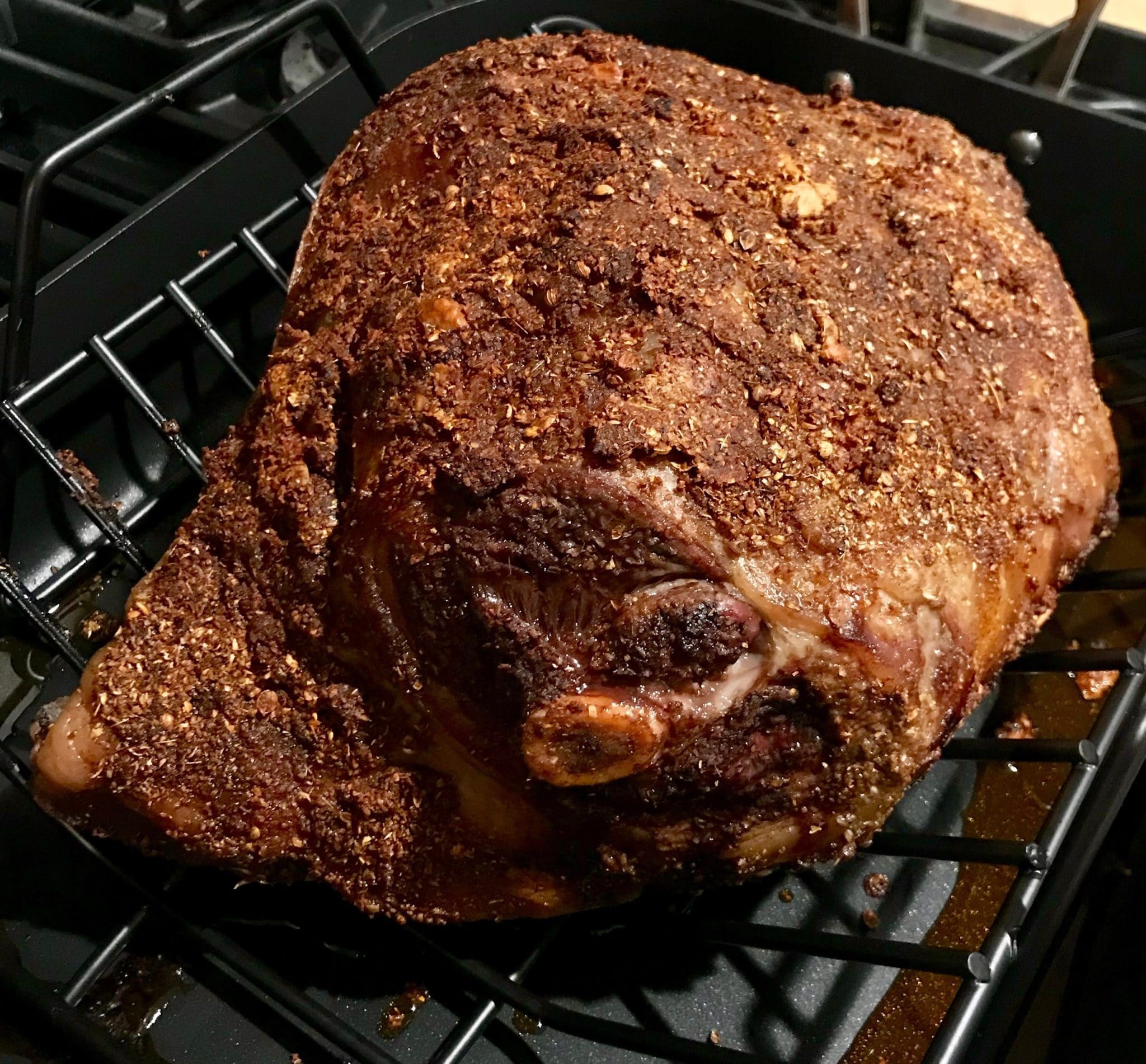
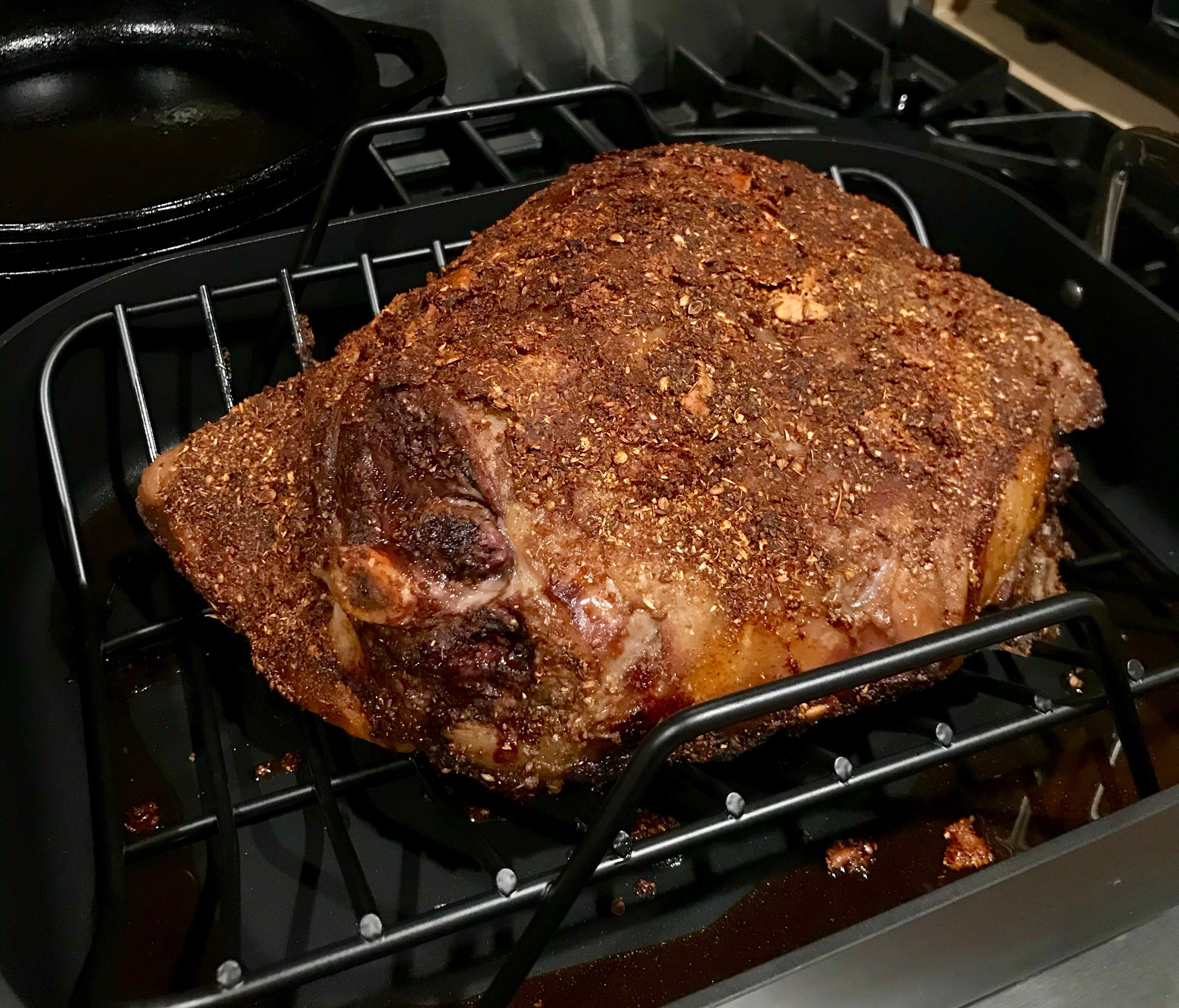
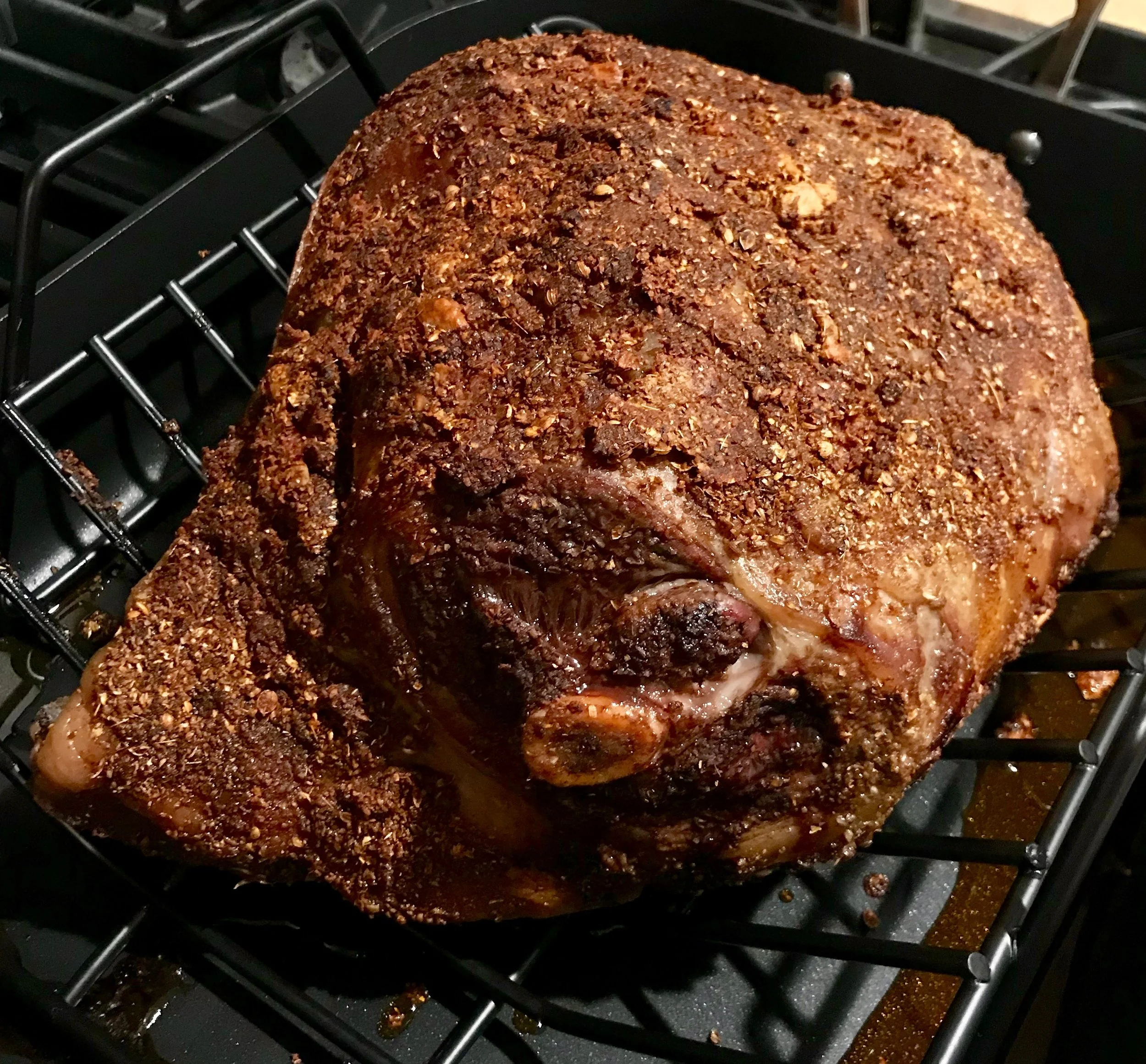
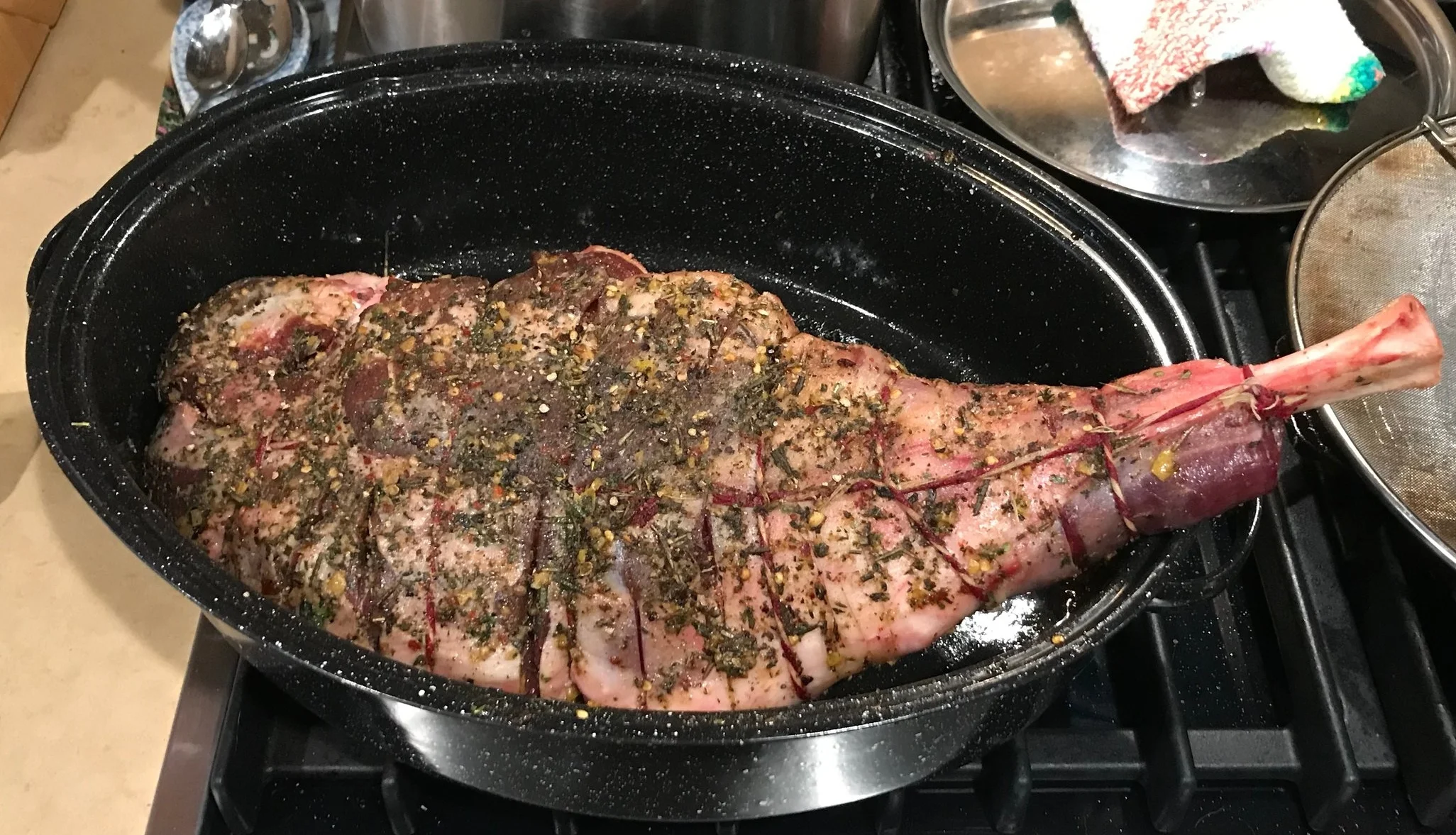
Roasted Herbed Leg of Lamb

This is a great recipe for cooking a whole leg of lamb low-and-slow. The recipe uses the delicious herb rub for meat.

One Day Before Cooking

One day before cooking, pull out for preparation:

1 (6-7 pound) bone-in lamb leg, with the aitch bone removed (ask your butcher to remove it)

Using a very sharp knife, small small cuts across the surface of both sides of lamb every 1/2 to 3/4″. The cuts should be about 1″ long by 1/2″ deep. These slits will help the marinade soak in and allow the fat to crisp up during cooking. Place the lamb on a rack in a large roasting pan.

Make the full amount of the herb rub. Scrape the paste into a small bowl and set aside.

Pour over lamb and massage in to infuse the meat:

1/3 cup red wine

Run the lamb all over with:

1/4 cup salt

1 T freshly ground black pepper

Work the seasoning in with your fingers, rubbing it thoroughly into the meat. Finally, apply the reserved herb rub all over the lamb, evenly coating it with a thin layer.

Refrigerate the lamb leg, uncovered, for 24 hours.

Cooking the Lamb

The following day, remove the lamb from the refrigerator and let it come to room temp, about 4 hours.

Preheat the oven to 275F. Roast the lamb, uncovered, for 1 hour, until the internal temperature is about 90F when a thermometer is inserted at several points in the thickest area of the leg. Be sure to test all the way into the deepest and largest part of the muscle. Because the leg is such a large cut and of varying shape, it is a good idea to check its internal temp in several of the thickest places. Avoid the bone with the thermometer.

Remove the lamb from the oven and turn the temp to 325. When the oven has reached temp, cook the lamb for another 20-40 minutes, until the internal temp is around 112 at the narrowest part of the leg and no more than 130F at the thickest part of the leg for medium-rare. As before, check the temp in several places. Loosely tent the roasting pan with aluminum foil and let rest for a minimum of 45 minutes and up to 2 hours. The meat can rest in the rack of the roasting pan.

About 20 minutes before serving, preheat the oven to 400F. Put the lamb, uncovered, back into the oven and heat until a gorgeous deep brown color, about 15 minutes. To carve the leg, slide your knife as close to the bone as possible and cut a large peace of meat off the bone. Slice the meat across the grain into individual pieces.

Serve the lamb with fresh rosemary sprigs on a platter family-style so guests can choose the slices they like best.

Notes

This dish can easily replace ham or turkey on a holiday table.

Serves 8, generously

Source

Recipe adapted from Taste & Technique: Recipes to Elevate Your Home Cooking by Naomi Pomeroy.

A Delicious Herb Rub for Meat

To make the herb rub, combine the following in a food processor and blend until evenly combined:

3 Tbsp minced garlic

1/4 cup loosely packed rosemary leaves

1/4 cup loosely packed thyme leaves

6 fresh or 12 dried bay leaves, crushed

Peel of 1 lemon, removed in strips and finely minced

2 tsp fennel pollen

1/2 tsp red chile flakes

1 whole nutmeg, finely grated on a microplane

With the blender running, stream in to make a paste:

1/2 cup EVOO

Scrape the paste into a small bowl and set aside.

Pairing

This rub works especially well on pork shoulder or lamb.

Source

Recipe adapted from Taste & Technique: Recipes to Elevate Your Home Cooking by Naomi Pomeroy.

What I’m Reading: December 2018

I was inspired by Venkatesh Rao’s “Refactorings Roundup” to start collecting the things I’ve been reading and sharing them as a blog post.

I’m always seeking to increase the quality of my input rather than the quantity. These posts are another way for me to engage with this content on a deeper level. Pruning and sharing my notes helps highlight and reinforce the major ideas of the article, and a time-spaced review increases my memory of the content.

Books

My reading this month was heavily tilted toward fiction. I’ve gotten too far ahead in my reading, so I’m reading less information-dense material while I’m working through my notes.

Articles

For those interested in reading the articles directly, you can click on the article title to go to the webpage. If you want to see the passages I highlighted from each article, click the “my notes” link to jump directly to the highlights.

How to Be a Systems Thinker

For the full article, click here.

Interesting idea around taxonomy and a connection to religion:

What you have is this process of differentiation, which is intellectually profound but only a beginning. Taxonomy is an essential basis for all we know about the natural world. We have learned to classify. A bee is not a butterfly. You can see that stage in many forms of religion and mythology. And then in some later forms, the switch is from making distinctions to recognizing relationships.

What comes along if you look at the New Testament is Jesus keeps violating all the rules about keeping things separate, which makes people angry, because that’s what they’ve been taught. He’s constantly posing the question, “What’s the connection?” And not, “What’s the difference?” You can see that this constant necessity of recognizing that things are separate and different and can be used in different ways, and then seeing that everything is connected, and how it’s connected and interdependent, that this is a sort of permanent balance in human intellect. If you look at the history of mythology, you can see people moving slowly forward. You can look at the history of science—things that were once equated we now see as separate. We can only go so far in breaking down more and more elementary particles, but we’re still finding particles. We’re still interested in the separation of things, but we’re also still discovering relationships.

We need to consider the entire system:

We have taller smoke stacks on factories now, trying to prevent smog and acid rain. What we’re getting is that the fumes are traveling further, higher up, and still coming down in the form of acid rain. Let’s look at that. Someone has tried to solve a problem, which they did—they reduced smog. But we still put smoke up the chimney and think it disappears. It isn’t gone. It’s gone somewhere. We need to look at the entire system. What happens to the smoke? What happens to the wash-off of fertilizer into brooks and streams? In that sense, we’re using the technology to correct a problem without understanding the epistemology of the problem. The problem is connected to a larger system, and it’s not solved by the quick fix.

Aquarium as a method for teaching about relationships and community:

One of my favorite memories of my childhood was my father helping me set up an aquarium. In retrospect, I understand that he was teaching me to think about a community of organisms and their interactions, interdependence, and the issue of keeping them in balance so that it would be a healthy community. That was just at the beginning of our looking at the natural world in terms of ecology and balance. Rather than itemizing what was there, I was learning to look at the relationships and not just separate things.

On humility as an essential element of wisdom:

One of the most essential elements of human wisdom at its best is humility, knowing that you don’t know everything. There’s a sense in which we haven’t learned how to build humility into our interactions with our devices. The computer doesn’t know what it doesn’t know, and it’s willing to make projections when it hasn’t been provided with everything that would be relevant to those projections. How do we get there? I don’t know. It’s important to be aware of it, to realize that there are limits to what we can do with AI. It’s great for computation and arithmetic, and it saves huge amounts of labor. It seems to me that it lacks humility, lacks imagination, and lacks humor. It doesn’t mean you can’t bring those things into your interactions with your devices, particularly, in communicating with other human beings. But it does mean that elements of intelligence and wisdom—I like the word wisdom, because it’s more multi-dimensional—are going to be lacking.

“War” is a problematic metaphor:

Americans are inclined to talk about the “war against drugs,” or the “war against poverty,” or the “war against cancer,” without questioning whether “war” is an appropriate metaphor. It’s a way of talking about complexity, but if it doesn’t fit, it will cause you to make errors in how you deal with your problems. The war on poverty failed partly because poverty is not something you can defeat, and that makes warfare an inappropriate metaphor. The same is true with the war on drugs, which has gotten us into some ugly situations.

Back to top

Problems are Interconnected

For the full article, click here.

Secondary effects occur are both on the positive and negative side of the spectrum:

The way it is usually told, the message Everything is Connected to Everything Else is not fun to hear. It is intended to cause repentance and reformation. More often, of course, it causes guilt, fear, and an uncontrollable urge to avoid environmentalists.

What we are rarely told is that solutions are as interconnected as problems. One good environmental action can send out waves of good effects as impressive as the chain of disasters that results from environmental evil.

Energy efficiency’s everything-connected-to-everything benefits:

Take energy efficiency, for example. That doesn’t mean deprivation of creature comforts; it means insulating houses, driving cars with better mileage, and plugging in appliances that deliver the same service for less electricity. Amory Lovins of the Rocky Mountain Institute says we could reduce electricity use in the U.S. by 70% with already-proven and currently-economic efficiency measures. We could cut our $430 billion annual energy bill in half just by being as efficient as Japan and West Germany are.

Energy efficiency is a solution to economic problems — it cuts costs to homes, businesses, and government. But look at all the other problems it solves. It could allow us to shut down every nuclear power plant in the country, eliminating the need for heroic financing, political hassle, evacuation planning, the disposal of undisposable wastes, and the bureaucracy of the Nuclear Regulatory Commission. It could free us from dependence on Persian Gulf oil and from involvement in Persian Gulf wars. It would do wonders for our trade and budget deficits. It would improve the air quality of our cities and go a long way toward solving the problems of acid rain and of global climate change.

Organic farming’s everything-connected-to-everything benefits:

Organic farming, practiced successfully by tens of thousands of farmers in this country, can cut a farmer’s costs, helping to save the family farm and reducing the need for billions of dollars of farm subsidy. The use of fewer hazardous chemicals improves the health of farm workers and animals, reduces contamination of groundwater and lakes, restores wildlife populations, and eliminates the need for polluting chemical factories. It saves energy (half the energy used for agriculture goes into the manufacture of fertilizer). Returning organic wastes to the land reduces soil erosion, improves water retention, slows siltation of downstream reservoirs, and reduces urban garbage.

When we look at the short-term benefits of proposed solutions, we may miss these beneficial secondary effects:

Many of these environmental solutions are considered “uneconomic”, but that is because the economics have been figured only for the most short-term and close-in links of the chains. If we calculated the effects on the whole system, we’d see that the wages of environmental sin may be deadly, but the wages of environmental good sense can be enormous.

Everything is connected to everything else on this planet. That can be good news as well as bad.

Back to top

How Your Brain Keeps You Believing

For the full article, click here.

Why we need to build explicit experimentation into our operational processes:

The best way is to build explicit experimentation into how you operate. For example, suppose you have a formal process for ranking candidates that you’re considering hiring. You might periodically, and at random, hire the candidate ranked second or third. This approach allows you to test whether your ranking algorithm is actually working; without it, you’ll never really know.
In the meantime, though, we shouldn’t be all that surprised that our brains assume that things that are easier to process are just all around better. After all, in the harsh and dangerous environment in which our brains evolved, things that were familiar–the people in our group, the path to the river, the sun and moon moving across the sky–were likely to be safer and more trustworthy.

But our environment has changed enormously since then. Now more than ever, we need something far more reliable to separate truth from fiction. And for that, there’s always the scientific method.

We are influenced by the way information is presented to us:

Nor does this come down to just different types of information–it also matters how the same piece of information is presented or stated. We’re more likely to believe statements that are themselves easy to process. And one of the easiest ways to increase the fluency of a statement is to repeat it. Randomized controlled trials have shown that people are more likely to believe things to which they’ve been exposed repeatedly. What’s more, the simple act of recalling a “fact” increases its fluency and therefore makes it more believable.

We view information that is easier to process as reliable:

How do these false truths come to be so widely believed? The answer lies in a powerful shortcut that our brains use every day: Information that’s easier to process is viewed positively in almost every way. Cognitive scientists refer to this ease as “processing fluency,” and it’s why your knowledge base is probably more full of flawed ideas than you’d like to believe.

Back to top

Never Ending Now

For the full article, click here.

How many of you also do this when you’re riding in a car?

From the moment the driver hit the gas pedal, everybody was on their phones. From the back, I watched my peers tap and text with ferocious intensity. As we sat in traffic and drove through Manhattan, one thing stuck out: the people in front of me only consumed content created within the last 24 hours. No exceptions.

We are stuck in a Never-Ending Now thanks to social media:

The structure of our social media feeds place us in a Never-Ending Now. It sucks us into a temporal myopia. Like hamsters running on a wheel, we live in an endless cycle of ephemeral content consumption.
Consider the time-bias of our major social media feeds:

  • Snapchat: 24 Hours or Less
  • Instagram Stories: 24 Hours or Less
  • The Instagram Feed: 3 Days or Less
  • Facebook: 5 Days or Less
  • Twitter: 2 Days or Less

The medium is the message:

As Marshall McLuhan wrote:

“Societies have been shaped more by the nature of the media by which men communicate than by the content of the communication… Environments are not passive wrappings but active processes… Men are never aware of the ground rulesof their environmental systems or cultures… All media works us over completely… and leaves no part of us untouched, unaffected, and unaltered. The medium is the message.”
You are what you consume. End of story. Here’s Tim Wu writing in The Attention Merchants:

“Any and all information that one consumes—pays attention to—will have some influence… As William James observed, we must reflect that, when we reach the end of our days, our life experience will equal what we have paid attention to, whether by choice or default. We are at risk, without quite fully realizing it, of living lives that are less our own than we imagine.”

I tend to prefer older information (especially books that have stood the test of time), and it seems the author agrees:

Soon, I will experiment with “atemporality.” For days or weeks at a time, I will escape the present moment and only consume content published in a different decade. For example, if I want to learn about the 1970s, all my media consumption will consist of books, videos, and interviews published in the 1970s. By doing so, I’ll embody the mindset of people in a bygone era and gain new perspectives on the here and now.

There is nothing new under the sun:

Everything has been said before. The big concepts aren’t new. You’ll find them in old works. Nassim Taleb calls this the Lindy Effect: “The longer something has been in print, the longer it will remain in print and the higher value it is.”

Back to top

The Side Effects of Meditation

For the full article, click here.

I’ve certainly noticed a general distancing from people (and their problems) after regular meditation:

Sometimes while he was meditating, he would feel a vertigo-type feeling, or like he was looking at one of those Magic Eye posters. He says he was feeling overall less stressed —about everything. “It’s like I figured out how to get around living and having problems,” he says. “So it was really positive at first.”

Then, when his girlfriend would tell him about problems at work, he’d look down from, what he calls, “cloud nine” and think, “Well, I can’t really relate to this.” He started to worry that if he kept meditating, he would become a zombie. “Am I not going to be able to relate to people and their stresses?” he asked himself.

Many people recommend Radical Acceptance, but this is how I felt after reading that book and working through the exercises. I had to stop thinking that there was something wrong with me to break the cycle; luckily I did not have any lasting struggles.

Around March 2018, things started to change. He began feeling highly emotional, crying a lot, and dealing with intrusive thoughts. He developed an obsession with the idea of trauma, and the idea that he had a repressed memory. He thought if he felt this terrible, there must have been something in his past that he didn’t remember making him feel this way.

He began to catalog everything he had ever done that he was ashamed or embarrassed about, revealing any secret he’d ever held close. “I was looking for the meaning of why I felt so bad,” he says. “Why did I feel so unlike myself? Why did I feel so upset, or guilty, or negative?”

I, for one, actually seek more of an even keel and immersion. With the positive and the negative, there is always the opposite close behind. But I have certainly never experienced a lack of love for my family.

Meditation has been shown to strengthen the prefrontal cortex, an area of your brain related to attention and also executive control; it keeps regions like the limbic system and amygdala—both emotion centers—under control. “That will result in reduced emotional reactivity,” Britton says

The amygdala isn’t only involved in negative emotions, but also positive ones. If you decrease one, the other may follow. “People in our research complain of not having any emotions, even positive ones, not feeling any kind of love or affection for their families,” Britton says. “That’s like too much of that same once-beneficial process.”

A point worth emphasizing: meditation is powerful.

What all the researchers and meditators can find common ground in, perhaps, and what’s ignored by the deluge of meditation apps and casual recommendations is this: Meditation is powerful. It’s a skill not to be taken lightly, and in the right circumstance can provide incredible benefit, and in others, harm.

Ensure a balanced diet with meditation (as with everything else):

“That would be my ideal sort of mindfulness program, would be to have multiple dimensions of different processes; use your own mindfulness or your monitoring skills to understand where you are, and then know which practices are going to get you to a more optimal level of each one,” Britton says. “Everybody’s going to be different.”

Back to top

Burger Death

For the full article, click here.

The author wondered whether other journalists avoided mentioning great spots to avoid destroying them:

But beyond a heads up, I wondered if they ever actually considered not writing about a place to not, for lack of a better phrase, “blow it up.” Brett Anderson, at the New Orleans Times-Picayune, said that, before and at the beginning of his tenure, this was something that went on. “My predecessor wrote about a restaurant she loved without naming it,” he said. “I’d never go that far, but before Bourdain and Fieri and the proliferation of listicles, there was certainly a lot more internal hand-wringing around ‘do we share every last precious secret we have with our readers?’ But now in the social media age, there’s no incentive to withhold. It just takes one Anderson Cooper tweet, and your favorite po’ boy place is packed for months.” He tells the story of Willie Mae’s Scotch House, a soul food restaurant in the Treme neighborhood known for its fried chicken. “It was always delicious, but never really crowded,” he said. “But then it started appearing on all these national lists, and now, no matter the day, you’ve got to get there before 11am if you don’t want to wait two hours.”

One restauranteur/chef does everything in his power to avoid internet-driven customers:

Willamette Week named Paiche its 2016 restaurant of the year. It made The Oregonian’s best restaurants list. Portland Monthly gave it a great review. Despite de Cossio’s wishes, it became a destination restaurant. So he changed it. He got rid of dinner service. And the ceviche. And made it just a breakfast and lunch cafe with a focus on coffee. He wasn’t interested in serving the “narrow kind of customer” that populated his restaurant. He was more interested, he said, in returning it to the neighborhood.

What happened after Stanich’s became internet famous:

Stanich explained that, as these issues were going on in the background, it was hard to read the social media screeds attacking them, and listen to the answering machine messages at the restaurant calling him a fat fuck and telling him to fuck himself for closing his own restaurant. He didn’t care about them, he insisted. He only cared about people like that woman who’d shown up, the regulars who live in NE Portland. “I need to take care of the people who took care of me,” he said. “They don’t turn on you.”

Internet-list-driven customers tend to be one-time customers.

This was the same sentiment the chef at Paiche had expressed, and that I’d heard from others. If there was one main negative takeaway from the raging fires of food tourist culture and the lists fanning the flames, it was that the people crowding the restaurant were one time customers. They were there to check off a thing on a list, and put it on Instagram. They weren’t invested in the restaurant’s success, but instead in having a public facing opinion of a well known place. In other words, they had nothing to lose except money and the restaurant had nothing to gain except money, and that made the entire situation feel both precarious and a little gross.

The question at the core of the article:

I’ve been asking myself what the other side of this looks like. How do I do this better? Is there a way to celebrate a place without the possibility of destroying it? Or is this just what we are now — a horde with a checklist and a camera phone, intent on self-producing the destruction of anything left that feels real, one Instagram story at a time?

The power that lists have on our mind:

But the most important part of the article revolves around a 2011 psychological study on the “paradox of choice.”

In the digital age, where every bit of information is available at any point in time and that overwhelming fact alone can render any person frozen in indecision for weeks, the study found things that allow us to make decisions faster, like lists, also make us happier. Knowing you can accomplish something, even if it’s as simple as reading a list, is pleasurable.

On top of that, our never-ending buffet of information has led us to reason that we must make the most of our time away from the information superhighway, and that time should only be spent doing the best things. So naturally, the best lists are lists of “bests.”

Centuries ago (2014), when Facebook’s algorithm overlords promoted the idea of Facebook becoming everyone’s “personalized newspaper,” “best” lists flourished in a way that, like the steroid era in baseball, seems in retrospect almost hilariously false, but the traffic gains looked real, so everyone made more lists. Except there was a slight problem: good, sturdy, reliable lists requiring on the ground knowledge and reporting were actually hard/expensive to make, and few places wanted to pay for that sort of reporting, so most lists just ended up plagiarizing off of the few good ones. And, as these lists increased in frequency while simultaneously decreasing in quality, you watched the collective trust in any one list diminish. Comment sections turned cynical, “this is clickbait!” being the most common refrain, then outright ugly and hostile as discourse on the internet has devolved into a garbage fire inside a waste processing plant atop a landfill built on a massive skunk burial ground.

Matt Levine had excellent commentary on this article which points out the dangerous aspect of internet fame and how it is impacting the physical world:

A thing that is often said about the internet is that it creates the conditions for the “long tail”: No matter how obscure your interests, there is a community that shares them, and because those people can be reached worldwide at zero marginal cost, there will be niche businesses that can make a quiet living catering to unusual interests.

But this is the other side of that. When your niche is as utterly mainstream as burgers, and you are very good at it, you can’t make a quiet living doing it. The internet will find you, and news of your success will go out to the whole world, and the whole world will beat a path to your door, and the niche that you wanted to serve—neighborhood sports fans who know you and care about your family and come in every week—will be swamped by tourists and list-checkers and Instagrammers, and it will be impossible for you to provide the experience you wanted to provide to the people you wanted to provide it to. Modern media systems “impose scale on fragile phenomena,” as Rob Horning tweeted. Everything finds the level of popularity it deserves, even if that’s not the level that it wants: Your anime knitting patterns business might find enough buyers to be sustainable, but your superlative neighborhood burger will find too many buyers to be sustainable.

Back to top

No One is Crazy

For the full article, click here.

No one is crazy.

People can be misinformed. They can have incomplete information. They can be bad at math. They can be persuaded by rotten marketing. They can have no idea what they’re doing. They can misjudge the consequences of their actions.

Oh, can they ever.

But the decision to buy a lottery ticket – or a stock, or a house, or whatever – makes sense to them in that moment and checks all the boxes they need to check. Every decision everyone makes is rationalized in their head when they make it.

We all think that we are immune to the crazy:

The cornerstone of behavioral finance is that most people assume it’s a field whose documented flaws apply to other people, but not themselves. That’s because we judge others based solely on their actions, but when judging ourselves we have an internal dialogue that rationalizes what others identify as bad decisions. We rarely hear the internal justifications other people have for their mistakes, but we’re keenly aware of our own. Daniel Kahneman begins his book: “The premise of this book is that it is easier to recognize other people’s mistakes than our own.”

The author’s proposed rules:

  1. Be careful taking cues from other people when you have no idea what they’re thinking.

  2. No one is crazy, including you. But everyone justifies actions based on poor reasoning, including you.

Back to top

Thirty Days of Kindness

For the full article, click here.

The author wanted to explore giving without the expectation of receiving:

But what about pure, altruistic generosity, without the expectation of receiving something in return? Some researchers argue this type of generosity doesn’t exist. But I set out to see whether I could learn to give without the promise of getting. I made lists of various kind acts and placed reminders on my bathroom mirror, my work computer, my car dashboard: Make someone’s day today!

It’s interesting that we find it easier to buy things for people than to perform other acts of kindness:

My first act of kindness was buying coffee for the woman behind me in the drive-thru lane at Starbucks. In fact, my first few acts were buying something for someone—lunch for an old friend, a copy of my favorite book to a stranger—but they didn’t make me feel much of anything. The recipients were grateful, but was I really making their day, and was that really boosting my happiness?

Ripple effect (behavior is contagious):

Shawn Achor, a Harvard-trained researcher and The Happiness Guy at SUCCESS, calls this the ripple effect. Our behavior, he discovered, is literally contagious. “Our habits, attitudes and actions spread through a complicated web of connections to infect those around us,” he writes. That’s why we sync up with our best friends, often finishing each other’s sentences and reading each other’s thoughts. It’s also why one negative attitude can spread like a disease across an office and infect everyone’s mood.

Does generosity make us happier?

So are happier people more generous, or does generosity make us happier? Rather than thinking of it as a cause-and-effect relationship, consider happiness and generosity as intertwining entities. “Generating and expressing kindness quickly dispels suffering and replaces it with lasting fulfillment,” writes Ricard, the Buddhist monk. “In turn the gradual actualization of genuine happiness allows kindness to develop as the natural reflection of inner joy.” Helping behavior increases positive emotions, which increases our sense of purpose, regulates stress, and improves short- and long-term health. All of that contributes to a heightened level of happiness, causing us to feel more generous, creating a circle of happiness and generosity.

Empathy:

Empathy requires feeling what others feel, “to experience, as much as you can, the terrible sorrow and pain,” whereas compassion involves concern and a desire to help without the need to mirror someone else’s anguish.

The author noted that she was kinder toward strangers:

And maybe I avoided generosity toward my close friends and co-workers because it was more difficult. Buying coffee for a stranger is easy, detached and allows for a clean exit. Gently pushing a friend to divulge her source of anxiety after she says “I’m fine” is not. After all, altruism and honest self-reflection take time and practice.

Back to top

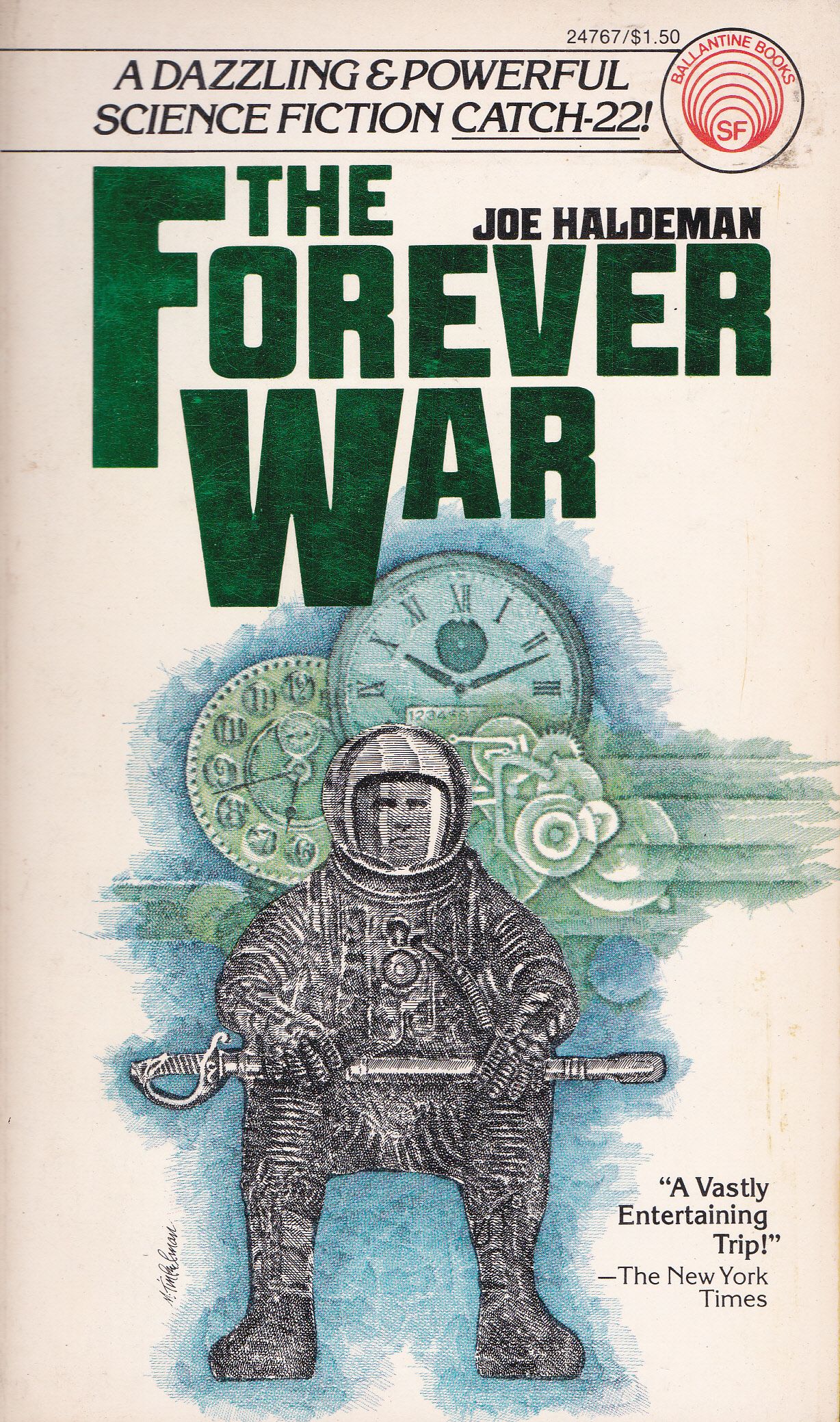
The Forever War

Author:  Joe Haldeman
Rating: 5/5
Last Read: November 2018
Who Should Read: Sci-fi fans, fans of military fiction, fans of Old Man’s War

I’ve been told that I should read The Forever War at least three times a year for the past ten years. I finally got around to reading it, like John Scalzi in the book’s introduction, and all I really have to say is: everyone was absolutely right. The Forever War is a wonderful book.

The novel is set in a future (circa 1996) where Earth is engaged in a war in the far-out reaches of space with another sentient race. Earth conscripts the best of humanity for soldiering and trains them to fight in laser-equipped battle suits. The novel follows the soldiering career of William Mandella, starting with his “boot camp” experiences and moving through various interstellar battles. Each battle involves a large relative time shift for Mandella, so on each return trip to our solar system he experiences “future” shock due to societal changes that happened in the hundreds of years he was away.

This book is an award-winning sci-fi classic for a good reason. There’s plenty of action, interesting future scenarios, and commentary on society and humanity.

To my mind, there are two things that make a novel a “classic”—a genuine classic, as opposed to merely “old and continuing to sell.” The first is that it speaks to the time in which the novel first appeared. There is no doubt The Forever War did this; its awards and acclaim are signifiers of that fact. The second thing is tougher, and that is that it keeps speaking to readers outside its time, because what’s in the book touches on something that never goes away, or at the very least keeps coming around.

I stopped at the first book (I tend to avoid series), but if you are interested in continuing there is another book in the series.

If you enjoy The Forever War, you will also enjoy John Scalzi’s Old Man’s War. (The same applies if you loved Old Man’s War – read this book!)

My Highlights

‘Man was born into barbarism, when killing his fellow man was a normal condition of existence. He became endowed with a conscience. And he has now reached the day when violence toward another human being must become as abhorrent as eating another’s flesh.’ — Martin Luther King, Jr.

Relativity propped it up, at least gave it the illusion of being there … the way all reality becomes illusory and observer-oriented when you study general relativity. Or Buddhism. Or get drafted.

Since the planet rotated rather slowly — once every ten and one-half days — a ‘stationary’ orbit for the ship had to be 150,000 klicks out. This made the people in the ship feel quite secure, with 6,000 miles of rock and 90,000 miles of space between them and the enemy. But it meant a whole second’s time lag in communication between us on the ground and the ship’s battle computer. A person could get awful dead while that neutrino pulse crawled up and back.

‘Sarge, tell that computer to do something! We’re gonna get—’
‘Oh, shut up, Mandella. Trust in th’ lord.’
‘Lord’ was definitely lower-case when Cortez said it.

… I felt my gorge rising and knew that all the lurid training tapes, all the horrible deaths in training accidents, hadn’t prepared me for this sudden reality … that I had a magic wand that I could point at a life and make it a smoking piece of half-raw meat; I wasn’t a soldier nor ever wanted to be one nor ever would want—

‘Night.’ It’s almost impossible to get sexually excited inside a suit, with the relief tube and all the silver chloride sensors poking you, but somehow this was my body’s response to the emotional impotence, maybe remembering more pleasant sleeps with Marygay, maybe feeling that in the midst of all this death, personal death could be very soon, cranking up the procreative derrick for one last try … lovely thoughts like this.

I fell asleep and dreamed that I was a machine, mimicking the functions of life, creaking and clanking my clumsy way through a world, people too polite to say anything but giggling behind my back, and the little man who sat inside my head pulling the levers and clutches and watching the dials, he was hopelessly mad and was storing up hurts for the day—

I hardly heard him for trying to keep track of what was going on in my skull. I knew it was just post-hypnotic suggestion, even remembered the session in Missouri when they’d implanted it, but that didn’t make it any less compelling. My mind reeled under the strong pseudo-memories: shaggy hulks that were Taurans (not at all what we now knew they looked like) boarding a colonists’ vessel, eating babies while mothers watched in screaming terror (the colonists never took babies; they wouldn’t stand the acceleration), then raping the women to death with huge veined purple members (ridiculous that they would feel desire for humans), holding the men down while they plucked flesh from their living bodies and gobbled it (as if they could assimilate the alien protein) … a hundred grisly details as sharply remembered as the events of a minute ago, ridiculously overdone and logically absurd. But while my conscious mind was rejecting the silliness, somewhere much deeper, down in that sleeping animal where we keep our real motives and morals, something was thirsting for alien blood, secure in the conviction that the noblest thing a man could do would be to die killing one of those horrible monsters

I spent a long time after that telling myself over and over that it hadn’t been me who so gleefully carved up those frightened, stampeding creatures. Back in the twentieth century, they had established to everybody’s satisfaction that ‘I was just following orders’ was an inadequate excuse for inhuman contact … but what can you do when the orders come from deep down in that puppet master of the unconscious?

While I was lying there being squeezed, a silly thought took hold of my brain and went round and round like a charge in a superconductor: according to military formalism, the conduct of war divides neatly into two categories, tactics and logistics. Logistics has to do with moving troops and feeding them and just about everything except the actual fighting, which is tactics. And now we’re fighting, but we don’t have a tactical computer to guide us through attack and defense, just a huge, super-efficient pacifistic cybernetic grocery clerk of a logistic, mark that word, logistic computer. The other side of my brain, perhaps not quite as pinched, would argue that it doesn’t matter what name you give to a computer, it’s a pile of memory crystals, logic banks, nuts and bolts … If you program it to be Genghis Khan, it is a tactical computer, even if its usual function is to monitor the stock market or control sewage conversion. But the other voice was obdurate and said by that kind of reasoning, a man is only a hank of hair and a piece of bone and some stringy meat; and no matter what kind of a man he is, if you teach him well, you can take a Zen monk and turn him into a slavering bloodthirsty warrior.

‘She’s very pretty.’ A remarkable observation, her body torn and caked with crusting blood, her face smeared where I had tried to wipe away the tears. I suppose a doctor or a woman or a lover can look beneath that and see beauty.

‘One cannot make command decisions simply by assessing the tactical situation and going ahead with whatever course of action will do the most harm to the enemy with a minimum of death and damage to your own men and material. Modern warfare has become very complex, especially during the last century. Wars are won not by a simple series of battles won, but by a complex interrelationship among military victory, economic pressures, logistic maneuvering, access to the enemy’s information, political postures — dozens, literally dozens of factors.’

‘I hope none of you ever has to face such a decision. When we get back to Stargate, I will in all probability be court-martialed for cowardice under fire. But I honestly believe that the information that may be gained from analysis of the damage to the Anniversary is more important than the destruction of this one Tauran base.’ He sat up straight. ‘More important than one soldier’s career.’

‘William, face it. It’s a miracle she survived to get into surgery. So there’s a big chance she won’t make it back to Earth. It’s sad; she’s a special person, the special person to you, maybe. But we’ve had so much death … you ought to be getting used to it, come to terms with it.’
I took a long pull at my drink, identical to hers except for the citric acid. ‘You’re getting pretty hard-boiled.’
‘Maybe … no. Just realistic. I have a feeling we’re headed for a lot more death and sorrow.’

‘I don’t know. If they could condition us to kill on cue, they can condition us to do almost anything. Re-enlist.’

‘I’m twenty-three, so I was still in diapers when you people left for Aleph … to begin with, how many of you are homosexual?’
Nobody.
‘That doesn’t really surprise me. I am, of course. I guess about a third of everybody in Europe and America is. ‘Most governments encourage homosexuality — the United Nations is neutral, leaves it up to the individual countries — they encourage homolife mainly because it’s the one sure method of birth control.’
That seemed specious to me. Our method of birth control in the army is pretty foolproof: all men making a deposit in the sperm bank, and then vasectomy.

‘Of course, an illegal market developed, and soon there was great inequality in the amount of food people in various strata of society consumed. A vengeance group in Ecuador, the Imparciales, systematically began to assassinate people who appeared to be well-fed. The idea caught on pretty quickly, and in a few months there was a full-scale, undeclared class war going on all over the world. The United Nations managed to get things back under control in a year or so, by which time the population was down to four billion, crops were more or less recovered, and the food crisis was over.

‘Incidentally, the General translated the money coming to you into dollars just for your own convenience. The world has only one currency now, calories. Your thirty-two thousand dollars comes to about three thousand million calories. Or three million k’s, kilocalories.

‘Also, we no longer have the abundance of electrical power I remember from boyhood … probably a good deal less than you remember. There are only a few places in the world where you can have power all day and night. They keep saying it’s a temporary situation, but it’s been going on for over a decade.’

Wars in the past often accelerated social reform, provided technological benefits, even sparked artistic activity. This one, however, seemed tailor-made to provide none of these positive by-products.

And in the past, people whose country was at war were constantly in contact with the war. The newspapers would be full of reports, veterans would return from the front; sometimes the front would move right into town, invaders marching down Main Street or bombs whistling through the night air — but always the sense of either working toward victory or at least delaying defeat. The enemy was a tangible thing, a propagandist’s monster whom you could understand, whom you could hate. But this war … the enemy was a curious organism only vaguely understood, more often the subject of cartoons than nightmares. The main effect of the war on the home front was economic, unemotional — more taxes but more jobs as well. After twenty-two years, only twenty-seven returned veterans; not enough to make a decent parade. The most important fact about the war to most people was that if it ended suddenly, Earth’s economy would collapse.

We got into a discussion about the war, with a bunch of people who knew Marygay and I were veterans. It’s hard to describe their attitude, which was pretty uniform. They were angry in an abstract way that it took so much tax money to support; they were convinced that the Taurans would never be any danger to Earth; but they all knew that nearly half the jobs in the world were associated with the war, and if it stopped, everything would fall apart.

Every time I’ve come down to Earth the past ten years, I’ve wondered whether she’d still be there. Neither of us had enough money to keep in very close touch.’ He had told us in Geneva that a letter from Luna to Earth cost $100 postage — plus $5,000 tax. It discouraged communication with what the UN considered to be a bunch of regrettably necessary anarchists.

Desperate fun, as I said. Unless the war changed radically, our chances of surviving the next three years were microscopic. We were remarkably healthy victims of a terminal disease, trying to cram a lifetime of sensation into a half of a year.

‘It doesn’t add up, though. Why would they haul me all the way from Heaven to take a chance on my “shaping up,” when probably a third of the people here on Stargate are better officer material? God, the military mind!’ ‘I suspect the bureaucratic mind, at least, had something to do with it. You have an embarrassing amount of seniority to be a footsoldier.’

Perhaps this statement is true of any hierarchical structure, but certainly of businesses:

A good sign that an army has been around too long is that it starts getting top-heavy with officers.

One thing we didn’t have to worry about in this war was enemy agents. With a good coat of paint, a Tauran might be able to disguise himself as an ambulatory mushroom. Bound to raise suspicions.

Hilleboe had called them to attention and was dutifully telling them what a good commander I was going to be; that I’d been in the war from the beginning, and if they intended to survive through their enlistment they had better follow my example. She didn’t mention that I was a mediocre soldier with a talent for getting missed.

‘Part of UNEF. Only has authority on Earth.’ She took a deep sniff at the empty capsule. ‘The idea was to keep people from making babies the biological way. Because, A, people showed a regrettable lack of sense in choosing their genetic partner. And B, the Council saw that racial differences had an unnecessarily divisive effect on humanity; with total control over births, they could make everybody the same race in a few generations.’

The art of chastising subordinates is a delicate art. I could see that I’d have to keep reminding Hilleboe that she wasn’t in charge.

‘As you will read in this book, the war ended 221 years ago. Accordingly, this is the year 220. Old style, of course, it is 3138 ad ‘You are the last group of soldiers to return. When you leave here, I will leave as well. And destroy Stargate. It exists only as a rendezvous point for returnees and as a monument to human stupidity. And shame. As you will read. Destroying it will be a cleansing.’ He stopped speaking and the woman started without a pause. ‘I am sorry for what you’ve been through and wish I could say that it was for good cause, but as you will read, it was not.

The 1143-year-long war had been begun on false pretenses and only because the two races were unable to communicate. Once they could talk, the first question was ‘Why did you start this thing?’ and the answer was ‘Me?’

‘Say, bartender.’
‘Yes, Major?’ ‘Do you know of a place called Middle Finger? Is it still there?’
‘Of course it is. Where else would it be?’ Reasonable question. ‘A very nice place. Garden planet. Some people don’t think it’s exciting enough.’

Summary

Major Characters

  • William Mandella
  • Marygay Potter
  • Sgt Cortes

Most other characters appear and die quickly.

Outline

When I read fiction, I make an outline as a memory aide. If you don’t want to see any spoilers, skip this section.

  1. Boot camp – elite conscripts w/ IQ over 150
  2. Sent to Charon – dark + cold – for training in battle suits
  3. Training + Deaths + Graduation
  4. Sent to Starbase for construction
  5. Sent to first battle against the Taurans – massive slaughter – one escapes
  6. Second battle – advanced weapons used, kill 1/3 of crew, abort attacks
  7. Leave army, return to Earth – Potter + Mandella experience future shock
  8. Mandella stays with Marygay’s family; family gets attacked and killed
  9. Return to Mandella’s mom – she does of illness
  10. Rejoin army as instructors on Luna. They immediately get transferred to a strick force
  11. Attack goes poorly; Potter + Mandella are amputees and sent to Heaven to regrow limbs and recover
  12. Marygay + Mandella are separated on separate strike forces
  13. Travel to the farthest known gate
  14. Set up base + wait for Taurans to attack
  15. Outlast Tauren attack, return to Starbase
  16. Meets “Man”, learns the war is over and was a big mistake
  17. Reunited with Marygay on Middle Finger

My Highlights

‘Man was born into barbarism, when killing his fellow man was a normal condition of existence. He became endowed with a conscience. And he has now reached the day when violence toward another human being must become as abhorrent as eating another’s flesh.’ — Martin Luther King, Jr.

Relativity propped it up, at least gave it the illusion of being there … the way all reality becomes illusory and observer-oriented when you study general relativity. Or Buddhism. Or get drafted.

Since the planet rotated rather slowly — once every ten and one-half days — a ‘stationary’ orbit for the ship had to be 150,000 klicks out. This made the people in the ship feel quite secure, with 6,000 miles of rock and 90,000 miles of space between them and the enemy. But it meant a whole second’s time lag in communication between us on the ground and the ship’s battle computer. A person could get awful dead while that neutrino pulse crawled up and back.

‘Sarge, tell that computer to do something! We’re gonna get—’
‘Oh, shut up, Mandella. Trust in th’ lord.’
‘Lord’ was definitely lower-case when Cortez said it.

… I felt my gorge rising and knew that all the lurid training tapes, all the horrible deaths in training accidents, hadn’t prepared me for this sudden reality … that I had a magic wand that I could point at a life and make it a smoking piece of half-raw meat; I wasn’t a soldier nor ever wanted to be one nor ever would want—

‘Night.’ It’s almost impossible to get sexually excited inside a suit, with the relief tube and all the silver chloride sensors poking you, but somehow this was my body’s response to the emotional impotence, maybe remembering more pleasant sleeps with Marygay, maybe feeling that in the midst of all this death, personal death could be very soon, cranking up the procreative derrick for one last try … lovely thoughts like this.

I fell asleep and dreamed that I was a machine, mimicking the functions of life, creaking and clanking my clumsy way through a world, people too polite to say anything but giggling behind my back, and the little man who sat inside my head pulling the levers and clutches and watching the dials, he was hopelessly mad and was storing up hurts for the day—

I hardly heard him for trying to keep track of what was going on in my skull. I knew it was just post-hypnotic suggestion, even remembered the session in Missouri when they’d implanted it, but that didn’t make it any less compelling. My mind reeled under the strong pseudo-memories: shaggy hulks that were Taurans (not at all what we now knew they looked like) boarding a colonists’ vessel, eating babies while mothers watched in screaming terror (the colonists never took babies; they wouldn’t stand the acceleration), then raping the women to death with huge veined purple members (ridiculous that they would feel desire for humans), holding the men down while they plucked flesh from their living bodies and gobbled it (as if they could assimilate the alien protein) … a hundred grisly details as sharply remembered as the events of a minute ago, ridiculously overdone and logically absurd. But while my conscious mind was rejecting the silliness, somewhere much deeper, down in that sleeping animal where we keep our real motives and morals, something was thirsting for alien blood, secure in the conviction that the noblest thing a man could do would be to die killing one of those horrible monsters

I spent a long time after that telling myself over and over that it hadn’t been me who so gleefully carved up those frightened, stampeding creatures. Back in the twentieth century, they had established to everybody’s satisfaction that ‘I was just following orders’ was an inadequate excuse for inhuman contact … but what can you do when the orders come from deep down in that puppet master of the unconscious?

While I was lying there being squeezed, a silly thought took hold of my brain and went round and round like a charge in a superconductor: according to military formalism, the conduct of war divides neatly into two categories, tactics and logistics. Logistics has to do with moving troops and feeding them and just about everything except the actual fighting, which is tactics. And now we’re fighting, but we don’t have a tactical computer to guide us through attack and defense, just a huge, super-efficient pacifistic cybernetic grocery clerk of a logistic, mark that word, logistic computer. The other side of my brain, perhaps not quite as pinched, would argue that it doesn’t matter what name you give to a computer, it’s a pile of memory crystals, logic banks, nuts and bolts … If you program it to be Genghis Khan, it is a tactical computer, even if its usual function is to monitor the stock market or control sewage conversion. But the other voice was obdurate and said by that kind of reasoning, a man is only a hank of hair and a piece of bone and some stringy meat; and no matter what kind of a man he is, if you teach him well, you can take a Zen monk and turn him into a slavering bloodthirsty warrior.

‘She’s very pretty.’ A remarkable observation, her body torn and caked with crusting blood, her face smeared where I had tried to wipe away the tears. I suppose a doctor or a woman or a lover can look beneath that and see beauty.

‘One cannot make command decisions simply by assessing the tactical situation and going ahead with whatever course of action will do the most harm to the enemy with a minimum of death and damage to your own men and material. Modern warfare has become very complex, especially during the last century. Wars are won not by a simple series of battles won, but by a complex interrelationship among military victory, economic pressures, logistic maneuvering, access to the enemy’s information, political postures — dozens, literally dozens of factors.’

‘I hope none of you ever has to face such a decision. When we get back to Stargate, I will in all probability be court-martialed for cowardice under fire. But I honestly believe that the information that may be gained from analysis of the damage to the Anniversary is more important than the destruction of this one Tauran base.’ He sat up straight. ‘More important than one soldier’s career.’

‘William, face it. It’s a miracle she survived to get into surgery. So there’s a big chance she won’t make it back to Earth. It’s sad; she’s a special person, the special person to you, maybe. But we’ve had so much death … you ought to be getting used to it, come to terms with it.’
I took a long pull at my drink, identical to hers except for the citric acid. ‘You’re getting pretty hard-boiled.’
‘Maybe … no. Just realistic. I have a feeling we’re headed for a lot more death and sorrow.’

‘I don’t know. If they could condition us to kill on cue, they can condition us to do almost anything. Re-enlist.’

‘I’m twenty-three, so I was still in diapers when you people left for Aleph … to begin with, how many of you are homosexual?’
Nobody.
‘That doesn’t really surprise me. I am, of course. I guess about a third of everybody in Europe and America is. ‘Most governments encourage homosexuality — the United Nations is neutral, leaves it up to the individual countries — they encourage homolife mainly because it’s the one sure method of birth control.’
That seemed specious to me. Our method of birth control in the army is pretty foolproof: all men making a deposit in the sperm bank, and then vasectomy.

‘Of course, an illegal market developed, and soon there was great inequality in the amount of food people in various strata of society consumed. A vengeance group in Ecuador, the Imparciales, systematically began to assassinate people who appeared to be well-fed. The idea caught on pretty quickly, and in a few months there was a full-scale, undeclared class war going on all over the world. The United Nations managed to get things back under control in a year or so, by which time the population was down to four billion, crops were more or less recovered, and the food crisis was over.

‘Incidentally, the General translated the money coming to you into dollars just for your own convenience. The world has only one currency now, calories. Your thirty-two thousand dollars comes to about three thousand million calories. Or three million k’s, kilocalories.

‘Also, we no longer have the abundance of electrical power I remember from boyhood … probably a good deal less than you remember. There are only a few places in the world where you can have power all day and night. They keep saying it’s a temporary situation, but it’s been going on for over a decade.’

> Wars in the past often accelerated social reform, provided technological benefits, even sparked artistic activity. This one, however, seemed tailor-made to provide none of these positive by-products.

And in the past, people whose country was at war were constantly in contact with the war. The newspapers would be full of reports, veterans would return from the front; sometimes the front would move right into town, invaders marching down Main Street or bombs whistling through the night air — but always the sense of either working toward victory or at least delaying defeat. The enemy was a tangible thing, a propagandist’s monster whom you could understand, whom you could hate. But this war … the enemy was a curious organism only vaguely understood, more often the subject of cartoons than nightmares. The main effect of the war on the home front was economic, unemotional — more taxes but more jobs as well. After twenty-two years, only twenty-seven returned veterans; not enough to make a decent parade. The most important fact about the war to most people was that if it ended suddenly, Earth’s economy would collapse.

We got into a discussion about the war, with a bunch of people who knew Marygay and I were veterans. It’s hard to describe their attitude, which was pretty uniform. They were angry in an abstract way that it took so much tax money to support; they were convinced that the Taurans would never be any danger to Earth; but they all knew that nearly half the jobs in the world were associated with the war, and if it stopped, everything would fall apart.

Every time I’ve come down to Earth the past ten years, I’ve wondered whether she’d still be there. Neither of us had enough money to keep in very close touch.’ He had told us in Geneva that a letter from Luna to Earth cost $100 postage — plus $5,000 tax. It discouraged communication with what the UN considered to be a bunch of regrettably necessary anarchists.

Desperate fun, as I said. Unless the war changed radically, our chances of surviving the next three years were microscopic. We were remarkably healthy victims of a terminal disease, trying to cram a lifetime of sensation into a half of a year.

‘It doesn’t add up, though. Why would they haul me all the way from Heaven to take a chance on my “shaping up,” when probably a third of the people here on Stargate are better officer material? God, the military mind!’ ‘I suspect the bureaucratic mind, at least, had something to do with it. You have an embarrassing amount of seniority to be a footsoldier.’

Perhaps this statement is true of any hierarchical structure, but certainly of businesses:

> A good sign that an army has been around too long is that it starts getting top-heavy with officers.

One thing we didn’t have to worry about in this war was enemy agents. With a good coat of paint, a Tauran might be able to disguise himself as an ambulatory mushroom. Bound to raise suspicions.

Hilleboe had called them to attention and was dutifully telling them what a good commander I was going to be; that I’d been in the war from the beginning, and if they intended to survive through their enlistment they had better follow my example. She didn’t mention that I was a mediocre soldier with a talent for getting missed.

‘Part of UNEF. Only has authority on Earth.’ She took a deep sniff at the empty capsule. ‘The idea was to keep people from making babies the biological way. Because, A, people showed a regrettable lack of sense in choosing their genetic partner. And B, the Council saw that racial differences had an unnecessarily divisive effect on humanity; with total control over births, they could make everybody the same race in a few generations.’

The art of chastising subordinates is a delicate art. I could see that I’d have to keep reminding Hilleboe that she wasn’t in charge.

‘As you will read in this book, the war ended 221 years ago. Accordingly, this is the year 220. Old style, of course, it is 3138 ad ‘You are the last group of soldiers to return. When you leave here, I will leave as well. And destroy Stargate. It exists only as a rendezvous point for returnees and as a monument to human stupidity. And shame. As you will read. Destroying it will be a cleansing.’ He stopped speaking and the woman started without a pause. ‘I am sorry for what you’ve been through and wish I could say that it was for good cause, but as you will read, it was not.

The 1143-year-long war had been begun on false pretenses and only because the two races were unable to communicate. Once they could talk, the first question was ‘Why did you start this thing?’ and the answer was ‘Me?’

‘Say, bartender.’
‘Yes, Major?’ ‘Do you know of a place called Middle Finger? Is it still there?’
‘Of course it is. Where else would it be?’ Reasonable question. ‘A very nice place. Garden planet. Some people don’t think it’s exciting enough.’

Summary

Major Characters

  • William Mandella
  • Marygay Potter
  • Sgt Cortes

Most other characters appear and die quickly.

Outline

When I read fiction, I make an outline as a memory aide. If you don’t want to see any spoilers, skip this section.

  1. Boot camp – elite conscripts w/ IQ over 150
  2. Sent to Charon – dark + cold – for training in battle suits
  3. Training + Deaths + Graduation
  4. Sent to Starbase for construction
  5. Sent to first battle against the Taurans – massive slaughter – one escapes
  6. Second battle – advanced weapons used, kill 1/3 of crew, abort attacks
  7. Leave army, return to Earth – Potter + Mandella experience future shock
  8. Mandella stays with Marygay’s family; family gets attacked and killed
  9. Return to Mandella’s mom – she does of illness
  10. Rejoin army as instructors on Luna. They immediately get transferred to a strick force
  11. Attack goes poorly; Potter + Mandella are amputees and sent to Heaven to regrow limbs and recover
  12. Marygay + Mandella are separated on separate strike forces
  13. Travel to the farthest known gate
  14. Set up base + wait for Taurans to attack
  15. Outlast Tauren attack, return to Starbase
  16. Meets “Man”, learns the war is over and was a big mistake
  17. Reunited with Marygay on Middle Finger

Buy the Book

If you are interested in purchasing this book, you can support the website by using our Amazon affiliate link.


The Forever War

By Joe Haldeman


Flashman

Author: George MacDonald Fraser
Rating: 4/5
Last Read: November 2018
Who Should Read: People who like to laugh, those interested in military fiction or historical fiction

Flashman is the first book in a long series of novels about the life and exploits of Harry Flashman, an entirely unlikeable anti-hero.

Flashman describes himself openly as a coward, cheat, and a bully, and yet somehow he makes his way to the top of every situation and encounter he’s in. Flashman’s star rises throughout the novel, and everyone who recognizes him for who he is somehow ends up dead or pushed by the wayside.

It details his life from 1839 to 1842 and his travels to Scotland, India, and Afghanistan. It also contains a number of notes by the author, in the guise of a fictional editor, providing additional historical glosses on the events described. The history in these books is largely accurate; most of the prominent figures Flashman meets were real people.

I highly recommend Flashman to anyone who enjoys fiction. The book is fast-paced and full of amusing antics. I found myself laughing and cursing Flashman on every page. Those interested in military fiction or historical fiction will also enjoy the novel, as it covers the terrible defeat of the British in Afghanistan under General Elphinstone.

I stopped at the first book (I tend to avoid series), but if you are interested in continuing there are eleven more books in the series.

My Highlights

Anyway, he gave me a fine holy harangue, about how through repentance I might be saved—which I’ve never believed, by the way. I’ve repented a good deal in my time, and had good cause, but I was never ass enough to suppose it mended anything. But I’ve learned to swim with the tide when I have to, so I let him pray over me, and when he had finished I left his study a good deal happier than when I went in.

Anyway, I was content to let the matter rest just now; I have always believed in one thing at a time, and the thing that was occupying my mind was Miss Judy Parsons.

A lot has been said about the purchase of commissions—how the rich and incompetent can buy ahead of better men, how the poor and efficient are passed over—and most of it, in my experience, is rubbish. Even with purchase abolished, the rich rise faster in the Service than the poor, and they’re both inefficient anyway, as a rule. I’ve seen ten men’s share of service, through no fault of my own, and can say that most officers are bad, and the higher you go, the worse they get, myself included.

Some human faults are military virtues, like stupidity, and arrogance, and narrow-mindedness.

Of course if he had thought at all he would have sniffed something fishy about a ten thousand bribe in the first place. But he was greedy, and I’ve lived long enough to discover that there isn’t any folly a man won’t contemplate if there’s money or a woman at stake.

In her, ignorance and stupidity formed a perfect shield against the world: this, I suppose, is innocence.

“Not fair! Well, well, this is one lesson you’re learning. Nothing’s fair, you young fool.”

if the day comes, don’t wait to die on the field of honour.” He said it without a sneer. “Heroes draw no higher wages than the others, boy. Sleep well.”

But looking back I can say that, all unwittingly, Kabul and the army were right to regard Elphy’s arrival as an incident of the greatest significance. It opened a new chapter: it was a prelude to events that rang round the world. Elphy, ably assisted by McNaghten, was about to reach the peak of his career; he was going to produce the most shameful, ridiculous disaster in British military history.

Think of all the conceivable misfortunes that can arise from combinations of folly, cowardice, and sheer bad luck, and I’ll give you chapter and verse. But I still state unhesitatingly, that for pure, vacillating stupidity, for superb incompetence to command, for ignorance combined with bad judgement—in short, for the true talent for catastrophe—Elphy Bey stood alone.

Only he could have permitted the First Afghan War and let it develop to such a ruinous defeat. It was not easy: he started with a good army, a secure position, some excellent officers, a disorganised enemy, and repeated opportunities to save the situation. But Elphy, with the touch of true genius, swept aside these obstacles with unerring precision, and out of order wrought complete chaos. We shall not, with luck, look upon his like again.

So it always goes with dissension at the top:

And neither of them got on with Shelton, a rude boor of a man who was Elphy’s second-in-command, and this dissension at the top made for uneasiness and mistrust farther down.

I don’t pretend that I became an expert in a few weeks, or that I ever “knew” Afghanistan, but I picked up a little here and there, and began to realise that those who studied the country only from the cantonment at Kabul knew no more about it than you would learn about a strange house if you stayed in one room of it all the time.

It was unfortunate that he happened, about this time, to be awaiting his promotion and transfer to the Governorship of Bombay; I think the knowledge that he was leaving may have made him careless.

Ask him,” I shouted, “how I came here! Ask the lying, treacherous bastard!”
“Never try to flatter Gul Shah,” said the stout man cheerfully. “He’ll believe every word of it. No, there has been a mistake, regrettably, but it has not been irreparable. For which God be thanked—and my timely arrival, to be sure.” And he smiled at me again. “But you must not blame Gul Shah, or his people: they did not know you for what you were.”
Now, as he said those words, he ceased to be a waggish madman; his voice was as gentle as ever, but there was no mistaking the steel underneath. Suddenly things became real again, and I understood that the kindly smiling man before me was strong in a way that folk like Gul Shah could never be: strong and dangerous.

You have to manage morale:

“First, my dear friend Flashman,” says he, all charm, “I must tell you that you have been kept here not only for your own good but for your people’s. Their situation is now bad. Why, I do not know, but Elfistan Sahib has behaved like a weak old woman. He has allowed the mobs to rage where they will, he has left the deaths of his servants unavenged, he has exposed his soldiers to the worst fate of all—humiliation—by keeping them shut up in cantonments while the Afghan rabble mock at them. Now his own troops are sick at heart; they have no fight in them.”

“The British cannot stay here now,” he went on. “They have lost their power, and we Afghans wish to be rid of them. There are those who say we should slaughter them all—needless to say, I do not agree.” And he smiled. “For one thing, it might not be so easy—”
“It is never easy,” said old Muhammed Din. “These same feringhees took Ghuznee Fort; I saw them, by God.”
“—and for another, what would the harvest be?” went on Akbar. “The White Queen avenges her children. No, there must be a peaceful withdrawal to India; this is what I would prefer myself. I am no enemy of the British, but they have been guests in my country too long.”

I have observed, in the course of a dishonest life, that when a rogue is outlining a treacherous plan, he works harder to convince himself than to move his hearers. Akbar wanted to cook his Afghan enemies’ goose, that was all, and perfectly understandable, but he wanted to look like a gentleman still—to himself.

“Now,” went on Akbar, “you must deliver my proposals to McLoten Sahib personally, and in the presence of Muhammed Din and Khan Hamet here, who will accompany you. If it seems”—he flashed his smile—“that I don’t trust you, my friend, let me say that I trust no one. The reflection is not personal.”

You don’t know one of the first rules of politics: that a man can be trusted to follow his own interest. I see perfectly well that Akbar is after undisputed power among his own people; well, who’s to blame him? And I tell you, I believe you wrong Akbar Khan; in our meetings he has impressed me more than any other Afghan I have met. I judge him to be a man of his word.”

“To my most beloved Hector,” and I thought, by God, she’s cheating on me, and has sent me the wrong letter by mistake. But in the second line was a reference to Achilles, and another to Ajax, so I understood she was just addressing me in terms which she accounted fitting for a martial paladin; she knew no better. It was a common custom at that time, in the more romantic females, to see their soldier husbands and sweethearts as Greek heroes, instead of the whoremongering, drunken clowns most of them were. However, the Greek heroes were probably no better, so it was not so far off the mark.

But chance helped me, as she always does if you keep your wits about you

“Why should you want to preserve my life?” says I. “What do you owe me?”
“We have been friends,” says he, grinning that sudden grin of his. “Also I admired the compliments you paid me as you rode away from Mohammed Khan’s fort the other day.”
“They weren’t meant to flatter you,” says I.
The insults of an enemy are a tribute to the brave,” laughs he.

When I woke it was broad day, and Sergeant Hudson had a little fire going and was brewing coffee. It was the first hot drink I had tasted in days; he even had a little sugar for it.
“Where the devil did you come by this, Hudson?” says I, for there had been nothing but dried mutton and a few scraps of biscuit on the last few days of the march.
“Foraged, sir,” says he, cool as you please, so I asked no more questions, but sipped contentedly as I lay in my blankets.

He’s a pretty a terrible leader:

So I agreed, and found myself considering this Sergeant Hudson for the first time, for beyond noting that he was a steady man I had given him not much notice before. After all, why should one notice one’s men very much?

There is a painting of the scene at Gandamack, which I saw a few years ago, and it is like enough the real thing as I remember it. No doubt it is very fine and stirs martial thoughts in the gloryblown asses who look at it; my only thought when I saw it was, “You poor bloody fools!” and I said so, to the disgust of other viewers. But I was there, you see, shivering with horror as I watched, unlike the good Londoners, who let the roughnecks and jailbirds keep their empire for them; they are good enough for getting cut up at the Gandamacks which fools like Elphy and McNaghten bring ’em to, and no great loss to anybody.

So we were safe, and to come safe out of a disaster is more gratifying than to come safe out of none at all.

There is great pleasure in catastrophe that doesn’t touch you, and anyone who says there isn’t is a liar. Haven’t you seen it in the face of a bearer of bad news, and heard it in the unctuous phrases at the church gate after a funeral?

Hudson, of course, didn’t understand why I should be so horrified at this, until I told him the whole story—about Narreeman, and how Akbar had rescued me from Gul’s snakes in Kabul. Heavens, how I must have talked, but when I tell you that we were in the cellar a week together, without ever so much as seeing beyond the door, and myself in a sweat of anxiety about what our fate might be, you will understand that I needed an audience. Your real coward always does, and the worse his fear the more he blabs.

God, how I called; I roared like a bull calf, and got nothing back, not even echoes. I would do it again, too, in the same position, for all that I don’t believe in God and never have. But I blubbered like an infant, calling on Christ to save me, swearing to reform and crying gentle Jesus meek and mild over and over again. It’s a great thing, prayer. Nobody answers, but at least it stops you from thinking.

God alone knew what I was supposed to have done that was so brave, but doubtless I should learn in time. All I could see was that somehow appearances were heavily on my side—and who needs more than that? Give me the shadow every time, and you can keep the substance—it’s a principle I’ve followed all my life, and it works, if you know how to act on it.

It calls for nice judgement, this art of bragging; you must be plain, but not too plain, and you must smile only rarely. Letting them guess more than you say is the kernel of it, and looking uncomfortable when they compliment you.

But you will have noticed, no doubt, that when a man has a reputation good or bad, folk will always delight in adding to it; there wasn’t a man in Afghanistan who knew me but who wanted to recall having seen me doing something desperate, and Broadfoot, quite sincerely, was like all the rest.

I forgot the incident at once. I remember it now, for it was that same day that everything happened all at once. There are days like that; a chapter in your life ends and another one begins, and nothing is the same afterwards.

This myth called bravery, which is half-panic, half-lunacy (in my case, all panic), pays for all; in England you can’t be a hero and bad. There’s practically a law against it.

We shook hands, and he drove off. I never spoke to him again. Years later, though, I told the American general, Robert Lee, of the incident, and he said Wellington was right—I had received the highest honour any soldier could hope for. But it wasn’t the medal; for Lee’s money it was Wellington’s hand. Neither, I may point out, had any intrinsic value.

Pride is a hellish thing; without it there isn’t any jealousy or ambition. And I was proud of the figure I cut—in bed and in barracks. And here was I, the lion of the hour, medal and all, the Duke’s handshake and the Queen’s regard still fresh—and I was gnawing my innards out about a gold-headed filly without a brain to her name.

Flashman shows his true character when finding out he’s been cheated on:

I looked, and seeing myself so damned dashing, and her radiant and fair beside me, I fought down the wretchedness and rage. No, it couldn’t be true….
“Susan, you have not put away my coat, silly girl. Take it at once, before it creases.”
By God, though, I knew it was. Or I thought I knew. To the devil with the consequences, no little ninny in petticoats was going to do this to me.
“Elspeth,” says I, turning.
“Hang it carefully, now, when you’ve brushed it. There. Yes, my love?”
“Elspeth….”
“Oh, Harry, you look so strong and fierce, on my word. I don’t think I shall feel easy in my mind when I see all these fancy London ladies making eyes at you.” And she pouted very pretty and touched her finger on my lips.
“Elspeth, I—”
“Oh, I had nearly forgot—you had better take some money with you. Susan, bring me my purse. In case of any need that may arise, you know. Twenty guineas, my love.”
“Much obliged,” says I. What the devil, you have to make do as best you can; if the tide’s there, swim with it and catch on to whatever offers. You only go by once.
“Will twenty be sufficient, do you think?”
“Better make it forty.”

Summary

Major Characters

  • Flashman
  • Earl of Cardigan
  • Bernier
  • Elspeth
  • Gul Shah
  • Burnes
  • Elby Bey (Elphinstone)
  • Akbar Khan
  • Sgt Hudson

Outline

When I read fiction, I make an outline as a memory aide. If you don’t want to see any spoilers, skip this section.

  1. Flashman is expelled from school
  2. Flashman joins the 11th Light Dragoons as an officer
  3. Flashman “wins” duel with Bernier after rigging it
  4. Flashman gets reassigned to Glasgow, marries Elspeth (Forced)
  5. Flashman gets transferred to India for marrying down
  6. Flashman learns Hindi, goes to a party with the governor, gets sent to Afghanistan
  7. Flashman learns Pashtu, gets sent as an emissary to the Gulzai
  8. Flashman rapes the dancer, makes an enemy of Gul Shah – ambushed while hunting
  9. The complacent garrison is attacked. Burnes dies.
  10. Flashman is captured by Gul Shah, then saved by Akbar Khan
  11. Flashman is sent to make a deal: British help double-cross a tribe, get safe retreat out of Afghanistan.
  12. British get double-crossed; still retreat out of Afghanistan
  13. Backstabbing by Akbar Khan – most of the force is wiped out in the Kabul pass (terrible decisions by Elphinstone)
  14. Flashman separates from the army with Sgt Hudson
  15. They see the massacre @ Gandamack, and are captured by Afghans
  16. Flashman is tortured by Gul Shah, he escapes with Sgt Hudson after they kill Gul Shah
  17. They make it to a fort outside of Jalalabad
  18. The fort is overrun, the only survivor is Flashman
  19. Flashman is sent to England as a hero – meets the Queen, Duke of Wellington, gets a medal
  20. Finds out his wife is cheating on him – fine with it because he wants money.

Buy the Book

If you are interested in purchasing this book, you can support the website by using our Amazon affiliate link.


Flashman: A Novel

By George MacDonald Fraser