The Collapsing Empire

Author: John Scalzi
Rating: 8/10
Last Read: April 2017

Quick Summary:  The Collapsing Empire is a newer book of John Scalzi’s (the latest at the time of this writing). The Collapsing Empire is a quick and fun read – it sets up a new universe on the verge of a massive problem. The future space-based empire of man lives on a network of worlds connected by “the flow”. The flow has been assumed to be a stable network between worlds; in the manner of most assumptions, this turns out to not be true and soon the flow will close and mankind will be stranded alone in the dark.

Naturally, many characters are poised to respond to this nascent information – some seek political advantage and power in the coming future, and others seek to prevent the mass extinction of mankind across its many colonies.

The Collapsing Empire is a fun (and mostly light-hearted) read. The only thing I really take points off for is the lack of real resolution at the end of the book. Scalzi is clearly building a new universe and series that will continue on.  However, I contrast this against Old Man’s War, which was the first part of a series but still had a satisfying ending of its own. I prefer my stories to be complete, rather than lacking a satisfying ending.

My Highlights

“You have this all planned out, then.”
“It’s not personal, Captain.”
“Getting murdered for money feels personal, Ollie.”
–loc 104

“But you just said it’s a politically advantageous match.” Batrin gave the very slightest of shrugs.
“It is, but so what? You’ll be emperox soon enough.”
“And then no one can tell me what to do.”
“Oh, no,” Batrin said. “Everyone will tell you what to do. But you won’t always have to listen.”
–loc 459

“If you like we can adjust my conversational model to be more like I was in life.”
“You’re telling me you lied to me in life.”
“No more than to anyone else.”

–loc 1203

“But you just said you were a prophet.”
“Anyone can be a prophet. You just have to say that what you’re talking about is a reflection of God. Or of the gods. Or of some divine spirit. However you want to put it. Whether those things come true isn’t one way or another about it.”
–loc 2638

“He’s a mess,” Marce said.
“Yes, well. Lady Kiva tossed him out an airlock,” Pinton answered.
“You threw him into space?”
“Yup.”
“And he didn’t die?”
“We only threw him out a little bit.”
–loc 3092

“Because he was in the corridor with your ‘associate’ when the bomb went off. He and several other crew members were trying to interrupt your friend. He survived. Two other crew members didn’t.”
“Condolences, Captain.”
“You just threatened to destroy my ship and kill my entire crew, Captain. Your condolences are hollow.”
–loc 3188

“You and me and him. There you’ll explain the entire situation to him, and apologize to him.”
“Sir, for what? As I said, this is entirely a misunderstanding.”
“Then you’ll apologize for the misunderstanding. Ghreni, it doesn’t matter whether you actually have anything to apologize for. The act of apologizing is the thing. You should know that already. That’s basic diplomacy.
–loc 3424

Mount snorted. “I’m not going to appoint her just because the duke died and now she doesn’t have to overthrow him. They are still in rebellion. You don’t win a rebellion by default.” –loc 3683

“I’m continually confronted with the human tendency to ignore or deny facts until the last possible instant. And then for several days after that, too.” –loc 5097

“That’s the human brain,” Attavio VI said. “It creates patterns when there aren’t any. Imagines causality when there is none. Imagines a narrative where none exists. It’s in the design of the brain itself. It’s primed to lie.” “And –loc 5137

What is Tao?

Author: Alan Watts
Rating: 9/10
Last Read: April 2017

Quick Summary:  Alan Watts’s short book What is Tao? is an excellent (and quick!) introduction to Taoism and its core philosophies. I immediately followed What is Tao? with the Tao Te Ching and started exploring the I Ching. I find that Taoism and Stoicism are very interesting to study together, and I’m excited to dive further into this new area.

My Highlights

As I sat working on this manuscript my eight-year-old son came up to me and asked, “Papa, what are you working on?” I told him it was a book on the Tao, and began to explain a little bit about it, but without a moment’s hesitation he said, “Oh, you mean what’s behind everything” — and then he headed off. Intuitively and experientially we know what it is, but for most of us the problem arises when we try to explain it. –loc 118

Living close to the earth one sees the wisdom of not interfering with the course of life, and of letting things go their way. This is the wisdom that also tells us not to get in our own way, and to paddle with the current, split wood along the grain, and seek to understand the inner workings of our nature instead of trying to change it. –loc 183

In the West our attitude is strangely different, and we constantly use a phrase that sounds peculiar indeed in the ears of a Chinese person: We speak of “the conquest of nature” or “the conquest of space,” and of the “conquest” of great mountains like Everest. And one might very well ask us, “What on Earth is the matter with you? Why must you feel as if you are in a fight with your environment all the time? –loc 235

They would say of a person who cannot trust his own basic nature, “If you cannot trust your own nature, how can you trust your own mistrusting of it? How do you know that your mistrust is not wrong as well?” –loc 267

Once Buddhism was imported to China, Taoism so completely permeated Mahayana Buddhism in general and Zen Buddhism in particular that the philosophies of these schools are often indistinguishable. –loc 278

Confucius was the first to say that he would rather trust human passions and instincts than trust human ideas about what is right, for like the Taoists he realized that we have to allow all living things to look after themselves. –loc 303

The core of Lao-tzu’s written philosophy deals with the art of getting out of one’s own way, learning how to act without forcing conclusions, and living in skillful harmony with the processes of nature instead of trying to push them around. –loc 336

Because of the inseparability of opposites, therefore, you realize that they always go together, and this hints at some kind of unity that underlies them. –loc 358

There is always something that we don’t know. This is well illustrated by the elusive qualities of energy in physics: We cannot really define energy, but we can work with it, and this is the case with the Tao. The Tao works by itself. Its nature is to be, as is said in Chinese, tzu-jan, that which is “of itself,” “by itself,” or “itself so.” –loc 411

The fundamental sense of it is that the Tao operates of itself. All that is natural operates of itself, and there is nothing standing over it and making it goon. In the same way one’s own body operates of itself. You don’t have to decide when and how you’re going to beat your heart; it just happens. You don’t decide exactly how you are going to breathe; your lungs fill and empty themselves without effort. You don’t determine the structure of your own nervous system or of your bones; they grow all by themselves. –loc 417

Lao-tzu would go on to say that since man is an integral part of the natural universe, he cannot hope to control it as if it were an object quite separate from himself. You can’t get outside of nature to be the master of nature. –loc 423

Remember that your heart beats “self-so” — and, if you give it a chance, your mind can function “self-so,” although most of us are afraid to give it a chance. –loc 425

Whenever we have the feeling of being able to dominate ourselves, master ourselves, or become the lords of nature, what happens is that we do not really succeed in getting outside of nature or of ourselves at all. Instead we have forced our way of seeing these things to conform to an illusion that makes us think they are controlled objects, and in doing this we invariably set up a conflict inside the system. –loc 430

We soon find that the tension between our idea of things and things as they are puts us out of accord with the way of things. –loc 433

In Chinese the second principle is called wu wei, and it means literally “not doing,” but would be much better translated to give it the spirit of “not forcing” or “not obstructing.” In reference to the Tao it is the sense that the activity of nature is not self-obstructive. It all works together as a unity and does not, as it were, split apart from itself to do something to itself. –loc 436

Wu wei is also applied to human activity, and refers to a person who does not get in his or her own way. One does not stand in one’s own light while working, and so the way of wu wei (this sounds like a pun but it isn’t) is the way of non-obstruction or noninterference. This is the preeminently practical Taoist principleof life. –loc 439

But what happens was expressed very well in a cartoon I saw the other day: A small boy is standing and looking at his teacher and saying, “I’m sorry, I didn’t hear what you were saying because I was listening so hard.” In other words, when we try to be loving, or to be virtuous, or to be sincere, we actually think about trying to do it in the same way the child was trying to listen, tightening up his muscles and trying to look intelligent as he thought about paying attention. But he wasn’t thinking about what the teacher is saying, and therefore he wasn’t really listening at all. This is a perfect example of what is meant by blocking yourself or getting in your own light. –loc 445

As our own proverb says, “Easy does it.” And wu wei means easy does it. Look out for the grain of things, the way of things. Move in accord with it and work is thereby made simple. –loc 457

The truly virtuous person is unobtrusive. It is not that they are affectedly modest; instead they are what they are quite naturally. –loc 475

This is the thing we all admire and envy so much about children. We say that they are naive, that they are unspoiled, that they are artless, and that they are unself-conscious. When you see a little child dancing who has not yet learned to dance before an audience, you can see the child dancing all by itself, and there is a kind of completeness and genuine integrity to their motion. –loc 479

In all this you will see that there are three stages. There is first what we mightwhat we migh call the natural or the childlike stage of life in which self-consciousness has not yet arisen. Then there comes a middle stage, which we might call one’s awkward age, in which one learns to become self-conscious. And finally the two are integrated in the rediscovered innocence of a liberated person. –loc 488

And so, the secret in Taoism is to get out of one’s own way, and to learn that this pushing ourselves, instead of making us more efficient, actually interferes with everything we set about to do. –loc 503

The ideal of the hundred-percent tough guy, the rigid, rugged fellow with muscles like steel, is really a model for weakness. We probably assume this sort of tough exterior will work as a hard shell to protect ourselves — but so much of what we fear from the outside gets to us because we fear our own weakness on the inside. –loc 529

The philosophy of the Tao has a basic respect for the balance of nature, and if you are sensitive you don’t upset that balance. Instead you try to find out what it is doing, and go along with it. –loc 544

The second principle, beyond understanding and keeping balance, is not to oppose strength with strength. When you are attacked by the enemy, you do not oppose him. Instead you yield to him, just like the matador yields to the bull, and you use his strength and the principle of balance to bring about his downfall. –loc 556

One reason life seems problematic to us, and one reason why we look to philosophy to try to clear it all up, is that we have been trying to fit the order of the universe to the order of words. And it simply does not work. –loc 577

I have often said that the real basis of Buddhism is not a set of ideas but an experience. This of course is equally true of Taoism as well, which like Buddhism recognizes that experience is altogether something different from words. If you have tasted a certain taste, even the taste of water, you know what it is. But to someone who has not tasted it, it can never be explained in words because it goes far beyond words. –loc 579

The order of the world is very different from the order we create with the rules of our syntax and grammar. The order of the world is extraordinarily complex, while the order of words is relatively simple, and to use the order of words to try to explain life is really as clumsy an operation as trying to drink water with a fork. Our confusion of the order of logic and of words with the order of nature is what makes everything seem so problematic to us. –loc 583

In the process of our upbringing, however, and particularly in our education, our parents and teachers are very careful to teach us not to rely on our spontaneous abilities. We are taught to figure things out, and our first task is to learn the different names for everything. In this way we learn to treat all of the things of the world as separate objects. –loc 613

The sociologist George Herbert Meade called this “the interiorized other.” That is to say, we have a kind of interior picture, a vague sense of who we are, and of what the reaction of other people to us says about who we are. That reaction is almost invariably communicated to us through what other people say and think, but soon we learn to maintain the commentary on our own, and each thought or observation is then compared to the idea we have formed. Therefore this image becomes interiorized — a second self who is commenting all the time upon what the first one is doing — and in any given situation we must either rationalize why a certain behavior is consistent with that image, or forceourselves to change that behavior, or fail to change it and feel guilty for failing. The difficulty with this is that although it is exceedingly important for all purposes of civilized intercourse and personal relationships to be able to make sense of what we are doing, and of what other people are doing, and to be able to talk about it all in words, this nevertheless warps –loc 625

We have all admired the spontaneity and freshness of children, and it is regrettable that as children are brought up they become more and more self-conscious. In this way people often lose their freshness, and more and more human beings seem to be turned into creatures calculated to get in their own way. –loc 633

The kind of question to ask the Book of Changes that would be appropriateunder most circumstances is something like this: “What is the best thing for me in my present state?” We phrase a clear question, and then take the coins and shake them and drop them; according to the way they fall on each toss — heads or tails — we construct a six-line hexagram consisting of a pair of three-line trigrams. –loc 654

THE IMAGE Mountains standing close together: The image of keeping still. Thus the superior man Does not permit his thoughts To go beyond his situation. –loc 725

The heart thinks constantly. This cannot be changed. But the movements of the heart — that is, a man’s thoughts — should restrict themselves to the immediate situation. All thinking that goes beyond this only makes the heart sore. –loc 732

But the symbolism of this answer is simply that sitting so as to keep one’s back still, so that one’s back is not noticed, is self-forgetfulness. And keeping one’s thoughts to the immediate situation suggests the practice of meditation or calmness or quietness. That’s what we’re advised to do. It’s good advice. –loc 738

To someone who believes in this system, however, perhaps a traditional Chinese or Japanese person, it does not seem farfetched at all. They might say to us, “First of all, when you consider the facts that are involved in any particular decision, and calculate all the data, how do you select which facts are most relevant?
“If you are going to enter into a business contract, for instance, perhaps the facts you believe pertain to this contract are the state of your own business, the state of the other person’s business, and the prospects of the market, but you probably would not think about many of the personal matters that might affect the plan. And nevertheless, something that you may never have considered at all may enter into the situation and change it completely. The person you’re going into business with may slip on a banana peel and get seriously injured and become inefficient or even detrimental in the business. How could anyone ever predict such an eventuality by taking a sane and rational assessment of the situation?”
–loc 755

Or perhaps they might say to us, “How do you know when you have collected enough data? After all, the data and the potential problems involved in any particular situation are virtually infinite. What causes you to stop collecting data, or stop gathering information about how to solve a problem? I think you just collect information until you are either tired of collecting it, or until the time comes to act and you have run out of time to collect more data.” –loc 764

And one could present a very convincing argument that because you decide when to stop investigating in a very arbitrary way, this method is just as arbitrary as flipping coins. –loc 767

the same is probably true if we look at any given decision that we may make: The probability is that we will weigh all the information, and in the final moment make our decision based upon our “hunch,” which is really a gut feeling about the situation that has little to do with rational thought. –loc 775

The point of view that underlies the Book of Changes is that instead of trying to understand events as relationships to past causes, it understands events by relation to their present pattern. –loc 811

In the same way, the fundamental philosophy of the Book of Changes and of the Chinese idea of the relationship between events is to understand every event in its present context. We do not understand something by what went before so much as we do by understanding it in terms of what goes with it. So the idea of the Book of Changes is to review through its symbols the total pattern of the moment when the question is asked, and the supposition is that the pattern of this moment governs even the tossing of the coins. –loc 824

In our restlessness we are always tempted to climb every hill and cross every skyline to find out what lies beyond, yet as you get older and wiser it is not just flagging energy but wisdom that teaches you to look at mountains from below, or perhaps just climb them a little way. For at the top you can no longer see the mountain. And beyond, on the other side, there is, perhaps, just another valley like this. –loc 853

Every stream, every road, if followed persistently and meticulously to its end, leads nowhere at all. –loc 868

Any place where we are may be considered the center of the universe. Anywhere that we stand can be considered the destination of our journey. –loc 880

In the end, we must decide what we really want to know about. Do we trust nature, or would we rather try to manage the whole thing? Do we want to be some kind of omnipotent god, in control of it all, or do we want to enjoy it instead? After all, we can’t enjoy what we are anxiously trying to control. –loc 895

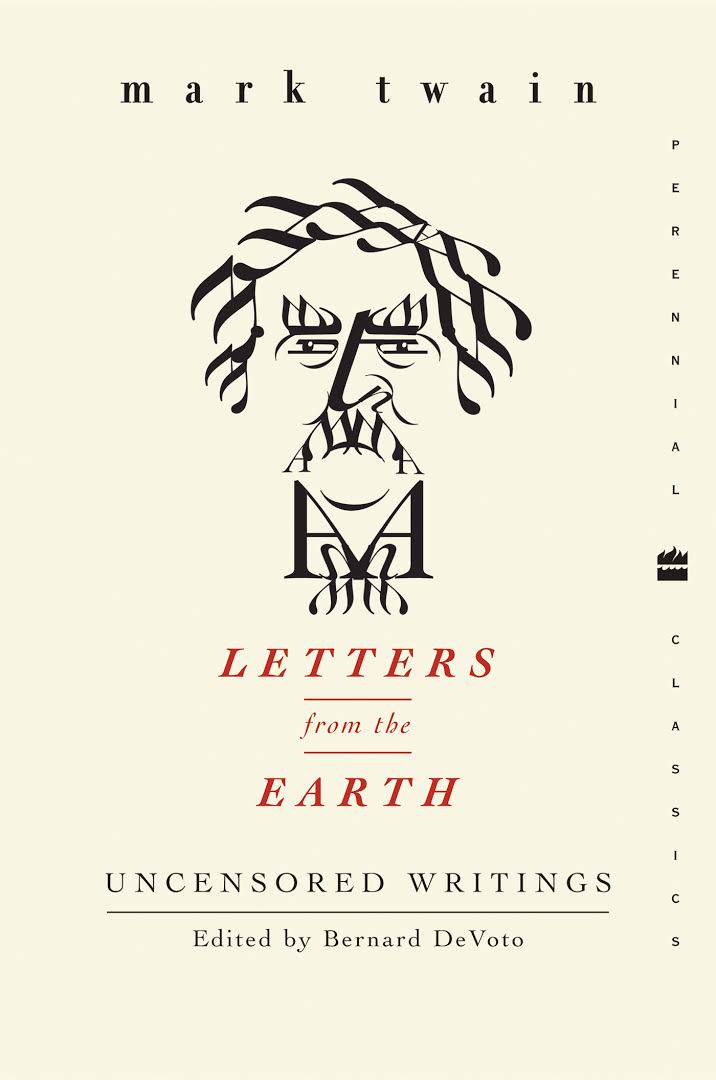
Letters from the Earth

Author: Mark Twain
Rating: 7/10
Last Read: April 2017

Quick Summary:  Letters from the Earth is a set of “essays” or short letters written from the perspective of the angel Lucifer while he spends a “timeout” of sorts on Earth. Lucifer writes to his fellow archangels Gabriel and Michael and shares his observations about mankind, God’s most recent creation. Lucifer is relentless is his mockery of the human religion, especially focusing on mankind’s inability to recognize that the God they worship and heaven they seek is n’t what they want at all.

This is an amusing and quick read, focusing on some idiosyncrasies of Christianity and the biblical stories we are familiar with. The Lucifer portrayed in the books is an amused observer rather than a silver-tongued trickster, and the tone of much of the work is what I would call “sarcastic astonishment”.

My Highlights

He prays for help, and favor, and protection, every day; and does it with hopefulness and confidence, too, although no prayer of his has ever been answered. The daily affront, the daily defeat, do not discourage him, he goes on praying just the same. There is something almost fine about this perseverance. I must put one more strain upon you: he thinks he is going to heaven! –loc 82

For instance, take this sample: he has imagined a heaven, and has left entirely out of it the supremest of all his delights, the one ecstasy that stands first and foremost in the heart of every individual of his race — and of ours — sexual intercourse! –loc 93

His heaven is like himself: strange, interesting, astonishing, grotesque. I give you my word, it has not a single feature in it that he actually values. It consists — utterly and entirely — of diversions which he cares next to nothing about, here in the earth, yet is quite sure he will like them in heaven. Isn’t it curious? Isn’t it interesting? –loc 96

Every man, according to the mental equipment that has fallen to his share, exercises his intellect constantly, ceaselessly, and this exercise makes up a vast and valued and essential part of his life. The lowest intellect, like the highest, possesses a skill of some kind and takes a keen pleasure in testing it, proving it, perfecting it. The urchin who is his comrade’s superior in games is as diligent and as enthusiastic in his practice as are the sculptor, the painter, the pianist, the mathematician and the rest. Not one of them could be happy if his talent were put under an interdict. –loc 112

It is because they do not think at all; they only think they think. Whereas they can’t think; not two human beings in ten thousand have anything to think with. And as to imagination — oh, well, look at their heaven! They accept it, they approve it, they admire it. That gives you their intellectual measure. –loc 153

Every man in the earth possesses some share of intellect, large or small; and be it large or be it small he takes pride in it. –loc 160

By this time you will have noticed that the human being’s heaven has been thought out and constructed upon an absolute definite plan; and that this plan is, that it shall contain, in labored detail, each and every imaginable thing that is repulsive to a man, and not a single thing he likes! –loc 170

This Bible is built mainly out of the fragments of older Bibles that had their day and crumbled to ruin. So it noticeably lacks in originality, necessarily. Its three or four most imposing and impressive events all happened in earlier Bibles; all its best precepts and rules of conduct came also from those Bibles; there are only two new things in it: hell, for one, and that singular heaven I have told you about. –loc 181

A Christian mother’s first duty is to soil her child’s mind, and she does not neglect it. –loc 237

Then at last, Noah sailed; and none too soon, for the Ark was only just sinking out of sight on the horizon when the monsters arrived, and added their lamentations to those of the multitude of weeping fathers and mothers and frightened little children who were clinging to the wave-washed rocks in the pouring rain and lifting imploring prayers to an All-Just and All-Forgiving and All-Pitying Being who had never answered a prayer since those crags were builded, grain by grain, out of the sands, and would still not have answered one when the ages should have crumbled them to sand again. –loc 339

Do you think he was able to stick to that upright and creditable position? No. He could keep to a bad resolution forever, but he couldn’t keep to a good one a month. By and by he threw aside and calmly claimed to be the only God in the entire universe. –loc 380

He equips the Creator with every trait that goes to the making of a fiend, and then arrives at the conclusion that a fiend and a father are the same thing! Yet he would deny that a malevolent lunatic and a Sunday school superintendent are essentially the same. What do you think of the human mind? I mean, in case you think there is a human mind. –loc 410

The poor’s most implacable and unwearying enemy is their Father in Heaven. The poor’s only real friend is their fellow man. He is sorry for them, he pities them, and he shows it by his deeds. He does much to relieve their distresses; and in every case their Father in Heaven gets the credit of it. –loc 451

For instance, he concedes that God made man. Made him without man’s desire of privity. This seems to plainly and indisputably make God, and God alone, responsible for man’s acts. But man denies this. –loc 520

He concedes that God has made the angels perfect, without blemish, and immune from pain and death, and that he could have been similarly kind to man if he had wanted to, but denies that he was under any moral obligation to do it. –loc 521

But man is only briefly competent; and only then in the moderate measure applicable to the word in his sex’s case. He is competent from the age of sixteen or seventeen thence-forward for thirty-five years. After fifty his performance is of poor quality, the intervals between are wide, and its satisfactions of no great value to either party; whereas his great-grandmother is as good as new. There is nothing the matter with her plant. Her candlestick is as firm as ever, whereas his candle is increasingly softened and weakened by the weather of age, as the years go by, until at last it can no longer stand, and is mournfully laid to rest in the hope of a blessed resurrection which is never to come. –loc 566

The first time the Deity came down to earth, he brought life and death; when he came the second time, he brought hell. –loc 619

He killed all those people — every male. They had offended the Deity in some way. We know what the offense was, without looking; that is to say, we know it was a trifle; some small thing that no one but a god would attach any importance to. –loc 689

For that had always been his idea of fair dealing. If he had had a motto, it would have read, “Let no innocent person escape.” –loc 695

Some Midianite must have repeated Onan’s act, and brought that dire disaster upon his nation. If that was not the indelicacy that outraged the feelings of the Deity, then I know what it was: some Midianite had been pissing against the wall. I am sure of it, for that was an impropriety which the Source of all Etiquette never could stand. A person could piss against a tree, he could piss on his mother, he could piss on his own breeches, and get off, but he must not piss against the wall — that would be going quite too far. The origin of the divine prejudice against this humble crime is not stated; but we know that the prejudice was very strong — so strong that nothing but a wholesale massacre of the people inhabiting the region where the wall was defiled could satisfy the Deity. –loc 701

Twenty-Seven Articles by T.E. Lawrence

Author: T.E. Lawrence
Rating: 9/10
Last Read: April 2017

Quick Summary

Twenty-Seven Articles is a short essay by T.E. Lawrence. On the surface, these articles are a set of notes and advice for his fellow soldiers who were going to work with indigenous Arab forces. I was quite surprised to find the general applicability of many of these articles to business, especially from a consulting perspective.

This short read can leave you with at least one piece of advice that you can use in your own life – why not take the time to read it? Best of all – it’s out of copyright, so you can find it for free on the internet!

My Highlights

Valuable advice for any new relationship:

Go easy for the first few weeks. A bad start is difficult to atone for, and the Arabs form their judgments on externals that we ignore. When you have reached the inner circle in a tribe, you can do as you please with yourself and them.

A few useful notes for consultants and advisors:

In matters of business deal only with the commander of the army, column, or party in which you serve. Never give orders to anyone at all, and reserve your directions or advice for the C.O., however great the temptation (for efficiency’s sake) of dealing with his underlings. Your place is advisory, and your advice is due to the commander alone. Let him see that this is your conception of your duty, and that his is to be the sole executive of your joint plans.

Win and keep the confidence of your leader. Strengthen his prestige at your expense before others when you can.

A few notes useful for managing up or consulting:

Never refuse or quash schemes he may put forward; but ensure that they are put forward in the first instance privately to you. Always approve them, and after praise modify them insensibly, causing the suggestions to come from him, until they are in accord with your own opinion. When you attain this point, hold him to it, keep a tight grip of his ideas, and push them forward as firmly as possibly, but secretly, so that to one but himself (and he not too clearly) is aware of your pressure.

Remain in touch with your leader as constantly and unobtrusively as you can. Live with him, that at meal times and at audiences you may be naturally with him in his tent. Formal visits to give advice are not so good as the constant dropping of ideas in casual talk.

Treat the sub-chiefs of your force quite easily and lightly. In this way you hold yourself above their level. Treat the leader, if a Sherif, with respect. He will return your manner and you and he will then be alike, and above the rest. Precedence is a serious matter among the Arabs, and you must attain it.

Your ideal position is when you are present and not noticed. Do not be too intimate, too prominent, or too earnest. Avoid being identified too long or too often with any tribal sheikh, even if C.O. of the expedition. To do your work you must be above jealousies, and you lose prestige if you are associated with a tribe or clan, and its inevitable feuds.

Cling tight to your sense of humour. You will need it every day. A dry irony is the most useful type, and repartee of a personal and not too broad character will double your influence with the chiefs. Reproof, if wrapped up in some smiling form, will carry further and last longer than the most violent speech. The power of mimicry or parody is valuable, but use it sparingly, for wit is more dignified than humour. Do not cause a laugh at a Sherif except among Sherifs.

A note I need to absorb personally:

It is difficult to keep quiet when everything is being done wrong, but the less you lose your temper the greater your advantage. Also then you will not go mad yourself.

This is valuable advice for anyone who has to manage employees or external teams:

Do not try to do too much with your own hands. Better the Arabs do it tolerably than that you do it perfectly. It is their war, and you are to help them, not to win it for them. Actually, also, under the very odd conditions of Arabia, your practical work will not be as good as, perhaps, you think it is.

Understand what the other side of the table really wants. What is said on the surface is probably not all there is:

The open reason that Bedu give you for action or inaction may be true, but always there will be better reasons left for you to divine. You must find these inner reasons (they will be denied, but are none the less in operation) before shaping your arguments for one course or other. Allusion is more effective than logical exposition: they dislike concise expression. Their minds work just as ours do, but on different premises. There is nothing unreasonable, incomprehensible, or inscrutable in the Arab. Experience of them, and knowledge of their prejudices will enable you to foresee their attitude and possible course of action in nearly every case.

The beginning and ending of the secret of handling Arabs is unremitting study of them. Keep always on your guard; never say an unnecessary thing: watch yourself and your companions all the time: hear all that passes, search out what is going on beneath the surface, read their characters, discover their tastes and their weaknesses and keep everything you find out to yourself.

The Old Man and the Sea

Author: Ernest Hemingway
Rating: 9/10
Last Read: May 2017

Quick Summary:  The Old Man and the Sea is a short book by Hemingway which focuses on an old Cuban fisherman who has gone three months without catching a fish.  He is seen as bad luck, and sets out to sea alone so as to not bring bad luck upon his young companion.

The old man manages to finally break his streak of bad luck by hooking a big fish – but he gets dragged further out to sea by the fish for two days as he strains against the lines and hopes to catch it.  His opponent is more than he bargained for, and a great struggle ensues.

This is a quick read, but I found it to be very emotionally powerful. I feel for the old man, struggling to survive and prove himself against a great foe, and for the eventual tragedy at the end. I agree with the old man, it would have been better if he had not gone out so far and hooked such a notable creature.

My Highlights

Everything about him was old except his eyes and they were the same color as the sea and were cheerful and undefeated. –loc 66

He no longer dreamed of storms, nor of women, nor of great occurrences, nor of great fish, nor fights, nor contests of strength, nor of his wife. He only dreamed of places now and of the lions on the beach. –loc 204

Every day is a new day. It is better to be lucky. But I would rather be exact. Then when luck comes you are ready. –loc 268

He also drank a cup of shark liver oil each day from the big drum in the shack where many of the fishermen kept their gear. It was there for all fishermen who wanted it. Most fishermen hated the taste. But it was no worse than getting up at the hours that they rose and it was very good against all colds and grippes and it was good for the eyes. –loc 312

No one should be alone in their old age, he thought. But it is unavoidable. –loc 407

He looked across the sea and knew how alone he was now. But he could see the prisms in the deep dark water and the line stretching ahead and the strange undulation of the calm. The clouds were building up now for the trade wind and he looked ahead and saw a flight of wild ducks etching themselves against the sky over the water, then blurring, then etching again and he knew no man was ever alone on the sea. –loc 518

I wonder why he jumped, the old man thought. He jumped almost as though to show me how big he was. I know now, anyway, he thought. I wish I could show him what sort of man I am. But then he would see the cramped hand. Let him think I am more man than I am and I will be so. I wish I was the fish, he thought, with everything he has against only my will and my intelligence. –loc 547

He was comfortable but suffering, although he did not admit the suffering at –loc 552

Holy Mary, Mother of God, pray for us sinners now and at the hour of our death. Amen.” Then he added, “Blessed Virgin, pray for the death of this fish. Wonderful though he is.” –loc 557

The thousand times that he had proved it meant nothing. Now he was proving it again. Each time was a new time and he never thought about the past when he was doing it. –loc 567

The punishment of the hook is nothing. The punishment of hunger, and that he is against something that he does not comprehend, is everything. –loc 656

I’m clear enough in the head, he thought. Too clear. I am as clear as the stars that are my brothers. Still I must sleep. They sleep and the moon and the sun sleep and even the ocean sleeps sometimes on certain days when there is no current and a flat calm. –loc 664

“Fish,” the old man said. “Fish, you are going to have to die anyway. Do you have to kill me too?” –loc 792

You are killing me, fish, the old man thought. But you have a right to. Never have I seen a greater, or more beautiful, or a calmer or more noble thing than you, brother. Come on and kill me. I do not care who kills who. –loc 796

“Come on, fish,” he said. But the fish did not come. Instead he lay there wallowing now in the seas and the old man pulled the skiff up onto him. –loc 827

Then his head started to become a little unclear and he thought, is he bringing me in or am I bringing him in? If I were towing him behind there would be no question. Nor if the fish were in the skiff, with all dignity gone, there would be no question either. But they were sailing together lashed side by side and the old man thought, let him bring me in if it pleases him. I am only better than him through trickery and he meant me no harm. –loc 854

But that was the location of the brain and the old man hit it. He hit it with his blood mushed hands driving a good harpoon with all his strength. He hit it without hope but with resolution and complete malignancy. –loc 879

“But man is not made for defeat,” he said. “A man can be destroyed but not defeated.” I am sorry that I killed the fish though, he thought. Now the bad time is coming and I do not even have the harpoon. The dentuso is cruel and able and strong and intelligent. But I was more intelligent than he was. Perhaps not, he thought. Perhaps I was only better armed. –loc 890

It is silly not to hope, he thought. Besides I believe it is a sin. Do not think about sin, he thought. There are enough problems now without sin. Also I have no understanding of it. –loc 903

Besides, he thought, everything kills everything else in some way. Fishing kills me exactly as it keeps me alive. –loc 914

Luck is a thing that comes in many forms and who can recognize her? I would take some though in any form and pay what they asked. –loc 1010

The wind is our friend, anyway, he thought. Then he added, sometimes. And the great sea with our friends and our enemies. And bed, he thought. Bed is my friend. Just bed, he thought. Bed will be a great thing. It is easy when you are beaten, he thought. I never knew how easy it was. And what beat you, he thought. –loc 1036

Haiku #2

Much disturbs water
Effects aren't always small, yet
Peace always returns

(circa 2012)

Haiku #1

You are beautiful.
I look at you, distracted.
I trip, falling hard.

(circa 2012)

Hitchhiker’s Guide to the Galaxy (Book 1)

Author: Douglas Adams
Rating: 9/10
Last Read: February 2017

Quick Summary:  Hitchhiker’s Guide is a science fiction book that follows the adventure of Arthur Dent and his unlikely companions. This books is full of nonsense – aliens with two heads, ridiculous names, strange encyclopedia articles, and mice running experiments on humans.  If you love to laugh, this book is for you. No, really, that’s the only recommendation you need.

If you want to take your enjoyment of this book to the next level, I recommend reading it out loud to yourself, your friends, your dog, or your spouse. Adams’s humor jumps to another level when you have to try to say the words written on the page out loud. Having read this book multiple times, I can definitely say that everything was funnier when I said it out loud.

Definitely an enjoyable read (and re-read).  Also a worthy pre-bed book, though you might find that the giggles don’t help you fall asleep.

My Highlights

The thing that used to worry him most was the fact that people always used to ask him what he was looking so worried about. –loc 425

“Time is an illusion. Lunchtime doubly so.” –loc 668

At first Ford had formed a theory to account for this strange behavior. If human beings don’t keep exercising their lips, he thought, their mouths probably seize up. After a few months’ consideration and observation he abandoned this theory in favor of a new one. If they don’t keep on exercising their lips, he thought, their brains start working. –loc 984

Or do you just find that coming to terms with the mindless tedium of it all presents an interesting challenge?” –loc 1288

“You know,” said Arthur, “it’s at times like this, when I’m trapped in a Vogon airlock with a man from Betelgeuse, and about to die of asphyxiation in deep space, that I really wish I’d listened to what my mother told me when I was young.” “Why, what did she tell you?” “I don’t know, I didn’t listen.” “Oh.” Ford carried on humming. –loc 1346

They both sat on the pavement and watched with a certain unease as huge children bounced heavily along the sand and wild horses thundered through the sky taking fresh supplies of reinforced railings to the Uncertain Areas. –loc 1420

Curiously enough, the only thing that went through the mind of the bowl of petunias as it fell was Oh no, not again. Many people have speculated that if we knew exactly why the bowl of petunias had thought that we would know a lot more about the nature of the Universe than we do now. –loc 1933

It is an important and popular fact that things are not always what they seem. –loc 2356

For instance, on the planet Earth, man had always assumed that he was more intelligent than dolphins because he had achieved so much—the wheel, New York, wars and so on—while all the dolphins had ever done was muck about in the water having a good time. But conversely, the dolphins had always believed that they were far more intelligent than man—for precisely the same reasons. –loc 2357

“You know,” said Arthur thoughtfully, “all this explains a lot of things. All through my life I’ve had this strange unaccountable feeling that something was going on in the world, something big, even sinister, and no one would tell me what it was.”
“No,” said the old man, “that’s just perfectly normal paranoia. Everyone in the Universe has that.” –loc 2771

“Maybe. Who cares?” said Slartibartfast before Arthur got too excited. “Perhaps I’m old and tired,” he continued, “but I always think that the chances of finding out what really is going on are so absurdly remote that the only thing to do is to say hang the sense of it and just keep yourself occupied. Look at me: I design coastlines. I got an award for Norway.” –loc 2776

The Man in the High Castle

Author: Philip K. Dick
Rating: 7/10
Last Read: February 2017

Quick Summary:  As a long time sci-fi fan (and Philip K. Dick fan), I was disappointed that I never read The Man in the High Castle.  Once I saw it was being made into a mini-series, I was motivated to finally read it.

The Man in the High Castle is a short novel set in an alternate universe. The notable difference between the book’s universe and our own is that the Axis won WWII. The United States is split between Japan and Germany. The book takes place in Japanese-occupied San Francisco and follows multiple Japanese, American, and German characters. The characters are interrelated, if only through chance meetings, and they provide different views into the culture and challenges of this alternative world.

If you’re looking for a complete story with a nice ending, The Man in the High Castle is not for you. The book offers no resolution, it is simply a glimpse into an alternative reality and a study of the characters who live there.

Overall I enjoyed reading the book – it was an excellent pre-bed reading option.

My Highlights

Yes, these new young people, of the rising generation, who did not remember the days before the war or even the war itself—they were the hope of the world. Place difference did not have the significance for them. It will end, Childan thought. Someday. The very idea of place. Not governed and governing, but people. –loc 92

‘What profit it a man if he gain the whole world but in this enterprise lose his soul?’” –loc 170

Random, and yet rooted in the moment in which he lived, in which his life was bound up with all other lives and particles in the universe. –loc 190

Tagomi had never ridden on such a ship; when he met Mr. Baynes he would have to take care to appear blasé, no matter how large the rocket turned out to be. Now to practice. He stood in front of the mirror on the office wall, creating a face of composure, mildly bored, inspecting his own cold features for any giveaway. Yes, they are very noisy, Mr. Baynes, sir. One cannot read. But then the flight from Stockholm to San Francisco is only forty-five minutes. –loc 225

“You never know what they’re going to do,” Juliana said. “They hide their real thoughts.” –loc 438

Watching him, Juliana thought, It’s idealism that makes him that bitter. Asking too much out of life. Always moving on, restless and griped. I’m the same way; I couldn’t stay on the West Coast and eventually I won’t be able to stand it here. Weren’t the old-timers like that? But, she thought, now the frontier isn’t here; it’s the other planets. –loc 492

Perhaps if you know you are insane then you are not insane. Or you are becoming sane, finally. Waking up. I suppose only a few are aware of all this. Isolated persons here and there. But the broad masses . . . what do they think? All these hundreds of thousands in this city, here. Do they imagine that they live in a sane world? Or do they guess, glimpse, the truth . . . –loc 572

They want to be the agents, not the victims, of history. They identify with God’s power and believe they are godlike. That is their basic madness. They are overcome by some archetype; their egos have expanded psychotically so that they cannot tell where they begin and the godhead leaves off. It is not hubris, not pride; it is inflation of the ego to its ultimate—confusion between him who worships and that which is worshiped. Man has not eaten God; God has eaten man. –loc 587

What they do not comprehend is man’s helplessness. I am weak, small, of no consequence to the universe. It does not notice me; I live on unseen. But why is that bad? Isn’t it better that way? Whom the gods notice they destroy. Be small . . . and you will escape the jealousy of the great. –loc 590

That McCarthy, he thought, is a damn good shop foreman. He has the knack of needling a man, getting him to put out his best efforts, to do his utmost in spite of himself. He’s a natural leader; he almost inspired me, for a moment, there. But—McCarthy had gone off, now; the effort had failed. –loc 691

“We must all have faith in something,” Mr. Tagomi said. “We cannot know the answers. We cannot see ahead, on our own.” –loc 1001

Gemeinschaft—folkness. –loc 2316

“Juliana, it’s all darkness,” Joe said. “Nothing is true or certain. Right?” “Maybe so,” she said absently, continuing to try to read. –loc 2329

Nothing. Heart pounding. Respiration and all somatic processes, including all manner of diencephalic-controlled autonomic responses to crisis: adrenaline, greater heartbeat, pulse rate, glands pouring, throat paralyzed, eyes staring, bowels loose, et al. Stomach queasy and sex instinct suppressed. –loc 2363

And yet, nothing to see; nothing for body to do. Run? All in preparation for panic flight. But where to and why? Mr. Tagomi asked himself. No clue. Therefore impossible. Dilemma of civilized man; body mobilized, but danger obscure. –loc 2365

Calmly, even harshly, Paul said, “Robert, you must face reality with more courage.” –loc 2531

Childan thought, He’s actually saying: Which are you Robert? He whom the oracle calls “the inferior man,” or that other for whom all the good advice is meant? Must decide, here. You may trot on one way or the other, but not both. Moment of choice now. –loc 2581

The oracle enigmatic. Perhaps it has withdrawn from the world of man in sorrow. The sages leaving. We have entered a Moment when we are alone. We cannot get assistance, as before. Well, Mr. Tagomi thought, perhaps that too is good. Or can be made good. One must still try to find the Way. –loc 3179

But we cannot do it all at once; it is a sequence. An unfolding process. We can only control the end by making a choice at each step. –loc 3516

We do not have the ideal world, such as we would like, where morality is easy because cognition is easy. Where one can do right with no effort because he can detect the obvious. –loc 3519

Juliana said, “Oracle, why did you write The Grasshopper Lies Heavy? What are we supposed to learn?”
“You have a disconcertingly superstitious way of phrasing your question,” Hawthorne said. –loc 3680

Show Your Work!


Author: Austin Kleon
Rating: 9/10
Last Read: December 2014

Quick Summary:  Show Your Work! is focused entirely on encouraging you to share your development process and work with your audience.  We are all supremely interested in what other people are doing and finding new tools and techniques to improve ourselves.  Kleon wants us to find holes in our communities and fill them, to share what we learn with others, and to document our own work processes.  When we share material and techniques, we can develop more of an audience and receive advice from our community in turn.  Give and people will give back.

This is another book that inspired me creatively in a major way.  Show Your Work! influenced me to start my own websites and to start sharing what I know about firmware development.  Even reviewing my notes to share with you inspires me to create and be more active in the world.

Once a day, after you’ve done your day’s work, go back to your documentation and find one little piece of your process that you can share. Where you are in your process will determine what that piece is. If you’re in the very early stages, share your influences and what’s inspiring you. If you’re in the middle of executing a project, write about your methods or share works in progress. If you’ve just completed a project, show the final product, share scraps from the cutting-room floor, or write about what you learned. If you have lots of projects out into the world, you can report on how they’re doing—you can tell stories about how people are interacting with your work.

My Highlights

Instead of wasting their time “networking,” they’re taking advantage of the network. By generously sharing their ideas and their knowledge, they often gain an audience that they can then leverage when they need it—for fellowship, feedback, or patronage. –loc 26

Imagine if your next boss didn’t have to read your résumé because he already reads your blog. Imagine being a student and getting your first gig based on a school project you posted online. Imagine losing your job but having a social network of people familiar with your work and ready to help you find a new one. Imagine turning a side project or a hobby into your profession because you had a following that could support you. –loc 34

The best way to get started on the path to sharing your work is to think about what you want to learn, and make a commitment to learning it in front of others. –loc 95

Find a scenius, pay attention to what others are sharing, and then start taking note of what they’re not sharing. Be on the lookout for voids that you can fill with your own efforts, no matter how bad they are at first. Don’t worry, for now, about how you’ll make money or a career off it. –loc 96

Share what you love, and the people who love the same things will find you. –loc 99

It sounds a little extreme, but in this day and age, if your work isn’t online, it doesn’t exist. –loc 117

Become a documentarian of what you do. Start a work journal: Write your thoughts down in a notebook, or speak them into an audio recorder. Keep a scrapbook. Take a lot of photographs of your work at different stages in your process. Shoot video of you working. This isn’t about making art, it’s about simply keeping track of what’s going on around you. Take advantage of all the cheap, easy tools at your disposal—these days, most of us carry a fully functional multimedia studio around in our smartphones. –loc 196

A daily dispatch is even better than a résumé or a portfolio, because it shows what we’re working on right now. –loc 217

The form of what you share doesn’t matter. Your daily dispatch can be anything you want—a blog post, an email, a tweet, a YouTube video, or some other little bit of media. There’s no one-size-fits-all plan for everybody. –loc 221

Don’t worry about everything you post being perfect. Science fiction writer Theodore Sturgeon once said that 90 percent of everything is crap. The same is true of our own work. The trouble is, we don’t always know what’s good and what sucks. That’s why it’s important to get things in front of others and see how they react. “Sometimes you don’t always know what you’ve got,” says artist Wayne White. “It really does need a little social chemistry to make it show itself to you sometimes.” –loc 235

Ideally, you want the work you post online to be copied and spread to every corner of the Internet, so don’t post things online that you’re not ready for everyone in the world to see. –loc 252

“Post as though everyone who can read it has the power to fire you.” –loc 253

The act of sharing is one of generosity—you’re putting something out there because you think it might be helpful or entertaining to someone on the other side of the screen. –loc 256

I had a professor in college who returned our graded essays, walked up to the chalkboard, and wrote in huge letters: “SO WHAT?” She threw the piece of chalk down and said, “Ask yourself that every time you turn in a piece of writing.” It’s a lesson I never forgot. –loc 257

Always be sure to run everything you share with others through The “So What?” Test. Don’t overthink it; just go with your gut. If you’re unsure about whether to share something, let it sit for 24 hours. Put it in a drawer and walk out the door. The next day, take it out and look at it with fresh eyes. Ask yourself, “Is this helpful? Is it entertaining? Is it something I’d be comfortable with my boss or my mother seeing?” There’s nothing wrong with saving things for later. The save as draft button is like a prophylactic—it might not feel as good in the moment, but you’ll be glad you used it in the morning. –loc 260

“Stock and flow” is an economic concept that writer Robin Sloan has adapted into a metaphor for media: “Flow is the feed. It’s the posts and the tweets. It’s the stream of daily and sub-daily updates that remind people you exist. Stock is the durable stuff. It’s the content you produce that’s as interesting in two months (or two years) as it is today. It’s what people discover via search. It’s what spreads slowly but surely, building fans over time.” Sloan says the magic formula is to maintain your flow while working on your stock in the background. –loc 268

In my experience, your stock is best made by collecting, organizing, and expanding upon your flow. Social media sites function a lot like public notebooks—they’re places where we think out loud, let other people think back at us, then hopefully think some more. But the thing about keeping notebooks is that you have to revisit them in order to make the most out of them. You have to flip back through old ideas to see what you’ve been thinking. Once you make sharing part of your daily routine, you’ll notice themes and trends emerging in what you share. You’ll find patterns in your flow. –loc 273

Don’t think of your website as a self-promotion machine, think of it as a self-invention machine. –loc 296

Your influences are all worth sharing because they clue people in to who you are and what you do—sometimes even more than your own work. –loc 333

Online, the most important form of attribution is a hyperlink pointing back to the website of the creator of the work. This sends people who come across the work back to the original source. The number one rule of the Internet: People are lazy. If you don’t include a link, no one can click it. Attribution without a link online borders on useless: 99.9 percent of people are not going to bother Googling someone’s name. –loc 372

What if you want to share something and you don’t know where it came from or who made it? The answer: Don’t share things you can’t properly credit. Find the right credit, or don’t share. –loc 376

Words matter. Artists love to trot out the tired line, “My work speaks for itself,” but the truth is, our work doesn’t speak for itself. Human beings want to know where things came from, how they were made, and who made them. –loc 401

The stories you tell about the work you do have a huge effect on how people feel and what they understand about your work, and how people feel and what they understand about your work effects how they value it. –loc 403

Your work doesn’t exist in a vacuum. Whether you realize it or not, you’re already telling a story about your work. Every email you send, every text, every conversation, every blog comment, every tweet, every photo, every video—they’re all bits and pieces of a multimedia narrative you’re constantly constructing. If you want to be more effective when sharing yourself and your work, you need to become a better storyteller. You need to know what a good story is and how to tell one. –loc 408

If you study the structure of stories, you start to see how they work, and once you know how they work, you can then start stealing story structures and filling them in with characters, situations, and settings from your own life. –loc 419

Every client presentation, every personal essay, every cover letter, every fund-raising request—they’re all pitches. They’re stories with the endings chopped off. A good pitch is set up in three acts: The first act is the past, the second act is the present, and the third act is the future. The first act is where you’ve been—what you want, how you came to want it, and what you’ve done so far to get it. The second act is where you are now in your work and how you’ve worked hard and used up most of your resources. The third act is where you’re going, and how exactly the person you’re pitching can help you get there. Like a Choose Your Own Adventure book, this story shape effectively turns your listener into the hero who gets to decide how it ends. –loc 434

Strike all the adjectives from your bio. If you take photos, you’re not an “aspiring” photographer, and you’re not an “amazing” photographer, either. You’re a photographer. Don’t get cute. Don’t brag. Just state the facts. –loc 468

If you want fans, you have to be a fan first. If you want to be accepted by a community, you have to first be a good citizen of that community. If you’re only pointing to your own stuff online, you’re doing it wrong. You have to be a connector. The writer Blake Butler calls this being an open node. If you want to get, you have to give. If you want to be noticed, you have to notice. Shut up and listen once in a while. Be thoughtful. Be considerate. –loc 538

If you want followers, be someone worth following. Donald Barthelme supposedly said to one of his students, “Have you tried making yourself a more interesting person?” This seems like a really mean thing to say, unless you think of the word interesting the way writer Lawrence Weschler does: For him, to be “interest-ing” is to be curious and attentive, and to practice “the continual projection of interest.” To put it more simply: If you want to be interesting, you have to be interested. –loc 548

Make stuff you love and talk about stuff you love and you’ll attract people who love that kind of stuff. It’s that simple. –loc 557

Brancusi practiced what I call The Vampire Test. It’s a simple way to know who you should let in and out of your life. If, after hanging out with someone you feel worn out and depleted, that person is a vampire. If, after hanging out with someone you still feel full of energy, that person is not a vampire. Of course, The Vampire Test works on many things in our lives, not just people—you can apply it to jobs, hobbies, places, etc. –loc 569

Keep your balance. You have to remember that your work is something you do, not who you are. This is especially hard for artists to accept, as so much of what they do is personal. Keep close to your family, friends, and the people who love you for you, not just the work. –loc 629

The first step in evaluating feedback is sizing up who it came from. You want feedback from people who care about you and what you do. Be extra wary of feedback from anybody who falls outside of that circle. –loc 634

At some point, you might consider turning off comments completely. Having a form for comments is the same as inviting comments. “There’s never a space under paintings in a gallery where someone writes their opinion,” says cartoonist Natalie Dee. “When you get to the end of a book, you don’t have to see what everyone else thought of it.” Let people contact you directly or let them copy your work over to their own spaces and talk about it all they want. –loc 650

Instead of having a donate now button on my website, I have buy now and hire me buttons. But even though I operate more like a traditional salesman, I do use some of the same tactics as crowdfunders: I try to be open about my process, connect with my audience, and ask them to support me by buying the things I’m selling. –loc 683

Even if you don’t have anything to sell right now, you should always be collecting email addresses from people who come across your work and want to stay in touch. –loc 694

Keep your own list, or get an account with an email newsletter company like MailChimp and put a little sign-up widget on every page of your website. Write a little bit of copy to encourage people to sign up. Be clear about what they can expect, whether you’ll be sending daily, monthly, or infrequent updates. Never ever add someone’s email address to your mailing list without her permission. –loc 701

Be ambitious. Keep yourself busy. Think bigger. Expand your audience. Don’t hobble yourself in the name of “keeping it real,” or “not selling out.” Try new things. If an opportunity comes along that will allow you to do more of the kind of work you want to do, say Yes. If an opportunity comes along that would mean more money, but less of the kind of work you want to do, say No. –loc 719

Add all this together and you get a way of working I call chain-smoking. You avoid stalling out in your career by never losing momentum. Here’s how you do it: Instead of taking a break in between projects, waiting for feedback, and worrying about what’s next, use the end of one project to light up the next one. Just do the work that’s in front of you, and when it’s finished, ask yourself what you missed, what you could’ve done better, or what you couldn’t get to, and jump right into the next project. –loc 771

His thinking is that we dedicate the first 25 years or so of our lives to learning, the next 40 to work, and the last 15 to retirement, so why not take 5 years off retirement and use them to break up the work years? He says the sabbatical has turned out to be invaluable to his work: “Everything that we designed in the seven years following the first sabbatical had its roots in thinking done during that sabbatical.” –loc 782