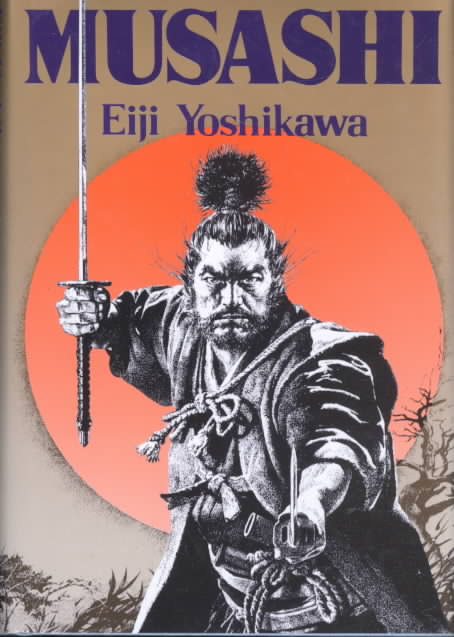
Author: Eiji Yoshikawa
Rating: 9/10
Last Read: Nov 2017
Quick Summary: This novel is quite the epic read, in both length and enjoyment. The book follows Miyamoto Musashi, a famous Japanese swordsman, across many journeys in the years of his life, culminating with his famous fight with Sasaki Kojiro. The novel is divided up into different stages in Musashi’s life, also representing different stages in his growth and development.
There are many philosophical and practical lessons to be gained from this book. Zen themes permeate throughout, as can be expected in a book about a Japanese swordsman. There is also much time to think of filial obligations, the path one has dedicated himself to in life, revenge, and other grandiose concepts that we all struggle with in our life’s journey.
I thoroughly enjoyed reading this book and look forward to my next reading.
My Highlights
Most important, he gradually transformed himself from an instinctive fighter into a man who fanatically pursued the goals of Zen-like self-discipline, complete inner mastery over oneself, and a sense of oneness with surrounding nature.
–loc 162He called out, but there was no reply, nor did he expect one. A vacant house has an aura all its own.
–loc 743After a while, Takuan grew reflective. “How peaceful it is here,” he sighed, sounding both religious and childlike. “Why, when we could live out our lives in a flower-filled paradise, do we all prefer to weep, suffer and get lost in a maelstrom of passion and fury, torturing ourselves in the flames of hell? I hope that you, at least, won’t have to go through all that.”
–loc 825The captain, who was by now screaming, had his sheathed sword in hand. “I’ve taken all I can take. Now you’re going to get what’s coming to you!”
Takuan burst out laughing. “Does that mean you plan to cut off my head? If so, forget it. It would be a terrible bore.”
“Huh?”
“A bore. I can’t think of anything more boring than cutting off a monk’s head. It would just fall to the floor and lie there laughing up at you. Not a very grand accomplishment, and what good could it possibly do you?”
–loc 1377“What are you saying, Otsū?” objected Takuan. “There’s nothing wrong with my mind, and I’m not joking. I’m only telling the truth, which no one seems to like to hear. He’s a dolt, so I called him a dolt. You want me to lie?”
–loc 1395The captain was a man in his forties, ten years or so older than Takuan, but it was clear from their faces at this moment that strength of character is not a matter of age. Takuan’s tongue-lashing had humbled the older man and his bluster had evaporated.
–loc 1431When word reached the temple priest, he nodded sagely and remarked that the human mouth is the gateway to catastrophe.
–loc 1472“Listen, men and women of Miyamoto. I have something to say, something important.” The hue and cry died down. “It is not I who deserve the credit for capturing Takezō. It was not I who accomplished it, but the law of nature. Those who break it always lose in the end. It is the law that you should respect.”
–loc 1781Loneliness, she mused, is like hunger; it isn’t outside but inside oneself. To be lonely, she thought, is to sense that one lacks something, something vitally necessary, but what she knew not.
–loc 1855“That’s not the point, you imbecile! The trouble with you is that you don’t even know how to think. You seem to be under the misconception that if you perform one brave deed, that alone makes you a samurai. Well, it doesn’t! You let that one act of loyalty convince you of your righteousness. The more convinced you became, the more harm you caused yourself and everyone else. And now where are you? Caught in a trap you set for yourself, that’s where!” He paused. “By the way, how’s the view from up there, Takezō?” “You pig! I won’t forget this!” “You’ll forget everything soon. Before you turn into dried meat, Takezō, take a good look at the wide world around you. Gaze out onto the world of human beings, and change your selfish way of thinking. And then, when you arrive in that other world beyond and are reunited with your ancestors, tell them that just before you died a man named Takuan Sōhō told you this. They’ll be overjoyed to learn you had such excellent guidance, even if you did learn what life was all about too late to bring anything but shame to your family name.”
–loc 1968Anger over petty emotional trifles is for women, not men.
–loc 2096“Sorry, Takezō. It’s out of my hands. It’s the law of nature. You can’t do things over again. That’s life. Everything in it is for keeps. Everything! You can’t put your head back on after the enemy’s cut it off. That’s the way it is. Of course, I feel sorry for you, but I can’t undo that rope, because it wasn’t me who tied it. It was you. All I can do is give you some advice. Face death bravely and quietly. Say a prayer and hope someone bothers to listen. And for the sake of your ancestors, Takezō, have the decency to die with a peaceful look on your face!”
–loc 2136The life that had been given to him was something to be treasured and cherished, polished and perfected.
–loc 2351He who knows the art of the warrior is not confused in his movements. He acts and is not confined.
–loc 2479“You may read as much as you want. A famous priest of ancient times once said, ‘I become immersed in the sacred scriptures and read thousands of volumes. When I come away, I find that my heart sees more than before.’
–loc 2485He wondered if he’d ever again meet the man who’d saved his life. And again he was struck by Takuan’s concern for his fellow man, which seemed all-encompassing and completely devoid of selfishness. Musashi realized how narrow-minded he himself had been, how petty, to suppose that the monk felt a special compassion for him alone; his generosity encompassed Ogin, Otsū, anyone in need whom he thought he could help.
–loc 2616These days he often felt deep admiration for other people’s work. He found he respected technique, art, even the ability to do a simple task well, particularly if it was a skill he himself had not mastered.
–loc 3240He stopped along the way to look at several well-known temples, and at each of them he bowed and said two prayers. One was: “Please protect my sister from harm.” The other was: “Please test the lowly Musashi with hardship. Let him become the greatest swordsman in the land, or let him die.”
–loc 3262If the young cannot harbor great dreams in their souls, who can? At the moment Musashi was imagining how he could create a place of his own in the world.
–loc 3271It was odd that they should have thought of it that way. Having since learned from Takuan that life is a jewel to be treasured, Musashi knew that far from giving up nothing, he and Matahachi had unwittingly been offering their most precious possession. Each had literally wagered everything he had on the hope of receiving a paltry stipend as a samurai. In retrospect, he wondered how they could have been so foolish.
–loc 3498True, you sensed belligerence in me, but it was only a reflection of your own.”
–loc 4055“Don’t you understand yet?” he asked. “That you’re too strong is the only thing I have to teach you. If you continue to pride yourself on your strength, you won’t live to see thirty. Why, you might easily have been killed today. Think about that, and decide how to conduct yourself in the future.”
–loc 4540“Fighting isn’t all there is to the Art of War. The men who think that way, and are satisfied to have food to eat and a place to sleep, are mere vagabonds. A serious student is much more concerned with training his mind and disciplining his spirit than with developing martial skills. He has to learn about all sorts of things—geography, irrigation, the people’s feelings, their manners and customs, their relationship with the lord of their territory. He wants to know what goes on inside the castle, not just what goes on outside it. He wants, essentially, to go everywhere he can and learn everything he can.”
–loc 4595Sometimes, he was thinking, it works the other way around. These pampered young sons of Kyoto were in a position to see what was happening at the center of things and to know what was going on everywhere, but it would not have occurred to them that while they were watching the great open sea, somewhere else, at the bottom of a deep well, a frog was steadily growing larger and stronger. Here in Koyagyū, well away from the country’s political and economic center, sturdy samurai had for decades been leading a healthy rural life, preserving the ancient virtues, correcting their weak points and growing in stature.
–loc 4643His perspicacity, which people admired, was one factor, but to survive in such turbulent times, Sekishūsai had to have an inner fortitude lacking in the ordinary samurai of his time; they were all too apt to side with a man one day and shamelessly desert him the next, to look after their own interests—with no thought to propriety or integrity—or even to slaughter their own kinsmen should they interfere with personal ambitions.
–loc 4701In Sekishūsai’s view, the Art of War was certainly a means of governing the people, but it was also a means of controlling the self.
–loc 4715To tell the truth, being from samurai families, we don’t know anything about tea. Our intention was to inquire personally after Sekishūsai’s health and persuade him to give us a lesson in swordsmanship.”
“He understands that perfectly, of course. But he’s spending his old age in retirement and has acquired the habit of expressing many of his thoughts in terms of tea.”
–loc 4843The old man had not shut his gate merely to wandering students but to all the affairs of this world, to its honors as well as its tribulations. He had put behind him worldly desire, both his own and that of others.
–loc 5423You should know that the path of darkness and desire leads only to frustration and misery—frustration and misery beyond salvation.”
–loc 5602“Ah, even I’m beginning to think priests are crazy. Everywhere they go, they meet no one but people rushing toward hell.”
–loc 5625Neither the townspeople nor the farmers nor the daimyō realized that they were being carefully fitted into a feudal system that would eventually bind them hand and foot. No one was thinking of what things might be like in another hundred years. No one, that is, except Ieyasu.
–loc 5672It was not hard to find able swordsmen. What was hard to find was a real man. While the world was full of people, all too full, finding a genuine human being was not easy. In his travels, Musashi had come to believe this very deeply, to the point of pain, and it discouraged him. But then his mind always turned to Takuan, for there, without doubt, was an authentic, unique individual. “I guess I’m lucky,” thought Musashi. “At least I’ve had the good fortune to know one genuine man. I must make sure the experience of having known him bears fruit.”
–loc 7251Moreover, while not being thrown off balance by the prospect of death was a mental state of a higher order, it was not really so difficult to face death if one knew that one had to die.
–loc 7416When I hear him talk, I wonder whether Nobunaga and Hideyoshi and Ieyasu are really such great men. I know they’re supposed to be important, but is it really so wonderful to take control of the country if you get the idea that you’re the only person in it who counts?”
–loc 7538Takuan had taught him life’s first lesson, namely that there are a lot of people in the world who may very well be one’s betters.
–loc 7768Before letting his pride and confidence betray him into underestimating an adversary, he wanted to size him up from every possible angle. While laying his groundwork, he would remain sociable, even if at times this might strike his opponent as being cowardly or subservient.
–loc 7771Those who love seek a philosophy and, because of this, are fond of solitude.
–loc 8242Musashi wondered how many people there were who on this night could say: “I was right. I did what I should have done. I have no regrets.” For him, each resounding knell evoked a tremor of remorse. He could conjure up nothing but the things he had done wrong during the last year. Nor was it only the last year—the year before, and the year before that, all the years that had gone by had brought regrets. There had not been a single year devoid of them. Indeed, there had hardly been one day. From his limited perspective of the world, it seemed that whatever people did they soon came to regret. Men, for example, took wives with the intention of living out their lives with them but often changed their minds later. One could readily forgive women for their afterthoughts, but then women rarely voiced their complaints, whereas men frequently did so. How many times had he heard men disparage their wives as if they were old discarded sandals?
–loc 8740Satisfied with this third effort, he put his brush down. Although the three sentences had been written with the same intent, the first two could conceivably mean he would have no regrets whether he acted rightly or wrongly, whereas the third emphasized his determination to act in such a way as to make self-reproach unnecessary.
–loc 8759Musashi repeated the resolution to himself, realizing it was an ideal he could not achieve unless he disciplined his heart and his mind to the utmost of his ability. Nevertheless, to strive for a state in which nothing he did would cause regrets was the path he must pursue. “Someday I will reach that state!” he vowed, driving the oath like a stake deep into his own heart.
–loc 8762As soon as I laid eyes on him, I knew there was danger. To me, that sign you put up looks more like an announcement of mourning for the House of Yoshioka. It’s very sad, but it seems to be the way of the world that people never realize when they’re finished.
–loc 9344Kojirō’s tone became snide. “It also seems to be typical of people on the way down that they won’t accept an act of kindness in the spirit in which it’s offered.
–loc 9347Judging her in terms of swordsmanship, he thought to himself, “She’s perfect! She doesn’t leave herself open anywhere.” As she whisked the tea, he sensed in her the same unearthly proficiency that one might observe in a master swordsman poised to strike. “It’s the Way,” he thought, “the essence of art. One has to have it to be perfect at anything.”
–loc 9642“If you become self-conscious about the proper way to drink, you won’t enjoy the tea. When you use a sword, you can’t let your body become too tense. That would break the harmony between the sword and your spirit. Isn’t that right?”
–loc 9656“I want you to take a good look at that girl’s head. You’ll see then just how pretty she is. I want you to see with your own eyes what a woman is like after she dies. Nothing but bones. I want you to know the folly of passion.”
–loc 10664“Takuan, you can carry a lantern through this life, but it won’t do you any good unless you open your eyes. What are they anyway? Just holes in your head, funny ornaments?”
–loc 10738I think every man should have a place he can regard as home, even if it’s nothing more than a little shack. Without a house, a person gets lonely-feels lost somehow.
–loc 10827Maybe I’m just a vagabond at heart.” “You’re not the only one, by any means. It’s only natural, but you should avoid the temptation of thinking that your dreams can be realized only in some far-off place. If you think that way, you’ll neglect the possibilities in your immediate surroundings. Most young people do, I fear, and become dissatisfied with their lives.” Kōetsu laughed. “But an idle old man like myself has no business preaching to the young.
–loc 10831There was a difference between Musashi’s idea of preparation and his opponent’s. Denshichirō, though physically prepared, had only begun to pull himself together spiritually, whereas Musashi had started fighting long before he presented himself to his enemy. For him, the battle was now entering its second and central phase.
–loc 11228His second opportunity came in the form of Denshichirō’s attempt to draw him out. One way of fighting would be to accept this; the other would be to ignore it and create an opening of his own. Caution was in order; in a case like this, victory is like the moon reflected on a lake. If one jumps for it impulsively, one can drown.
–loc 11235It is said that one need not be young to enjoy playing games.
–loc 11326The peony, remarked Yoshino, was the king of flowers. Perhaps it was only natural that its withered branches had a quality not to be found in ordinary wood, just as certain men had a worth not displayed by others. “How many men are there,” she mused, “whose merit endures after the blossoms have faded and died?” With a melancholy smile, she answered her own question. “We human beings blossom only during our youth, then become dry, odorless skeletons even before we die.”
–loc 11546Why should I cling to A life so far removed from Beauty and passion? Peonies though lovely Shed their bright petals and die. Takuan’s poem was in the Japanese style. Mitsuhiro chose to write in the Chinese manner, setting down lines from a poem by Tsai Wen: When I am busy, the mountain looks at me. When I am at leisure, I look at the mountain. Though it seems the same, it is not the same, For busy-ness is inferior to leisure.
–loc 11559Even as they bloom
A breath of sadness hangs
Over the flowers.
Do they think of the future,
When their petals will be gone?
–loc 11564The servant returned in less than an hour with a note from Kōetsu: “When we have another chance, let us meet again. Life, though it may seem long, is in truth all too short. I beg you to take the best possible care of yourself. My regards from afar.”
–loc 11946“You’ll be lucky if it doesn’t lead you straight to hell!” “This river, you know, may be the three-pronged river of hell; this road, the mile-long road to perdition; the hill I’ll soon climb, the mountain of needles on which the damned are impaled. Nevertheless, this is the only path toward true life.” “The way you talk, you may already be possessed by the god of death.” “Think what you like. *There are people who die by remaining alive and others who gain life by dying.”
–loc 12561It wasn’t that he had forgotten the lesson Takuan had taught him: the truly brave man is one who loves life, cherishing it as a treasure that once forfeited can never be recovered. He well knew that to live was more than merely to survive. The problem was how to imbue his life with meaning, how to ensure that his life would cast a bright ray of light into the future, even if it became necessary to give up that life for a cause. If he succeeded in doing this, the length of his life—twenty years or seventy—made little difference. A lifetime was only an insignificant interval in the endless flow of time.
–loc 12592“I know myself better than anyone else does. I’m neither a genius nor a great man.”
–loc 12743My dying will have a meaning to me, just as yours has to you. If you can face the end calmly, so can I. I won’t be trampled down like an insect, or drown in a moment of grief. I have to decide for myself. Nobody else can do it for me, not even you.”
–loc 12761She felt her very soul had left her, but she did not think of this as a parting. It was more as though the two of them were being engulfed in a great wave of life and death.
–loc 12780To the universe, the death of one man could hardly have any more significance than that of a butterfly, but in the realm of mankind, a single death could affect everything, for better or worse. Musashi’s only concern now was how to die a noble death.
–loc 12911It’s because by painting a picture or carving an image of the Buddha, they draw closer to him. A swordsman can purify his spirit in the same way. We human beings all look up at the same moon, but there are many roads we may travel to reach the top of the peak nearest it. Sometimes, when we lose our way, we decide to try someone else’s, but the ultimate aim is to find fulfillment in life.”
–loc 13161“Why, when you have a mother like yours, don’t you try to do something to make her happy? Having no parents, I can’t help feeling you’re not as grateful as you ought to be. It’s not that you don’t show her enough respect. But somehow, even though you’re blessed with the best thing a person can have, you seem to think no more of it than of so much dirt. If I had a mother like yours, I’d be much more eager to improve myself and do something really worthwhile simply because there’d be someone to share my happiness. Nobody rejoices over a person’s accomplishments as much as his parents.
–loc 13414His hand glued to the underside of his sword hilt, Musashi’s eyes seemed to pierce Gonnosuke’s body. Inwardly, the battle had already begun, for the eye can damage a man more seriously than sword or staff. After the opening slice is made with the eye, the sword or staff slips in effortlessly.
–loc 14362For the first time, he asked whether it was possible for an insignificant human being to become one with the universe.
–loc 14583“Out with it. Speak. A man should state his thoughts simply and clearly.”
–loc 15275When asked by one of his underlings why he displayed such deference toward a stranger, Yajibei confessed that he had acted very badly toward his own father and mother while they were still alive. “At my age,” he said, “I feel I have a filial duty to all older people.”
–loc 15429Civilization, Musashi was thinking, does not flourish until men have learned to exercise control over the forces of nature. He wondered why the people here in the center of the Kanto Plain were so powerless, why they allowed themselves to be oppressed by nature. As the sun rose, Musashi caught glimpses of small animals and birds reveling in the riches that man had not yet learned to harvest. Or so it seemed.
–loc 16018Still, Musashi thought, if a man dwells only on the dangers ahead, he cannot advance a single step, let alone make his way through life successfully.
–loc 16028Furthermore, in the case of a child, no one, not even his parents, can actually guarantee his future. “Is it really possible to decide objectively what’s good for a child and what’s not?” he asked himself. “If it’s a matter of developing Sannosuke’s talents and guiding him in the right direction, I can do that. I guess that’s about as much as anyone can do.”
–loc 16029He wanted to make a change, a radical one, since he’d long suspected that only those who had actually grown their own grain and vegetables really understood how sacred and valuable they were.
–loc 16096A year or two earlier, he had wanted only to conquer all rivals, but now the idea that the sword existed for the purpose of giving him power over other people was unsatisfying. To cut people down, to triumph over them, to display the limits of one’s strength, seemed increasingly vain. He wanted to conquer himself, to make life itself submit to him, to cause people to live rather than die. The Way of the Sword should not be used merely for his own perfection. It should be a source of strength for governing people and leading them to peace and happiness.
–loc 16120On the following day, it was still raining. Iori, delighted, took out the book again and said, “Shall we begin?” “Not today. You’ve had enough of reading for a while.” “Why?” “If you do nothing but read, you’ll lose sight of the reality around you. Why don’t you take the day off and play? I’m going to relax too.” “But I can’t go outside.” “Then just do like me,” said Musashi, sprawling on his back and crossing his arms under his head. “Do I have to lie down?” “Do what you want. Lie down, stand up, sit—whatever’s comfortable.”
–loc 16211In his own way, he had submitted to the attitude of the peasants. On that day he became nature’s manservant. He ceased trying to impose his will on nature and let nature lead the way, while at the same time seeking out possibilities beyond the grasp of other inhabitants of the plain.
–loc 16252“The same rules must apply to governing people,” he said to himself. In his notebook, he wrote: “Do not attempt to oppose the way of the universe. But first make sure you know the way of the universe.”
–loc 16256A few minutes later, he reined up in front of the village headman’s gate. There, written in shiny ink on a fresh board, hung a sign: “Reminder for the People of the Village: Your plow is your sword. Your sword is your plow. Working in the fields, don’t forget the invasion. Thinking of the invasion, don’t forget your fields. All things must be balanced and integrated. Most important, do not oppose the Way of successive generations.”
–loc 16492Musashi treated them all fairly and equally, first convincing them that it was pointless to live like animals. He then tried to impress upon them the importance of exerting a little extra effort so as to give their children a chance for a better life. To be real human beings, he told them, they must work for the sake of posterity.
–loc 16575“He must be awfully important. That’s what I want to be when I grow up.” “Important?” “Umm.” “You shouldn’t aim so low.” “What do you mean?” “Look at Mount Fuji.” “I’ll never be like Mount Fuji.” “Instead of wanting to be like this or that, make yourself into a silent, immovable giant. That’s what the mountain is. Don’t waste your time trying to impress people. If you become the sort of man people can respect, they’ll respect you, without your doing anything.”
–loc 16635“When people live together in harmony, the earth is a paradise,” Musashi went on gravely. “But every man has a bad side as well as a good side. There are times when only the bad comes out. Then the world’s not paradise, but hell. Do you understand what I’m saying?” “Yes, I think so,” said Iori, more subdued now. “There’s a reason we have manners and etiquette. They keep us from letting the bad side take over. This promotes social order, which is the objective of the government’s laws.” Musashi paused. “The way you acted . . . It was a trivial matter, but your attitude couldn’t help but make the man angry. I’m not at all happy about it.”
–loc 16676the lessons he teaches his disciples.” “As I’m sure you know, the Hon’ami family served the Ashikaga shōguns. From time to time they’ve also been called upon to polish the Emperor’s swords. Kōetsu was always saying that Japanese swords were created not to kill or injure people but to maintain the imperial rule and protect the nation, to subdue devils and drive out evil. The sword is the samurai’s soul; he carries it for no other purpose than to maintain his own integrity. It is an ever-present admonition to the man who rules over other men and seeks in doing so to follow the Way of Life. It’s only natural that the craftsman who polishes the sword must also polish the swordsman’s spirit.”
–loc 16860“The owners are like parents who protect their children so jealously that the children grow up to be fools. In the case of children, more are being born all the time—doesn’t make any difference if a few are stupid. But swords .
–loc 16926“What was it you noticed about him? You only saw him from a distance.”
“You wouldn’t understand. When you do, you’ll be old and withered like me.”
“But there must have been something.”
“I admired his alertness. He wasn’t taking any chances, even on a sick old man like me. When he came through the gate, he paused and looked around—at the layout of the house, at the windows, whether they were open or closed, at the path to the garden—everything. He took it all in at a single glance. There was nothing unnatural about it. Anyone would have assumed he was simply halting for a moment as a sign of deference. I was amazed.”
–loc 17779Remember, when the cherry blossom falls, it must rely on the wind to spread its pollen.”
“You mustn’t fall, Father. You must try to live.”
The old man glared and raised his head. “Talk like that proves you’re still a child!
–loc 17798It pleased him that today, as on other days, he had on spotless underwear, in the tradition of the good samurai, who started each day with a smile and an uncertainty: by evening he might be a corpse.
–loc 18262When they finally reached a pine-covered knoll, Musashi made a quick survey of the terrain and said, “This’ll do fine.” To him, any place could serve as home—more than that: wherever he happened to be was the universe.
–loc 18475An old saying came back to his mind: it is easy to surpass a predecessor, but difficult to avoid being surpassed by a successor.
–loc 19061“In my opinion, this is something that happens to all men. Age creeps up on us while we’re not looking. Times change. The followers surpass their leaders. A younger generation opens up a new way. . . . This is the way it ought to be, for the world advances only through change. Yet this is inadmissible in the field of swordsmanship. The Way of the Sword must be a way that does not permit a man to age.
–loc 19074Tadaaki stood up. “I, too, must take my leave of the world.” Suppressed sobs were audible. His final words were stern, yet full of affection. “Why mourn? Your day has come. It’s up to you to see that this school advances into a new age with honor. Beginning now, be humble, work hard and try with all your might to cultivate your spirit.”
–loc 19129He felt he had arrived at an undeniable truth: custom had made the unnatural appear natural, and vice versa.
–loc 19319While custom was bred by daily experience, being on the boundary between life and death was something that occurred only a few times during a lifetime. Yet the ultimate aim of the Way of the Sword was to be able to stand on the brink of death at any time: facing death squarely, unflinchingly, should be as familiar as all other daily experiences. And the process had to be a conscious one, though movement should be as free as if it were purely reflexive.
–loc 19320“Well, young people do grow up. Old people just get older, no matter how hard they work at staying young.”
–loc 19610It seemed to be the story of the man’s life, but then, Takuan reflected, that couldn’t have been too different from his own. Whether people were great or not, there was not much variety in their inner life experience. Any difference lay merely in how they dealt with common human weaknesses. To Takuan, both he and the other man were basically a bundle of illusions wrapped in human skin.
–loc 19756To hear you tell it, you’re doing something grand for the sake of other people. In fact, you’re putting yourself before others. Has it not occurred to you that you leave quite a number of people unhappy?” “One can’t consider himself when one is working on behalf of society.” “Stupid fool!” He struck Jōtarō soundly on the cheek with his fist. “One’s self is the basis of everything. Every action is a manifestation of the self. A person who doesn’t know himself can do nothing for others.”
–loc 19832It occurred to Musashi what an odd fact it was that most children could draw—and sing, for that matter—but that they forgot how to as they grew older. Perhaps the little bit of wisdom they acquired inhibited them. He himself was no exception.
–loc 20456In some ways, Iori was too serious for his years. He paid close attention to his personal finances, never wasted a thing, was meticulously neat, and felt grateful for every bowl of rice, every fair day. He was, in short, fastidious, and he looked down on people who were not.
–loc 20942“Don’t let it worry you. We don’t have anything worth stealing.”
“We have our lives! They’re not nothing.”
“Ha, ha. I keep my life locked up. Don’t you?”
–loc 21065I tell you, Sado, there’s nothing worse than having people make you out to be more than you are.
–loc 21387“If you can bear up under hardship, you can experience a pleasure greater than the pain,” Musashi said solemnly. “Day and night, hour by hour, people are buffeted by waves of pain and pleasure, one after the other. If they try to experience only pleasure, they cease to be truly alive. Then the pleasure evaporates.”
–loc 21733An easy existence imposed restrictions; he could not submit to them.
–loc 21748“To tell the truth, I myself have run up against a wall. There are times when I wonder if I have any future. I feel completely empty. It’s like being confined in a shell. I hate myself. I tell myself I’m no good. But by chastising myself and forcing myself to go on, I manage to kick through the shell. Then a new path opens up before me.
–loc 21757Speculation wouldn’t get him very far. The Art of War demanded that he find out where he stood and act accordingly.
–loc 21864“If I desert the Way, I fall into the depths. Yet when I try to pursue it to the peak, I find I’m not up to the task. I’m twisting in the wind halfway up, neither the swordsman nor the human being I want to be.” “That seems to sum it up.” “You can’t know how desperate I’ve been. What should I do? Tell me! How can I free myself from inaction and confusion?” “Why ask me? You can only rely on yourself.”
–loc 21931Musashi reread the last two lines. Leaves and branches . . . How many people were thrown off course by irrelevant matters? Was he himself not an example? While the thought seemed to lighten his burden, his doubts would not go away. Why would his sword not obey him? Why did his eyes wander from his goal? What prevented him from achieving serenity?
–loc 21982People had long since stopped talking about her great beauty. Flowers bloomed and flowers fell.
–loc 22471Musashi resented being a public hero. In view of his exploits, it was inevitable that he would be made one, but he did not seek this. What he really wanted was more time to himself for meditation. He needed to develop harmony, to make sure his ideas did not outpace his ability to act.
–loc 22494“I think this trip may be the decisive point in Musashi’s life. He disciplines himself constantly. He isn’t likely to lose to Kojirō. Still, in a fight like that, you never know. There’s a superhuman element involved. All warriors have to face it; winning or losing is partly a matter of luck.”
–loc 22525“It’ll be a test of strength between a man who’s a genius, but really somewhat conceited, and an ordinary man who’s polished his talents to the utmost, won’t it?” “I wouldn’t call Musashi ordinary.” “But he is. That’s what’s extraordinary about him. He’s not content with relying on whatever natural gifts he may have. Knowing he’s ordinary, he’s always trying to improve himself. No one appreciates the agonizing effort he’s had to make. Now that his years of training have yielded such spectacular results, everybody’s talking about his ‘god-given talent.’ That’s how men who don’t try very hard comfort themselves.”
–loc 22530Kōetsu looked like what he was, a man of leisure who had deliberately set himself apart from the rest of the world. At the moment, his eyes lacked that gleam that emanated from them when he concentrated on artistic creation. Now they were like a smooth sea, calm and unruffled, under a clear, bright sky.
–loc 22537“He said you don’t have to be in a temple to practice religious discipline. It’s more difficult, but he said it’s more praiseworthy to be able to control yourself and keep your faith in the midst of lies and filth and conflict—all the ugly things in the outside world—than in the clean, pure surroundings of a temple.”
–loc 22583Kojirō disagreed. “The whole point of the Art of War is to be quick to seize an opening. Even when a man takes precautions, it often happens that his opponent will have anticipated them and devised means of offsetting them. It’s much better to approach the situation with an open mind and move with perfect freedom.
–loc 22819“You have to do more than just practice martial arts, you know. You have to learn from books. And although you should be the first to help when help is needed, you should try to be more modest than the other boys.”
–loc 22988“You’re bright, Iori, but be careful. Don’t let your rough upbringing get the best of you. Keep yourself under tight rein. You’re still a child; you have a long life ahead of you. Guard it carefully. Save it until you can give it for a really good cause—for your country, your honor, the Way of the Samurai. Hold on to your life and make it honest and brave.”
–loc 22992“You can win, though, can’t you, Sensei?” “I wouldn’t even waste my time thinking about it.” “You mean you’re sure you won’t lose?” “Even if I do lose, I promise to do it bravely.”
–loc 23004“Everyone has a public and private life,” he thought. “Behind all that fanfare, a woman stands weeping her heart out.”
–loc 23246He saw the white paper as the great universe of nonexistence. A single stroke would give rise to existence within it. He could evoke rain or wind at will, but whatever he drew, his heart would remain in the painting forever. If his heart was tainted, the picture would be tainted; if his heart was listless, so would the picture be. If he attempted to make a show of his craftsmanship, it could not be concealed. Men’s bodies fade away, but ink lives on. The image of his heart would continue to breathe after he himself was gone.
–loc 23312A samurai’s wife must not weep and go to pieces when he goes off to war. Laugh for me, Otsū. Send me away with a smile. This may be your husband’s last departure.”
–loc 23405Waiting just long enough for a wave to strike the reef and retreat, Musashi suddenly said in a quiet voice, “You’ve lost, Kojirō.” “What?” Ganryū was shaken to the core. “The fight’s been fought. I say you’ve been defeated.” “What are you talking about?” “If you were going to win, you wouldn’t throw your scabbard away. You’ve cast away your future, your life.”
–loc 23534Their lives were totally absorbed in deadly combat, and both were free from conscious thought.
–loc 23551Kojirō had put his confidence in the sword of strength and skill. Musashi trusted in the sword of the spirit. That was the only difference between them.
–loc 23598