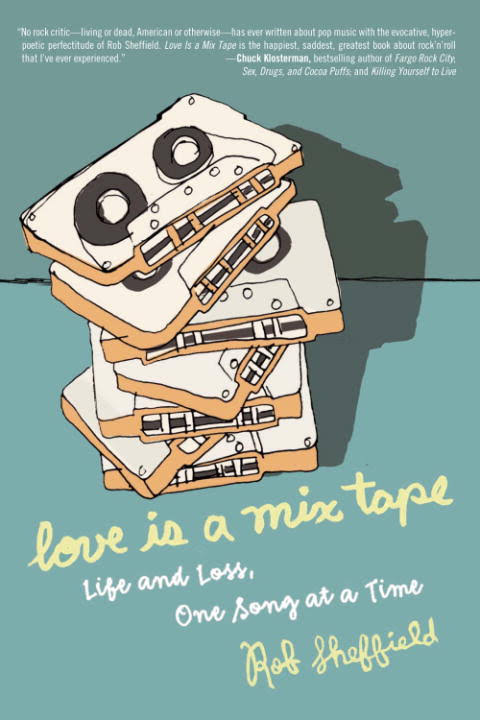
Love is a Mixtape

Author: Rob Sheffield
Rating: 10/10
Last Read: February 2015

Quick Summary:  A music journalist for the Rolling Stone writes a book about his relationship with the love of his life.  Each chapter has a playlist, and the songs that are picked are intertwined into his retelling of their life story.  

The book opens telling you that this is not a happy story – it’s the story of how he found love and then lost it due to a tragic death.  As he’s spinning the tale of their love, you manage to forget this fact – until the terrible event happens and you feel the deep pang of loss (“how could this happen to them?!”).

I have a deep appreciation for this book – music is equally important to me and equally intertwined in my life. Losing the music is a tragic thing.

My Highlights

It was a smashing time, and then it ended, because that’s what times do. –loc 141

Renée loved to do things. That was mysterious to me, since I was more comfortable talking about things and never doing them. –loc 149

Tonight, I feel like my whole body is made out of memories. I’m a mix tape, a cassette that’s been rewound so many times you can hear the fingerprints smudged on the tape. –loc 171

A song nobody likes is a sad thing. But a love song nobody likes is hardly a thing at all. –loc 188

There are millions of songs in the world, and millions of ways to connect them into mixes. Making the connections is part of the fun of being a fan. –loc 295

Walter Benjamin, in his prescient 1923 essay “One Way Street,” said a book was an outdated means of communication between two boxes of index cards. One professor goes through books, looking for tasty bits he can copy onto index cards. Then he types his index cards up into a book, so other professors can go through it and copy tasty bits onto their own index cards. Benjamin’s joke was: Why not just sell the index cards? –loc 301

I’d rather hear a Frank Sinatra song between Run-DMC and Bananarama than between two other Frank Sinatra songs. When you stick a song on a tape, you set it free. –loc 307

Every mix tape tells a story. Put them together, and they add up to the story of a life. –loc 335

It was a painful night, but I got the message: Let the dancing girls dance. That’s the one ironclad rule of pop muzik, whether in New York, London, Paris, or Munich, and I’m just lucky I learned it so early. I had always been taught to fear disco, and to fear the disco inside me. But by the second verse of “Bad Girls,” it was obvious everything I knew was wrong. “Toot toot, beep beep” was meaningful on a much deeper level than I could have fathomed. –loc 440

It’s this kind of syndrome—where if a guy sees his girlfriend likin’ somebody, that’s called ‘bitch power.’ Like Elvis Presley was hated by men, hated, ’cause he had bitch power. Teddy Pendergrass has bitch power. I just found out that I have a little bitch power. But beyond bitch power, I have something else, that men like—and that’s the truth, and the down-to-earth shit, OK? So men don’t mind bringin’ their women to see me, ’cause I have bitch power but it’s in another way. –loc 448

How do you turn down the volume on your personal-drama earphones and learn how to listen to other people? How do you jump off one moving train, marked Yourself, and jump onto a train moving in the opposite direction, marked Everybody Else? –loc 620

Sometimes you lie in a strange room, in a strange person’s home, and you feel yourself bending out of shape. –loc 765

Is there any scarier word than “irreversible”? It’s a hiss of a word, full of side effects and mutilations. Severe tire damage—no backing up. –loc 774

Girls take up a lot of room. –loc 792

I thought, There is nowhere else in the universe I would rather be at this moment. I could count the places I would not rather be. I’ve always wanted to see New Zealand, but I’d rather be here. The majestic ruins of Machu Picchu? I’d rather be here. A hillside in Cuenca, Spain, sipping coffee and watching leaves fall? Not even close. There is nowhere else I could imagine wanting to be besides here in this car, with this girl, on this road, listening to this song. If she breaks my heart, no matter what hell she puts me through, I can say it was worth it, just because of right now. Out the window is a blur and all I can really hear is this girl’s hair flapping in the wind, and maybe if we drive fast enough the universe will lose track of us and forget to stick us somewhere else. –loc 839

I kept thinking of an old Robert Mitchum cowboy movie where he goes back to see the farmhouse where he was born and finds the house falling apart and an old man living in it by himself. “Lonely place,” Robert Mitchum says. The old man says, “Nothing wrong with a lonely place as long as it’s private. That’s why I never married. Marriage is lonely, but it ain’t private.” –loc 946

Our lives were just beginning, our favorite moment was right now, our favorite songs were unwritten. –loc 1073

The songs were all either fast or sad, because all songs should be either fast or sad. Some of the fast ones were sad, too. –loc 1122

“Honey, is this song about us?” the strategic answer is, “Yes, but so is ‘Just Like Heaven.’” –loc 1250

“If it’s got tits or tires, it’s gonna cost you money.” –loc 1284

Chuck Berry the night he decided to mix country with the blues, –loc 1399

I suddenly realized how much being a husband was about fear: fear of not being able to keep somebody safe, of not being able to protect somebody from all the bad stuff you want to protect them from. Knowing they have more tears in them than you will be able to keep them from crying. –loc 1439

Every time I started to cry, I remembered how Renée used to say real life was a bad country song, except bad country songs are believable and real life isn’t. –loc 1747

I had no voice to talk with because she was my whole language. –loc 1825

You lose a certain kind of innocence when you experience this type of kindness. You lose your right to be a jaded cynic. You can no longer go back through the looking glass and pretend not to know what you know about kindness. It’s a defeat, in a way. –loc 1912

Human benevolence is totally unfair. We don’t live in a kind or generous world, yet we are kind and generous. We know the universe is out to burn us, and it gets us all the way it got Renée, but we don’t burn each other, not always. –loc 1944

One day, you’re in a physical landscape you share with this bizarre and fundamentally alien creature, not alien because she’s female but alien because you’re a fool in love and there’s nothing not alien about that. And then when she’s gone, you’re alone and all the strangeness and wonder have gone out of the landscape and you’re still a fool but now nobody notices how many days in a row you wear the same socks and cleaning the shower doesn’t make the girl smile anymore so everything smells a little worse and doesn’t get fixed when it breaks. –loc 2049

But all the things you want to learn from grief turn out to be the total opposite of what you actually learn. There are no revelations, no wisdoms as a trade-off for the things you have lost. You just get stupider, more selfish. Colder and grimmer. You forget your keys. You leave the house and panic that you won’t remember where you live. You know less than you ever did. You keep crossing thresholds of grief and you think, Maybe this one will unveil some sublime truth about life and death and pain. But on the other side, there’s just more grief. –loc 2181

It’s not human to let go of love, even when it’s dead. –loc 2187

Ralph Waldo Emerson knew the score: “I grieve that grief can teach me nothing.” That’s from “Experience,” his late essay about human loss and his son’s death. –loc 2195

It’s the same with people who say, “Whatever doesn’t kill you makes you stronger.” Even people who say this must realize that the exact opposite is true. What doesn’t kill you maims you, cripples you, leaves you weak, makes you whiny and full of yourself at the same time. The more pain, the more pompous you get. Whatever doesn’t kill you makes you incredibly annoying.

Sometimes great tunes happen to bad times, and when the bad time is over, not all the tunes get to move on with you. –loc 2294

It was strange to fall back in love with really old songs, or to hear them for the first time and not get to hear Renée sing along with them. –loc 2390

I realize that I will never fully understand the millions of bizarre ways that music brings people together. –loc 2438

After Renée died, I assumed the rest of my life would be just a consolation prize. I would keep living, and keep having new experiences, but none of them would compare to the old days. I would have to settle for a lonely life I didn’t want, which would always remind me of the life I couldn’t have anymore. But it didn’t turn out that way, and there’s something strange and upsetting about that. –loc 2450

sometimes I think, man, all the people I get to hear this song with, we’re going to miss each other when we die. When we die, we will turn into songs, and we will hear each other and remember each other. –loc 2504

But the rhythm of the mix tape is the rhythm of romance, the analog hum of a physical connection between two sloppy, human bodies. –loc 2511

The cassette is full of tape hiss and room tone; it’s full of wasted space, unnecessary noise. –loc 2511

But the answer is simple. Love is a mix tape. –loc 2533

Sanctificum

Author: Chris Abani
Rating: 9/10
Last Read: February 2015

Quick Summary: Collected book of poems by one of my favorite poets – Chris Abani.  

Check out his two TED talks and fall in love with him.

My Highlights

A man once asked me in the street: Do you own your own bones?

The safety of doorways is an illusion. They lead nowhere. This is why we build houses.

Sometimes we find treasure. Sometimes something fills the mind, something at which we pause, stopped. The way a photograph cannot remember the living.

The more we promise to never leave our lovers, the faster the horizon arrives.

After six months in a hole in the ground, the prison is not the building, or the bars, or the beatings, or the denials, or the lies, or the forgetting, or the negotiating — It is the small door in your mind closing.

For fear of being loved we will kill the world

I drink tea in the shade and believe in poetry. –p. 60

If Zeno’s paradox reveals anything it is not that space and time can be divided into infinity infinitely, but simply this: That we can only approximate the object of our desire. That we are always on a train traveling to happiness. But what we do reach are coffee, biscotti, and Bob on the iPod.

It is easy to forget the decadence of glass. How some of us find it only in fragments. The glass between us and the world is often the measure of our wealth. Looking out at the world through it colors the hunger beyond.

This is a callout to Jack Gilbert’s “Forgotten Dialect of the Heart”:

Words mean only what you want them to.
You say sunshine and you mean hope.
You say food and you mean refuge.
You say sand and you mean play.
You say stone and you mean, I will never forget.
But you do, but you do and thank God, thank God.
–pp. 79-80

Your name is a hunger on my tongue.
Your eyes are the light that shelters me.
Your beauty makes me beautiful.
–p. 72

When we say love we mean, I want.
When we say sorry we mean, forgive me.
–p. 54

Ritual is the only language we truly believe in:
tea steaming a glass mug on a table,
smoke from a cigarette filling the room with blue,
the way the sun falls across our face as we sleep.
These are our things, we say.

–p. 46

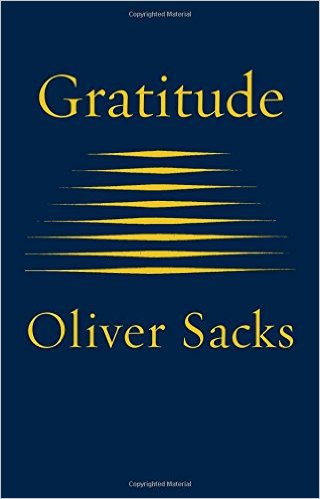
Gratitude

Author: Oliver Sacks
Rating: 10/10
Last Read: July 2016

Quick Summary: A short selection of four essays written by Dr. Oliver Sacks.  These essays cover the end of his life, with reflections on old age, facing mortality, and the gratitude he has for being a sentient being on this planet.  

“Whatever must have a beginning must have an ending.”

Recommended Reads: On the Move (autobiography), On Death and Dying

My Takeaways

You never quite lose the sense of childish wonder if you keep that attitude about you as you grow older.

There really is an essential truth to the matter of dying: when it comes time for you to accept your fate, the nonessential falls away and you focus on the truly important things.  

It is possible to meet death with dignity and grace.

I cannot pretend I am without fear. But my predominant feeling is one of gratitude. I have loved and been loved; I have been given much and I have given something in return; I have read and traveled and thought and written. I have had an intercourse with the world, the special intercourse of writers and readers.

My Highlights

A few years ago, when I gave a friend a bottle of mercury for his eightieth birthday—a special bottle that could neither leak nor break—he gave me a peculiar look, but later sent me a charming letter in which he joked, “I take a little every morning for my health.” –loc 80

Eighty! I can hardly believe it. I often feel that life is about to begin, only to realize it is almost over. –loc 83

I thought I would die at forty-one, when I had a bad fall and broke a leg while mountaineering alone. I splinted the leg as best I could and started to lever myself down the mountain, clumsily, with my arms. In the long hours that followed, I was assailed by memories, both good and bad. Most were in a mode of gratitude—gratitude for what I had been given by others, gratitude too that I had been able to give something back. –loc 86

I am sorry I have wasted (and still waste) so much time; I am sorry to be as agonizingly shy at eighty as I was at twenty; I am sorry that I speak no languages but my mother tongue and that I have not traveled or experienced other cultures as widely as I should have done. –loc 96

At eighty, the specter of dementia or stroke looms. A third of one’s contemporaries are dead, and many more, with profound mental or physical damage, are trapped in a tragic and minimal existence. At eighty, the marks of decay are all too visible. One’s reactions are a little slower, names more frequently elude one, and one’s energies must be husbanded, but even so, one may often feel full of energy and life and not at all “old.” Perhaps, with luck, I will make it, more or less intact, for another few years and be granted the liberty to continue to love and work, the two most important things, Freud insisted, in life. –loc 105

When pressed about his diagnosis a few weeks later, he said, “Whatever has a beginning must have an ending.” When he died, at eighty-eight, he was still fully engaged in his most creative work. –loc 112

He felt, as I begin to feel, not a shrinking but an enlargement of mental life and perspective. One has had a long experience of life, not only one’s own life, but others’ too. One has seen triumphs and tragedies, booms and busts, revolutions and wars, great achievements and deep ambiguities. One has seen grand theories rise, only to be toppled by stubborn facts. One is more conscious of transience and, perhaps, of beauty. At eighty, one can take a long view and have a vivid, lived sense of history not possible at an earlier age. I can imagine, feel in my bones, what a century is like, which I could not do when I was forty or sixty. I do not think of old age as an ever grimmer time that one must somehow endure and make the best of, but as a time of leisure and freedom, freed from the factitious urgencies of earlier days, free to explore whatever I wish, and to bind the thoughts and feelings of a lifetime together. –loc 115

It is up to me now to choose how to live out the months that remain to me. I have to live in the richest, deepest, most productive way I can. –loc 134

And yet, one line from Hume’s essay strikes me as especially true: “It is difficult,” he wrote, “to be more detached from life than I am at present.” Over the last few days, I have been able to see my life as from a great altitude, as a sort of landscape, and with a deepening sense of the connection of all its parts. This does not mean I am finished with life. On the contrary, I feel intensely alive, and I want and hope in the time that remains to deepen my friendships, to say farewell to those I love, to write more, to travel if I have the strength, to achieve new levels of understanding and insight. –loc 147

I feel a sudden clear focus and perspective. There is no time for anything inessential. I must focus on myself, my work, and my friends. I shall no longer look at the NewsHour every night. I shall no longer pay any attention to politics or arguments about global warming. –loc 153

My generation is on the way out, and each death I have felt as an abruption, a tearing away of part of myself. There will be no one like us when we are gone, but then there is no one like anyone else, ever. When people die, they cannot be replaced. They leave holes that cannot be filled, for it is the fate—the genetic and neural fate—of every human being to be a unique individual, to find his own path, to live his own life, to die his own death. –loc 159

I cannot pretend I am without fear. But my predominant feeling is one of gratitude. I have loved and been loved; I have been given much and I have given something in return; I have read and traveled and thought and written. I have had an intercourse with the world, the special intercourse of writers and readers. –loc 163

Above all, I have been a sentient being, a thinking animal, on this beautiful planet, and that in itself has been an enormous privilege and adventure. –loc 165

It was this celestial splendor that suddenly made me realize how little time, how little life, I had left. My sense of the heavens’ beauty, of eternity, was inseparably mixed for me with a sense of transience—and death. –loc 191

(Auden used to say that one should always celebrate one’s birthday, no matter how one felt.) –loc 215

“The observance of the Sabbath is extremely beautiful,” he said, “and is impossible without being religious. It is not even a question of improving society—it is about improving one’s own quality of life.” –loc 301

Robert John visited. He was full of entertaining stories about the Nobel Prize and the ceremony in Stockholm, but made a point of saying that, had he been compelled to travel to Stockholm on a Saturday, he would have refused the prize. His commitment to the Sabbath, its utter peacefulness and remoteness from worldly concerns, would have trumped even a Nobel. –loc 307

The peace of the Sabbath, of a stopped world, a time outside time, was palpable, infused everything, and I found myself drenched with a wistfulness, something akin to nostalgia, wondering what if: What if A and B and C had been different? –loc 324

And now, weak, short of breath, my once-firm muscles melted away by cancer, I find my thoughts, increasingly, not on the supernatural or spiritual but on what is meant by living a good and worthwhile life—achieving a sense of peace within oneself. I find my thoughts drifting to the Sabbath, the day of rest, the seventh day of the week, and perhaps the seventh day of one’s life as well, when one can feel that one’s work is done, and one may, in good conscience, rest. –loc 333

On the Move

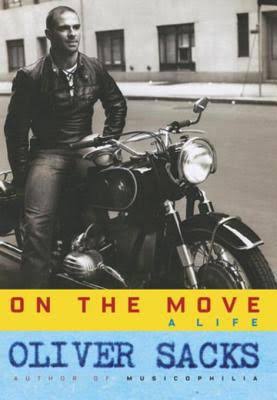
Author: Oliver Sacks
Rating: 9/10
Last Read: September 2015

Quick Summary:  Autobiography of the late Dr. Oliver Sacks, writing about his career, growth, struggles, and thoughts as he revisited his life. Dr. Sacks is a wise man who has been through much in life – and there is much humanity to be gleaned from the pages of this book.

I recommend Maria Popova’s review.

Recommended Reads: Gratitude

My Takeaways

Life was (and probably still is) very difficult for LGBT individuals in ways that I have not considered.

The history of a thing is just as important as the recent developments.  It is hard to continue forward if you are not sure where you came from.

Everybody has their struggles, and even those who have achieved much in life struggle in ways you wouldn’t expect – such as being addicted to amphetamines.

As Dr. Sacks recounts a tale of Einstein and humanity, so to does he reveal his humanity by giving a frank and honest recounting of his life.

Aubrey recounted with a smile, he and a colleague from the Israeli consulate visited Einstein in his house in Princeton. Einstein invited them in and courteously asked if they would like coffee, and (thinking that an assistant or housekeeper would make it), Aubrey said yes. But he was “horrified,” as he put it, when Einstein trotted into the kitchen himself. They soon heard the clatter of cups and pots and an occasional piece of crockery falling, as the great man, in his friendly but slightly clumsy way, made the coffee for them. This, more than anything, Aubrey said, showed him the human and endearing side of the world’s greatest genius.

My Highlights

We think of science as discovery, art as invention, but is there a “third world” of mathematics, which is somehow, mysteriously, both? –loc 295

one day, with my heart in my mouth, I told Richard that I was in love with him, not knowing how he would react. He hugged me, gripped my shoulders, and said, “I know. I am not that way, but I appreciate your love and love you too, in my own way.” –loc 343

“Travel now by all means—if you have the time. But travel the right way, the way I travel. I am always reading and thinking of the history and geography of a place. I see its people in terms of these, placed in the social framework of time and space. Take the prairies, for example; you’re wasting your time visiting these unless you know the saga of the homesteaders, the influence of law and religion at different times, the economic problems, the difficulties of communication, and the effects of successive mineral finds. –loc 708

When you were born, people congratulated us on what they considered a wonderful family of four sons! Where are you all now? I feel lonely and bereft. Ghosts inhabit this house. When I go into the various rooms I feel overcome with a sense of loss. –loc 779

These and a host of other memories of your vital personality will always remain with us. When we contemplate this large empty house, we feel a wrench at our heart and a deep sense of loss. We realize nevertheless that you have to make your way in the world, and with you must rest the ultimate decision! –loc 786

I wondered whether systems in the brain concerned with the perception (or projection) of meaning, significance, and intentionality, systems underlying a sense of wonder and mysteriousness, systems for appreciation of the beauty of art and science, had lost their balance in schizophrenia, producing a mental world overcharged with intense emotion and distortions of reality. These systems had lost their middle ground, it seemed, so that any attempt to titrate them, damp them down, could tip the person from a pathologically heightened state to one of great dullness, a sort of mental death. –loc 884

It was at Mount Zion that Libet performed his astounding experiments showing that if subjects were asked to make a fist or perform another voluntary action, their brains would register a “decision” nearly half a second before there was any conscious decision to act. While his subjects felt that they had consciously and of their own free will made a movement, their brains had made a decision, seemingly, long before they did. –loc 1302

I sometimes annoyed the group, I think, by saying that we should also discuss the writings of our nineteenth-century forebears, relating what we were seeing in patients to their observations and thoughts. This was seen by the others as archaism; we were short of time, and we had better things to do than consider such “obsolete” matters. This attitude was reflected, implicitly, in many of the journal articles we read; they made little reference to anything more than five years old. It was as if neurology had no history. –loc 1379

I found this dismaying, for I think in narrative and historical terms. As a chemistry-mad boy, I devoured books on the history of chemistry, the evolution of its ideas, and the lives of my favorite chemists. Chemistry had, for me, a historical and human dimension too. –loc 1383

I was not a book collector myself, and when I bought books or articles, it was to read them, not to show them. –loc 1392

I felt that I was enjoying California too much, was getting addicted to an easy, sleazy life, to say nothing of a deepening drug addiction. I felt I needed to go to a hard, real place, a place where I could devote myself to work and perhaps discover or create a real identity, a voice of my own. –loc 1760

I sometimes wonder why I have spent more than fifty years in New York, when it was the West, and especially the Southwest, which so enthralled me. I now have many ties in New York—to my patients, my students, my friends, and my analyst—but I have never felt it move me the way California did. I suspect my nostalgia may be not only for the place itself but for youth, and a very different time, and being in love, and being able to say, “The future is before me.” –loc 1773

But then the feeling started to fade. We asked ourselves whether the experience we had shared was real, authentic, given the huge aphrodisiac thrust of the amphetamines. I found this question particularly humiliating—could so lofty a transport as falling in love be reduced to something purely physiological? –loc 1908

I asked Shengold if I too was schizophrenic. “No,” he answered. Was I then, I asked, “merely neurotic”? “No,” he answered. I left it there, we left it there, and there it has been left for the last forty-nine years. –loc 1982

I would continue to seek satisfaction in drugs, I felt, unless I had satisfying—and, hopefully, creative—work. It was crucial for me to find something with meaning, and this, for me, was seeing patients. –loc 1987

We maintain the proprieties—he is always “Dr. Shengold,” and I am always “Dr. Sacks”—but it is because the proprieties are there that there can be such freedom of communication. And this is something I also feel with my own patients. They can tell me things, and I can ask things, which would be impermissible in ordinary social intercourse. –loc 2000

Above all, Dr. Shengold has taught me about paying attention, listening to what lies beyond consciousness or words. –loc 2002

For me, this was an example of how unconscious motives may sometimes ally themselves to physiological propensities, of how one cannot abstract an ailment or its treatment from the whole pattern, the context, the economy of someone’s life. –loc 2028

This painful story—painful on both sides—is not an uncommon one: an older man, a father figure, and his youthful son-in-science find their roles reversed when the son starts to outshine the father. This happened with Humphry Davy and Michael Faraday—Davy first giving every encouragement to Faraday, then trying to block his career. I am no Faraday, and Friedman was no Davy, but I think the same deadly dynamic was at work, at a much humbler level. –loc 2143

I did not feel she used the word “Darling” lightly; I felt very loved by her, and I loved her intensely too, and this was a love without ambivalence, without conditionality. Nothing I could say could repel or shock her; there seemed no limit to her powers of sympathy and understanding, the generosity and spaciousness of her heart. –loc 2169

I mentioned to her, a couple of months later, that I had been in a depression. “I know we all suffer them at times,” Len wrote. “Well, don’t have any more. You’ve got so much in your favour—brains, charm, presentability, a sense of the ridiculous, and a whole gaggle of us who believe in you.” –loc 2220

“Your Dr. Friedman,” she wrote in October of 1967, “sounds a most unpleasant piece of work, but don’t let him get under your skin. Keep hold of your faith in yourself.” –loc 2255

As one grows older, the years seem to blur into one another, but 1972 remains sharply etched in my memory. –loc 2500

It seems to me that I discover my thoughts through the act of writing, in the act of writing. Occasionally, a piece comes out perfectly, but more often my writings need extensive pruning and editing, because I may express the same thought in many different ways. –loc 2581

As the decorous stranger discreetly retired, I asked Wystan how he experienced the world, whether he thought of it as being a very small or very large place. “Neither,” he replied. “Neither large nor small. Cozy, cozy.” He added in an undertone, “Like home.” –loc 2708

Informally (I sometimes think) I see and learn and do a great deal, with the extremely varied patients I see in various clinics and Homes, and every seeing-and-learning-and-doing situation is, eo ipso, a teaching situation. I find every patient I see, everywhere, vividly alive, interesting and rewarding; I have never seen a patient who didn’t teach me something new, or stir in me new feelings and new trains of thought; and I think that those who are with me in these situations share in, and contribute to, this sense of adventure. (I regard all neurology, everything, as a sort of adventure!) –loc 3130

“You care, you really care for me!” “Of course,” Eric said. “How could you doubt it?” But it was not easy to believe that anyone cared for me; I sometimes failed to realize, I think, how much my parents cared for me. It is only now, reading the letters they wrote to me when I came to America fifty years ago, that I see how deeply they did care. –loc 3232

And perhaps how deeply many others have cared for me—was the imagined lack of caring by others a projection of something deficient or inhibited in myself? –loc 3235

When Lennie learned of this, she felt that life with intravenous nourishment and a spreading cancer was not worthwhile. She resolved to stop eating, though she would take water. My father insisted she be seen by a psychiatrist, but the psychiatrist said, “She is the sanest person I have ever seen. You must respect her decision.” –loc 3246

Dearest Len, We have all of us been hoping so intensely that this month would see your return to health; but, alas! this was not to be. My heart is torn when I hear of your weakness, your misery—and, now, your longing to die. You, who have always loved life, and been such a source of strength and life to so many, can face death, even choose it, with serenity and courage, mixed, of course, with the grief of all passing. We, I, can much less bear the thought of losing you. You have been as dear to me as anyone in this world. I shall hope against hope that you may weather this misery, and be restored again to the joy of full living. But if this is not to be, I must thank you—thank you, once again, and for the last time, for living—for being you. Love, Oliver –loc 3254

When I visited Gallaudet University in Washington, D.C., (it is the only university in the world for deaf and hearing-impaired students) and talked about the “hearing impaired,” one of the deaf students signed, “Why don’t you look at yourself as sign impaired?” –loc 3605

He has one of the most spacious, thoughtful minds I have ever encountered, with a vast base of knowledge of every sort, but it is a base under continual questioning and scrutiny. (I have seen him suddenly stop in mid-sentence and say, “I no longer believe what I was about to say.”) –loc 3697

I think we all live in a swirl of anecdotes…. We (most of us) compose our lives into narratives…. I wonder what the origin is of the urge to “compose” oneself. –loc 3781

I found you so talented, but so deficient in one quality—just the most important quality—call it humanity, or sympathy, or something like that. And, frankly, I despaired of your ever becoming a good writer, because I didn’t see how one could be taught such a quality…. Your deficiency of sympathy made for a limitation of your observation…. What I didn’t know was that the growth of sympathies is something frequently delayed till one’s thirties. –loc 3826

I am however a rather derivative poet. I learn what I can from whom I can. I borrow heavily from my reading, because I take my reading seriously. It is part of my total experience and I base most of my poetry on my experience. –loc 3857

There is a danger, when old friends meet, that they will talk mostly of the past. –loc 3860

At worst, one is in motion; and at best, Reaching no absolute, in which to rest, One is always nearer by not keeping still. –loc 3866

Aubrey recounted with a smile, he and a colleague from the Israeli consulate visited Einstein in his house in Princeton. Einstein invited them in and courteously asked if they would like coffee, and (thinking that an assistant or housekeeper would make it), Aubrey said yes. But he was “horrified,” as he put it, when Einstein trotted into the kitchen himself. They soon heard the clatter of cups and pots and an occasional piece of crockery falling, as the great man, in his friendly but slightly clumsy way, made the coffee for them. This, more than anything, Aubrey said, showed him the human and endearing side of the world’s greatest genius. –loc 4090

And in its broadest sense, neural Darwinism implies that we are destined, whether we wish it or not, to a life of particularity and self-development, to make our own individual paths through life. –loc 5111

The Book Thief

Author: Markus Zusak
Rating: 7/10
Last Read: January 2015

Quick Summary: The story of a small girl living in Germany during WWII.  Particularly interesting because the narrator is Death. She is taught to read by her foster father and steals books from the Nazi regime. Her family takes in a Jewish man.  Horror and sadness ensue all around.


I have hated the words and I have loved them, and I hope I have made them right.

My Highlights

He was the crazy one who had painted himself black and defeated the world. She was the book thief without the words. Trust me, though, the words were on their way, and when they arrived, Liesel would hold them in her hands like the clouds, and she would wring them out like the rain.

It’s very rare, don’t you think, for a statue to appear before its subject has become famous.

“After all,” he said, “you should know it yourself—a young man is still a boy, and a boy sometimes has the right to be stubborn.”

“The sky is blue today, Max, and there is a big long cloud, and it’s stretched out, like a rope. At the end of it, the sun is like a yellow hole ….” Max, at that moment, knew that only a child could have given him a weather report like that.

You might well ask just what the hell he was thinking. The answer is, probably nothing at all. He’d probably say that he was exercising his God-given right to stupidity.

When the elderly Jew climbed to his feet for the last time and continued on, he looked briefly back. He took a last sad glance at the man who was kneeling now himself, whose back was burning with four lines of fire, whose knees were aching on the road. If nothing else, the old man would die like a human. Or at least with the thought that he was a human.

Now more than ever, 33 Himmel Street was a place of silence, and it did not go unnoticed that the Duden Dictionary was completely and utterly mistaken, especially with its related words. Silence was not quiet or calm, and it was not peace.

The accordion remained strapped to her chest. When she bowed her head, it sank to her lap. Liesel watched. She knew that for the next few days, Mama would be walking around with the imprint of an accordion on her body. There was also an acknowledgment that there was great beauty in what she was currently witnessing, and she chose not to disturb it.

THE BEST word shakers were the ones who understood the true power of words. They were the ones who could climb the highest. One such word shaker was a small, skinny girl. She was renowned as the best word shaker of her region because she knew how powerless a person could be WITHOUT words.

I have hated the words and I have loved them, and I hope I have made them right.