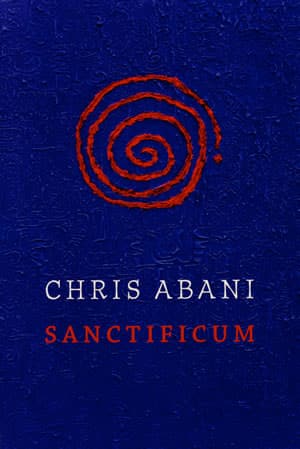
Sanctificum

Author: Chris Abani
Rating: 9/10
Last Read: February 2015

Quick Summary: Collected book of poems by one of my favorite poets – Chris Abani.  

Check out his two TED talks and fall in love with him.

My Highlights

A man once asked me in the street: Do you own your own bones?

The safety of doorways is an illusion. They lead nowhere. This is why we build houses.

Sometimes we find treasure. Sometimes something fills the mind, something at which we pause, stopped. The way a photograph cannot remember the living.

The more we promise to never leave our lovers, the faster the horizon arrives.

After six months in a hole in the ground, the prison is not the building, or the bars, or the beatings, or the denials, or the lies, or the forgetting, or the negotiating — It is the small door in your mind closing.

For fear of being loved we will kill the world

I drink tea in the shade and believe in poetry. –p. 60

If Zeno’s paradox reveals anything it is not that space and time can be divided into infinity infinitely, but simply this: That we can only approximate the object of our desire. That we are always on a train traveling to happiness. But what we do reach are coffee, biscotti, and Bob on the iPod.

It is easy to forget the decadence of glass. How some of us find it only in fragments. The glass between us and the world is often the measure of our wealth. Looking out at the world through it colors the hunger beyond.

This is a callout to Jack Gilbert’s “Forgotten Dialect of the Heart”:

Words mean only what you want them to.
You say sunshine and you mean hope.
You say food and you mean refuge.
You say sand and you mean play.
You say stone and you mean, I will never forget.
But you do, but you do and thank God, thank God.
–pp. 79-80

Your name is a hunger on my tongue.
Your eyes are the light that shelters me.
Your beauty makes me beautiful.
–p. 72

When we say love we mean, I want.
When we say sorry we mean, forgive me.
–p. 54

Ritual is the only language we truly believe in:
tea steaming a glass mug on a table,
smoke from a cigarette filling the room with blue,
the way the sun falls across our face as we sleep.
These are our things, we say.

–p. 46

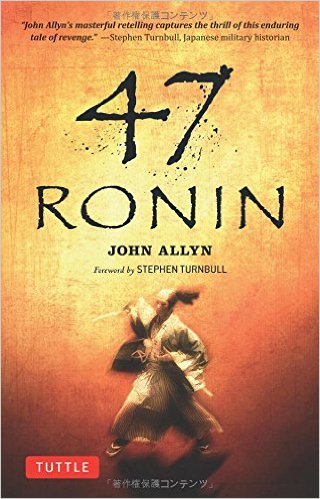
47 Ronin

Author: John Allyn
Rating: 7/10
Last Read: January 2014

Quick Summary: A retelling of the tale of the 47 Ronin. The samurai of Lord Asano spend months planning revenge for their disgraced master, who had been ordered to commit seppuku.  This story covers the downfall of Lord Asano, the disbandment of the samurai, the life led in the interim, and the long, careful planning spent to bring about their revenge.

Please don’t judge this novel by the movie – this is a much more realistic retelling of the tale of this historical legend.

My Highlights

The path of honor was easy to follow when it was easy to see.

When there were conflicts between choice of action, such as Hara had raised, the solutions could not be expected to satisfy everyone.

“You see,” he went on, “some people live all their lives without knowing which path is right. They’re buffeted by this wind or that and never really know where they’re going. That’s largely the fate of the commoners—those who have no choice over their destiny. For those of us born as samurai, life is something else. We know the path of duty and we follow it without question.”

Remember, there’s sacrifice involved in any kind of life. Even the man who chooses the safe way has to give up the thrill of combat. The point is that once you know what you want, you must be prepared to sacrifice everything to get.

In the end this was all that mattered, for a man will only be as long as his life but his name will be for all time.

The Sands of Mars

Author: Arthur C. Clarke
Rating: 8/10
Last Read: June 2014

Quick Summary: A famous sci-fi writer gets a chance to travel to mars (and takes lots of shit for how unrealistic his writings about sci-fi and space travel were). He meets the colonial leadership on Mars, eventually finding native creatures and falling in love with the planet.

Arthur C. Clarke is one of my favorite sci-fi writers, and this was his first published sci-fi novel.  The fact that he takes the chance to make his main character a writer, and has that writer get picked on for his wild and crazy predictions about the future of human space travel was quite enjoyable.  The story was a smooth read as well – highly recommended.

My Highlights

Well, this is it, thought Gibson. Down there is all my past life, and the lives of all my ancestors back to the first blob of jelly in the first primeval sea. No colonist or explorer setting sail from his native land ever left so much behind as I am leaving now. Down beneath those clouds lies the whole of human history; soon I shall be able to eclipse with my little finger what was, until a lifetime ago, all of Man’s dominion and everything that his art had saved from time.

This inexorable drawing away from the known into the unknown had almost the finality of death. Thus must the naked soul, leaving all its treasures behind it, go out at last into the darkness and the night.

Gibson had found it very hard to get his impressions of space down on paper; one could not very well say “space is awfully big” and leave it at that.

Only Hilton, who seemed to possess unlimited reserves of patience, took life easily and relaxed while the others fussed around him.

It’s always fatal to adapt oneself to one’s surroundings. The thing to do is to alter your surroundings to suit you.”

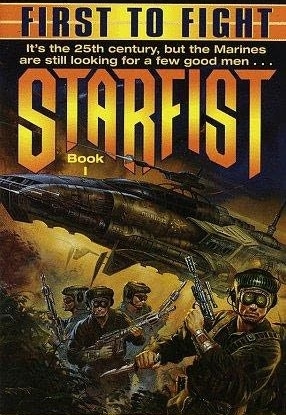
Starfist: First to Fight

Author: Dan Cragg & David Sherman
Rating: 6/10
Last Read: August 2010

Quick Summary: This follows the lives and experiences of marines in space during the 25th century – dealing with new recruits, old fuckups, and handling warlords on outer world.  Reads like a military novel in the future.

Looking for militaristic marine sci-fi novel of the future?  Check out Starship Troopers.

Looking for some relaxing junk militaristic sci-fi?  Not a bad pick.  I did not continue the series.

My Highlights

“All right, recruits,” Neeley announced one day during a classroom training session, “I’m gonna give you Neeley’s Thirteen Rules for Staying Alive in Combat. You listening?
“One: Incoming fire always has the right-of-way.
“Two: Keep it simple, stupid.
“Three: Keeping it simple is the hardest thing in the world.
“Four: Never stand next to anyone braver than you are.
“Five: If things are going too well, it’s an ambush.
“Six: The easiest way is mined.
“Seven: The one thing you never run out of is the enemy.
“Eight: Infrared works both ways.
“Nine: Professionals are always predictable.
“Ten: We always wind up fighting amateurs.
“Eleven: When the enemy’s in range, so are you.
“Twelve: When in doubt, shoot until your magazine is empty.”
Neeley placed his hands on his hips and smiled fiercely. “You remember those rules and you’ll be okay.”

I just made up a new rule: Never stand next to anyone dumber than you!

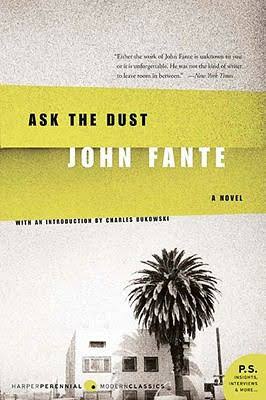
Ask the Dust

Author: John Fante
Rating: 6/10
Last Read: April 2014

Quick Summary: Arturo Bandini is a struggling writer in LA during the depression.  He’s convinced of his own greatness, but can’t seem to get the words onto the page correctly!  This follows his adventures (and madness) through the city, into love, and on a mad chase after his love into the desert.

I heard this book described as “The Great Gatsby of the West Coast.”  I’m not totally sure about that one – I like Gatsby much more.  I didn’t love the book, but it was still a decent read.  Perhaps I should give it a second chance one day.

I picked it up because one of my favorite poets – Charles Bukowski – loved this book.  One bonus for me was the fact that Bukowski wrote the foreword! What a surprise. 

My Takeaways

No matter how convinced you are of your own talent, if you cannot do the work and produce output, you are nothing.  Ego is your enemy.

My Highlights

But let me say that the way of his words and the way of his way are the same: strong and good and warm.

Almighty God, I am sorry I am now an atheist, but have You read Nietzsche? Ah, such a book!

“My advice to all young writers is quite simple. I would caution them never to evade a new experience. I would urge them to live life in the raw, to grapple with it bravely, to attack it with naked fists.”

every morning you’ll see the mighty sun, the eternal blue of the sky, and the streets will be full of sleek women you never will possess, and the hot semitropical nights will reek of romance you’ll never have, but you’ll still be in paradise, boys, in the land of sunshine.

You are nobody, and I might have been somebody, and the road to each of us is love.

God was such a dirty crook, such a contemptible skunk, that’s what he was for doing that thing to that woman. Come down out of the skies, you God, come on down and I’ll hammer your face all over the city of Los Angeles, you miserable unpardonable prankster. If it wasn’t for you, this woman would not be so maimed, and neither would the world

a Bandini with dynamite in his body and volcanic fire in his eyes, who goes to this Camilla Lopez and says: see here, young woman, I have been very patient with you, but now I have had enough of your impudence, and you will kindly oblige me by removing your clothes.

the world seemed a myth, a transparent plane, and all things upon it were here for only a little while; all of us, Bandini, and Hackmuth and Camilla and Vera, all of us were here for a little while, and then we were somewhere else; we were not alive at all; we approached living, but we never achieved it. We are going to die. Everybody was going to die.

The world was dust, and dust it would become.

What doth it profit a man if he gain the whole world and suffer the loss of his own soul?

“What’s the matter with him?”
“T. B.” she said.
“Tough.”
“He won’t live long.”
I didn’t give a damn. “We all have to die someday.”

He was going to die in a year, she said. He had left Los Angeles and gone to the edge of the Santa Ana desert. There he lived in a shack, writing feverishly. All his life he had wanted to write. Now, with such little time remaining, his chance had come.

There came over me a terrifying sense of understanding about the meaning and the pathetic destiny of men. The desert was always there, a patient white animal, waiting for men to die, for civilizations to flicker and pass into the darkness. Then men seemed brave to me, and I was proud to be numbered among them. All the evil of the world seemed not evil at all, but inevitable and good and part of that endless struggle to keep the desert down.

I looked southward in the direction of the big stars, and I knew that in that direction lay the Santa Ana desert, that under the big stars in a shack lay a man like myself, who would probably be swallowed by the desert sooner than I, and in my hand I held an effort of his, an expression of his struggle against the implacable silence toward which he was being hurled. Murderer or bartender or writer, it didn’t matter: his fate was the common fate of all, his finish my finish; and here tonight in this city of darkened windows were other millions like him and like me: as indistinguishable as dying blades of grass. Living was hard enough. Dying was a supreme task. And Sammy was soon to die.

To hell with that Hitler, this is more important than Hitler, this is about my book. It won’t shake the world, it won’t kill a soul, it won’t fire a gun, ah, but you’ll remember it to the day you die, you’ll lie there breathing your last, and you’ll smile as you remember the book.

This was the life for a man, to wander and stop and then go on, ever following the white line along the rambling coast, a time to relax at the wheel, light another cigaret, and grope stupidly for the meanings in that perplexing desert sky.

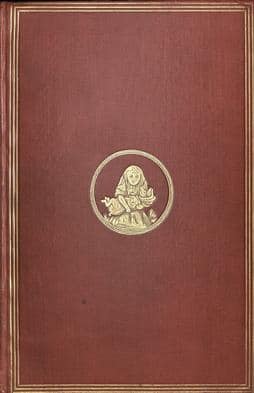
Alice’s Adventures in Wonderland

Author: Lewis Carroll
Rating: 8/10
Last Read: August 2010

Quick Summary: Truly a book of nonsense – Alice is a little girl who falls down a rabbit hole and wanders through a fantastic world.  Sometimes it feels like you’re in the middle of an acid trip, other times it just feels like weird nonsense. But there’s plenty of poetry, riddles, and interesting turns of language around.

My Highlights

‘How am I to get in?’ asked Alice again, in a louder tone. ‘Are you to get in at all?’ said the Footman. ‘That’s the first question, you know.’

And with that she began nursing her child again, singing a sort of lullaby to it as she did so, and giving it a violent shake at the end of every line: ‘Speak roughly to your little boy, And beat him when he sneezes: He only does it to annoy, Because he knows it teases.’

‘Would you tell me, please, which way I ought to go from here?’
‘That depends a good deal on where you want to get to,’ said the Cat.
‘I don’t much care where–‘ said Alice.
‘Then it doesn’t matter which way you go,’ said the Cat.
‘–so long as I get somewhere,’ Alice added as an explanation.
‘Oh, you’re sure to do that,’ said the Cat, ‘if you only walk long enough.’

She had quite forgotten the Duchess by this time, and was a little startled when she heard her voice close to her ear. ‘You’re thinking about something, my dear, and that makes you forget to talk. I can’t tell you just now what the moral of that is, but I shall remember it in a bit.’ ‘Perhaps it hasn’t one,’ Alice ventured to remark. ‘Tut, tut, child!’ said the Duchess. ‘Everything’s got a moral, if only you can find it.’

“Never imagine yourself not to be otherwise than what it might appear to others that what you were or might have been was not otherwise than what you had been would have appeared to them to be otherwise.”

‘That’s the reason they’re called lessons,’ the Gryphon remarked: ‘because they lessen from day to day.’

The White Rabbit put on his spectacles. ‘Where shall I begin, please your Majesty?’ he asked.
‘Begin at the beginning,’ the King said gravely, ‘and go on till you come to the end: then stop.

Now, here, you see, it takes all the running you can do, to keep in the same place. If you want to get somewhere else, you must run at least twice as fast as that!” ~ The Queen

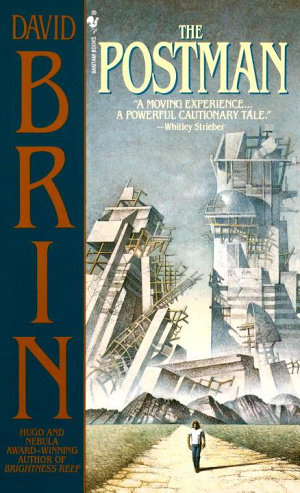
The Postman

Author: David Brin
Rating: 8/10
Last Read: December 2012

Quick Summary:  In the post-apocalyptic wasteland of America, a man finds a postal worker’s uniform and uses it to spread the lie of restoring the United States – giving hope to people threatened with death and destruction, culminating in a struggle with the warlords around him.

My Highlights

“Short of Death itself, there is no such thing as a ‘total’ defeat.… There is never a disaster so devastating that a determined person cannot pull something out of the ashes—by risking all that he or she has left.… “Nothing in the world is more dangerous than a desperate man.”

The steely gray eyes were narrow and sad when next he looked up at Gordon. “I found out something, you know. I discovered that the big things don’t love you back. They take and take, and never give in return. They’ll drain your blood, your soul, if you let them, and never let go.

Men can be brilliant and strong, they whispered to one another. But men can be mad, as well. And the mad ones can ruin the world.

There is power there, slumbering below the surface. And there is magic.

“It’s said that ‘power corrupts,’ but actually it’s more true that power attracts the corruptible. The sane are usually attracted by other things than power. When they do act, they think of it as service, which has limits. The tyrant, though, seeks mastery, for which he is insatiable, implacable.

“The problem is one of balance,” the graying statesman-scientist said to his invention, ignoring Gordon as he contemplated the chessboard. “I’ve put some thought to it. How can we set up a system which encourages individuals to strive and excel, and yet which shows some compassion to the weak, and weeds out madmen and tyrants?”

Of course we can establish constitutional checks and balances, but those won’t mean a thing unless citizens make sure the safeguards are taken seriously. The greedy and the power-hungry will always look for ways to break the rules, or twist them to their advantage.

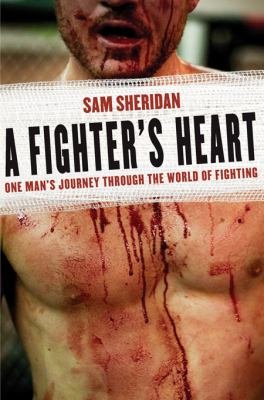
A Fighter’s Heart

Author: Sam Sheridan
Rating: 7/10
Last Read: April 2014

Quick Summary:  A guy who has found himself in possession of a bunch of cash and the intention to not work decides to dedicate himself to becoming a fighter.  The book covers his journey through different fights and training camps, and provides insight into the mind of a fighter and the athletes who participate in the sport.

My Takeaways

Fundamentals are important.

Fighting is not totally about violence – even if it is a violent activity.  There can be a sense of peace and satisfaction that arises out of the struggling with others and learning to master yourself.

It captured the idea that life is born of struggle and striving, that true joy and understanding do not come from comfort and safety; they come from epiphany born in exhaustion (and not exhaustion for its own sake). Safety and comfort are mortal danger to the soul.

My Highlights 

I learned one of the most important lessons in life: Keep your mouth shut. –loc 98

I was discovering the key to building endurance: Push on when you feel you can’t, and next time that moment will come later. I –loc 476

This is a guy who kicked so hard that if you blocked with your arm, he’d break it—and yet he had the utter control to not be baited. That’s what I admired, more than anything. Apidej is a devout Buddhist, and he meditated often, and I was curious about that. Something in that attitude seemed like the real warrior attitude, secure in self-knowledge, aware of things that don’t matter and untroubled by them. –loc 624

By doing something repeatedly, though, and understanding it, you can diffuse and defuse the fear. This is true for sailing, riding motorcycles, asking girls out—even getting hit in the face by a man who wants to kill you. –loc 656

It captured the idea that life is born of struggle and striving, that true joy and understanding do not come from comfort and safety; they come from epiphany born in exhaustion (and not exhaustion for its own sake). Safety and comfort are mortal danger to the soul. –loc 698

If only I could find a way to get it to pay for itself—that’s how I had done all my traveling before. It’s a part of my philosophy: You can always get it to pay for itself somehow. –loc 703

You have a specific responsibility to existence, to God if you like, to taste, touch, and smell what there is to experience. You have to do everything. If given an option between doing something and not doing it, you have to do it; because you’ve already done the “not do it” part. –loc 714

All of the old gods required sacrifice, forms of which exist today: Thus the ritual of sacrifice reveals an almost universal attribute of the archaic deity to whom sacrifices are offered: He or she is a carnivore. –loc 1156

“Truth in observation, that’ll win a fight,” he said. –loc 1335

But I fell back on those immortal words at the base of all good decision making: Fuck it. –loc 1448

I think I have a fatal flaw; when I get hit, I just want to hit back, without rhyme or reason. –loc 1555

“Do you ever watch animals, horses and cows and birds?” asked Darryl’s father, a tall, thick, distinguished man with an open, handsome face and gray hair. He made the motions of jostling his elbows for space, for position. “It’s natural, everything fights.” –loc 1807

“You have to learn from everybody, and stay open-minded, learn and watch carefully: Observation is critical. Watch how they grip. Guys who have been to a lot of different schools are very good because they learn so many different techniques. Now there is so much interchange that we have a lot of broad innovation and spreading ideas.” –loc 2105

Being willing to lose is important, to take risks, to find new ways of doing things; I’ve heard this again and again from different fighters. –loc 2108

You know only 5 percent of what there is to know. Fight your own pride and ego and be open-minded and always learning new techniques, new things from anyone. –loc 2231

Love has given him belief in himself. It’s what makes a dog fight past forty-five minutes. Love is what makes us great, and this display of strength, heart, and love is what brings us all to the fights. –loc 2644

I quickly came to understand one of Virgil’s governing precepts, which is fight when it’s good for you. Don’t stand and fight when your opponent wants to. Move around—fight only when it’s better for you. Muhammad Ali’s first fight with Floyd Patterson is a perfect example. Ali just kept moving and moving and moving, and every now and again paused to hit Floyd, and then moved some more. Boxing critics hated him for it, the “cowardice” of it, but it was unbeatable. Floyd didn’t have an answer. –loc 2936

Afterward, as I was taking off my wraps, Virgil said, “Fundamentals, Sam, fundamentals. If you don’t have them, you will run into somebody else’s.” –loc 2948

“Don’t let me rush you. Wait for things to be right, be deliberate. You don’t want to be flying down the freeway so fast you can’t see the scenery, because you’ll miss your exit. I’ll try and hurry you up, but don’t let me, stay within yourself, within what you want to do, and wait for the opening.” –loc 3187

Look strong when you are weak, Virgil would counsel. –loc 3421

After the fight, Mike said that his ferocity was all gone, he couldn’t even kill the bugs in his house. He had completely lost the killer instinct in the sixth round. “At one point, I thought life was about acquiring things,” he said. “Life is totally about losing everything.” –loc 3587

I was a big fan of something the English call the “wind-up.” You play someone very seriously with something you know will make them crazy, just to get them to lose composure. I’ve seen him do it to little boys who come into the gym. “Oh, I heard about you, you were the one crying when that Korean kid stole your bike,” and the little boy will be raging, “That wasn’t me!” Virgil used to do that at the juvenile hall with young toughs in front of their friends. The –loc 3877

A woman walked by, and Virgil talked about the sound of her footsteps. “I listen to people walk,” he said. “That can tell you a lot.” –loc 4126

“By becoming aware, you can understand that there is no ownership of body or mind, that thoughts are just illusions, and that suffering can be overcome.” –loc 4278

“Pain is a friend. It is a reminder to mindfulness, and it tells us in the end that it is only pain, another illusion, and this helps our understanding.” –loc 4311

“Mindfulness can be brought to bear on everything, can be a part of everything, of your training, and of your fighting,” Ajahn told me. The monks had no trouble at all with the fact that I was a sometime fighter. “If you are mindful in boxing, then you can be aware and not trapped in a same movement, you can be formless, and formless can not be beat—as long as you are strong inside and have your feet rooted,” Ajahn said. Virgil would have agreed with him. –loc 4462

“Mindfulness will help you see without illusion.” –loc 4467

I had a professor once tell me that man cannot view himself clearly; only less complicated organisms can be completely understood. –loc 4852

The appreciation of gameness, then, is probably both cultural and biological. The love of aggression, a willingness to fight regardless of safety or consequences, is a biological key to success, to domination. –loc 4864

There comes a moment when we stop creating ourselves. —John Updike –loc 5314

Michael Kimmel, in his book Manhood in America, talks about the “homosociality” of the manly arenas (sports, business); for a man, the most important thing is “his reputation as a man among men.” –loc 5342

Kimmel writes that for men, one of the deepest fears is that “others will see us as less than manly, as weak, timid, frightened.” –loc 5417

manhood, that endless test, is a sham, an illusion of sorts; because when you start fighting, you realize there’s never an end to it, there’s always somebody better—stronger, faster, bigger, younger, whatever, something. –loc 5441

Having a fighter’s heart, having gameness, is about knowing yourself and not being afraid of losing. You become a better version of yourself. Nobility is a by-product of that attitude, just like love is a byproduct of aggression. –loc 5498

Cormac McCarthy wrote a book called Blood Meridian in which the character of the judge makes an argument that war is the most essential of human activities. He starts by saying that men are born for games, and that everybody, even children, know that “play is nobler than work.” If that is true, says the judge, then what changes the quality of the game but the stakes? And what could be a more valuable stake than your life? So war, the game you play with your life, is the greatest of human endeavors. –loc 5508

I do not believe that men were meant for games, that that is their highest purpose. Work is nobler than play. I believe that men were meant for work, that their highest calling is to build, not destroy or even protect. Learning to fight, trying to embody the virtues of the hunter and warrior—these things are useful and important, even essential. But don’t be content with being a warrior, be a builder as well. Make something. The true calling of man, real manhood, is about creation, not destruction, and everyone secretly knows it. –loc 5516

Every love can be merciless. –loc 5566

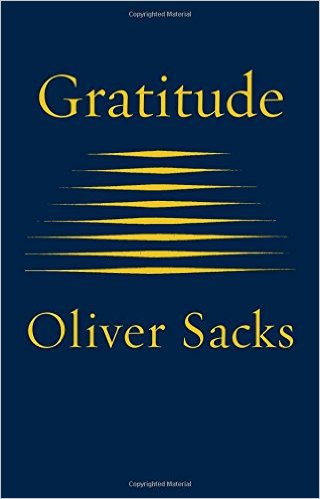
Gratitude

Author: Oliver Sacks
Rating: 10/10
Last Read: July 2016

Quick Summary: A short selection of four essays written by Dr. Oliver Sacks.  These essays cover the end of his life, with reflections on old age, facing mortality, and the gratitude he has for being a sentient being on this planet.  

“Whatever must have a beginning must have an ending.”

Recommended Reads: On the Move (autobiography), On Death and Dying

My Takeaways

You never quite lose the sense of childish wonder if you keep that attitude about you as you grow older.

There really is an essential truth to the matter of dying: when it comes time for you to accept your fate, the nonessential falls away and you focus on the truly important things.  

It is possible to meet death with dignity and grace.

I cannot pretend I am without fear. But my predominant feeling is one of gratitude. I have loved and been loved; I have been given much and I have given something in return; I have read and traveled and thought and written. I have had an intercourse with the world, the special intercourse of writers and readers.

My Highlights

A few years ago, when I gave a friend a bottle of mercury for his eightieth birthday—a special bottle that could neither leak nor break—he gave me a peculiar look, but later sent me a charming letter in which he joked, “I take a little every morning for my health.” –loc 80

Eighty! I can hardly believe it. I often feel that life is about to begin, only to realize it is almost over. –loc 83

I thought I would die at forty-one, when I had a bad fall and broke a leg while mountaineering alone. I splinted the leg as best I could and started to lever myself down the mountain, clumsily, with my arms. In the long hours that followed, I was assailed by memories, both good and bad. Most were in a mode of gratitude—gratitude for what I had been given by others, gratitude too that I had been able to give something back. –loc 86

I am sorry I have wasted (and still waste) so much time; I am sorry to be as agonizingly shy at eighty as I was at twenty; I am sorry that I speak no languages but my mother tongue and that I have not traveled or experienced other cultures as widely as I should have done. –loc 96

At eighty, the specter of dementia or stroke looms. A third of one’s contemporaries are dead, and many more, with profound mental or physical damage, are trapped in a tragic and minimal existence. At eighty, the marks of decay are all too visible. One’s reactions are a little slower, names more frequently elude one, and one’s energies must be husbanded, but even so, one may often feel full of energy and life and not at all “old.” Perhaps, with luck, I will make it, more or less intact, for another few years and be granted the liberty to continue to love and work, the two most important things, Freud insisted, in life. –loc 105

When pressed about his diagnosis a few weeks later, he said, “Whatever has a beginning must have an ending.” When he died, at eighty-eight, he was still fully engaged in his most creative work. –loc 112

He felt, as I begin to feel, not a shrinking but an enlargement of mental life and perspective. One has had a long experience of life, not only one’s own life, but others’ too. One has seen triumphs and tragedies, booms and busts, revolutions and wars, great achievements and deep ambiguities. One has seen grand theories rise, only to be toppled by stubborn facts. One is more conscious of transience and, perhaps, of beauty. At eighty, one can take a long view and have a vivid, lived sense of history not possible at an earlier age. I can imagine, feel in my bones, what a century is like, which I could not do when I was forty or sixty. I do not think of old age as an ever grimmer time that one must somehow endure and make the best of, but as a time of leisure and freedom, freed from the factitious urgencies of earlier days, free to explore whatever I wish, and to bind the thoughts and feelings of a lifetime together. –loc 115

It is up to me now to choose how to live out the months that remain to me. I have to live in the richest, deepest, most productive way I can. –loc 134

And yet, one line from Hume’s essay strikes me as especially true: “It is difficult,” he wrote, “to be more detached from life than I am at present.” Over the last few days, I have been able to see my life as from a great altitude, as a sort of landscape, and with a deepening sense of the connection of all its parts. This does not mean I am finished with life. On the contrary, I feel intensely alive, and I want and hope in the time that remains to deepen my friendships, to say farewell to those I love, to write more, to travel if I have the strength, to achieve new levels of understanding and insight. –loc 147

I feel a sudden clear focus and perspective. There is no time for anything inessential. I must focus on myself, my work, and my friends. I shall no longer look at the NewsHour every night. I shall no longer pay any attention to politics or arguments about global warming. –loc 153

My generation is on the way out, and each death I have felt as an abruption, a tearing away of part of myself. There will be no one like us when we are gone, but then there is no one like anyone else, ever. When people die, they cannot be replaced. They leave holes that cannot be filled, for it is the fate—the genetic and neural fate—of every human being to be a unique individual, to find his own path, to live his own life, to die his own death. –loc 159

I cannot pretend I am without fear. But my predominant feeling is one of gratitude. I have loved and been loved; I have been given much and I have given something in return; I have read and traveled and thought and written. I have had an intercourse with the world, the special intercourse of writers and readers. –loc 163

Above all, I have been a sentient being, a thinking animal, on this beautiful planet, and that in itself has been an enormous privilege and adventure. –loc 165

It was this celestial splendor that suddenly made me realize how little time, how little life, I had left. My sense of the heavens’ beauty, of eternity, was inseparably mixed for me with a sense of transience—and death. –loc 191

(Auden used to say that one should always celebrate one’s birthday, no matter how one felt.) –loc 215

“The observance of the Sabbath is extremely beautiful,” he said, “and is impossible without being religious. It is not even a question of improving society—it is about improving one’s own quality of life.” –loc 301

Robert John visited. He was full of entertaining stories about the Nobel Prize and the ceremony in Stockholm, but made a point of saying that, had he been compelled to travel to Stockholm on a Saturday, he would have refused the prize. His commitment to the Sabbath, its utter peacefulness and remoteness from worldly concerns, would have trumped even a Nobel. –loc 307

The peace of the Sabbath, of a stopped world, a time outside time, was palpable, infused everything, and I found myself drenched with a wistfulness, something akin to nostalgia, wondering what if: What if A and B and C had been different? –loc 324

And now, weak, short of breath, my once-firm muscles melted away by cancer, I find my thoughts, increasingly, not on the supernatural or spiritual but on what is meant by living a good and worthwhile life—achieving a sense of peace within oneself. I find my thoughts drifting to the Sabbath, the day of rest, the seventh day of the week, and perhaps the seventh day of one’s life as well, when one can feel that one’s work is done, and one may, in good conscience, rest. –loc 333

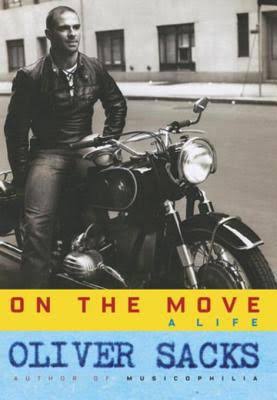
On the Move

Author: Oliver Sacks
Rating: 9/10
Last Read: September 2015

Quick Summary:  Autobiography of the late Dr. Oliver Sacks, writing about his career, growth, struggles, and thoughts as he revisited his life. Dr. Sacks is a wise man who has been through much in life – and there is much humanity to be gleaned from the pages of this book.

I recommend Maria Popova’s review.

Recommended Reads: Gratitude

My Takeaways

Life was (and probably still is) very difficult for LGBT individuals in ways that I have not considered.

The history of a thing is just as important as the recent developments.  It is hard to continue forward if you are not sure where you came from.

Everybody has their struggles, and even those who have achieved much in life struggle in ways you wouldn’t expect – such as being addicted to amphetamines.

As Dr. Sacks recounts a tale of Einstein and humanity, so to does he reveal his humanity by giving a frank and honest recounting of his life.

Aubrey recounted with a smile, he and a colleague from the Israeli consulate visited Einstein in his house in Princeton. Einstein invited them in and courteously asked if they would like coffee, and (thinking that an assistant or housekeeper would make it), Aubrey said yes. But he was “horrified,” as he put it, when Einstein trotted into the kitchen himself. They soon heard the clatter of cups and pots and an occasional piece of crockery falling, as the great man, in his friendly but slightly clumsy way, made the coffee for them. This, more than anything, Aubrey said, showed him the human and endearing side of the world’s greatest genius.

My Highlights

We think of science as discovery, art as invention, but is there a “third world” of mathematics, which is somehow, mysteriously, both? –loc 295

one day, with my heart in my mouth, I told Richard that I was in love with him, not knowing how he would react. He hugged me, gripped my shoulders, and said, “I know. I am not that way, but I appreciate your love and love you too, in my own way.” –loc 343

“Travel now by all means—if you have the time. But travel the right way, the way I travel. I am always reading and thinking of the history and geography of a place. I see its people in terms of these, placed in the social framework of time and space. Take the prairies, for example; you’re wasting your time visiting these unless you know the saga of the homesteaders, the influence of law and religion at different times, the economic problems, the difficulties of communication, and the effects of successive mineral finds. –loc 708

When you were born, people congratulated us on what they considered a wonderful family of four sons! Where are you all now? I feel lonely and bereft. Ghosts inhabit this house. When I go into the various rooms I feel overcome with a sense of loss. –loc 779

These and a host of other memories of your vital personality will always remain with us. When we contemplate this large empty house, we feel a wrench at our heart and a deep sense of loss. We realize nevertheless that you have to make your way in the world, and with you must rest the ultimate decision! –loc 786

I wondered whether systems in the brain concerned with the perception (or projection) of meaning, significance, and intentionality, systems underlying a sense of wonder and mysteriousness, systems for appreciation of the beauty of art and science, had lost their balance in schizophrenia, producing a mental world overcharged with intense emotion and distortions of reality. These systems had lost their middle ground, it seemed, so that any attempt to titrate them, damp them down, could tip the person from a pathologically heightened state to one of great dullness, a sort of mental death. –loc 884

It was at Mount Zion that Libet performed his astounding experiments showing that if subjects were asked to make a fist or perform another voluntary action, their brains would register a “decision” nearly half a second before there was any conscious decision to act. While his subjects felt that they had consciously and of their own free will made a movement, their brains had made a decision, seemingly, long before they did. –loc 1302

I sometimes annoyed the group, I think, by saying that we should also discuss the writings of our nineteenth-century forebears, relating what we were seeing in patients to their observations and thoughts. This was seen by the others as archaism; we were short of time, and we had better things to do than consider such “obsolete” matters. This attitude was reflected, implicitly, in many of the journal articles we read; they made little reference to anything more than five years old. It was as if neurology had no history. –loc 1379

I found this dismaying, for I think in narrative and historical terms. As a chemistry-mad boy, I devoured books on the history of chemistry, the evolution of its ideas, and the lives of my favorite chemists. Chemistry had, for me, a historical and human dimension too. –loc 1383

I was not a book collector myself, and when I bought books or articles, it was to read them, not to show them. –loc 1392

I felt that I was enjoying California too much, was getting addicted to an easy, sleazy life, to say nothing of a deepening drug addiction. I felt I needed to go to a hard, real place, a place where I could devote myself to work and perhaps discover or create a real identity, a voice of my own. –loc 1760

I sometimes wonder why I have spent more than fifty years in New York, when it was the West, and especially the Southwest, which so enthralled me. I now have many ties in New York—to my patients, my students, my friends, and my analyst—but I have never felt it move me the way California did. I suspect my nostalgia may be not only for the place itself but for youth, and a very different time, and being in love, and being able to say, “The future is before me.” –loc 1773

But then the feeling started to fade. We asked ourselves whether the experience we had shared was real, authentic, given the huge aphrodisiac thrust of the amphetamines. I found this question particularly humiliating—could so lofty a transport as falling in love be reduced to something purely physiological? –loc 1908

I asked Shengold if I too was schizophrenic. “No,” he answered. Was I then, I asked, “merely neurotic”? “No,” he answered. I left it there, we left it there, and there it has been left for the last forty-nine years. –loc 1982

I would continue to seek satisfaction in drugs, I felt, unless I had satisfying—and, hopefully, creative—work. It was crucial for me to find something with meaning, and this, for me, was seeing patients. –loc 1987

We maintain the proprieties—he is always “Dr. Shengold,” and I am always “Dr. Sacks”—but it is because the proprieties are there that there can be such freedom of communication. And this is something I also feel with my own patients. They can tell me things, and I can ask things, which would be impermissible in ordinary social intercourse. –loc 2000

Above all, Dr. Shengold has taught me about paying attention, listening to what lies beyond consciousness or words. –loc 2002

For me, this was an example of how unconscious motives may sometimes ally themselves to physiological propensities, of how one cannot abstract an ailment or its treatment from the whole pattern, the context, the economy of someone’s life. –loc 2028

This painful story—painful on both sides—is not an uncommon one: an older man, a father figure, and his youthful son-in-science find their roles reversed when the son starts to outshine the father. This happened with Humphry Davy and Michael Faraday—Davy first giving every encouragement to Faraday, then trying to block his career. I am no Faraday, and Friedman was no Davy, but I think the same deadly dynamic was at work, at a much humbler level. –loc 2143

I did not feel she used the word “Darling” lightly; I felt very loved by her, and I loved her intensely too, and this was a love without ambivalence, without conditionality. Nothing I could say could repel or shock her; there seemed no limit to her powers of sympathy and understanding, the generosity and spaciousness of her heart. –loc 2169

I mentioned to her, a couple of months later, that I had been in a depression. “I know we all suffer them at times,” Len wrote. “Well, don’t have any more. You’ve got so much in your favour—brains, charm, presentability, a sense of the ridiculous, and a whole gaggle of us who believe in you.” –loc 2220

“Your Dr. Friedman,” she wrote in October of 1967, “sounds a most unpleasant piece of work, but don’t let him get under your skin. Keep hold of your faith in yourself.” –loc 2255

As one grows older, the years seem to blur into one another, but 1972 remains sharply etched in my memory. –loc 2500

It seems to me that I discover my thoughts through the act of writing, in the act of writing. Occasionally, a piece comes out perfectly, but more often my writings need extensive pruning and editing, because I may express the same thought in many different ways. –loc 2581

As the decorous stranger discreetly retired, I asked Wystan how he experienced the world, whether he thought of it as being a very small or very large place. “Neither,” he replied. “Neither large nor small. Cozy, cozy.” He added in an undertone, “Like home.” –loc 2708

Informally (I sometimes think) I see and learn and do a great deal, with the extremely varied patients I see in various clinics and Homes, and every seeing-and-learning-and-doing situation is, eo ipso, a teaching situation. I find every patient I see, everywhere, vividly alive, interesting and rewarding; I have never seen a patient who didn’t teach me something new, or stir in me new feelings and new trains of thought; and I think that those who are with me in these situations share in, and contribute to, this sense of adventure. (I regard all neurology, everything, as a sort of adventure!) –loc 3130

“You care, you really care for me!” “Of course,” Eric said. “How could you doubt it?” But it was not easy to believe that anyone cared for me; I sometimes failed to realize, I think, how much my parents cared for me. It is only now, reading the letters they wrote to me when I came to America fifty years ago, that I see how deeply they did care. –loc 3232

And perhaps how deeply many others have cared for me—was the imagined lack of caring by others a projection of something deficient or inhibited in myself? –loc 3235

When Lennie learned of this, she felt that life with intravenous nourishment and a spreading cancer was not worthwhile. She resolved to stop eating, though she would take water. My father insisted she be seen by a psychiatrist, but the psychiatrist said, “She is the sanest person I have ever seen. You must respect her decision.” –loc 3246

Dearest Len, We have all of us been hoping so intensely that this month would see your return to health; but, alas! this was not to be. My heart is torn when I hear of your weakness, your misery—and, now, your longing to die. You, who have always loved life, and been such a source of strength and life to so many, can face death, even choose it, with serenity and courage, mixed, of course, with the grief of all passing. We, I, can much less bear the thought of losing you. You have been as dear to me as anyone in this world. I shall hope against hope that you may weather this misery, and be restored again to the joy of full living. But if this is not to be, I must thank you—thank you, once again, and for the last time, for living—for being you. Love, Oliver –loc 3254

When I visited Gallaudet University in Washington, D.C., (it is the only university in the world for deaf and hearing-impaired students) and talked about the “hearing impaired,” one of the deaf students signed, “Why don’t you look at yourself as sign impaired?” –loc 3605

He has one of the most spacious, thoughtful minds I have ever encountered, with a vast base of knowledge of every sort, but it is a base under continual questioning and scrutiny. (I have seen him suddenly stop in mid-sentence and say, “I no longer believe what I was about to say.”) –loc 3697

I think we all live in a swirl of anecdotes…. We (most of us) compose our lives into narratives…. I wonder what the origin is of the urge to “compose” oneself. –loc 3781

I found you so talented, but so deficient in one quality—just the most important quality—call it humanity, or sympathy, or something like that. And, frankly, I despaired of your ever becoming a good writer, because I didn’t see how one could be taught such a quality…. Your deficiency of sympathy made for a limitation of your observation…. What I didn’t know was that the growth of sympathies is something frequently delayed till one’s thirties. –loc 3826

I am however a rather derivative poet. I learn what I can from whom I can. I borrow heavily from my reading, because I take my reading seriously. It is part of my total experience and I base most of my poetry on my experience. –loc 3857

There is a danger, when old friends meet, that they will talk mostly of the past. –loc 3860

At worst, one is in motion; and at best, Reaching no absolute, in which to rest, One is always nearer by not keeping still. –loc 3866

Aubrey recounted with a smile, he and a colleague from the Israeli consulate visited Einstein in his house in Princeton. Einstein invited them in and courteously asked if they would like coffee, and (thinking that an assistant or housekeeper would make it), Aubrey said yes. But he was “horrified,” as he put it, when Einstein trotted into the kitchen himself. They soon heard the clatter of cups and pots and an occasional piece of crockery falling, as the great man, in his friendly but slightly clumsy way, made the coffee for them. This, more than anything, Aubrey said, showed him the human and endearing side of the world’s greatest genius. –loc 4090

And in its broadest sense, neural Darwinism implies that we are destined, whether we wish it or not, to a life of particularity and self-development, to make our own individual paths through life. –loc 5111