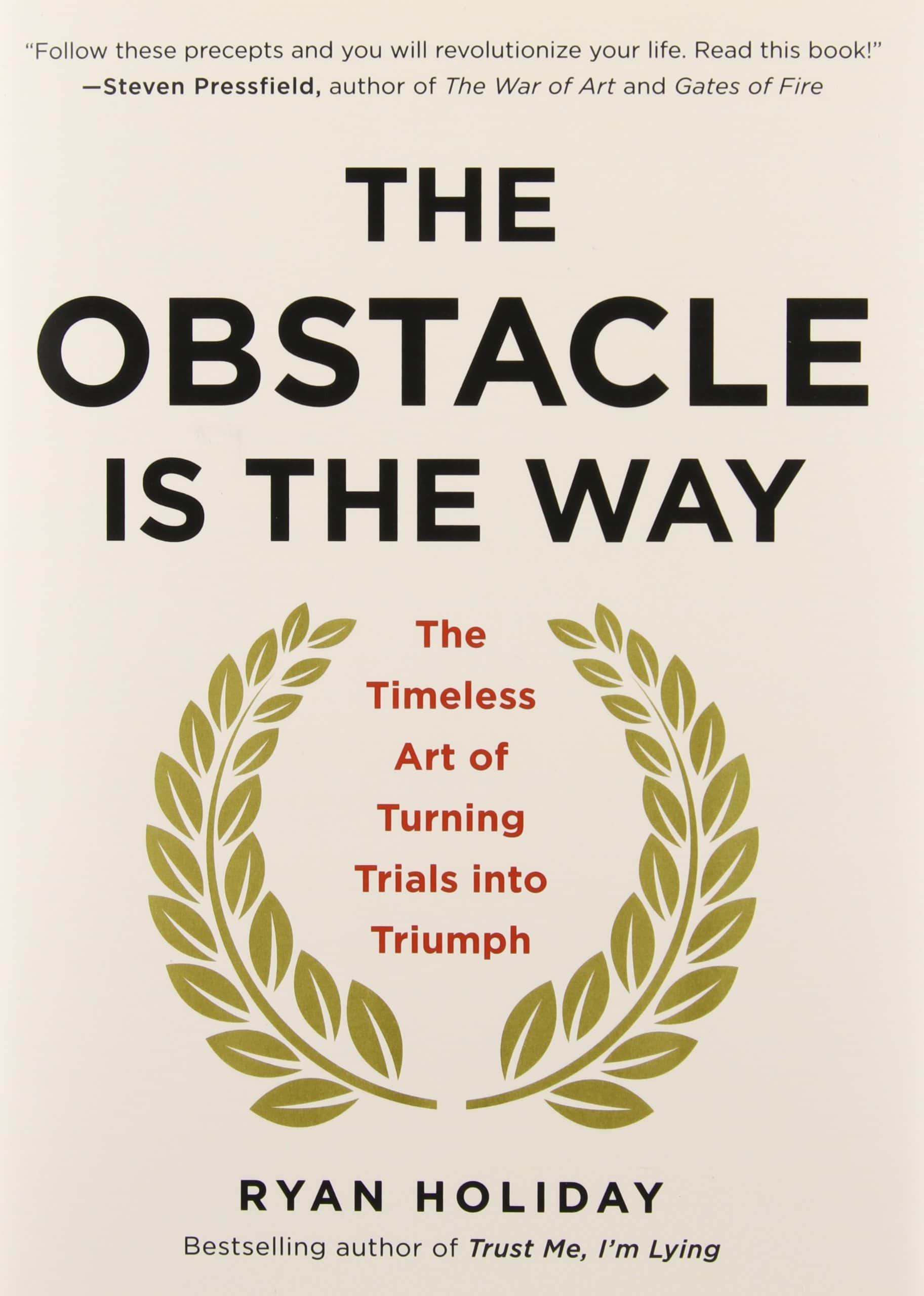
The Obstacle is the Way

Author: Ryan Holiday
Rating: 7/10
Last Read: September 2015

Quick Summary: The Obstacle is the Way is an accessible introductory book to the philosophy of stoicism.  Ryan Holiday draws from the stories of various historical figures and relates them to key principles of Stoic philosophy.  I find Stoicism to be a very helpful mindset to cultivate in my own life, and it is nice to see accessible books popularizing the wisdom of the Stoics.

If you like this book, I definitely recommend checking out the Meditations (Marcus Aurelius) and Enchiridon (Epictetus)

See things for what they are.
Do what we can.
Endure and bear what we must.
What blocked the path now is a path.
What once impeded action advances action.
The Obstacle is the Way.

My Highlights

Whatever we face, we have a choice: Will we be blocked by obstacles, or will we advance through and over them? –loc 113

Let’s be honest: Most of us are paralyzed. Whatever our individual goals, most of us sit frozen before the many obstacles that lie ahead of us. –loc 124

Objective judgment, now at this very moment. Unselfish action, now at this very moment. Willing acceptance—now at this very moment—of all external events. That’s all you need. –loc 223

“Oh, how blessed young men are who have to struggle for a foundation and beginning in life,” he once said. “I shall never cease to be grateful for the three and half years of apprenticeship and the difficulties to be overcome, all along the way.” –loc 279

You must realize: Nothing makes us feel this way; we choose to give in to such feelings. –loc 288

Seen properly, everything that happens—be it an economic crash or a personal tragedy—is a chance to move forward. Even if it is on a bearing that we did not anticipate. –loc 311

There are a few things to keep in mind when faced with a seemingly insurmountable obstacle. We must try:
To be objective
To control emotions and keep an even keel
To choose to see the good in a situation
To steady our nerves
To ignore what disturbs or limits others
To place things in perspective
To revert to the present moment
To focus on what can be controlled
–loc 313

Choose not to be harmed — and you won’t feel harmed. Don’t feel harmed — and you haven’t been. —MARCUS AURELIUS –loc 322

Nothing either good or bad, but thinking makes it so (Shakespeare) –loc 357

What such a man needs is not courage but nerve control, cool headedness. This he can get only by practice.
—THEODORE ROOSEVELT
–loc 377

During the Overland Campaign, Grant was surveying the scene through field glasses when an enemy shell exploded, killing the horse immediately next to him. Grant’s eyes stayed fixed on the front, never leaving the glasses. There’s another story about Grant at City Point, Union headquarters, near Richmond. Troops were unloading a steamboat and it suddenly exploded. Everyone hit the dirt except Grant, who was seen running toward the scene of the explosion as debris and shells and even bodies rained down. That’s a man who has steadied himself properly. That’s a man who has a job to do and would bear anything to get it done. That’s nerve. –loc 384

Don’t forget, there are always people out there looking to get you. They want to intimidate you. Rattle you. Pressure you into making a decision before you’ve gotten all the facts. They want you thinking and acting on their terms, not yours. So the question is, are you going to let them? –loc 395

We must possess, as Voltaire once explained about the secret to the great military success of the first Duke of Marlborough, that “tranquil courage in the midst of tumult and serenity of soul in danger, which the English call a cool head.” –loc 400

Defiance and acceptance come together well in the following principle: There is always a countermove, always an escape or a way through, so there is no reason to get worked up. –loc 408

Would you have a great empire? Rule over yourself.
—PUBLIUS SYRUS
–loc 416

America raced to send the first men into space, they trained the astronauts in one skill more than in any other: the art of not panicking. When people panic, they make mistakes. They override systems. They disregard procedures, ignore rules. They deviate from the plan. They become unresponsive and stop thinking clearly. They just react—not to what they need to react to, but to the survival hormones that are coursing through their veins. –loc 418

Uncertainty and fear are relieved by authority. Training is authority. It’s a release valve. With enough exposure, you can adapt out those perfectly ordinary, even innate, fears that are bred mostly from unfamiliarity. Fortunately, unfamiliarity is simple to fix (again, not easy), which makes it possible to increase our tolerance for stress and uncertainty. –loc 430

‘What am I choosing to not see right now?’ What important things are you missing because you chose worry over introspection, alertness or wisdom? –loc 450

If an emotion can’t change the condition or the situation you’re dealing with, it is likely an unhelpful emotion. Or, quite possibly, a destructive one. –loc 454

Real strength lies in the control or, as Nassim Taleb put it, the domestication of one’s emotions, not in pretending they don’t exist. –loc 456

We defeat emotions with logic, or at least that’s the idea. Logic is questions and statements. With enough of them, we get to root causes (which are always easier to deal with). –loc 460

It might help to say it over and over again whenever you feel the anxiety begin to come on: I am not going to die from this. I am not going to die from this. I am not going to die from this. Or try Marcus’s question: Does what happened keep you from acting with justice, generosity, self-control, sanity, prudence, honesty, humility, straightforwardness? –loc 472

Don’t let the force of an impression when it first hit you knock you off your feet; just say to it: Hold on a moment; let me see who you are and what you represent. Let me put you to the test. —EPICTETUS –loc 481

Perceptions are the problem. They give us the “information” that we don’t need, exactly at the moment when it would be far better to focus on what is immediately in front of us: the thrust of a sword, a crucial business negotiation, an opportunity, a flash of insight or anything else, for that matter. –loc 495

Epictetus told his students, when they’d quote some great thinker, to picture themselves observing the person having sex. It’s funny, you should try it the next time someone intimidates you or makes you feel insecure. See them in your mind, grunting, groaning, and awkward in their private life—just like the rest of us. –loc 505

Man does not simply exist but always decides what his existence will be, what he will become the next moment. By the same token, every human being has the freedom to change at any instant. —VIKTOR FRANKL –loc 523

Perspective has two definitions. Context: a sense of the larger picture of the world, not just what is immediately in front of us Framing: an individual’s unique way of looking at the world, a way that interprets its events Both matter, both can be effectively injected to change a situation that previously seemed intimidating or impossible. –loc 554

Perception precedes action. Right action follows the right perspective. –loc 571

In life our first job is this, to divide and distinguish things into two categories: externals I cannot control, but the choices I make with regard to them I do control. Where will I find good and bad? In me, in my choices. —EPICTETUS –loc 573

To argue, to complain, or worse, to just give up, these are choices. Choices that more often than not, do nothing to get us across the finish line. –loc 620

The trick to forgetting the big picture is to look at everything close up. —CHUCK PALAHNIUK –loc 633

Yet in our own lives, we aren’t content to deal with things as they happen. We have to dive endlessly into what everything “means,” whether something is “fair” or not, what’s “behind” this or that, and what everyone else is doing. Then we wonder why we don’t have the energy to actually deal with our problems. Or we get ourselves so worked up and intimidated because of the overthinking, that if we’d just gotten to work we’d probably be done already. –loc 651

For all species other than us humans, things just are what they are. Our problem is that we’re always trying to figure out what things mean—why things are the way they are. –loc 662

It doesn’t matter whether this is the worst time to be alive or the best, whether you’re in a good job market or a bad one, or that the obstacle you face is intimidating or burdensome. What matters is that right now is right now. –loc 665

You’ll find the method that works best for you, but there are many things that can pull you into the present moment: Strenuous exercise. Unplugging. A walk in the park. Meditation. Getting a dog—they’re a constant reminder of how pleasant the present is. –loc 671

It’s not simply a matter of saying: Oh, I’ll live in the present. You have to work at it. Catch your mind when it wanders—don’t let it get away from you. Discard distracting thoughts. Leave things well enough alone—no matter how much you feel like doing otherwise. –loc 673

This is why we shouldn’t listen too closely to what other people say (or to what the voice in our head says, either). We’ll find ourselves erring on the side of accomplishing nothing. Be open. Question. –loc 700

Now, how do you and I usually deal with an impossible deadline handed down from someone above us? We complain. We get angry. We question. How could they? What’s the point? Who do they think I am? We look for a way out and feel sorry for ourselves. –loc 708

Jobs refused to tolerate people who didn’t believe in their own abilities to succeed. Even if his demands were unfair, uncomfortable, or ambitious. –loc 711

Jobs learned to reject the first judgments and the objections that spring out of them because those objections are almost always rooted in fear. –loc 716

This is radically different from how we’ve been taught to act. Be realistic, we’re told. Listen to feedback. Play well with others. Compromise. Well, what if the “other” party is wrong? What if conventional wisdom is too conservative? It’s this all-too-common impulse to complain, defer, and then give up that holds us back. –loc 720

An entrepreneur is someone with faith in their ability to make something where there was nothing before. –loc 722

It’s our preconceptions that are the problem. They tell us that things should or need to be a certain way, so when they’re not, we naturally assume that we are at a disadvantage or that we’d be wasting our time to pursue an alternate course. When really, it’s all fair game, and every situation is an opportunity for us to act. –loc 757

How about that business decision that turned out to be a mistake? Well, you had a hypothesis and it turned out to be wrong. Why should that upset you? It wouldn’t piss off a scientist, it would help him. –loc 775

When people are:
—rude or disrespectful: They underestimate us. A huge advantage.
—conniving: We won’t have to apologize when we make an example out of them.
—critical or question our abilities: Lower expectations are easier to exceed.
—lazy: Makes whatever we accomplish seem all the more admirable.
–loc 792

It’s a huge step forward to realize that the worst thing to happen is never the event, but the event and losing your head. Because then you’ll have two problems (one of them unnecessary and post hoc). –loc 809

Once you see the world as it is, for what it is, you must act. The proper perception—objective, rational, ambitious, clean—isolates the obstacle and exposes it for what it is. –loc 811

We’ve all done it. Said: “I am so [overwhelmed, tired, stressed, busy, blocked, outmatched].” And then what do we do about it? Go out and party. Or treat ourselves. Or sleep in. Or wait. –loc 869

We forget: In life, it doesn’t matter what happens to you or where you came from. It matters what you do with what happens and what you’ve been given. –loc 872

Consider this mind-set.
never in a hurry
never worried
never desperate
never stopping short
–loc 1003

Remember and remind yourself of a phrase favored by Epictetus: “persist and resist.” Persist in your efforts. Resist giving in to distraction, discouragement, or disorder. –loc 1006

What is defeat? Nothing but education; nothing but the first steps to something better. —WENDELL PHILLIPS –loc 1025

Great entrepreneurs are:
never wedded to a position
never afraid to lose a little of their investment
never bitter or embarrassed
never out of the game for long
They slip many times, but they don’t fall.
–loc 1051

The one way to guarantee we don’t benefit from failure—to ensure it is a bad thing—is to not learn from it. To continue to try the same thing over and over –loc 1068

“Don’t think about winning the SEC Championship. Don’t think about the national championship. Think about what you needed to do in this drill, on this play, in this moment. That’s the process: Let’s think about what we can do today, the task at hand.” –loc 1086

The process is about finishing. Finishing games. Finishing workouts. Finishing film sessions. Finishing drives. Finishing reps. Finishing plays. Finishing blocks. Finishing the smallest task you have right in front of you and finishing it well. –loc 1094

Viktor Frankl, survivor of three concentration camps, found presumptuousness in the age-old question: “What is the meaning of life?” As though it is someone else’s responsibility to tell you. Instead, he said, the world is asking you that question. And it’s your job to answer with your actions. –loc 1188

A very Zen stance from our boy M. Aurelius:

The cucumber is bitter? Then throw it out. There are brambles in the path? Then go around. That’s all you need to know. —MARCUS AURELIUS –loc 1199

Whoever cannot seek the unforeseen sees nothing, for the known way is an impasse. —HERACLITUS –loc 1254

Take a step back, then go around the problem. Find some leverage. Approach from what is called the “line of least expectation.” –loc 1282

You’re acting like a real strategist. You aren’t just throwing your weight around and hoping it works. You’re not wasting your energy in battles driven by ego and pride rather than tactical advantage. –loc 1316

Wise men are able to make a fitting use even of their enmities. —PLUTARCH –loc 1320

The great strategist Saul Alinsky believed that if you “push a negative hard enough and deep enough it will break through into its counterside.” Every positive has its negative. Every negative has its positive. The action is in the pushing through—all the way through to the other side. Making a negative into a positive. –loc 1369

The best men are not those who have waited for chances but who have taken them; besieged chance, conquered the chance, and made chance the servitor. —E. H. CHAPIN –loc 1420

Great commanders look for decision points. For it is bursts of energy directed at decisive points that break things wide open. They press and press and press and then, exactly when the situation seems hopeless—or, more likely, hopelessly deadlocked—they press once more. –loc 1464

In the meantime, cling tooth and nail to the following rule: not to give in to adversity, not to trust prosperity, and always take full note of fortune’s habit of behaving just as she pleases. —SENECA –loc 1473

Nothing can ever prevent us from trying. Ever. –loc 1479

It’s an infinitely elastic formula: In every situation, that which blocks our path actually presents a new path with a new part of us. If someone you love hurts you, there is a chance to practice forgiveness. If your business fails, now you can practice acceptance. If there is nothing else you can do for yourself, at least you can try to help others. –loc 1483

Will is our internal power, which can never be affected by the outside world. It is our final trump card. If action is what we do when we still have some agency over our situation, the will is what we depend on when agency has all but disappeared. –loc 1494

True will is quiet humility, resilience, and flexibility; the other kind of will is weakness disguised by bluster and ambition. –loc 1500

It’s much easier to control our perceptions and emotions than it is to give up our desire to control other people and events. –loc 1571

These lessons come harder but are, in the end, the most critical to wresting advantage from adversity. In every situation, we can Always prepare ourselves for more difficult times. Always accept what we’re unable to change. Always manage our expectations. Always persevere. Always learn to love our fate and what happens to us. Always protect our inner self, retreat into ourselves. Always submit to a greater, larger cause. Always remind ourselves of our own mortality. –loc 1574

Nobody is born with a steel backbone. We have to forge that ourselves. –loc 1605

We craft our spiritual strength through physical exercise, and our physical hardiness through mental practice (mens sana in corpore sano—sound mind in a strong body). –loc 1606

During the good times, we strengthen ourselves and our bodies so that during the difficult times, we can depend on it. We protect our inner fortress so it may protect us. –loc 1620

Offer a guarantee and disaster threatens. —ANCIENT INSCRIPTION AT THE ORACLE OF DELPHI –loc 1639

A premortem is different. In it, we look to envision what could go wrong, what will go wrong, in advance, before we start. Far too many ambitious undertakings fail for preventable reasons. Far too many people don’t have a backup plan because they refuse to consider that something might not go exactly as they wish. –loc 1649

Mike Tyson, who, reflecting on the collapse of his fortune and fame, told a reporter, “If you’re not humble, life will visit humbleness upon you.” –loc 1654

“Nothing happens to the wise man against his expectation,” he wrote to a friend. “…nor do all things turn out for him as he wished but as he reckoned—and above all he reckoned that something could block his plans.” –loc 1662

The only guarantee, ever, is that things will go wrong. The only thing we can use to mitigate this is anticipation. –loc 1677

About the worst thing that can happen is not something going wrong, but something going wrong and catching you by surprise. Why? Because unexpected failure is discouraging and being beaten back hurts. –loc 1693

When the cause of our problem lies outside of us, we are better for accepting it and moving on. For ceasing to kick and fight against it, and coming to terms with it. The Stoics have a beautiful name for this attitude. They call it the Art of Acquiescence. –loc 1731

It is far easier to talk of the way things should be. It takes toughness, humility, and will to accept them for what they actually are. It takes a real man or woman to face necessity. –loc 1734

We don’t get to choose what happens to us, but we can always choose how we feel about it. And why on earth would you choose to feel anything but good? We can choose to render a good account of ourselves. If the event must occur, Amor fati (a love of fate) is the response. –loc 1829

Determination, if you think about it, is invincible. Nothing other than death can prevent us from following Churchill’s old acronym: KBO. Keep Buggering On. –loc 1895

Pride can be broken. Toughness has its limits. But a desire to help? No harshness, no deprivation, no toil should interfere with our empathy toward others. Compassion is always an option. Camaraderie as well. That’s a power of the will that can never be taken away, only relinquished. –loc 1958

Help your fellow humans thrive and survive, contribute your little bit to the universe before it swallows you up, and be happy with that. Lend a hand to others. Be strong for them, and it will make you stronger. –loc 1970

When a man knows he is to be hanged in a fortnight, it concentrates his mind wonderfully. —DR. JOHNSON –loc 1973

Memento mori, the Romans would remind themselves. Remember you are mortal. –loc 1994

We forget how light our grip on life really is. Otherwise, we wouldn’t spend so much time obsessing over trivialities, or trying to become famous, make more money than we could ever spend in our lifetime, or make plans far off in the future. –loc 1998

The paths of glory, Thomas Gray wrote, lead but to the grave. –loc 2001

Reminding ourselves each day that we will die helps us treat our time as a gift. Someone on a deadline doesn’t indulge himself with attempts at the impossible, he doesn’t waste time complaining about how he’d like things to be. –loc 2013

See things for what they are. Do what we can. Endure and bear what we must. What blocked the path now is a path. What once impeded action advances action. The Obstacle is the Way. –loc 2114

The Latin translation for the title of Enchiridion—Epictetus’s famous work—means “close at hand,” or as some have said, “in your hands.” That’s what the philosophy was meant for: to be in your hands, to be an extension of you. Not something you read once and put up on a shelf. It was meant, as Marcus once wrote, to make us boxers instead of fencers—to wield our weaponry, we simply need to close our fists. –loc 2161

Enchiridion

Author: Epictetus
Rating: 9/10
Last Read: August 2016

Quick Summary:  This book has been on my reading list for years – and I’m sorry that I put it off so long.  I love the stoics, and have read Meditations and Seneca multiple times.  The Enchiridion is a short work, mostly full of short precepts instructing readers in the stoic style.  This book contains lots of useful thoughts to mull over and revisit throughout your life.

No man is free who is not master of himself.


Fortify yourself with contentment, for this is an impregnable fortress.

My Highlights

In the Stoic view, our capacity to be happy is completely dependent on ourselves—how we treat ourselves, how we relate to others, and how we react to events in general. Events are good or bad only in terms of our reaction to them. –loc 30

The only thing we control is our will, and God has given us a will that cannot be influenced or thwarted by external events—unless we allow it. We are not responsible for the ideas or events that present themselves to us, but only for the ways in which we act on them. –loc 32

Of things some are in our power, and others are not. In our power are opinion, movement toward a thing, desire, aversion (turning from a thing); and in a word, whatever are our own acts: not in our power are the body, property, reputation, offices (magisterial power), and in a word, whatever are not our own acts. –loc 45

Straightway then practice saying to every harsh appearance,1 You are an appearance, and in no manner what you appear to be. –loc 56

But destroy desire completely for the present. For if you desire anything which is not in our power, you must be unfortunate: but of the things in our power, and which it would be good to desire, nothing yet is before you. –loc 64

Men are disturbed not by the things which happen, but by the opinions about the things –loc 77

When then we are impeded or disturbed or grieved, let us never blame others, but ourselves, that is, our opinions. –loc 78

It is the act of an ill-instructed man to blame others for his own bad condition; it is the act of one who has begun to be instructed, to lay the blame on himself; and of one whose instruction is completed, neither to blame another, nor himself. –loc 79

Seek not that the things which happen should happen as you wish; but wish the things which happen to be as they are, and you will have a tranquil flow of life. –loc 91

Disease is an impediment to the body, but not to the will, unless the will itself chooses. Lameness is an impediment to the leg, but not to the will. And add this reflection on the occasion of everything that happens; for you will find it an impediment to something else, but not to yourself. –loc 93

On the occasion of every accident (event) that befalls you, remember to turn to yourself and inquire what power you have for turning it to use. –loc 95

For it is better to die of hunger and so to be released from grief and fear than to live in abundance with perturbation; and it is better for your slave to be bad than for you to be unhappy. –loc 104

If you would have your children and your wife and your friends to live forever, you are silly; for you would have the things which are not in your power to be in your power, and the things which belong to others to be yours. –loc 114

He is the master of every man who has the power over the things, which another person wishes or does not wish, the power to confer them on him or to take them away. Whoever then wishes to be free, let him neither wish for anything nor avoid anything which depends on others: if he does not observe this rule, he must be a slave. –loc 117

Remember that in life you ought to behave as at a banquet. Suppose that something is carried round and is opposite to you. Stretch out your hand and take a portion with decency. Suppose that it passes by you. Do not detain it. Suppose that it is not yet come to you. Do not send your desire forward to it, but wait till it is opposite to you. –loc 120

But you yourself will not wish to be a general or senator or consul, but a free man: and there is only one way to this, to despise (care not for) the things which are not in our power. –loc 141

Remember that it is not he who reviles you or strikes you, who insults you, but it is your opinion about these things as being insulting. When then a man irritates you, you must know that it is your own opinion which has irritated you. Therefore especially try not to be carried away by the appearance. For if you once gain time and delay, you will more easily master yourself. –loc 143

Let death and exile and every other thing which appears dreadful be daily before your eyes; but most of all death: and you will never think of anything mean nor will you desire anything extravagantly. –loc 147

If it should ever happen to you to be turned to externals in order to please some person, you must know that you have lost your purpose in life. Be satisfied then in everything with being a philosopher; and if you wish to seem also to any person to be a philosopher, appear so to yourself, and you will be able to do this. –loc 153

how will you be nobody nowhere, when you ought to be somebody in those things only which are in your power, in which indeed it is permitted to you to be a man of the greatest worth? –loc 159

If I can acquire money and also keep myself modest, and faithful and magnanimous, point out the way, and I will acquire it. But if you ask me to lose the things which are good and my own, in order that you may gain the things which are not good, see how unfair and silly you are. –loc 163

Besides, which would you rather have, money or a faithful and modest friend? For this end then rather help me to be such a man, and do not ask me to do this by which I shall lose that character. –loc 165

You must be one man, either good or bad. You must either cultivate your own ruling faculty, or external things; you must either exercise your skill on internal things or on external things; that is you must either maintain the position of a philosopher or that of a common person. –loc 213

Immediately prescribe some character and some form to yourself, which you shall observe both when you are alone and when you meet with –loc 250

And let silence be the general rule, or let only what is necessary be said, and in few words. And rarely and when the occasion calls we shall say something; but about none of the common subjects, nor about gladiators, nor horse-races, nor about athletes, nor about eating or drinking, which are the usual subjects; and especially not about men, as blaming them or praising them, or comparing them. If then you are able, bring over by your conversation the conversation of your associates to that which is proper; but if you should happen to be confined to the company of strangers, be silent. –loc 251

a man has reported to you, that a certain person speaks ill of you, do not make any defense (answer) to what has been told you: but reply, The man did not know the rest of my faults, for he would not have mentioned these only. –loc 263

When you have decided that a thing ought to be done and are doing it, never avoid being seen doing it, though the many shall form an unfavorable opinion about it. For if it is not right to do it, avoid doing the thing; but if it is right, why are you afraid of those who shall find fault wrongly? –loc 288

In walking about as you take care not to step on a nail or to sprain your foot, so take care not to damage your own ruling faculty: and if we observe this rule in every act, we shall undertake the act with more security. –loc 297

When any person treats you ill or speaks ill of you, remember that he does this or says this because he thinks that it is his duty. It is not possible then for him to follow that which seems right to you, but that which seems right to himself. Accordingly if he is wrong in his opinion, he is the person who is hurt, for he is the person who has been deceived; for if a man shall suppose the true conjunction to be false, it is not the conjunction which is hindered, but the man who has been deceived about it. If you proceed then from these opinions, you will be mild in temper to him who reviles you: for say on each occasion, It seemed so to him. –loc 309

These reasonings do not cohere: I am richer than you, therefore I am better than you; I am more eloquent than you, therefore I am better than you. On the contrary these rather cohere, I am richer than you, therefore my possessions are greater than yours: I am more eloquent than you, therefore my speech is superior to yours. But you are neither possession nor speech. –loc 317

For even sheep do not vomit up their grass and show to the shepherds how much they have eaten; but when they have internally digested the pasture, they produce externally wool and milk. Do you also show not your theorems to the uninstructed, but show the acts which come from their digestion. –loc 330

But when I shall have found the interpreter, the thing that remains is to use the precepts (the lessons). This itself is the only thing to be proud of. –loc 349

If you wish to be well spoken of, learn to speak well (of others): and when you have learned to speak well of them, try to act well, and so you will reap the fruit of being well spoken of. –loc 396

For no man is a slave who is free in his will. –loc 400

If you wish to live without perturbation and with pleasure, try to have all who dwell with you good. And you will have them good, if you instruct the willing, and dismiss those who are unwilling (to be taught): for there will fly away together with those who have fled away both wickedness and slavery; and there will be left with those who remain with you goodness and liberty. –loc 406

No man who loves money, and loves pleasure, and loves fame, also loves mankind, but only he who loves virtue. –loc 410

Examine yourself whether you wish to be rich or to be happy. If you wish to be rich, you should know that it is neither a good thing nor at all in your power: but if you wish to be happy, you should know that it is both a good thing and in your power, for the one is a temporary loan of fortune, and happiness comes from the will. –loc 427

It is not poverty which produces sorrow, but desire; nor does wealth release from fear, but reason (the power of reasoning). If then you acquire this power of reasoning, you will neither desire wealth nor complain of poverty. –loc 445

In banquets remember that you entertain two guests, body and soul: and whatever you shall have given to the body you soon eject: but what you shall have given to the soul, you keep always. –loc 463

It is better to live with one free man and to be without fear and free, than to be a slave with many. –loc 491

What you avoid suffering, do not attempt to make others suffer. You avoid slavery: take care that others are not your slaves. For if you endure to have a slave, you appear to be a slave yourself first. For vice has no community with virtue, nor freedom with slavery. –loc 492

As he who is in health would not choose to be served (ministered to) by the sick, nor for those who dwell with him to be sick, so neither would a free man endure to be served by slaves, or for those who live with him to be slaves. –loc 494

Instead of a herd of oxen, endeavor to assemble herds of friends in your house. –loc 506

As a wolf resembles a dog, so both a flatterer, and an adulterer and a parasite, resemble a friend. Take care then that instead of watch-dogs you do not without knowing it let in mischievous wolves. –loc 508

Do not give judgment in one court (of justice) before you have been tried yourself before justice. –loc 538

A man ought to know that it is not easy for him to have an opinion (or fixed principle), if he does not daily say the same things, and hear the same things, and at the same time apply them to life. –loc 562

Neither should a ship rely on one small anchor, nor should life rest on a single hope. –loc 601

When Thales was asked what is most universal, he answered, Hope, for hope stays with those who have nothing else. –loc 603

It is more necessary to heal the soul than the body, for to die is better than to live a bad life. –loc 605

When a man dies young, he blames the gods. When he is old and does not die, he blames the gods because he suffers when he ought to have already ceased from suffering. And nevertheless, when death approaches, he wishes to live, and sends to the physician and entreats him to omit no care or trouble. Wonderful, he said, are men, who are neither willing to live nor to die. –loc 616

Listen to those who wish to advise what is useful, but not to those who are eager to flatter on all occasions; for the first really see what is useful, but the second look to that which agrees with the opinion of those who possess power, and imitating the shadows of bodies they assent to what is said by the powerful. –loc 634

To admonish is better than to reproach: for admonition is mild and friendly, but reproach is harsh and insulting; and admonition corrects those who are doing wrong, but reproach only convicts them. –loc 639

A pirate had been cast on the land and was perishing through the tempest. A man took clothing and gave it to him, and brought the pirate into his house, and supplied him with everything else that was necessary. When the man was reproached by a person for doing kindness to the bad, he replied, I have shown this regard not to the man, but to mankind.43 –loc 642

No man is free who is not master of himself. –loc 651

As it is pleasant to see the sea from the land, so it is pleasant for him who has escaped from troubles to think of them. –loc 661

In prosperity it is very easy to find a friend; but in adversity it is most difficult of all things. –loc 669

Epictetus being asked how a man should give pain to his enemy answered, By preparing himself to live the best life that he can. –loc 673

Fortify yourself with contentment, for this is an impregnable fortress. –loc 699

Be careful to leave your sons well instructed rather than rich, for the hopes of the instructed are better than the wealth of the ignorant. –loc 710

You ought to choose both physician and friend not the most agreeable, but the most useful. –loc 725

If you wish to live a life free from sorrow, think of what is going to happen as if it had already happened. –loc 727

When a young man was boasting in the theater and saying, I am wise, for I have conversed with many wise men; Epictetus said, I also have conversed with many rich men, but I am not rich. –loc 749

Epictetus being asked, What man is rich, answered, He who is content (who has enough). –loc 753

Xanthippe was blaming Socrates, because he was making small preparation for receiving his friends: but Socrates said, If they are our friends, they will not care about it; and if they are not, we shall care nothing about them. –loc 754

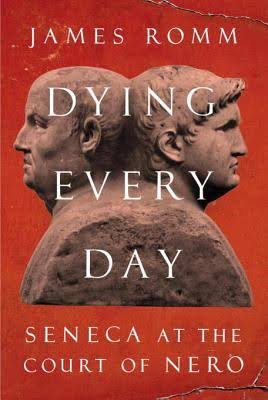
Dying Every Day: Seneca at the Court of Nero

Author: James Romm
Rating: 9/10
Last Read: January 2016

Quick Summary: An overview of the life of Seneca, putting his philosophical works into context with his life and surroundings.  Discusses palace intrigues with the emperor Nero.

If you like history or philosophy, it is an excellent read.

Life, properly regarded, is only a journey toward death. We wrongly say that the old and sick are “dying,” when infants and youths are doing so just as certainly. We are dying every day, all of us

Key Takeaways

Nothing is created in a vacuum.  Seneca’s letters are a source of immense wisdom still today… but when added into the context of his life, his goals, and his aspirations they can take on a totally different slant.

Nothing can be proven, but the theory fits with a pattern of opportunism in much of Seneca’s work. His command of the written word was so deft, his rhetorical skills so subtle, that it was easy for him to help himself while also helping others.

History is super fucking interesting and way better than anything we can make up.  

Elsewhere in De Ira Seneca calls to mind the sufferings of Asian viziers in old Greek legends. Harpagus served as chief minister to a Persian king but offended his master by disregarding an order. The king took a gory revenge: he served Harpagus a stew of his own children’s flesh, then showed him the severed heads to reveal what he had eaten. How did Harpagus like his dinner? the king asked, with Caligulan cruelty. Harpagus’ choking reply was “At a king’s table, every meal is pleasant.” The flattery at least gained him this, Seneca says grimly: he did not have to finish his meal.

My Highlights

Amici vitia si feras, facias tua. If you put up with the crimes of a friend, you make them your own. —ROMAN PROVERB –loc 47

Consolation to Marcia, written about A.D. 40, takes the form of a letter addressed to a mother grieving for a dead son, but it was meant to be read widely. Seneca would play the same rhetorical trick his entire life, allowing his readers to listen in on what seemed to be an intimate exchange. –loc 306

Nothing can be proven, but the theory fits with a pattern of opportunism in much of Seneca’s work. His command of the written word was so deft, his rhetorical skills so subtle, that it was easy for him to help himself while also helping others. –loc 324

Marcia’s grief, for Seneca, exemplifies a universal human blindness. We assume that we own things—family, wealth, position—whereas we have only borrowed them from Fortune. We take for granted that they will be with us forever, and we grieve at their loss; but loss is the more normal event—it is what we should have expected all along. –loc 336

life, properly regarded, is only a journey toward death. We wrongly say that the old and sick are “dying,” when infants and youths are doing so just as certainly. We are dying every day, all of us. –loc 343

Not only in Rome, but everywhere and in all times, good men have knuckled under to despots. –loc 410

Elsewhere in De Ira Seneca calls to mind the sufferings of Asian viziers in old Greek legends. Harpagus served as chief minister to a Persian king but offended his master by disregarding an order. The king took a gory revenge: he served Harpagus a stew of his own children’s flesh, then showed him the severed heads to reveal what he had eaten. How did Harpagus like his dinner? the king asked, with Caligulan cruelty. Harpagus’ choking reply was “At a king’s table, every meal is pleasant.” The flattery at least gained him this, Seneca says grimly: he did not have to finish his meal. –loc 411

Seneca’s hymn to suicide is thus very much of its time. By his day, suicide had come to signify, for aristocratic victims of the emperors, an inability to fight back; the best one could hope for was to embarrass the princeps by a highly public exit. –loc 459

Prexaspes was another vizier like Harpagus, a right-hand man to a Persian monarch. His master, Cambyses, a notorious drunk, set out one day to prove to his court that wine did not affect him. He set up an archery course, with Prexaspes’ son as the target; then, good as his word, he shot the boy through the heart. The story is related in De Ira just before the hymn to suicide above (in which Prexaspes is recalled as “the man whom it befell to have a king shoot arrows at his dear ones”). But Seneca leaves the sequel to the story curiously untold. Years later Prexaspes found himself in possession of dangerous information. He knew that a group of plotters had murdered Cambyses’ heir and put an impostor on the throne. He had colluded with the plot’s leaders, who valued his high standing among the Persian people. When the people became uneasy about their king’s legitimacy, the plotters asked Prexaspes to reassure them. Prexaspes climbed a high tower in a central square of the capital. From a window at the top, he called out to the populace below—but not as instructed. He denounced the impostor and revealed the plot, confessing that he himself had killed the true heir to the throne, on Cambyses’ orders. Then he launched himself off the tower and fell to his death. Inspired by his deed, the Persians rallied against the conspirators and soon overthrew them and their false king. –loc 463

Was life under such arbitrary power worth living? It was the question Seneca had posed in De Ira and, in a different way, in Consolation to Marcia. For Lucius Junius Silanus, the answer—no—was clear enough. Three days after his dismissal, on the same day Claudius wed Agrippina, he took his own life. –loc 618

As in the biblical tale of the Tower of Babel, the very complexity of civilization seemed to carry the seeds of its own destruction—or at least to have a fixed terminus, reached at a regular point every few thousand years. To Seneca, who lived in a city that had reached unimagined levels of sophistication, that terminus seemed not far off. –loc 633

By a curious coincidence, the careers of these two brothers—Seneca’s older brother Novatus, and Pallas’ brother Antonius Felix—are bound together by an unlikely thread: the travels of the apostle Paul. –loc 843

Only philosophic contemplation, he argues, can fulfill that quest. Only those who study philosophy are truly alive, in that they move outside the prison of time into the realm of eternals. All others, those who follow worldly pursuits, are squandering their time, merely running out the ever-ticking clock of mortality. –loc 972

“To fight against an equal is risky; against a higher-up, insane; against someone beneath you, degrading,” –loc 1202

But De Clementia is more emphatic on this point. “We have all of us done wrong,” Seneca intones here, in words that would not be out of place in a modern Christian sermon, “some seriously, some lightly, some intentionally, some pushed into it by accident or carried away by the wrongdoing of others; some have stood by our good designs not firmly enough and have lost our guiltlessness, unwillingly, while trying to keep our grasp on –loc 1563

Seneca had made the bargain that many good men have made when agreeing to aid bad regimes. On the one hand, their presence strengthens the regime and helps it endure. But their moral influence may also improve the regime’s behavior or save the lives of its enemies. For many, this has been a bargain worth making, even if it has cost them—as it may have cost Seneca—their immortal soul. –loc 2088

According to Seneca’s definition in the treatise, Nero’s giving had been not a beneficium, an act of generosity, but a means of asserting power and imposing obligation. –loc 2200

In the fog-bound glens of eastern England, Boudicca, warrior-queen of the Iceni, was gathering a mighty host determined to end Roman rule. At her hands, more than 80,000 Romans and their allies would soon be killed, and the Roman army would come within a hairsbreadth of an epic disaster. –loc 2206

According to Dio’s account, before the rebellion began, Seneca had called in his loans to British tribal leaders, abruptly and on harsh terms. That put many Britons into bankruptcy, while others were broken by the corrupt finance officer in charge of the region, Decianus Catus. Together, Dio suggests, Catus and Seneca forced Britons into a corner where they had nothing to lose by revolt. Tacitus, by contrast, says nothing of Seneca’s moneylending in Britain, though he confirms that Catus had made enemies there by rapacity. For Tacitus, the principal spark of the conflict was the flogging of Boudicca and the rape of her daughters, committed by arrogant Roman troops grown scornful of British tribesmen. –loc 2246

Then Nero turned to a more salient point. “If you return money to me, it won’t be your moderation spoken of by every mouth, but my greed; if you leave your princeps, it will be chalked up to fear of my cruelty. Your self-restraint would earn great praise; but it doesn’t befit a wise man to get glory for himself while bringing ill repute on a friend.” –loc 2329

The most consequential departure was that of Burrus, the stalwart Praetorian prefect, recently dead. The gruff old soldier had been one of few who stood up to Nero, speaking his mind and then, if asked to reconsider, saying to the princeps: “I’ve told you already, don’t question me twice.” –loc 2452

Discomforts overwhelm the body, Seneca muses, in the same way that vice and ignorance overwhelm the soul. The sufferer may not even know he is suffering, just as a deep sleeper does not know he is asleep. Only philosophy can rouse souls from such comas. –loc 2563

By insisting that death is everywhere and cannot be escaped, Seneca seems to relieve himself of the burden of action. For indeed, Seneca was taking very little action in these years to help himself or others. –loc 2672

The will to power, Atreus implies, lurks in even the most detached, self-contented sage. –loc 2945

Seneca’s prose works offer forgiveness, but in the bleak world of the tragedies, the sin of weakness comes back on the sinner’s head a thousandfold. In a gruesome messenger speech, we hear how Atreus butchered, fileted, and stewed Thyestes’ children. Then we watch as Thyestes unknowingly consumes the horrid casserole. –loc 2964

A great stream of manacled men surged toward Nero’s residence, so many that the suspects had to be detained outside, near the gates, for lack of rooms to torture them in. –loc 3167

Seneca allegedly once told Nero—the occasion of the remark is not known—“No matter how many you kill, you can’t kill your successor.” But in this case, as in many others, Nero proved his teacher wrong. He had indeed eliminated all possible successors, men belonging to the Julian line, by the end of 65. –loc 3376

The power to die, Seneca had promised, was present at every moment and transcended every oppression. –loc 3430

Domitian again, as his father had done, banished the Stoics from Rome, including Epictetus, whose magnetic personality had by now become a phenomenon. Epictetus landed in Nicopolis, in the Greek East, and began attracting new followers. His conversations and quips were written down by one of them, young Arrian of Nicomedia (later a famous historian), and began circulating as the Discourses and Encheiridion (“Handbook”). In time these writings, in Greek, filtered back to Rome, where they came under the eyes of an aristocratic youth named Marcus Aurelius Antoninus. One day, after his elevation to princeps, this Marcus would quote the sayings of Epictetus in his own writings—bringing Stoic philosophy back into the palace from which it had been exiled since the death of Seneca. –loc 3519