Rules for a Knight

Author: Ethan Hawke (yes, the actor)
Rating: 7/10
Last Read: September 2016

Quick Summary:  Rules for a Knight is a short book is a collection of “knightly wisdom” told in short stories.  The overall book is framed as a letter from a knight to his children, sent on the eve of a battle from which he expects not to return.  The book is full of lessons from the Buddhist cannon – if you are familiar with other philosophical works, the stories will likely be very familiar to you.

When I re-read the passages I have highlighted, I realize that Rules for a Knight repeatedly speaks to the very things I am seeking.  There is much wisdom contained in these pages – it is a shame to realize I have blown through this book and have not spent time to reflect upon it.  How many other lessons have been ignored?

Pay attention: what you need to know is usually in front of you. There are no secrets, just things people choose not to notice.

My Highlights

For this I am most sad, but none of you children yet know me as anything but the tall person who scolds or encourages you, or as a voice talking to your mother as you fall asleep. I have worked too hard in the last ten years and traveled too much, and now it seems I may miss your childhoods entirely. This comes as a blow. I have been looking forward to your growing up and hoped that we could, over time, know one another in a more meaningful way. –loc 100

My grandfather set down two blue cups and poured some tea into the first, but he did not stop when the cup was full. He kept pouring and pouring until the hot tea spilled all over the table and splattered onto the floor.
“What are you doing?” I shouted, jumping up, hot tea scalding my legs.
“You are like that cup spilling over,” said my grandfather. “You cannot retain anything. There is too much going on and you are splashing everywhere, burning what you touch.”
–loc 125

Answers to your questions will come, but if you are not still and empty, you will never be able to retain anything. –loc 132

But the first thing you must understand is that you need not have gone anywhere. You are always in the right place at exactly the right time, and you always have been.” –loc 138

CREATE time alone with yourself. When seeking the wisdom and clarity of your own mind, silence is a helpful tool. The voice of our spirit is gentle and cannot be heard when it has to compete with others. Just as it is impossible to see your reflection in troubled water, so too is it with the soul. In silence, we can sense eternity sleeping inside us. –loc 151

Humility is the ability to see yourself in the context of a much larger world. –loc 184

The stars are magnificent. They are always there whether you see them or not. –loc 185

Aspire to be like the soil after the March rains, wet, open, and receptive. –loc 185

“When people speak, listen.” This was a point he would consistently stress. “As much as you like to be heard and understood, so does everyone else.” –loc 188

THE only intelligent response to the ongoing gift of life is gratitude. For all that has been, a knight says, “Thank you.” For all that is to come, a knight says, “Yes!” –loc 229

The quiet of each morning, the tangible bond of friendship, a snowball fight, warm water on your skin, laughing until your stomach hurts, a job well done, a shooting star that you witness alone; the simple joys are the great ones. Pleasure is not complicated. –loc 243

Constant awareness of even the smallest detail trains your mind to be observant and conscientious. –loc 264

Responsibility, awareness, and self-knowledge are his allies. Forgetfulness is his enemy. His mind is not in the future. He is fully engaged in what he is doing. –loc 265

I learned that evening that rain falls equally on all things. Jealousy, fear, and anger are obstacles to a knight’s first goal: a clear mind. Through his practice a knight should cultivate an open, unclouded mind, so that his instincts will guide him and he is free to act spontaneously. Understanding that our “talents” are simply gifts we have received brings humility to our actions. It also allows us to appreciate the “talents” we see in others as expressions from the same universal source. There are only two possible outcomes whenever you compare yourself to another, vanity or bitterness, and both are without value. –loc 310

THE quality of your life will, to a large extent, be decided by with whom you elect to spend your time. –loc 330

The skeptic shouted out, mocking the knight for believing that his ancient whispers and primitive style of healing could have any power. In front of all the townspeople, Sir Richard answered, “You are an ignorant fool.” The skeptic’s derision became angry. His face reddened, and his hands began to shake with humiliation and rage. Before the skeptic could gather himself to shout back or raise his fist in violence, Sir Richard spoke again. “When a few words have the power to make you so angry, why would others not have the power to heal?” –loc 342

Remember, a friend does not need you to impress him. A friend loves you because you are true to yourself, not because you agree with him. Beware of grand gestures; the real mettle of friendship is forged in life’s daily workings. –loc 350

A DISHONEST tongue and a dishonest mind waste time, and therefore waste our lives. We are here to grow, and the truth is the water, the light, and the soil from which we rise. The armor of falsehood is subtly wrought out of the darkness and hides us not only from others but from our own soul. –loc 389

Don’t fear suffering. The strongest steel is forged in the hottest fire. The facts are always friendly. Without a little agony, none of us would bother to learn a thing. The earth has to be tilled before the seeds can be planted. In much the same way, sometimes we have to be stirred and ripped apart so that the seeds of compassion, wisdom, and understanding can be firmly planted in us. –loc 407

Pay attention: what you need to know is usually in front of you. There are no secrets, just things people choose not to notice. –loc 427

Later he told me when he was younger he learned the secret to performing under pressure: don’t do it for yourself. Do it for someone else. “I know your grandfather always tells us to think of nothing. But when I get scared I just think of someone I love.” –loc 460

GRACE is the ability to accept change. Be open and supple; the brittle break. –loc 482

Young people, women and men, often use the possession of beauty or wealth as permission to be uninteresting, undisciplined, and ill-informed. If they are fortunate enough to reach the age of twenty-eight or so, they become like coddled coyotes. Cute when little, but, upon adulthood, nasty, fearful, and living off the scraps of others. –loc 497

All of us are asked to surrender the superficial beauty of youth and step towards something greater. We are being made ready for the spirit world. Each wrinkle is a crack in the shell of our conceit. Our conceit must be pulverized for the soul to fly. –loc 511

YOU were born owning nothing and with nothing you will pass out of this life. Be frugal and you can be generous. –loc 586

There have always been two ways to be rich: by accumulating vast sums or by needing very little. –loc 591

Often we imagine that we will work hard until we arrive at some distant goal, and then we will be happy. This is a delusion. Happiness is the result of a life lived with purpose. Happiness is not an objective. It is the movement of life itself, a process, and an activity. It arises from curiosity and discovery. Seek pleasure and you will quickly discover the shortest path to suffering. Other people, friends, brothers, sisters, neighbors, spouses, even your mother and I are not responsible for your happiness. Your life is your responsibility, and you always have the choice to do your best. Doing your best will bring happiness. Do not be overconcerned with avoiding pain or seeking pleasure. If you are concentrating on the results of your actions, you are not dedicated to your task. –loc 645

Be resolute in your beliefs, my children. Your friendship cannot be bought. –loc 673

Be cautious when anyone, even family, has too extreme an expectation from your behavior. Under the guise of love or loyalty, people can use guilt or fear to manipulate. A healthy conscience should be used like an internal compass: it is yours, not an instrument for others to play. –loc 673

A knight does not whine. He concerns himself with affecting change, not burdening the world with his grievances. –loc 716

In courtship, honesty is the first requisite. To achieve honesty, a knight must first be intimate with his own soul. This is difficult and takes time. Just as we all have secret thoughts and concerns inside ourselves, which we would share only with a person we value, respect, and trust, so too is it with the body. There are secret places that we need not share, which need not to be shared. –loc 866

Buy the Book

If you are interested in reading Rules for a Knight, you can support the website by using our Amazon affiliate link:


Rules for a Knight

By Ethan Hawke


Enchiridion

Author: Epictetus
Rating: 9/10
Last Read: August 2016

Quick Summary:  This book has been on my reading list for years – and I’m sorry that I put it off so long.  I love the stoics, and have read Meditations and Seneca multiple times.  The Enchiridion is a short work, mostly full of short precepts instructing readers in the stoic style.  This book contains lots of useful thoughts to mull over and revisit throughout your life.

No man is free who is not master of himself.


Fortify yourself with contentment, for this is an impregnable fortress.

My Highlights

In the Stoic view, our capacity to be happy is completely dependent on ourselves—how we treat ourselves, how we relate to others, and how we react to events in general. Events are good or bad only in terms of our reaction to them. –loc 30

The only thing we control is our will, and God has given us a will that cannot be influenced or thwarted by external events—unless we allow it. We are not responsible for the ideas or events that present themselves to us, but only for the ways in which we act on them. –loc 32

Of things some are in our power, and others are not. In our power are opinion, movement toward a thing, desire, aversion (turning from a thing); and in a word, whatever are our own acts: not in our power are the body, property, reputation, offices (magisterial power), and in a word, whatever are not our own acts. –loc 45

Straightway then practice saying to every harsh appearance,1 You are an appearance, and in no manner what you appear to be. –loc 56

But destroy desire completely for the present. For if you desire anything which is not in our power, you must be unfortunate: but of the things in our power, and which it would be good to desire, nothing yet is before you. –loc 64

Men are disturbed not by the things which happen, but by the opinions about the things –loc 77

When then we are impeded or disturbed or grieved, let us never blame others, but ourselves, that is, our opinions. –loc 78

It is the act of an ill-instructed man to blame others for his own bad condition; it is the act of one who has begun to be instructed, to lay the blame on himself; and of one whose instruction is completed, neither to blame another, nor himself. –loc 79

Seek not that the things which happen should happen as you wish; but wish the things which happen to be as they are, and you will have a tranquil flow of life. –loc 91

Disease is an impediment to the body, but not to the will, unless the will itself chooses. Lameness is an impediment to the leg, but not to the will. And add this reflection on the occasion of everything that happens; for you will find it an impediment to something else, but not to yourself. –loc 93

On the occasion of every accident (event) that befalls you, remember to turn to yourself and inquire what power you have for turning it to use. –loc 95

For it is better to die of hunger and so to be released from grief and fear than to live in abundance with perturbation; and it is better for your slave to be bad than for you to be unhappy. –loc 104

If you would have your children and your wife and your friends to live forever, you are silly; for you would have the things which are not in your power to be in your power, and the things which belong to others to be yours. –loc 114

He is the master of every man who has the power over the things, which another person wishes or does not wish, the power to confer them on him or to take them away. Whoever then wishes to be free, let him neither wish for anything nor avoid anything which depends on others: if he does not observe this rule, he must be a slave. –loc 117

Remember that in life you ought to behave as at a banquet. Suppose that something is carried round and is opposite to you. Stretch out your hand and take a portion with decency. Suppose that it passes by you. Do not detain it. Suppose that it is not yet come to you. Do not send your desire forward to it, but wait till it is opposite to you. –loc 120

But you yourself will not wish to be a general or senator or consul, but a free man: and there is only one way to this, to despise (care not for) the things which are not in our power. –loc 141

Remember that it is not he who reviles you or strikes you, who insults you, but it is your opinion about these things as being insulting. When then a man irritates you, you must know that it is your own opinion which has irritated you. Therefore especially try not to be carried away by the appearance. For if you once gain time and delay, you will more easily master yourself. –loc 143

Let death and exile and every other thing which appears dreadful be daily before your eyes; but most of all death: and you will never think of anything mean nor will you desire anything extravagantly. –loc 147

If it should ever happen to you to be turned to externals in order to please some person, you must know that you have lost your purpose in life. Be satisfied then in everything with being a philosopher; and if you wish to seem also to any person to be a philosopher, appear so to yourself, and you will be able to do this. –loc 153

how will you be nobody nowhere, when you ought to be somebody in those things only which are in your power, in which indeed it is permitted to you to be a man of the greatest worth? –loc 159

If I can acquire money and also keep myself modest, and faithful and magnanimous, point out the way, and I will acquire it. But if you ask me to lose the things which are good and my own, in order that you may gain the things which are not good, see how unfair and silly you are. –loc 163

Besides, which would you rather have, money or a faithful and modest friend? For this end then rather help me to be such a man, and do not ask me to do this by which I shall lose that character. –loc 165

You must be one man, either good or bad. You must either cultivate your own ruling faculty, or external things; you must either exercise your skill on internal things or on external things; that is you must either maintain the position of a philosopher or that of a common person. –loc 213

Immediately prescribe some character and some form to yourself, which you shall observe both when you are alone and when you meet with –loc 250

And let silence be the general rule, or let only what is necessary be said, and in few words. And rarely and when the occasion calls we shall say something; but about none of the common subjects, nor about gladiators, nor horse-races, nor about athletes, nor about eating or drinking, which are the usual subjects; and especially not about men, as blaming them or praising them, or comparing them. If then you are able, bring over by your conversation the conversation of your associates to that which is proper; but if you should happen to be confined to the company of strangers, be silent. –loc 251

a man has reported to you, that a certain person speaks ill of you, do not make any defense (answer) to what has been told you: but reply, The man did not know the rest of my faults, for he would not have mentioned these only. –loc 263

When you have decided that a thing ought to be done and are doing it, never avoid being seen doing it, though the many shall form an unfavorable opinion about it. For if it is not right to do it, avoid doing the thing; but if it is right, why are you afraid of those who shall find fault wrongly? –loc 288

In walking about as you take care not to step on a nail or to sprain your foot, so take care not to damage your own ruling faculty: and if we observe this rule in every act, we shall undertake the act with more security. –loc 297

When any person treats you ill or speaks ill of you, remember that he does this or says this because he thinks that it is his duty. It is not possible then for him to follow that which seems right to you, but that which seems right to himself. Accordingly if he is wrong in his opinion, he is the person who is hurt, for he is the person who has been deceived; for if a man shall suppose the true conjunction to be false, it is not the conjunction which is hindered, but the man who has been deceived about it. If you proceed then from these opinions, you will be mild in temper to him who reviles you: for say on each occasion, It seemed so to him. –loc 309

These reasonings do not cohere: I am richer than you, therefore I am better than you; I am more eloquent than you, therefore I am better than you. On the contrary these rather cohere, I am richer than you, therefore my possessions are greater than yours: I am more eloquent than you, therefore my speech is superior to yours. But you are neither possession nor speech. –loc 317

For even sheep do not vomit up their grass and show to the shepherds how much they have eaten; but when they have internally digested the pasture, they produce externally wool and milk. Do you also show not your theorems to the uninstructed, but show the acts which come from their digestion. –loc 330

But when I shall have found the interpreter, the thing that remains is to use the precepts (the lessons). This itself is the only thing to be proud of. –loc 349

If you wish to be well spoken of, learn to speak well (of others): and when you have learned to speak well of them, try to act well, and so you will reap the fruit of being well spoken of. –loc 396

For no man is a slave who is free in his will. –loc 400

If you wish to live without perturbation and with pleasure, try to have all who dwell with you good. And you will have them good, if you instruct the willing, and dismiss those who are unwilling (to be taught): for there will fly away together with those who have fled away both wickedness and slavery; and there will be left with those who remain with you goodness and liberty. –loc 406

No man who loves money, and loves pleasure, and loves fame, also loves mankind, but only he who loves virtue. –loc 410

Examine yourself whether you wish to be rich or to be happy. If you wish to be rich, you should know that it is neither a good thing nor at all in your power: but if you wish to be happy, you should know that it is both a good thing and in your power, for the one is a temporary loan of fortune, and happiness comes from the will. –loc 427

It is not poverty which produces sorrow, but desire; nor does wealth release from fear, but reason (the power of reasoning). If then you acquire this power of reasoning, you will neither desire wealth nor complain of poverty. –loc 445

In banquets remember that you entertain two guests, body and soul: and whatever you shall have given to the body you soon eject: but what you shall have given to the soul, you keep always. –loc 463

It is better to live with one free man and to be without fear and free, than to be a slave with many. –loc 491

What you avoid suffering, do not attempt to make others suffer. You avoid slavery: take care that others are not your slaves. For if you endure to have a slave, you appear to be a slave yourself first. For vice has no community with virtue, nor freedom with slavery. –loc 492

As he who is in health would not choose to be served (ministered to) by the sick, nor for those who dwell with him to be sick, so neither would a free man endure to be served by slaves, or for those who live with him to be slaves. –loc 494

Instead of a herd of oxen, endeavor to assemble herds of friends in your house. –loc 506

As a wolf resembles a dog, so both a flatterer, and an adulterer and a parasite, resemble a friend. Take care then that instead of watch-dogs you do not without knowing it let in mischievous wolves. –loc 508

Do not give judgment in one court (of justice) before you have been tried yourself before justice. –loc 538

A man ought to know that it is not easy for him to have an opinion (or fixed principle), if he does not daily say the same things, and hear the same things, and at the same time apply them to life. –loc 562

Neither should a ship rely on one small anchor, nor should life rest on a single hope. –loc 601

When Thales was asked what is most universal, he answered, Hope, for hope stays with those who have nothing else. –loc 603

It is more necessary to heal the soul than the body, for to die is better than to live a bad life. –loc 605

When a man dies young, he blames the gods. When he is old and does not die, he blames the gods because he suffers when he ought to have already ceased from suffering. And nevertheless, when death approaches, he wishes to live, and sends to the physician and entreats him to omit no care or trouble. Wonderful, he said, are men, who are neither willing to live nor to die. –loc 616

Listen to those who wish to advise what is useful, but not to those who are eager to flatter on all occasions; for the first really see what is useful, but the second look to that which agrees with the opinion of those who possess power, and imitating the shadows of bodies they assent to what is said by the powerful. –loc 634

To admonish is better than to reproach: for admonition is mild and friendly, but reproach is harsh and insulting; and admonition corrects those who are doing wrong, but reproach only convicts them. –loc 639

A pirate had been cast on the land and was perishing through the tempest. A man took clothing and gave it to him, and brought the pirate into his house, and supplied him with everything else that was necessary. When the man was reproached by a person for doing kindness to the bad, he replied, I have shown this regard not to the man, but to mankind.43 –loc 642

No man is free who is not master of himself. –loc 651

As it is pleasant to see the sea from the land, so it is pleasant for him who has escaped from troubles to think of them. –loc 661

In prosperity it is very easy to find a friend; but in adversity it is most difficult of all things. –loc 669

Epictetus being asked how a man should give pain to his enemy answered, By preparing himself to live the best life that he can. –loc 673

Fortify yourself with contentment, for this is an impregnable fortress. –loc 699

Be careful to leave your sons well instructed rather than rich, for the hopes of the instructed are better than the wealth of the ignorant. –loc 710

You ought to choose both physician and friend not the most agreeable, but the most useful. –loc 725

If you wish to live a life free from sorrow, think of what is going to happen as if it had already happened. –loc 727

When a young man was boasting in the theater and saying, I am wise, for I have conversed with many wise men; Epictetus said, I also have conversed with many rich men, but I am not rich. –loc 749

Epictetus being asked, What man is rich, answered, He who is content (who has enough). –loc 753

Xanthippe was blaming Socrates, because he was making small preparation for receiving his friends: but Socrates said, If they are our friends, they will not care about it; and if they are not, we shall care nothing about them. –loc 754

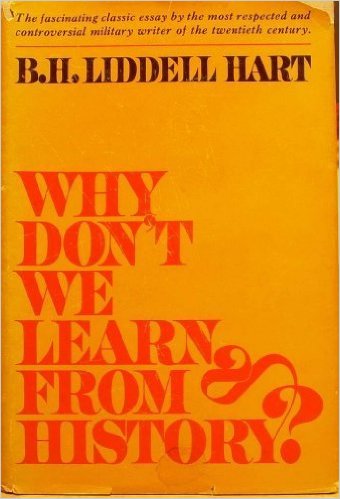
Why Don’t We Learn From History?

Author: B. H. Liddell Hart
Rating: 10/10
Last Read: June 2014

Quick Summary: This short read covers Hart’s opinion of how much we tend to misread history and how many lessons we fail to take away from it. The study of history provides experiences and lessons that an individual may not normally be able to draw from otherwise in life.  Hart shares some of the lessons he has learned, as well as provides his thoughts on the mindset needed to get the most out of historical lessons.

“Fools,” said Bismarck, “say they learn by experience. I prefer to profit by other people’s experience.”

My Highlights

Man seems to come into the this world with an inalterable belief that he knows best and that he can make others think as he does by force. –loc 87

People live by comfortable habit, we think and act more from habit than we do from reflection. Those who read history tend to look for what proves them right and confirms their personal opinions. –loc 115

Any successful institution, bureaucracy, bank, business, medical, legal protects itself from change to it own eventual destruction. ‘For where unification has been able to establish unity of ideas it has usually ended in uniformity, paralysing the growth of new ideas.’ It keeps doing what may or may not have at one time worked until it no longer works. –loc 120

“Fools,” said Bismarck, “say they learn by experience. I prefer to profit by other people’s experience.” –loc 136

Polybius. “There are two roads to the reformation for mankind, one through misfortunes of their own, the other through the misfortunes of others; the former is the most unmistakable, the latter the less painful . . . we should always look out for the latter, for thereby we can, without hurt to ourselves, gain a clearer view of the best course to pursue –loc 142

It helps us to realize that there are two forms of practical experience, direct and indirect and that, of the two, indirect practical experience may be the more valuable because infinitely wider. –loc 181

“History is universal experience,” the experience not of another but of many others under manifold conditions. –loc 187

And from all that the historian is led to realize how greatly the causation of events on which the fate of nations depends is ruled not by balanced judgment but by momentary currents of feeling, as well as by personal considerations of a low kind. –loc 223

Many documents are written to deceive or conceal. Moreover, the struggles that go on behind the scenes, and largely determine the issue, are rarely recorded in documents. –loc 227

Exploration should be objective, but selection is subjective. Its subjectiveness can, and should be, controlled by scientific method and objectiveness. Too many people go to history merely in search of texts for their sermons instead of facts for analysis. But after analysis comes art, to bring out the meaning and to ensure it becomes known. –loc 274

Adaptation to changing conditions is the condition of survival. –loc 283

The path of truth is paved with critical doubt and lighted by the spirit of objective inquiry. To view any question subjectively is self-blinding. –loc 297

Faith matters so much to a soldier, in the stress of war, that military training inculcates a habit of unquestioning obedience which in turn fosters an unquestioning acceptance of the prevailing doctrine. –loc 305

While fighting is a most practical test of theory, it is a small part of soldiering; and there is far more in soldiering that tends to make men the slaves of a theory. –loc 306

Doubt is unnerving save to philosophic minds, and armies are not composed of philosophers, either at the top or at the bottom. –loc 309

Lung Ming Academy, a motto that headed each page of the books used there: “The student must first learn to approach the subject in a spirit of doubt.” –loc 312

expressed in the eleventh-century teaching of Chang-Tsai: “If you can doubt at points where other people feel no impulse to doubt, then you are making progress.” –loc 314

We learn from history that in every age and every clime the majority of people have resented what seems in retrospect to have been purely matter-of-fact comment on their institutions. –loc 316

Always the tendency continues to be shocked by natural comment and to hold certain things too “sacred” to think about. –loc 319

I can conceive of no finer ideal of a man’s life than to face life with clear eyes instead of stumbling through it like a blind man, an imbecile, or a drunkard, which, in a thinking sense, is the common preference. –loc 320

How rarely does one meet anyone whose first reaction to anything is to ask “Is it true?” Yet unless that is a man’s natural reaction it shows that truth is not uppermost in his mind, and, unless it is, true progress is unlikely. –loc 321

‘Wahr ist was wirkt.’ (Anything that works is true.) –loc 331

History that bears the qualification “official” carries with it a natural reservation; and the additional prefix “military” is apt to imply a double reservation. –loc 332

Yet the longer I watch current events, the more I have come to see how many of our troubles arise from the habit, on all sides, of suppressing or distorting what we know quite well is the truth, out of devotion to a cause, an ambition, or an institution; at bottom, this devotion being inspired by our own interest. –loc 341

We learn from history that those who are disloyal to their own superiors are most prone to preach loyalty to their subordinates. Not many years ago there was a man who preached it so continually when in high position as to make it a catchword; that same man had been privately characterized by his chief, his colleague, and his assistant in earlier years as one who would swallow anything in order to get on. –loc 389

Loyalty is a noble quality, so long as it is not blind and does not exclude the higher loyalty to truth and decency. –loc 392

They are in a false relation to each other, and the loyalty which is then so much prized can be traced, if we probe deep enough, to an ultimate selfishness on either side. –loc 395

Truth may not be absolute, but it is certain that we are likely to come nearest to it if we search for it in a purely scientific spirit and analyse the facts with a complete detachment from all loyalties save that to truth itself. –loc 420

All of us do foolish things, but the wiser realize what they do. The most dangerous error is failure to recognize our own tendency to error. That failure is a common affliction of authority. –loc 432

the tendency of all “governments” is to infringe the standards of decency and truth; this is inherent in their nature and hardly avoidable in their practice. –loc 446

We learn from history that democracy has commonly put a premium on conventionality. By its nature, it prefers those who keep step with the slowest march of thought and frowns on those who may disturb the “conspiracy for mutual inefficiency.” –loc 450

There is always an “Inner Cabinet,” but usually it has no official constitution and might be more aptly described as an “Intimate Cabinet.” It is a fluid body. It may comprise those members of the actual Cabinet on whom the Prime Minister mainly relies or considers it essential to consult. But it may include men who have no ministerial position. For its constituent elements depend on the Prime Minister’s judgment, and choice, of the men whose opinions are most helpful and stimulating to him. The essential condition of membership is intimacy, not status. –loc 499

“Once you’ve behaved like a knave, you must never behave like a fool.” –loc 607

It is man’s power of thought which has generated the current of human progress through the ages. –loc 628

the thinking man must be against authoritarianism in any form, because it shows its fear of thoughts which do not suit momentary authority. –loc 629

Efficiency springs from enthusiasm, because this alone can develop a dynamic impulse. Enthusiasm is incompatible with compulsion, because it is essentially spontaneous. Compulsion is thus bound to deaden enthusiasm, because it dries up the source. The more an individual, or a nation, has been accustomed to freedom, the more deadening will be the effect of a change to compulsion. –loc 656

Moreover, every unwilling man is a germ carrier, spreading infection to an extent altogether disproportionate to the value of the service he is forced to contribute. –loc 665

As defined by Lord Lothian, in a letter to The Times in March 1938, it embodied the “allocation of every individual” to a particular form of service “whether in peace or in emergency.” It is being freshly urged now as an “educational” measure. –loc 697

Such a system entails the suppression of individual judgment. It violates the cardinal principle of a free community: that there should be no restriction of individual freedom save where this is used for active interference with others’ freedom. Our tradition of individual freedom is the slow-ripening fruit of centuries of effort. To surrender it within after fighting to defend it against dangers without would be a supremely ironical turn of our history. In respect of personal service, freedom means the right to be true to your convictions, to choose your course, and decide whether the cause is worth service and sacrifice. That is the difference between the free man and the state slave. –loc 699

Another false argument is that since conscription has long been the rule in the Continental countries, including those which remain democracies, we need not fear the effect of adopting –loc 714

Civilization is built on the practice of keeping promises. –loc 788

Any constructive effort and all human relations, personal, political, and commercial, depend on being able to depend on promises. –loc 789

I have come to think that accuracy, in the deepest sense, is the basic virtue, the foundation of understanding, supporting the promise of progress. The cause of most troubles can be traced to excess; the failure to check them to deficiency; their prevention lies in moderation. So in the case of troubles that develop from spoken or written communication, their cause can be traced to overstatement, their maintenance to understatement, while their prevention lies in exact statement. –loc 830

Sweeping judgments, malicious gossip, inaccurate statements which spread a misleading impression; these are symptoms of the moral and mental recklessness that gives rise to war. Studying their effect, one is led to see that the germs of war lie within ourselves, not in economics, politics, or religion as such. How can we hope to rid the world of war until we have cured ourselves of the originating causes? –loc 834

Where the two sides are too evenly matched to offer a reasonable chance of early success to either, the statesman is wise who can learn something from the psychology of strategy. It is an elementary principle of strategy that, if you find your opponent in a strong position costly to force, you should leave him a line of retreat as the quickest way of loosening his resistance. It should, equally, be a principle of policy, especially in war, to provide your opponent with a ladder by which he can climb down. –loc 917

War is only profitable if victory is quickly gained. Only an aggressor can hope to gain a quick victory. If he is frustrated, the war is bound to be long, and mutually ruinous, unless it is brought to an end by mutual agreement. –loc 923

Since an aggressor goes to war for gain, he is apt to be the more ready of the two sides to seek peace by agreement. The aggressed side is usually more inclined to seek vengeance through the pursuit of victory; even though all experience has shown that victory is a mirage in the desert created by a long war. –loc 925

The side that has suffered aggression would be unwise to bid for peace lest its bid be taken as a sign of weakness or fear. But it would be wise to listen to any bid that the enemy makes. –loc 929

The history of ancient Greece showed that, in a democracy, emotion dominates reason to a greater extent than in any other political system, thus giving freer rein to the passions which sweep a state into war and prevent it getting out at any point short of the exhaustion and destruction of one or other of the opposing sides. Democracy is a system which puts a break on preparation for war, aggressive or defensive, but it is not one that conduces to the limitation of warfare or the prospects of a good peace. No political system more easily becomes out of control when passions are aroused. These defects have been multiplied in modern democracies, since their great extension of size and their vast electorate produce a much larger volume of emotional pressure. –loc 935

It was because he really understood war that he became so good at securing peace. He was the least militaristic of soldiers and free from the lust of glory. It was because he saw the value of peace that he became so unbeatable in war. For he kept the end in view, instead of falling in love with the means. Unlike Napoleon, he was not infected by the romance of war, which generates illusions and self-deceptions. That was how Napoleon had failed and Wellington prevailed. –loc 951

Like most planning, unless of a mainly material kind, it breaks down through disregard of human nature. Worse still, the higher the hopes that are built on such a plan, the more likely that their collapse may precipitate war. –loc 984

There is no panacea for peace that can be written out in a formula like a doctor’s prescription. But one can set down a series of practical points; elementary principles drawn from the sum of human experience in all times. Study war and learn from its history. Keep strong, if possible. In any case, keep cool. Have unlimited patience. Never corner an opponent and always assist him to save his face. Put yourself in his shoes so as to see things through his eyes. Avoid self-righteousness like the devil; nothing is so self-blinding. Cure yourself of two commonly fatal delusions: the idea of victory and the idea that war cannot be limited. –loc 986

An intellectual ought to realize the extent to which the world is shaped by human emotions, emotions uncontrolled by reason; his thinking must have been shallow, and his observation narrow, if he fails to realize that. –loc 997

History bears witness to the vital part that the “prophets” have played in human progress, which is evidence of the ultimate practical value of expressing unreservedly the truth as one sees it. Yet it also becomes clear that the acceptance and spreading of their vision has always depended on another class of men, “leaders” who had to be philosophical strategists, striking a compromise between truth and men’s receptivity to it. Their effect has often depended as much on their own limitations in perceiving the truth as on their practical wisdom in proclaiming it. –loc 1015

The prophets must be stoned; that is their lot and the test of their self fulfilment. A leader who is stoned, however, may merely prove that he has failed in his function through a deficiency of wisdom or through confusing his function with that of a prophet. –loc 1019

Even among great scholars there is no more unhistorical fallacy than that, in order to command, you must learn to obey. A more temperamentally insubordinate lot than the outstanding soldiers and sailors of the past could scarcely be found in England one has only to think of Wolfe and Wellington, Nelson and Dundonald; in France, Napoleon’s marshals in this respect at least were worthy of their master. –loc 1037

Robert E. Lee’s conduct at West Point was so immaculate that he had not a single offence recorded against him, while he became known among his fellows as the “Marble Model.” What a contrast this offers to the experience of Sherman and Grant, who were both often unbearably irked by the petty restrictions and often kicked over the traces. –loc 1040

For Sherman, even when looking back upon it when he had risen to be commanding general of the United States Army, sarcastically wrote: “Then, as now, neatness in dress and form, with a strict conformity to the rules, were the qualifications for office, and I suppose I was not found to excel in any of these.” –loc 1043

A model boy rarely goes far, and even when he does he is apt to falter when severely tested. A boy who conforms immaculately to school rules is not likely to grow into a man who will conquer by breaking the stereotyped professional rules of his time, as conquest has most often been achieved. Still less does it imply the development of the wide views necessary in a man who is not merely a troop commander but the strategic adviser of his Government. The wonderful thing about Lee’s generalship is not his legendary genius but the way he rose above his handicaps, handicaps that were internal even more than external. –loc 1049

Beyond this is the doubt whether we should be able to eliminate it even if we had the strength of mind to take such a risk. For weaker minds will cling to this protection and by so doing spoil the possible effectiveness of non-resistance. Is there any way out of the dilemma? There is at least one solution that has yet to be tried; that the masters of force should be those who have mastered all desire to employ it. –loc 1057

That solution is an extension of what Bernard Shaw expressed in Major Barbara: that wars would continue until the makers of gunpowder became professors of Greek, and he here had Gilbert Murray in mind, or the professors of Greek became the makers of gunpowder. And this, in turn, was derived from Plato’s conclusion that the affairs of mankind would never go right until either the rulers became philosophers or the philosophers became the rulers. –loc 1060

Can war be limited? Logic says, “No. War is the sphere of violence, and it would be illogical to hesitate in using any extreme of violence that can help you to win the war.” History replies, “Such logic makes nonsense. You go to war to win the peace, not just for the sake of fighting. Extremes of violence may frustrate your purpose, so that victory becomes a boomerang. Moreover, it is a matter of historical fact that war has been limited in many ways.” –loc 1068

Contact with the East, however, helped to foster the growth of chivalry in the West. That code, for all its faults, helped to humanise warfare by formalising it. –loc 1085

Another important influence was the growth of more formal and courteous manners in social life. This code of manners spread into the field of international relations. These two factors, reason and manners, saved civilization when it was on the verge of collapse. Men came to feel that behaviour mattered more than belief, and customs more than creeds, in making earthly life tolerable and human relations workable. –loc 1099

Sherman saw very clearly that the resisting power of a democracy depends even more on the strength of the people’s will than on the strength of its armies. His strategy was ably fitted to fulfil the primary aim of his grand strategy. His unchecked march through the heart of the South, destroying its resources, was the most effective way to create and spread a sense of helplessness that would undermine the will to continue the war. –loc 1119

Another was the growth of a new theory of war which embodied all the most dangerous features of revolutionary and Napoleonic practice. That theory was evolved in Prussia by Clausewitz. Pursuing logic to the extreme, he argued that moderation had no place in war: “War is an act of violence pursued to the utmost.” As his thinking proceeded he came to realize the fallacy of such logic. Unfortunately, he died before he could revise his writings and his disciples remembered only his extreme starting point. A further dangerous factor was also developing, the terrific scientific improvement in the weapons of war. –loc 1129

Indeed, in the destruction of cities, the record of World War II exceeds anything since the campaigns of Genghis Khan and Tamerlane. –loc 1146

A wider and more profound treatment of the subject came, a century later, in T. E. Lawrence’s Seven Pillars of Wisdom. His masterly formulation of the theory of guerrilla warfare focused on its offensive value and was the product of his combined experience and reflection during the Arab Revolt against the Turks, both as a struggle for independence and as part of the Allied campaign against Turkey. –loc 1194

Ascending the spiral, it can be seen that individual security increases with the growth of society, that local security increases when linked to a wider organization, that national security increases when nationalism decreases and would become much greater if each nation’s claim to sovereignty were merged in a super-national body. Every step that science achieves in reducing space and time emphasizes the necessity of political integration and a common morality. The advent of the atomic era makes that development more vitally urgent. A movement of the spirit as well as of the mind is needed to attain –loc 1384

To face life with clear eyes, desirous to see the truth, and to come through it with clean hands, behaving with consideration for others, while achieving such conditions as enable a man to get the best out of life, is enough for ambition: and a high ambition. Only as a man progresses toward it does he realize what effort it entails and how large is the distance to go. –loc 1407

He may realize that the world is a jungle. But if he has seen that it could be better for anyone if the simple principles of decency and kindliness were generally applied, then he must in honesty try to practice these consistently and to live, personally, as if they were general. In other words, he must follow the light he has seen. –loc 1416

“Behold, I send you forth as sheep in the midst of wolves: be ye therefore wise as serpents, and harmless as doves.” –loc 1419

Hagakure

Author: Yamamoto Tsunetomo
Rating: 7/10
Last Read: August 2015

Quick Summary: A collection of notes from the early 1700s meant to serve as a guide for warriors.  The book summarizes the author’s view of the warrior code (in the context of bushido).  The book touches on many practical and spiritual points, as well as highlights many interesting facts of life for the time period.

There are many practical things that modern man can still draw from this historic work, assuming westerners can handle the fixation with death that flows through the work. (But really, you’re going to die too!)

My Highlights

To say that dying without reaching one’s aim is to die a dog’s death is the frivolous way of sophisticates. When pressed with the choice of life or death, it is not necessary to gain one’s aim. –loc 28

We all want to live. And in large part we make our logic according to what we like. But not having attained our aim and continuing to live is cowardice. –loc 29

If by setting one’s heart right every morning and evening, one is able to live as though his body were already dead, he pains freedom in the Way. His whole life will be without blame, and he will succeed in his calling. –loc 31

Having only wisdom and talent is the lowest tier of usefulness. –loc 37

According to their nature, there are both people who have quick intelligence, and those who must withdraw and take time to think things over. Looking into this thoroughly, if one thinks selflessly and adheres to the four vows of the Nabeshima samurai, surprising wisdom will occur regardless of the high or low points of one’s nature.’ People think that they can clear up profound matters if they consider them deeply, but they exercise perverse thoughts and come to no good because they do their reflecting with only self-interest at the center. –loc 38

Men of high position, low position, deep wisdom and artfulness all feel that they are the ones who are working righteously, but when it comes to the point of throwing away one’s life for his lord, all get weak in the knees. –loc 64

To discover the good and bad points of a person is an easy thing, and to give an opinion concerning them is easy, too. For the most part, people think that they are being kind by saying the things that others find distasteful or difficult to say. But if it is not received well, they think that there is nothing more to be done. This is completely worthless. It is the same as brining shame to a person by slandering him. It is nothing more than getting it off one’s chest. –loc 72

When I observed the application of men’s treatment to men, there was no result. Thus I knew that men’s spirit had weakened and that they had become the same as women, and the end of the world had come. –loc 101

The Way is in a higher place then righteousness. This is very difficult to discover, but it is the highest wisdom. When seen from this standpoint, things like righteousness are rather shallow. If one does not understand this on his own, it cannot be known. There is a method of getting to this Way, however, even if one cannot discover it by himself. This is found in consultation with others. Even a person who has not attained this Way sees others front the side. –loc 121

Listening to the old stories and reading books are for the purpose of sloughing off one’s own discrimination and attaching oneself to that of the ancients. –loc 126

Although all things are not to be judged in this manner, I mention it in the investigation of the Way of the Samurai. When the time comes, there is no moment for reasoning. And if you have not done your inquiring beforehand , there is most often shame. Reading books and listening to people’s talk are for the purpose of prior resolution. –loc 168

Above all, the Way of the Samurai should be in being aware that you do not know what is going to happen next, and in querying every item day and night. Victory and defeat are matters of the temporary force of circumstances. The way of avoiding shame is different. It is simply in death. –loc 171

Even if it seems certain that you will lose, retaliate. Neither wisdom nor technique has a place in this. A real man does not think of victory or defeat. He plunges recklessly towards an irrational death. By doing this, you will awaken from your dreams. –loc 173

It is not good to settle into a set of opinions. It is a mistake to put forth effort and obtain some understanding and then stop at that. –loc 184

Do not rely on following the degree of understanding that you have discovered, but simply think, “This is not enough.” –loc 186

How should a person respond when he is asked, “As a human being, what is essential in terms of purpose and discipline?” First, let us say, “It is to become of the mind that is right now pure and lacking complications.” People in general all seem to be dejected. When one has a pure and uncomplicated mind, his expression will be lively. When one is attending to matters, there is one thing that comes forth from his heart. That is, in terms of one’s lord, loyalty; in terms of one’s parents, filial piety; in martial affairs, bravery ; and apart from that, something that can be used by all the world. –loc 199

This is very difficult to discover. Once discovered, it is again difficult to keep in constant effect. There is nothing outside the thought of the immediate moment. –loc 203

Although it seems that taking special care of one’s appearance is similar to showiness, it is nothing akin to elegance. Even if you are aware that you may be struck down today and are firmly resolved to an inevitable death, if you are slain with an unseemly appearance, you will show your lack of previous resolve, will be despised by your enemy, and will appear unclean. For this reason it is said that both old and young should take care of their appearance. –loc 207

And if he thinks that this is not shameful, and feels that nothing else matters as long as he is comfortable, then his dissipate and discourteous actions will be repeatedly regrettable. –loc 214

What things a person should be able to accomplish if he had no haughtiness concerning his place in society! –loc 222

Look at the human condition. It is unseemly for a person to become prideful and extravagant when things are going well. Therefore, it is better to have some unhappiness while one is still young, for if a person does not experience some bitterness, his disposition will not settle down. –loc 241

There is surely nothing other than the single purpose of the present moment. A man’s whole life is a succession of moment after moment. If one fully understands the present moment, there will be nothing else to do, and nothing else to pursue. Live being true to the single purpose of the moment . –loc 267

Everyone lets the present moment slip by, then looks for it as though he thought it were somewhere else. No one seems to have noticed this fact. But grasping this firmly, one must pile experience upon experience. And once one has come to this understanding he will be a different person from that point on, though he may not always bear it in mind. –loc 270

As Yasuda Ukyo said about offering up the last wine cup, only the end of things is important. One’s whole life should be like this. When guests are leaving, the mood of being reluctant to say farewell is essential. If this mood is lacking, one will appear bored and the day and evening’s conversation will disappear. In all dealings with people it is essential to have a fresh approach. One should constantly give the impression that he is doing something exceptional. It is said that this is possible with but a little understanding. –loc 291

Whether people be of high or low birth, rich or poor, old or young, enlightened or confused, they are all alike in that they will one day die. It is not that we don’t know that we are going to die, but we grasp at straws. While knowing that we will die someday, we think that all the others will die before us and that we will be the last to go. Death seems a long way oft . –loc 343

insofar as death is always at one’s door, one should make sufficient effort and act quickly. –loc 347

One should think well and then speak. This is clear and firm, and one should learn it with no doubts. It is a matter of putting forth one’s whole effort and having the correct attitude previously. –loc 368

Human life is truly a short affair. It is better to live doing the things that you like. It is foolish to live within this dream of a world seeing unpleasantness and doing only things that you do not like. But it is important never to tell this to young people as it is something that would be harmful if incorrectly understood. –loc 371

What is done casually and freely will not work out well. It is a matter of attitude. –loc 399

People with intelligence will use it to fashion things both true and false and will try to push through whatever they want with their clever reasoning. This is injury from intelligence . Nothing you do will have effect if you do not use truth. –loc 418

To go without knowing whether the other party is busy, or when he has some particular anxiety, is awkward. There is nothing that surpasses not going where you have not been invited. –loc 427

The late Jin’emon said that it is better not to bring up daughters. They are a blemish to the family name and a shame to the parents. The eldest daughter is special, but it is better to disregard the others. –loc 432

The late Nakano Kazuma said that the original purpose of the Tea Ceremony is to cleanse the six senses. For the eyes there are the hanging scroll and flower arrangement. For the nose there is the incense. For the ears there is the sound of the hot water. For the mouth there is the taste of the tea. And for the hands and feet there is the correctness of term. When the five senses have thus been cleansed, the mind will of itself be purified. The Tea Ceremony will cleanse the mind when the mind is clogged up. –loc 436

A person who does not set himself in just one direction will be of no value at all. –loc 498

It is fine for retired old men to learn about Buddhism as a diversion, but if a warrior makes loyalty and filial piety one load, and courage and compassion another, and carries these twenty-four hours a day until his shoulders wear out, he will be a samurai. –loc 499

A man’s whole life should be like this. To exert oneself to a great extent when one is young and then to sleep when he is old or at the point of death is the way it should be. But to first sleep and then exert oneself . . . To exert oneself to the end, and to end one’s whole life in toil is regrettable.” –loc 629

“If a retainer will just think about what he is to do for the day at hand, he will be able to do anything. If it is a single day’s work, one should be able to put up with it. Tomorrow, too, is but a single day.” –loc 700

“To be prideful about your strength while your mettle is not yet established is likely to bring you shame in the midst of people. You are weaker than you look.” –loc 860

Everyone says that no masters of the arts will appear as the world comes to an end. This is something that I cannot claim to understand. Plants such as peonies, azaleas and camellias will be able to produce beautiful flowers, end of the world or not. If men would give some thought to this fact, they would understand. –loc 928

The basic meaning of etiquette is to be quick at both the beginning and end and tranquil in the middle. Mitani Chizaemon heard this and said, “That’s just like being a kaishaku. –loc 965

There was no goodness visible to Tesshu’s eyes. It is not a good idea to praise people carelessly. When praised, both wise and foolish become prideful. To praise is to do harm.” –loc 970

When there is something to be said, it is better if it is said right away. If it is said later, it will sound like an excuse. –loc 1098

How will a man who has doubts even in his own room achieve anything on the battlefield? There is a saying that goes, “No matter what the circumstances might be, one should be of the mind to win. One should be holding the first spear to strike.” –loc 1134

To ask when you already know is politeness. To ask when you don’t know is the rule. –loc 1156

The essentials of speaking are in not speaking at all. If you think that you can finish something without speaking, finish it without saying a single word. If there is something that cannot be accomplished without speaking, one should speak with few words, in a way that will accord well with reason –loc 1206

Meditation on inevitable death should be performed daily. Every day when one’s body and mind are at peace, one should meditate upon being ripped apart by arrows, rifles, spears and swords, being carried away by surging waves, being thrown into the midst of a great fire, being struck by lightning, being shaken to death by a great earthquake, falling from thousand-foot cliffs, dying of disease or committing seppuku at the death of one’s master. And every day without fail one should consider himself as dead. –loc 1226

People will become your enemies if you become eminent too quickly in life, and you will be ineffectual. Rising slowly in the world, people will be your allies and your happiness will he assured. –loc 1232

The Warrior Ethos

Author: Steven Pressfield
Rating: 6/10
Last Read: June 2014

Quick Summary: This is a quick read.  Pressfield examines the warrior values and mindset in a variety of cultures throughout history. This book is pretty quick and segmented, structured as almost a series of thoughts on various topics related to the warrior ethos.  

Mostly it’s a collection of statements with some anecdotes – it could have been more fully fleshed out to be really something good. There are still interesting precepts to mull over – that provides value to me, even if the overall text is weak.

My Highlights

The Spartans do not ask how many are the enemy but where are they. —Plutarch –loc 15

At a deeper level, the Warrior Ethos recognizes that each of us, as well, has enemies inside himself. Vices and weaknesses like envy and greed, laziness, selfishness, the capacity to lie and cheat and do harm to our brothers. The tenets of the Warrior Ethos, directed inward, inspire us to contend against and defeat those enemies within our own hearts. –loc 106

Be brave, my heart [wrote the poet and mercenary Archilochus]. Plant your feet and square your shoulders to the enemy. Meet him among the man-killing spears. Hold your ground. In victory, do not brag; in defeat, do not weep. –loc 118

The god who ruled the battlefield was Phobos. Fear. –loc 123

The Spartan king Agesilaus was once asked what was the supreme warrior virtue, from which all other virtues derived. He replied, “Contempt for death.” –loc 139

Courage—in particular, stalwartness in the face of death—must be considered the foremost warrior virtue. –loc 141

The dictionary defines ethos as: The moral character, nature, disposition and customs of a people or culture. –loc 145

“You’ve got the watches,” say the Taliban, “but we’ve got the time.” –loc 171

Individuals in a guilt-based culture internalize their society’s conceptions of right and wrong. The sinner feels his crime in his guts. He doesn’t need anyone to convict him and sentence him; he convicts and sentences himself. –loc 204

The West is a guilt-based culture. Since the Judeo-Christian God sees and knows our private deeds and innermost thoughts, we are always guilty of something, with no way out save some form of divine absolution, forgiveness or grace. –loc 206

A shame-based culture is the opposite. In a shame-based culture, “face” is everything. All that matters is what the community believes of us. –loc 208

The Japanese warrior culture of Bushido is shame-based; it compels those it deems cowards or traitors to commit ritual suicide. The tribal cultures of Pashtunistan are shame-based. The Marine Corps is shame-based. So were the Romans, Alexander’s Macedonians and the ancient Spartans. –loc 213

There’s a well-known gunnery sergeant in the Marine Corps who explains to his young Marines, when they complain about pay, that they get two kinds of salary—a financial salary and a psychological salary. The financial salary is indeed meager. But the psychological salary? Pride, honor, integrity, the chance to be part of a corps with a history of service, valor, glory; to have friends who would sacrifice their lives for you, as you would for them—and to know that you remain a part of this brotherhood as long as you live. How much is that worth? –loc 285

This is another key element of the Warrior Ethos: the willing and eager embracing of adversity. –loc 413

The payoff for a life of adversity is freedom. –loc 419

“You may defeat us,” said the tribal elders, “but you will never defeat our poverty.” –loc 423

For warrior cultures—from the Sioux and the Comanche to the Zulu and the mountain Pashtun—honor is a man’s most prized possession. Without it, life is not worth living. –loc 439

The American brand of honor is inculcated on the football field, in the locker room and in the street. Back down to no one, avenge every insult, never show fear, never display weakness. Play hurt, never quit. –loc 446

Honor is the psychological salary of any elite unit. Pride is the possession of honor. –loc 457

Honor is connected to many things, but one thing it’s not connected to is happiness. In honor cultures, happiness as we think of it—“life, liberty and the pursuit of happiness”—is not a recognized good. Happiness in honor cultures is the possession of unsullied honor. Everything else is secondary. –loc 458

Patton said, “Americans play to win at all times. I wouldn’t give a hoot in hell for a man who lost and laughed. That’s why Americans have never lost a war and never will lose one.” –loc 478

The will to fight, the passion to be great, is an indispensable element of the Warrior Ethos. It is also a primary quality of leadership, because it inspires men and fires their hearts with ambition and the passion to go beyond their own limits. –loc 480

Second, they don’t solve the problem. Neither remark offers hope or promises a happy ending. They’re not inspirational. The deliverers of these quips don’t point to glory or triumph—or seek to allay their comrades’ anxiety by holding out the prospect of some rosy outcome. The remarks confront reality. They say, “Some heavy shit is coming down, brothers, and we’re going to go through it.” –loc 527

For the warrior, all choices have consequences. His decisions have meaning; every act he takes is significant. What he says and does can save (or cost) his own life or the lives of his brothers. –loc 545

Selflessness is a virtue in a warrior culture. Civilian society gives lip service to this, while frequently acting as selfishly as it possibly can. –loc 570

Cyrus of Persia believed that the spoils of his victories were meant for one purpose—so that he could surpass his enemies in generosity. I contend against my foes in this arena only: the capacity to be of greater service to them than they are to me. –loc 617

Let us conduct ourselves so that all men wish to be our friends and all fear to be our enemies. –loc 622

The Bhagavad-Gita changes this. It takes the Warrior Ethos and elevates it to a loftier and nobler plane—the plane of the individual’s inner life, to his struggle to align himself with his own higher nature. –loc 641

In other words, by the interior exercise of his exterior Warrior Ethos. Arjuna’s divine instructor (one of whose titles in Sanskrit is “Lord of Discipline”) charges his disciple to: Fix your mind upon its object. Hold to this, unswerving, Disowning fear and hope, Advance only upon this goal. –loc 648

Collective Unconscious, meaning that part of the psyche that is common to all cultures in all eras and at all times. –loc 675

The Collective Unconscious, Jung said, contains the stored wisdom of the human race, accumulated over thousands of generations. –loc 676

The lieutenant pointed to Alexander and said to the yogi, “This man has conquered the world! What have you accomplished?”
The yogi looked up calmly and replied, “I have conquered the need to conquer the world.” –loc 704

What Alexander was acknowledging was that the yogi was a warrior too. An inner warrior. Alexander looked at him and thought, “This man was a fighter when he was my age. He has taken the lessons he learned as a warrior dueling external enemies and is turning them to use now as he fights internal foes to achieve mastery over himself.” –loc 709

The hardest thing in the world is to be ourselves. –loc 714

Let us be, then, warriors of the heart, and enlist in our inner cause the virtues we have acquired through blood and sweat in the sphere of conflict—courage, patience, selflessness, loyalty, fidelity, self-command, respect for elders, love of our comrades (and of the enemy), perseverance, cheerfulness in adversity and a sense of humor, however terse or dark. –loc 726

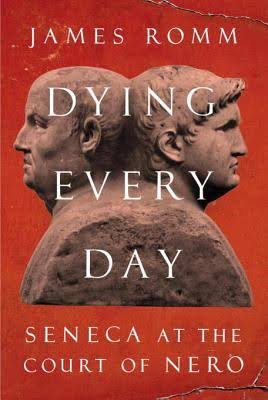
Dying Every Day: Seneca at the Court of Nero

Author: James Romm
Rating: 9/10
Last Read: January 2016

Quick Summary: An overview of the life of Seneca, putting his philosophical works into context with his life and surroundings.  Discusses palace intrigues with the emperor Nero.

If you like history or philosophy, it is an excellent read.

Life, properly regarded, is only a journey toward death. We wrongly say that the old and sick are “dying,” when infants and youths are doing so just as certainly. We are dying every day, all of us

Key Takeaways

Nothing is created in a vacuum.  Seneca’s letters are a source of immense wisdom still today… but when added into the context of his life, his goals, and his aspirations they can take on a totally different slant.

Nothing can be proven, but the theory fits with a pattern of opportunism in much of Seneca’s work. His command of the written word was so deft, his rhetorical skills so subtle, that it was easy for him to help himself while also helping others.

History is super fucking interesting and way better than anything we can make up.  

Elsewhere in De Ira Seneca calls to mind the sufferings of Asian viziers in old Greek legends. Harpagus served as chief minister to a Persian king but offended his master by disregarding an order. The king took a gory revenge: he served Harpagus a stew of his own children’s flesh, then showed him the severed heads to reveal what he had eaten. How did Harpagus like his dinner? the king asked, with Caligulan cruelty. Harpagus’ choking reply was “At a king’s table, every meal is pleasant.” The flattery at least gained him this, Seneca says grimly: he did not have to finish his meal.

My Highlights

Amici vitia si feras, facias tua. If you put up with the crimes of a friend, you make them your own. —ROMAN PROVERB –loc 47

Consolation to Marcia, written about A.D. 40, takes the form of a letter addressed to a mother grieving for a dead son, but it was meant to be read widely. Seneca would play the same rhetorical trick his entire life, allowing his readers to listen in on what seemed to be an intimate exchange. –loc 306

Nothing can be proven, but the theory fits with a pattern of opportunism in much of Seneca’s work. His command of the written word was so deft, his rhetorical skills so subtle, that it was easy for him to help himself while also helping others. –loc 324

Marcia’s grief, for Seneca, exemplifies a universal human blindness. We assume that we own things—family, wealth, position—whereas we have only borrowed them from Fortune. We take for granted that they will be with us forever, and we grieve at their loss; but loss is the more normal event—it is what we should have expected all along. –loc 336

life, properly regarded, is only a journey toward death. We wrongly say that the old and sick are “dying,” when infants and youths are doing so just as certainly. We are dying every day, all of us. –loc 343

Not only in Rome, but everywhere and in all times, good men have knuckled under to despots. –loc 410

Elsewhere in De Ira Seneca calls to mind the sufferings of Asian viziers in old Greek legends. Harpagus served as chief minister to a Persian king but offended his master by disregarding an order. The king took a gory revenge: he served Harpagus a stew of his own children’s flesh, then showed him the severed heads to reveal what he had eaten. How did Harpagus like his dinner? the king asked, with Caligulan cruelty. Harpagus’ choking reply was “At a king’s table, every meal is pleasant.” The flattery at least gained him this, Seneca says grimly: he did not have to finish his meal. –loc 411

Seneca’s hymn to suicide is thus very much of its time. By his day, suicide had come to signify, for aristocratic victims of the emperors, an inability to fight back; the best one could hope for was to embarrass the princeps by a highly public exit. –loc 459

Prexaspes was another vizier like Harpagus, a right-hand man to a Persian monarch. His master, Cambyses, a notorious drunk, set out one day to prove to his court that wine did not affect him. He set up an archery course, with Prexaspes’ son as the target; then, good as his word, he shot the boy through the heart. The story is related in De Ira just before the hymn to suicide above (in which Prexaspes is recalled as “the man whom it befell to have a king shoot arrows at his dear ones”). But Seneca leaves the sequel to the story curiously untold. Years later Prexaspes found himself in possession of dangerous information. He knew that a group of plotters had murdered Cambyses’ heir and put an impostor on the throne. He had colluded with the plot’s leaders, who valued his high standing among the Persian people. When the people became uneasy about their king’s legitimacy, the plotters asked Prexaspes to reassure them. Prexaspes climbed a high tower in a central square of the capital. From a window at the top, he called out to the populace below—but not as instructed. He denounced the impostor and revealed the plot, confessing that he himself had killed the true heir to the throne, on Cambyses’ orders. Then he launched himself off the tower and fell to his death. Inspired by his deed, the Persians rallied against the conspirators and soon overthrew them and their false king. –loc 463

Was life under such arbitrary power worth living? It was the question Seneca had posed in De Ira and, in a different way, in Consolation to Marcia. For Lucius Junius Silanus, the answer—no—was clear enough. Three days after his dismissal, on the same day Claudius wed Agrippina, he took his own life. –loc 618

As in the biblical tale of the Tower of Babel, the very complexity of civilization seemed to carry the seeds of its own destruction—or at least to have a fixed terminus, reached at a regular point every few thousand years. To Seneca, who lived in a city that had reached unimagined levels of sophistication, that terminus seemed not far off. –loc 633

By a curious coincidence, the careers of these two brothers—Seneca’s older brother Novatus, and Pallas’ brother Antonius Felix—are bound together by an unlikely thread: the travels of the apostle Paul. –loc 843

Only philosophic contemplation, he argues, can fulfill that quest. Only those who study philosophy are truly alive, in that they move outside the prison of time into the realm of eternals. All others, those who follow worldly pursuits, are squandering their time, merely running out the ever-ticking clock of mortality. –loc 972

“To fight against an equal is risky; against a higher-up, insane; against someone beneath you, degrading,” –loc 1202

But De Clementia is more emphatic on this point. “We have all of us done wrong,” Seneca intones here, in words that would not be out of place in a modern Christian sermon, “some seriously, some lightly, some intentionally, some pushed into it by accident or carried away by the wrongdoing of others; some have stood by our good designs not firmly enough and have lost our guiltlessness, unwillingly, while trying to keep our grasp on –loc 1563

Seneca had made the bargain that many good men have made when agreeing to aid bad regimes. On the one hand, their presence strengthens the regime and helps it endure. But their moral influence may also improve the regime’s behavior or save the lives of its enemies. For many, this has been a bargain worth making, even if it has cost them—as it may have cost Seneca—their immortal soul. –loc 2088

According to Seneca’s definition in the treatise, Nero’s giving had been not a beneficium, an act of generosity, but a means of asserting power and imposing obligation. –loc 2200

In the fog-bound glens of eastern England, Boudicca, warrior-queen of the Iceni, was gathering a mighty host determined to end Roman rule. At her hands, more than 80,000 Romans and their allies would soon be killed, and the Roman army would come within a hairsbreadth of an epic disaster. –loc 2206

According to Dio’s account, before the rebellion began, Seneca had called in his loans to British tribal leaders, abruptly and on harsh terms. That put many Britons into bankruptcy, while others were broken by the corrupt finance officer in charge of the region, Decianus Catus. Together, Dio suggests, Catus and Seneca forced Britons into a corner where they had nothing to lose by revolt. Tacitus, by contrast, says nothing of Seneca’s moneylending in Britain, though he confirms that Catus had made enemies there by rapacity. For Tacitus, the principal spark of the conflict was the flogging of Boudicca and the rape of her daughters, committed by arrogant Roman troops grown scornful of British tribesmen. –loc 2246

Then Nero turned to a more salient point. “If you return money to me, it won’t be your moderation spoken of by every mouth, but my greed; if you leave your princeps, it will be chalked up to fear of my cruelty. Your self-restraint would earn great praise; but it doesn’t befit a wise man to get glory for himself while bringing ill repute on a friend.” –loc 2329

The most consequential departure was that of Burrus, the stalwart Praetorian prefect, recently dead. The gruff old soldier had been one of few who stood up to Nero, speaking his mind and then, if asked to reconsider, saying to the princeps: “I’ve told you already, don’t question me twice.” –loc 2452

Discomforts overwhelm the body, Seneca muses, in the same way that vice and ignorance overwhelm the soul. The sufferer may not even know he is suffering, just as a deep sleeper does not know he is asleep. Only philosophy can rouse souls from such comas. –loc 2563

By insisting that death is everywhere and cannot be escaped, Seneca seems to relieve himself of the burden of action. For indeed, Seneca was taking very little action in these years to help himself or others. –loc 2672

The will to power, Atreus implies, lurks in even the most detached, self-contented sage. –loc 2945

Seneca’s prose works offer forgiveness, but in the bleak world of the tragedies, the sin of weakness comes back on the sinner’s head a thousandfold. In a gruesome messenger speech, we hear how Atreus butchered, fileted, and stewed Thyestes’ children. Then we watch as Thyestes unknowingly consumes the horrid casserole. –loc 2964

A great stream of manacled men surged toward Nero’s residence, so many that the suspects had to be detained outside, near the gates, for lack of rooms to torture them in. –loc 3167

Seneca allegedly once told Nero—the occasion of the remark is not known—“No matter how many you kill, you can’t kill your successor.” But in this case, as in many others, Nero proved his teacher wrong. He had indeed eliminated all possible successors, men belonging to the Julian line, by the end of 65. –loc 3376

The power to die, Seneca had promised, was present at every moment and transcended every oppression. –loc 3430

Domitian again, as his father had done, banished the Stoics from Rome, including Epictetus, whose magnetic personality had by now become a phenomenon. Epictetus landed in Nicopolis, in the Greek East, and began attracting new followers. His conversations and quips were written down by one of them, young Arrian of Nicomedia (later a famous historian), and began circulating as the Discourses and Encheiridion (“Handbook”). In time these writings, in Greek, filtered back to Rome, where they came under the eyes of an aristocratic youth named Marcus Aurelius Antoninus. One day, after his elevation to princeps, this Marcus would quote the sayings of Epictetus in his own writings—bringing Stoic philosophy back into the palace from which it had been exiled since the death of Seneca. –loc 3519

Siddhartha

Author: Herman Hesse
Rating: 10/10
Last Read: June 2016
Recommended Reading? Yes!

Quick Summary: Siddhartha is a Brahman seeking enlightenment in the time of the Buddha.  He walks many paths in order to find the elusive secret to enlightenment.

Key Takeaways

Even after straying from the path, Siddhartha still manages to find enlightenment.  You can learn from your failures, and in the end perhaps they even open the doorways you need to reach your goal.

Teachers can be dangerous – sometimes the secret is that you must search for the answers on your own, rather than buying into dogma too readily.

Business, property, and the sense-dulling enjoyments of the world stole Siddhartha from the path.  Make sure they don’t do the same to you – treat it as Siddhartha originally did, like a game.

My Highlights

Siddhartha was thus loved by everyone. He was a source of joy for everybody, he was a delight for them all. But he, Siddhartha, was not a source of joy for himself, he found no delight in himself. –loc. 35

“Your soul is the whole world”, –loc. 58

Marvellous wisdom was in these verses, all knowledge of the wisest ones had been collected here in magic words, pure as honey collected by bees. –loc. 59

all of this was not worthy of one look from his eye, it all lied, it all stank, it all stank of lies, it all pretended to be meaningful and joyful and beautiful, and it all was just concealed putrefaction. –loc. 139

A goal stood before Siddhartha, a single goal: to become empty, empty of thirst, empty of wishing, empty of dreams, empty of joy and sorrow. Dead to himself, not to be a self any more, to find tranquility with an emptied heard, to be open to miracles in unselfish thoughts, that was his goal. –loc. 141

Thus Gotama walked towards the town, to collect alms, and the two Samanas recognised him solely by the perfection of his calm, by the quietness of his appearance, in which there was no searching, no desire, no imitation, no effort to be seen, only light and peace. –loc. 301

Whether it may be good or bad, whether living according to it would be suffering or joy, I do not wish to discuss, possibly this is not essential—but the uniformity of the world, that everything which happens is connected, that the great and the small things are all encompassed by the same forces of time, by the same law of causes, of coming into being and of dying, this is what shines brightly out of your exalted teachings, oh perfected one. –loc. 356

“You’ve heard the teachings, oh son of a Brahman, and good for you that you’ve thought about it thus deeply. You’ve found a gap in it, an error. You should think about this further. But be warned, oh seeker of knowledge, of the thicket of opinions and of arguing about words. There is nothing to opinions, they may be beautiful or ugly, smart or foolish, everyone can support them or discard them. But the teachings, you’ve heard from me, are no opinion, and their goal is not to explain the world to those who seek knowledge. They have a different goal; their goal is salvation from suffering. This is what Gotama teaches, nothing else.” –loc. 366

It is not my place to judge another person’s life. Only for myself, for myself alone, I must decide, I must chose, I must refuse. –loc. 385

He realized that one thing had left him, as a snake is left by its old skin, that one thing no longer existed in him, which had accompanied him throughout his youth and used to be a part of him: the wish to have teachers and to listen to teachings. He had also left the last teacher who had appeared on his path, even him, the highest and wisest teacher, the most holy one, Buddha, he had left him, had to part with him, was not able to accept his teachings. –loc. 407

I want to learn from myself, want to be my student, want to get to know myself, the secret of Siddhartha.” –loc. 425

The purpose and the essential properties were not somewhere behind the things, they were in them, in everything. –loc. 433

Because suddenly, he had also become aware of this: He, who was indeed like someone who had just woken up or like a new-born baby, he had to start his life anew and start again at the very beginning. –loc. 440

Beautiful was this world, looking at it thus, without searching, thus simply, thus childlike. Beautiful were the moon and the stars, beautiful was the stream and the banks, the forest and the rocks, the goat and the gold-beetle, the flower and the butterfly. Beautiful and lovely it was, thus to walk through the world, thus childlike, thus awoken, thus open to what is near, thus without distrust. Differently the sun burnt the head, differently the shade of the forest cooled him down, differently the stream and the cistern, the pumpkin and the banana tasted. Short were the days, short the nights, every hour sped swiftly away like a sail on the sea, and under the sail was a ship full of treasures, full of joy. –loc. 472

“Surely. This too, I have learned from the river: everything is coming back! –loc. 513

All are thankful, though they are the ones who would have a right to receive thanks. All are submissive, all would like to be friends, like to obey, think little. Like children are all people.” –loc. 516

You are learning easily, Siddhartha, thus you should also learn this: love can be obtained by begging, buying, receiving it as a gift, finding it in the street, but it cannot be stolen. –loc. 588

Everyone can perform magic, everyone can reach his goals, if he is able to think, if he is able to wait, if he is able to fast.” –loc. 653

“I am without possessions,” said Siddhartha, “if this is what you mean. Surely, I am without possessions. But I am so voluntarily, and therefore I am not destitute.” –loc. 667

“So it seems to be indeed. Everyone takes, everyone gives, such is life.” –loc. 674

“But if you don’t mind me asking: being without possessions, what would you like to give?” “Everyone gives what he has. The warrior gives strength, the merchant gives merchandise, the teacher teachings, the farmer rice, the fisher fish.” “Yes indeed. And what is it now what you’ve got to give? What is it that you’ve learned, what you’re able to do?” “I can think. I can wait. I can fast.” –loc. 674

But like this, Siddhartha can wait calmly, he knows no impatience, he knows no emergency, for a long time he can allow hunger to besiege him and can laugh about it. This, sir, is what fasting is good for.” –loc. 682

“This Brahman,” he said to a friend, “is no proper merchant and will never be one, there is never any passion in his soul when he conducts our business. But he has that mysterious quality of those people to whom success comes all by itself, whether this may be a good star of his birth, magic, or something he has learned among Samanas. He always seems to be merely playing with out business-affairs, they never fully become a part of him, they never rule over him, he is never afraid of failure, he is never upset by a loss.” –loc. 709

Kamaswami held against him that he had not turned back right away, that he had wasted time and money. Siddhartha answered: “Stop scolding, dear friend! Nothing was ever achieved by scolding. If a loss has occurred, let me bear that loss. I am very satisfied with this trip. I have gotten to know many kinds of people, a Brahman has become my friend, children have sat on my knees, farmers have shown me their fields, nobody knew that I was a merchant.” –loc. 719

Besides from this, Siddhartha’s interest and curiosity was only concerned with the people, whose businesses, crafts, worries, pleasures, and acts of foolishness used to be as alien and distant to him as the moon. However easily he succeeded in talking to all of them, in living with all of them, in learning from all of them, he was still aware that there was something which separated him from them and this separating factor was him being a Samana. –loc. 740

He saw mankind going through life in a childlike or animallike manner, which he loved and also despised at the same time. He saw them toiling, saw them suffering, and becoming gray for the sake of things which seemed to him to entirely unworthy of this price, for money, for little pleasures, for being slightly honoured, he saw them scolding and insulting each other, he saw them complaining about pain at which a Samana would only smile, and suffering because of deprivations which a Samana would not feel. –loc. 743

The source ran somewhere, far away from him, ran and ran invisibly, had nothing to do with his life any more. And at several times he suddenly became scared on account of such thoughts and wished that he would also be gifted with the ability to participate in all of this childlike-naive occupations of the daytime with passion and with his heart, really to live, really to act, really to enjoy and to live instead of just standing by as a spectator. –loc. 759

“You are like me, you are different from most people. You are Kamala, nothing else, and inside of you, there is a peace and refuge, to which you can go at every hour of the day and be at home at yourself, as I can also do. Few people have this, and yet all could have it.” “Not all people are smart,” said Kamala. “No,” said Siddhartha, “that’s not the reason why. Kamaswami is just as smart as I, and still has no refuge in himself. Others have it, who are small children with respect to their mind. Most people, Kamala, are like a falling leaf, which is blown and is turning around through the air, and wavers, and tumbles to the ground. But others, a few, are like stars, they go on a fixed course, no wind reaches them, in themselves they have their law and their course. –loc. 765

It is that Gotama, the exalted one, who is spreading that teachings. Thousands of followers are listening to his teachings every day, follow his instructions every hour, but they are all falling leaves, not in themselves they have teachings and a law.” –loc. 772

“It might very well be so,” Siddhartha said tiredly. “I am like you. You also do not love—how else could you practise love as a craft? Perhaps, people of our kind can’t love. The childlike people can; that’s their secret.” –loc. 782

It was still the art of thinking, of waiting, of fasting, which guided his life; still the people of the world, the childlike people, had remained alien to him as he was alien to them. –loc. 788

And yet, he envied them, envied them just the more, the more similar he became to them. He envied them for the one thing that was missing from him and that they had, the importance they were able to attach to their lives, the amount of passion in their joys and fears, the fearful but sweet happiness of being constantly in love. These people were all of the time in love with themselves, with women, with their children, with honours or money, with plans or hopes. But he did not learn this from them, this out of all things, this joy of a child and this foolishness of a child; he learned from them out of all things the unpleasant ones, which he himself despised. –loc. 812

It happened more and more often that, in the morning after having had company the night before, he stayed in bed for a long time, felt unable to think and tired. It happened that he became angry and impatient, when Kamaswami bored him with his worries. It happened that he laughed just too loud, when he lost a game of dice. His face was still smarter and more spiritual than others, but it rarely laughed, and assumed, one after another, those features which are so often found in the faces of rich people, those features of discontent, of sickliness, of ill-humour, of sloth, of a lack of love. Slowly the disease of the soul, which rich people have, grabbed hold of him. –loc. 816

He had been captured by the world, by lust, covetousness, sloth, and finally also by that vice which he had used to despise and mock the most as the most foolish one of all vices: greed. Property, possessions, and riches also had finally captured him; they were no longer a game and trifles to him, had become a shackle and a burden. –loc. 827

And whenever he woke up from this ugly spell, whenever he found his face in the mirror at the bedroom’s wall to have aged and become more ugly, whenever embarrassment and disgust came over him, he continued fleeing, fleeing into a new game, fleeing into a numbing of his mind brought on by sex, by wine, and from there he fled back into the urge to pile up and obtain possessions. In this pointless cycle he ran, growing tired, growing old, growing ill. –loc. 843

Tiredness was written on Kamala’s beautiful face, tiredness from walking a long path, which has no happy destination, tiredness and the beginning of withering, and concealed, still unsaid, perhaps not even conscious anxiety: fear of old age, fear of the autumn, fear of having to die. –loc. 856

But out of all secrets of the river, he today only saw one, this one touched his soul. He saw: this water ran and ran, incessantly it ran, and was nevertheless always there, was always at all times the same and yet new in every moment! Great be he who would grasp this, understand this! He understood and grasped it not, only felt some idea of it stirring, a distant memory, divine voices. –loc. 1082

“It must be beautiful to live by this water every day and to cruise on it.” With a smile, the man at the oar moved from side to side: “It is beautiful, sir, it is as you say. But isn’t every life, isn’t every work beautiful?” –loc. 1090

This was among the ferryman’s virtues one of the greatest: like only a few, he knew how to listen. –loc. 1115

See, you’ve already learned this from the water too, that it is good to strive downwards, to sink, to seek depth. –loc. 1127

Most of all, he learned from it to listen, to pay close attention with a quiet heart, with a waiting, opened soul, without passion, without a wish, without judgement, without an opinion. –loc. 1142

Oh, was not all suffering time, were not all forms of tormenting oneself and being afraid time, was not everything hard, everything hostile in the world gone and overcome as soon as one had overcome time, as soon as time would have been put out of existence by one’s thoughts? –loc. 1153

“Pardon me.” he said, “from a friendly heart, I’m talking to you. –loc. 1269

Would you think, my dear, anybody might perhaps be spared from taking this path? That perhaps your little son would be spared, because you love him, because you would like to keep him from suffering and pain and disappointment? But even if you would die ten times for him, you would not be able to take the slightest part of his destiny upon yourself.” –loc. 1302

This he had learned by the river, this one thing: waiting, having patience, listening attentively. –loc. 1371

Worthy of love and admiration were these people in their blind loyalty, their blind strength and tenacity. They lacked nothing, there was nothing the knowledgeable one, the thinker, had to put him above them except for one little thing, a single, tiny, small thing: the consciousness, the conscious thought of the oneness of all life. –loc. 1398

Slowly blossomed, slowly ripened in Siddhartha the realisation, the knowledge, what wisdom actually was, what the goal of his long search was. It was nothing but a readiness of the soul, an ability, a secret art, to think every moment, while living his life, the thought of oneness, to be able to feel and inhale the oneness. Slowly this blossomed in him, was shining back at him from Vasudeva’s old, childlike face: harmony, knowledge of the eternal perfection of the world, smiling, oneness. –loc. 1403

When he had finished talking, Vasudeva turned his friendly eyes, which had grown slightly weak, at him, said nothing, let his silent love and cheerfulness, understanding and knowledge, shine at him. –loc. 1439

The river sang with a voice of suffering, longingly it sang, longingly, it flowed towards its goal, lamentingly its voice sang. –loc. 1446

In this hour, Siddhartha stopped fighting his fate, stopped suffering. On his face flourished the cheerfulness of a knowledge, which is no longer opposed by any will, which knows perfection, which is in agreement with the flow of events, with the current of life, full of sympathy for the pain of others, full of sympathy for the pleasure of others, devoted to the flow, belonging to the oneness. –loc. 1469

“What should I possibly have to tell you, oh venerable one? Perhaps that you’re searching far too much? That in all that searching, you don’t find the time for finding?” –loc. 1492

“When someone is searching,” said Siddhartha, “then it might easily happen that the only thing his eyes still see is that what he searches for, that he is unable to find anything, to let anything enter his mind, because he always thinks of nothing but the object of his search, because he has a goal, because he is obsessed by the goal. Searching means: having a goal. But finding means: being free, being open, having no goal. You, oh venerable one, are perhaps indeed a searcher, because, striving for your goal, there are many things you don’t see, which are directly in front of your eyes.” –loc. 1494

“A ferryman, yes. Many people, Govinda, have to change a lot, have to wear many a robe, I am one of those, my dear. –loc. 1505

Look, my dear Govinda, this is one of my thoughts, which I have found: wisdom cannot be passed on. Wisdom which a wise man tries to pass on to someone always sounds like foolishness.” –loc. 1522

Knowledge can be conveyed, but not wisdom. It can be found, it can be lived, it is possible to be carried by it, miracles can be performed with it, but it cannot be expressed in words and taught. –loc. 1524

That’s like this: any truth can only be expressed and put into words when it is one-sided. Everything is one-sided which can be thought with thoughts and said with words, it’s all one-sided, all just one half, all lacks completeness, roundness, oneness. –loc. 1528

But the world itself, what exists around us and inside of us, is never one-sided. –loc. 1531

The words are not good for the secret meaning, everything always becomes a bit different, as soon as it is put into words, gets distorted a bit, a bit silly—yes, and this is also very good, and I like it a lot, I also very much agree with this, that this what is one man’s treasure and wisdom always sounds like foolishness to another person.” –loc. 1560

I can love a stone, Govinda, and also a tree or a piece of bark. This are things, and things can be loved. But I cannot love words. Therefore, teachings are no good for me, they have no hardness, no softness, no colours, no edges, no smell, no taste, they have nothing but words. Perhaps it are these which keep you from finding peace, perhaps it are the many words. Because salvation and virtue as well, Sansara and Nirvana as well, are mere words, Govinda. There is no thing which would be Nirvana; there is just the word Nirvana.” –loc. 1566

love, oh Govinda, seems to me to be the most important thing of all. To thoroughly understand the world, to explain it, to despise it, may be the thing great thinkers do. But I’m only interested in being able to love the world, not to despise it, not to hate it and me, to be able to look upon it and me and all beings with love and admiration and great respect.” –loc. 1581