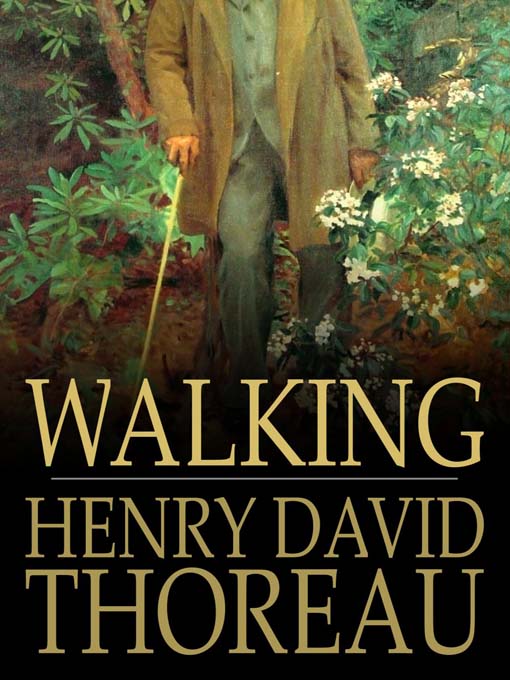
Walking

Author: Henry David Thoreau
Rating: 8/10
Last Read: August 2016

Quick Summary:  Thoreau’s essay on the joys and virtues of the walking man is an enjoyable read if you like to walk (as I do).   Your head will become inflated and you will feel better than all those around you who are in their cars or at their homes sitting idly.  The real crown jewel of the essay, however, is his departure into discussion of the wild.   It is true, still in this day, that the wild calls to us. 

I did not expect to find a timeless piece like this one calling through the ages. Take Thoreau’s advice.  Go outside.  Turn off your phone.  Be in the world with body and spirit.  Find something wild.

Nowadays almost all man’s improvements, so called, as the building of houses and the cutting down of the forest and of all large trees, simply deform the landscape, and make it more and more tame and cheap.

My Highlights

For this is the secret of successful sauntering. He who sits still in a house all the time may be the greatest vagrant of all; but the saunterer, in the good sense, is no more vagrant than the meandering river, which is all the while sedulously seeking the shortest course to the sea. –loc 11

It is true, we are but faint-hearted crusaders, even the walkers, nowadays, who undertake no persevering, never-ending enterprises. Our expeditions are but tours, and come round again at evening to the old hearth-side from which we set out. Half the walk is but retracing our steps. –loc 15

No wealth can buy the requisite leisure, freedom, and independence which are the capital in this profession. –loc 25

Ambulator nascitur, non fit. –loc 27

I think that I cannot preserve my health and spirits, unless I spend four hours a day at least—and it is commonly more than that—sauntering through the woods and over the hills and fields, absolutely free from all worldly engagements. –loc 33

When sometimes I am reminded that the mechanics and shopkeepers stay in their shops not only all the forenoon, but all the afternoon too, sitting with crossed legs, so many of them—as if the legs were made to sit upon, and not to stand or walk upon—I think that they deserve some credit for not having all committed suicide long ago. –loc 35

When a traveler asked Wordsworth’s servant to show him her master’s study, she answered, “Here is his library, but his study is out of doors.” –loc 57

Living much out of doors, in the sun and wind, will no doubt produce a certain roughness of character—will cause a thicker cuticle to grow over some of the finer qualities of our nature, as on the face and hands, or as severe manual labor robs the hands of some of their delicacy of touch. –loc 58

I am alarmed when it happens that I have walked a mile into the woods bodily, without getting there in spirit. –loc 70

In my afternoon walk I would fain forget all my morning occupations and my obligations to Society. But it sometimes happens that I cannot easily shake off the village. The thought of some work will run in my head and I am not where my body is—I am out of my senses. In my walks I would fain return to my senses. What business have I in the woods, if I am thinking of something out of the woods? –loc 71

Nowadays almost all man’s improvements, so called, as the building of houses and the cutting down of the forest and of all large trees, simply deform the landscape, and make it more and more tame and cheap. –loc 79

To enjoy a thing exclusively is commonly to exclude yourself from the true enjoyment of it. Let us improve our opportunities, then, before the evil days come. –loc 129

Every sunset which I witness inspires me with the desire to go to a West as distant and as fair as that into which the sun goes down. –loc 162

Every tree sends its fibers forth in search of the Wild. The cities import it at any price. Men plow and sail for it. From the forest and wilderness come the tonics and barks which brace mankind. Our ancestors were savages. The story of Romulus and Remus being suckled by a wolf is not a meaningless fable. The founders of every state which has risen to eminence have drawn their nourishment and vigor from a similar wild source. –loc 220

Life consists with wildness. The most alive is the wildest. Not yet subdued to man, its presence refreshes him. –loc 242

In literature it is only the wild that attracts us. Dullness is but another name for tameness. It is the uncivilized free and wild thinking in Hamlet and the Iliad, in all the scriptures and mythologies, not learned in the schools, that delights us. –loc 290

In short, all good things are wild and free. There is something in a strain of music, whether produced by an instrument or by the human voice—take the sound of a bugle in a summer night, for instance—which by its wildness, to speak without satire, reminds me of the cries emitted by wild beasts in their native forests. It is so much of their wildness as I can understand. Give me for my friends and neighbors wild men, not tame ones. The wildness of the savage is but a faint symbol of the awful ferity with which good men and lovers meet. –loc 325

By long years of patient industry and reading of the newspapers—for what are the libraries of science but files of newspapers—a man accumulates a myriad facts, lays them up in his memory, and then when in some spring of his life he saunters abroad into the Great Fields of thought, he, as it were, goes to grass like a horse and leaves all his harness behind in the stable. –loc 382

My desire for knowledge is intermittent, but my desire to bathe my head in atmospheres unknown to my feet is perennial and constant. The highest that we can attain to is not Knowledge, but Sympathy with Intelligence. –loc 390

There is something servile in the habit of seeking after a law which we may obey. We may study the laws of matter at and for our convenience, but a successful life knows no law. –loc 395

It is an unfortunate discovery certainly, that of a law which binds us where we did not know before that we were bound. –loc 396

Above all, we cannot afford not to live in the present. He is blessed over all mortals who loses no moment of the passing life in remembering the past. –loc 452
Gratitude

Author: Oliver Sacks
Rating: 10/10
Last Read: July 2016

Quick Summary: A short selection of four essays written by Dr. Oliver Sacks.  These essays cover the end of his life, with reflections on old age, facing mortality, and the gratitude he has for being a sentient being on this planet.  

“Whatever must have a beginning must have an ending.”

Recommended Reads: On the Move (autobiography), On Death and Dying

My Takeaways

You never quite lose the sense of childish wonder if you keep that attitude about you as you grow older.

There really is an essential truth to the matter of dying: when it comes time for you to accept your fate, the nonessential falls away and you focus on the truly important things.  

It is possible to meet death with dignity and grace.

I cannot pretend I am without fear. But my predominant feeling is one of gratitude. I have loved and been loved; I have been given much and I have given something in return; I have read and traveled and thought and written. I have had an intercourse with the world, the special intercourse of writers and readers.

My Highlights

A few years ago, when I gave a friend a bottle of mercury for his eightieth birthday—a special bottle that could neither leak nor break—he gave me a peculiar look, but later sent me a charming letter in which he joked, “I take a little every morning for my health.” –loc 80

Eighty! I can hardly believe it. I often feel that life is about to begin, only to realize it is almost over. –loc 83

I thought I would die at forty-one, when I had a bad fall and broke a leg while mountaineering alone. I splinted the leg as best I could and started to lever myself down the mountain, clumsily, with my arms. In the long hours that followed, I was assailed by memories, both good and bad. Most were in a mode of gratitude—gratitude for what I had been given by others, gratitude too that I had been able to give something back. –loc 86

I am sorry I have wasted (and still waste) so much time; I am sorry to be as agonizingly shy at eighty as I was at twenty; I am sorry that I speak no languages but my mother tongue and that I have not traveled or experienced other cultures as widely as I should have done. –loc 96

At eighty, the specter of dementia or stroke looms. A third of one’s contemporaries are dead, and many more, with profound mental or physical damage, are trapped in a tragic and minimal existence. At eighty, the marks of decay are all too visible. One’s reactions are a little slower, names more frequently elude one, and one’s energies must be husbanded, but even so, one may often feel full of energy and life and not at all “old.” Perhaps, with luck, I will make it, more or less intact, for another few years and be granted the liberty to continue to love and work, the two most important things, Freud insisted, in life. –loc 105

When pressed about his diagnosis a few weeks later, he said, “Whatever has a beginning must have an ending.” When he died, at eighty-eight, he was still fully engaged in his most creative work. –loc 112

He felt, as I begin to feel, not a shrinking but an enlargement of mental life and perspective. One has had a long experience of life, not only one’s own life, but others’ too. One has seen triumphs and tragedies, booms and busts, revolutions and wars, great achievements and deep ambiguities. One has seen grand theories rise, only to be toppled by stubborn facts. One is more conscious of transience and, perhaps, of beauty. At eighty, one can take a long view and have a vivid, lived sense of history not possible at an earlier age. I can imagine, feel in my bones, what a century is like, which I could not do when I was forty or sixty. I do not think of old age as an ever grimmer time that one must somehow endure and make the best of, but as a time of leisure and freedom, freed from the factitious urgencies of earlier days, free to explore whatever I wish, and to bind the thoughts and feelings of a lifetime together. –loc 115

It is up to me now to choose how to live out the months that remain to me. I have to live in the richest, deepest, most productive way I can. –loc 134

And yet, one line from Hume’s essay strikes me as especially true: “It is difficult,” he wrote, “to be more detached from life than I am at present.” Over the last few days, I have been able to see my life as from a great altitude, as a sort of landscape, and with a deepening sense of the connection of all its parts. This does not mean I am finished with life. On the contrary, I feel intensely alive, and I want and hope in the time that remains to deepen my friendships, to say farewell to those I love, to write more, to travel if I have the strength, to achieve new levels of understanding and insight. –loc 147

I feel a sudden clear focus and perspective. There is no time for anything inessential. I must focus on myself, my work, and my friends. I shall no longer look at the NewsHour every night. I shall no longer pay any attention to politics or arguments about global warming. –loc 153

My generation is on the way out, and each death I have felt as an abruption, a tearing away of part of myself. There will be no one like us when we are gone, but then there is no one like anyone else, ever. When people die, they cannot be replaced. They leave holes that cannot be filled, for it is the fate—the genetic and neural fate—of every human being to be a unique individual, to find his own path, to live his own life, to die his own death. –loc 159

I cannot pretend I am without fear. But my predominant feeling is one of gratitude. I have loved and been loved; I have been given much and I have given something in return; I have read and traveled and thought and written. I have had an intercourse with the world, the special intercourse of writers and readers. –loc 163

Above all, I have been a sentient being, a thinking animal, on this beautiful planet, and that in itself has been an enormous privilege and adventure. –loc 165

It was this celestial splendor that suddenly made me realize how little time, how little life, I had left. My sense of the heavens’ beauty, of eternity, was inseparably mixed for me with a sense of transience—and death. –loc 191

(Auden used to say that one should always celebrate one’s birthday, no matter how one felt.) –loc 215

“The observance of the Sabbath is extremely beautiful,” he said, “and is impossible without being religious. It is not even a question of improving society—it is about improving one’s own quality of life.” –loc 301

Robert John visited. He was full of entertaining stories about the Nobel Prize and the ceremony in Stockholm, but made a point of saying that, had he been compelled to travel to Stockholm on a Saturday, he would have refused the prize. His commitment to the Sabbath, its utter peacefulness and remoteness from worldly concerns, would have trumped even a Nobel. –loc 307

The peace of the Sabbath, of a stopped world, a time outside time, was palpable, infused everything, and I found myself drenched with a wistfulness, something akin to nostalgia, wondering what if: What if A and B and C had been different? –loc 324

And now, weak, short of breath, my once-firm muscles melted away by cancer, I find my thoughts, increasingly, not on the supernatural or spiritual but on what is meant by living a good and worthwhile life—achieving a sense of peace within oneself. I find my thoughts drifting to the Sabbath, the day of rest, the seventh day of the week, and perhaps the seventh day of one’s life as well, when one can feel that one’s work is done, and one may, in good conscience, rest. –loc 333