How to Tell a Mother Her Child is Dead

I like to listen to podcasts and lectures during my morning dog walk. This morning I listened to Jocko Podcast, specifically episode 58. The episode opened with Jocko reading a powerful essay by Dr. Naomi Rosenberg titled “How to Tell a Mother Her Child is Dead”. The essay is stark, direct, and powerful. While the surface level provides instructions for how to deliver terrible news of a child’s death, there are lessons to take away in how to deliver any hard news:

  1. Rehearse delivering the news out loud
  2. Be polite upon meeting and shake everyone’s hand
  3. Indicate up front that “I have bad news”
  4. If related to a person, it is never “the patient”, or “the employee”, or “him”. ALWAYS USE THEIR NAME
  5. Provide the information as clearly as possible
  6. Always deliver the truth and do not sugar coat the answer
  7. Avoid sharing excessive information or answering questions which were not asked
  8. Stay around for support as long as it is necessary
  9. Expect emotional reactions and allow them to happen
  10. Keep your feelings in the room and do not take your frustration out on others

I highly recommend listening to Jocko read this essay, and the original text is included below.


How to Tell a Mother Her Child Is Dead

By NAOMI ROSENBERG
SEPT. 3, 2016

Philadelphia — First you get your coat. I don’t care if you don’t remember where you left it, you find it. If there was a lot of blood you ask someone to go quickly to the basement to get you a new set of scrubs. You put on your coat and you go into the bathroom. You look in the mirror and you say it. You use the mother’s name and you use her child’s name. You may not adjust this part in any way.

I will show you: If it were my mother you would say, “Mrs. Rosenberg. I have terrible, terrible news. Naomi died today.” You say it out loud until you can say it clearly and loudly. How loudly? Loudly enough. If it takes you fewer than five tries you are rushing it and you will not do it right. You take your time.

After the bathroom you do nothing before you go to her. You don’t make a phone call, you do not talk to the medical student, you do not put in an order. You never make her wait. She is his mother.

When you get inside the room you will know who the mother is. Yes, I’m very sure. Shake her hand and tell her who you are. If there is time you shake everyone’s hand. Yes, you will know if there is time. You never stand. If there are no seats left, the couches have arms on them.

You will have to make a decision about whether you will ask what she already knows. If you were the one to call her and tell her that her son had been shot then you have already done part of it, but you have not done it yet. You are about to do it now. You never make her wait. She is his mother. Now you explode the world. Yes, you have to. You say something like: “Mrs. Booker. I have terrible, terrible news. Ernest died today.”

Then you wait.

You will not stand up. You may leave yourself in the heaviness of your breath or the racing of your pulse or the sight of your shoelaces on your shoe, but you will not stand up. You are here for her. She is his mother.

If the mother has another son with her and he has punched the wall or broken the chair, do not be worried. The one that punched the wall or broke the chair will be better than the one who looks down and refuses to cry. The one who punched the wall or broke the chair will be much easier than the sister who looks up and closes her eyes as they fill.

Security is already outside the room and when they hear the first loud noise they will know to come in. No, you will not have to tell them. They know about the family room in the emergency department in summer in North Philadelphia. It is all right. They will be kind. If the chair cannot be sat in again that is all right. We have money for new chairs every summer. If he does not break your chair you stay in your chair. If he does you find a new place to sit. You are here for the mother and you have more to do.

If she asks you, you will tell her what you know. You do not lie. But do not say he was murdered or he was killed. Yes, I know that he was, but that is not what you say. You say that he died; that is the part that you saw and that you know. When she asks if he felt any pain, you must be very careful. If he did not, you assure her quickly. If he did, you do not lie. But his pain is over now. Do not ever say he was lucky that he did not feel pain. He was not lucky. She is not lucky. Don’t make that face. The depth of the stupidity of the things you will say sometimes is unimaginable.

Before you leave you break her heart one more time. “No, I’m so sorry, but you cannot see him. There are strict rules when a person dies this way and the police have to take him first. We cannot let you in. I’m so sorry.” You do not ever say “the body.” It is not a body. It is her son. You want to tell her that you know that he was hers. But she knows that and she does not need for you to tell her. Instead you tell her you will give her time and come back in case she has questions. More questions, or questions for the first time. If she has no questions you do not give her the answers to the questions she has not asked.

When you leave the room, do not yell at the medical student who has a question. When you get home, do not yell at your husband. If he left his socks on the floor again today, it is all right.
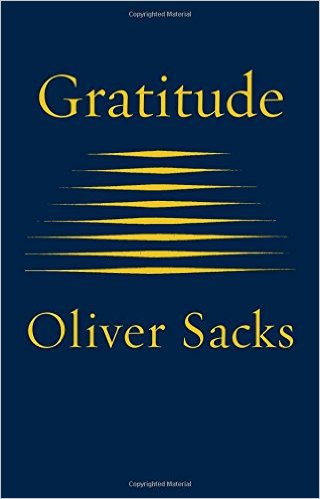
Gratitude

Author: Oliver Sacks
Rating: 10/10
Last Read: July 2016

Quick Summary: A short selection of four essays written by Dr. Oliver Sacks.  These essays cover the end of his life, with reflections on old age, facing mortality, and the gratitude he has for being a sentient being on this planet.  

“Whatever must have a beginning must have an ending.”

Recommended Reads: On the Move (autobiography), On Death and Dying

My Takeaways

You never quite lose the sense of childish wonder if you keep that attitude about you as you grow older.

There really is an essential truth to the matter of dying: when it comes time for you to accept your fate, the nonessential falls away and you focus on the truly important things.  

It is possible to meet death with dignity and grace.

I cannot pretend I am without fear. But my predominant feeling is one of gratitude. I have loved and been loved; I have been given much and I have given something in return; I have read and traveled and thought and written. I have had an intercourse with the world, the special intercourse of writers and readers.

My Highlights

A few years ago, when I gave a friend a bottle of mercury for his eightieth birthday—a special bottle that could neither leak nor break—he gave me a peculiar look, but later sent me a charming letter in which he joked, “I take a little every morning for my health.” –loc 80

Eighty! I can hardly believe it. I often feel that life is about to begin, only to realize it is almost over. –loc 83

I thought I would die at forty-one, when I had a bad fall and broke a leg while mountaineering alone. I splinted the leg as best I could and started to lever myself down the mountain, clumsily, with my arms. In the long hours that followed, I was assailed by memories, both good and bad. Most were in a mode of gratitude—gratitude for what I had been given by others, gratitude too that I had been able to give something back. –loc 86

I am sorry I have wasted (and still waste) so much time; I am sorry to be as agonizingly shy at eighty as I was at twenty; I am sorry that I speak no languages but my mother tongue and that I have not traveled or experienced other cultures as widely as I should have done. –loc 96

At eighty, the specter of dementia or stroke looms. A third of one’s contemporaries are dead, and many more, with profound mental or physical damage, are trapped in a tragic and minimal existence. At eighty, the marks of decay are all too visible. One’s reactions are a little slower, names more frequently elude one, and one’s energies must be husbanded, but even so, one may often feel full of energy and life and not at all “old.” Perhaps, with luck, I will make it, more or less intact, for another few years and be granted the liberty to continue to love and work, the two most important things, Freud insisted, in life. –loc 105

When pressed about his diagnosis a few weeks later, he said, “Whatever has a beginning must have an ending.” When he died, at eighty-eight, he was still fully engaged in his most creative work. –loc 112

He felt, as I begin to feel, not a shrinking but an enlargement of mental life and perspective. One has had a long experience of life, not only one’s own life, but others’ too. One has seen triumphs and tragedies, booms and busts, revolutions and wars, great achievements and deep ambiguities. One has seen grand theories rise, only to be toppled by stubborn facts. One is more conscious of transience and, perhaps, of beauty. At eighty, one can take a long view and have a vivid, lived sense of history not possible at an earlier age. I can imagine, feel in my bones, what a century is like, which I could not do when I was forty or sixty. I do not think of old age as an ever grimmer time that one must somehow endure and make the best of, but as a time of leisure and freedom, freed from the factitious urgencies of earlier days, free to explore whatever I wish, and to bind the thoughts and feelings of a lifetime together. –loc 115

It is up to me now to choose how to live out the months that remain to me. I have to live in the richest, deepest, most productive way I can. –loc 134

And yet, one line from Hume’s essay strikes me as especially true: “It is difficult,” he wrote, “to be more detached from life than I am at present.” Over the last few days, I have been able to see my life as from a great altitude, as a sort of landscape, and with a deepening sense of the connection of all its parts. This does not mean I am finished with life. On the contrary, I feel intensely alive, and I want and hope in the time that remains to deepen my friendships, to say farewell to those I love, to write more, to travel if I have the strength, to achieve new levels of understanding and insight. –loc 147

I feel a sudden clear focus and perspective. There is no time for anything inessential. I must focus on myself, my work, and my friends. I shall no longer look at the NewsHour every night. I shall no longer pay any attention to politics or arguments about global warming. –loc 153

My generation is on the way out, and each death I have felt as an abruption, a tearing away of part of myself. There will be no one like us when we are gone, but then there is no one like anyone else, ever. When people die, they cannot be replaced. They leave holes that cannot be filled, for it is the fate—the genetic and neural fate—of every human being to be a unique individual, to find his own path, to live his own life, to die his own death. –loc 159

I cannot pretend I am without fear. But my predominant feeling is one of gratitude. I have loved and been loved; I have been given much and I have given something in return; I have read and traveled and thought and written. I have had an intercourse with the world, the special intercourse of writers and readers. –loc 163

Above all, I have been a sentient being, a thinking animal, on this beautiful planet, and that in itself has been an enormous privilege and adventure. –loc 165

It was this celestial splendor that suddenly made me realize how little time, how little life, I had left. My sense of the heavens’ beauty, of eternity, was inseparably mixed for me with a sense of transience—and death. –loc 191

(Auden used to say that one should always celebrate one’s birthday, no matter how one felt.) –loc 215

“The observance of the Sabbath is extremely beautiful,” he said, “and is impossible without being religious. It is not even a question of improving society—it is about improving one’s own quality of life.” –loc 301

Robert John visited. He was full of entertaining stories about the Nobel Prize and the ceremony in Stockholm, but made a point of saying that, had he been compelled to travel to Stockholm on a Saturday, he would have refused the prize. His commitment to the Sabbath, its utter peacefulness and remoteness from worldly concerns, would have trumped even a Nobel. –loc 307

The peace of the Sabbath, of a stopped world, a time outside time, was palpable, infused everything, and I found myself drenched with a wistfulness, something akin to nostalgia, wondering what if: What if A and B and C had been different? –loc 324

And now, weak, short of breath, my once-firm muscles melted away by cancer, I find my thoughts, increasingly, not on the supernatural or spiritual but on what is meant by living a good and worthwhile life—achieving a sense of peace within oneself. I find my thoughts drifting to the Sabbath, the day of rest, the seventh day of the week, and perhaps the seventh day of one’s life as well, when one can feel that one’s work is done, and one may, in good conscience, rest. –loc 333