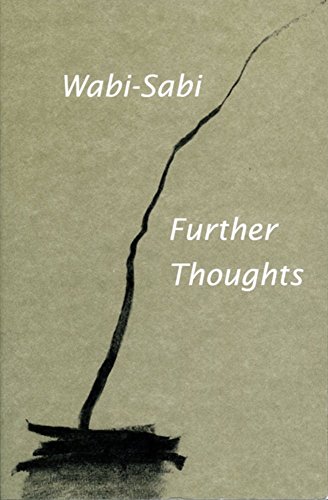
Wabi-Sabi: Further Thoughts

Author: Leonard Koren
Rating: 9/10
Last Read: 11/2017

Wabi-Sabi: Further Thoughts seeks to expand upon Koren’s previous work Wabi-Sabi: For Artists, Designers, Poets & Philosophers. Koren seeks to clarify some of the concepts that were introduced in his first work, and provide more context to the interested mind. He also discusses some interesting topics, such as whether digital art can ever express wabi-sabi.

If you liked the first book and want to further refine your understanding of wabi-sabi, read Wabi-Sabi: Further Thoughts.

My Highlights

wabi-sabi =

The aesthetic other.

  • a contrast/differentiation from the dominant aesthetic convention.
  • bulwark against sameness
  • rejection of the Chinese-derived taste for smooth, symmetrical perfection
  • Wabi taste: irregular and rough-textured objects, aka the aesthetic other in that historical context

The transfiguration of the commonplace.

  • Beauty of wabi-sabi is a perpetual event; it is not an inherent property of things
  • Wabi-sabi “happens” when conditioned and habituated ways of looking at things fall away, when things are defamiliarized
  • The beauty of wabi-sabi involves perceiving something extraordinary in something that might otherwise be regarded as quite ordinary, undistinguished or barely there.

Beauty at the edge of nothingness

  • Infinite potentiality of nothingness
  • Distinctiveness comes from something which is so faint, tentative, delicate, and subtle that it may be overlooked – or mistaken as trivial or insignificant.

Elegant Poverty

  • “Poverty” in this meaning as the mindset of non-attachment, I.e. not holding onto fixed ideas or material things.
  • “Elegant” refers to a graceful acceptance of restraint, inconvenience, and uncertainty.

Imperfection

  • Represented by entropic processes of nature made visible
  • Chaos and unpredictability, producing variety and interest
  • Under the right conditions, imperfection-embodied things can arouse a sense of empathy.

In the era of wabi-tea, the Japanese telling of the creation process: “things spontaneously appear beyond the technical and conceptual intervention” of artists or designers. An egoless point of view. wabi-sabi “occurs”, it is not “created” or “made”

Reluctance to make wabi-ness a mode of agency

Anonymously made objects taken from other contexts and used in new ways. Broken things, both common and special, are fixed, leaving scars of repair, and put back into service.

Never up to the fabricator to decide whether or not something is wabi: it’s up to the individual beholder.

“According to Rikyu, a preoccupation with things in and of themselves is tantamount to a spiritual failing”

“Sloppiness, whether by design or accident, is the result of thoughtlessness. Thoughtlessness has no place in the wabi-sabi concept.”

The modern project:

  • Reason is superior to all other forms of cognition
  • Science offers the ultimate solutions to mankind’s problems
  • The world is “broken”, but in the future things will be better.
  • It is necessary for humans to master nature
  • Look for universal solutions to fit all instances and circumstances

Wabi-sabi:

  • Reason is only one of many equally important modes of cognition
  • Science can only solve a limited range of mankind’s problems
  • The world simply “is”, and always will be so
  • Humans and nature are one; there is no master, there is no slave
  • Look for specific solutions for particular instances and circumstances

“Wabi-sabi is based on effortless, uninterrupted interactions with real (actual) things in the real (actual) world. The real world is dependent only on a consciousness to perceive it.”

“Digital reality, on the other hand, requires the effort of someone (the encoder, the device maker) to exist, and is dependent upon machinery and an external power source. When either the will of the maker, the machinery, or the power fails, digital reality ceases to be.”

Buy the Book

If you are interested in purchasing this book, you can support the website by using our Amazon affiliate link:


Wabi-Sabi: For Artists, Designers, Poets & Philosophers

Author: Leonard Koren
Rating: 10/10
Last Read: 11/2017

I’ve recently found myself immersed in Japanese topics. I have been listening to Zen lectures by Alan Watts, working at the Japanese Tea Garden, and learning more about bonsai. I’ve also recently read Shogun, Samurai William, and Taiko, each focused on the end of the Sengoku period.

Wabi-Sabi: For Artists, Designers, Poets & Philosophers also fits into the same Japanese theme. Wabi-sabi is an aesthetic aspect that permeates much of Japanese culture. Leonard Koren has created a beautiful (and short) work that seeks to demystify wabi-sabi so it can be more accessible to interested minds. Koren avoids using absolute terms to describe wabi-sabi, instead giving us a general picture of the feelings, attitudes, and qualities that imbune wabi-sabi. The books is designed, printed, and arranged in such a way to highlight these same characteristics. I appreciate Koren’s thoughtfulness in creating this work, and I find myself reviewing it on a regular basis.

If you’re looking for some artistic inspiration, have a fond love of natural processes, or are just curious about an essential element of Japanese culture, check out Wabi-Sabi: For Artists, Designers, Poets & Philosophers.

My Highlights

wabi refers to:

  • a way of life, a spiritual path
  • the inward, the subjective
  • a philosophical construct
  • spacial events

sabi refers to:

  • material objects, art and literature
  • the outward, the objective
  • an aesthetic ideal
  • temporal events

Similarities between modernism and wabi-sabi:

  • Both apply to all manner of manmade objects, spaces, and designs.
  • Botha re strong reactions against the dominant, established sensibilities of their time. Modernism was a radical departure from 19th-century classicism and eclecticism. Wabi-sabi was a radical departure from the Chinese perfection and gorgeousness of the 16h-century and earlier.
  • Both eschew any decoration that is not integral to structure.
  • Both are abstract, nonrepresentational ideals of beauty.
  • Both have readily identifiable surface characteristics. Modernism is seamless, polished, and smooth. Wabi-sabi is earthy, imperfect, and variegated.

Differences between the Modernism and wabi-sabi

Modernism:

  • Primarily expressed in the public domain
  • implies a logical, rational worldview
  • absolute
  • looks for universal, prototypical solutions
  • Mass-produced/modular
  • Expresses faith in progress
  • Future-oriented
  • Believes in the control of nature
  • Romanticizes technology
  • People adapting to machines
  • Geometric organization of form (sharp, precise, definite shapes and edges)
  • The box as metaphor (rectilinear, precise, contained)
  • Manmade materials
  • Ostensibly slick
  • needs to be well-maintained
  • purity makes its expression richer
  • solicits the reduction of sensory information
  • Is intolerant of ambiguity and contradiction
  • Cool
  • Generally light and bright
  • Function and utility are primary values
  • Perfect materiality is an ideal
  • Everlasting

wabi-sabi:

  • Primarily expressed in the private domain
  • Implies an intuitive worldview
  • Relative
  • Looks for personal, idiosyncratic solutions
  • One-of-a-kind/variable
  • There is no progress
  • Present-oriented
  • Believes in the fundamental uncontrollability of nature
  • Romanticizes nature
  • People adapting to nature
  • Organic organization of form (soft, vague shapes and edges)
  • The bowl as a metaphor (free shape, open at top)
  • Natural materials
  • Ostensibly crude
  • Accomodates to degradation and attrition
  • Corrosion and contamination make its expression richer
  • Solicits the expansion of sensory information
  • Is comfortable with ambiguity and contradiction
  • Warm
  • Generally dark and dim
  • Function and utility are not so important
  • Perfect immateriality is an ideal
  • To every thing there is a season

The Wabi-Sabi Universe

Metaphysical basis: Things are either devolving toward, or evolving from, nothingness

Spiritual Values:

  • Truth comes from the observation of nature
  • “Greatness” exists in the inconspicuous and overlooked details
  • Beauty can be coaxed out of ugliness

State of mind:

  • Acceptance of the inevitable
  • Appreciation of the cosmic order

Moral Precepts:

  • Get rid of all that is unnecessary
  • Focus on the intrinsic and ignore material hierarchy

Material Qualities:

  • The suggestion of natural process
  • Irregular
  • Intimate
  • Unpretentious
  • Earthy
  • Murky
  • Simple

What are the lessons of the universe?

  1. All things are impermanent
  2. All things are imperfect
  3. All things are incomplete

The simplicity of wabi-sabi is probably best described as the state of grace arrived at by a sober, modest, heartfelt intelligence. The main strategy of this intelligence is economy of means. Pare down to the essence, but don’t remove the poetry. Keep things clean and unencumbered, but don’t sterilize. (Things wabi-sabi are emotionally warm, never cold.) Usually this implies a limited palette of materials. It also means keeping conspicuous features to a minimum. But it doesn’t mean removing the invisible connective tissue that somehow binds the elements into meaningful whole. It also doesn’t mean in any way diminishing something’s “interestingness,” the quality that compels us to look at that something over, and over, and over again.

Buy the Book

If you are interested in purchasing this book, you can support the website by using our Amazon affiliate link: