What is Tao?

Author: Alan Watts
Rating: 9/10
Last Read: April 2017

Quick Summary:  Alan Watts’s short book What is Tao? is an excellent (and quick!) introduction to Taoism and its core philosophies. I immediately followed What is Tao? with the Tao Te Ching and started exploring the I Ching. I find that Taoism and Stoicism are very interesting to study together, and I’m excited to dive further into this new area.

My Highlights

As I sat working on this manuscript my eight-year-old son came up to me and asked, “Papa, what are you working on?” I told him it was a book on the Tao, and began to explain a little bit about it, but without a moment’s hesitation he said, “Oh, you mean what’s behind everything” — and then he headed off. Intuitively and experientially we know what it is, but for most of us the problem arises when we try to explain it. –loc 118

Living close to the earth one sees the wisdom of not interfering with the course of life, and of letting things go their way. This is the wisdom that also tells us not to get in our own way, and to paddle with the current, split wood along the grain, and seek to understand the inner workings of our nature instead of trying to change it. –loc 183

In the West our attitude is strangely different, and we constantly use a phrase that sounds peculiar indeed in the ears of a Chinese person: We speak of “the conquest of nature” or “the conquest of space,” and of the “conquest” of great mountains like Everest. And one might very well ask us, “What on Earth is the matter with you? Why must you feel as if you are in a fight with your environment all the time? –loc 235

They would say of a person who cannot trust his own basic nature, “If you cannot trust your own nature, how can you trust your own mistrusting of it? How do you know that your mistrust is not wrong as well?” –loc 267

Once Buddhism was imported to China, Taoism so completely permeated Mahayana Buddhism in general and Zen Buddhism in particular that the philosophies of these schools are often indistinguishable. –loc 278

Confucius was the first to say that he would rather trust human passions and instincts than trust human ideas about what is right, for like the Taoists he realized that we have to allow all living things to look after themselves. –loc 303

The core of Lao-tzu’s written philosophy deals with the art of getting out of one’s own way, learning how to act without forcing conclusions, and living in skillful harmony with the processes of nature instead of trying to push them around. –loc 336

Because of the inseparability of opposites, therefore, you realize that they always go together, and this hints at some kind of unity that underlies them. –loc 358

There is always something that we don’t know. This is well illustrated by the elusive qualities of energy in physics: We cannot really define energy, but we can work with it, and this is the case with the Tao. The Tao works by itself. Its nature is to be, as is said in Chinese, tzu-jan, that which is “of itself,” “by itself,” or “itself so.” –loc 411

The fundamental sense of it is that the Tao operates of itself. All that is natural operates of itself, and there is nothing standing over it and making it goon. In the same way one’s own body operates of itself. You don’t have to decide when and how you’re going to beat your heart; it just happens. You don’t decide exactly how you are going to breathe; your lungs fill and empty themselves without effort. You don’t determine the structure of your own nervous system or of your bones; they grow all by themselves. –loc 417

Lao-tzu would go on to say that since man is an integral part of the natural universe, he cannot hope to control it as if it were an object quite separate from himself. You can’t get outside of nature to be the master of nature. –loc 423

Remember that your heart beats “self-so” — and, if you give it a chance, your mind can function “self-so,” although most of us are afraid to give it a chance. –loc 425

Whenever we have the feeling of being able to dominate ourselves, master ourselves, or become the lords of nature, what happens is that we do not really succeed in getting outside of nature or of ourselves at all. Instead we have forced our way of seeing these things to conform to an illusion that makes us think they are controlled objects, and in doing this we invariably set up a conflict inside the system. –loc 430

We soon find that the tension between our idea of things and things as they are puts us out of accord with the way of things. –loc 433

In Chinese the second principle is called wu wei, and it means literally “not doing,” but would be much better translated to give it the spirit of “not forcing” or “not obstructing.” In reference to the Tao it is the sense that the activity of nature is not self-obstructive. It all works together as a unity and does not, as it were, split apart from itself to do something to itself. –loc 436

Wu wei is also applied to human activity, and refers to a person who does not get in his or her own way. One does not stand in one’s own light while working, and so the way of wu wei (this sounds like a pun but it isn’t) is the way of non-obstruction or noninterference. This is the preeminently practical Taoist principleof life. –loc 439

But what happens was expressed very well in a cartoon I saw the other day: A small boy is standing and looking at his teacher and saying, “I’m sorry, I didn’t hear what you were saying because I was listening so hard.” In other words, when we try to be loving, or to be virtuous, or to be sincere, we actually think about trying to do it in the same way the child was trying to listen, tightening up his muscles and trying to look intelligent as he thought about paying attention. But he wasn’t thinking about what the teacher is saying, and therefore he wasn’t really listening at all. This is a perfect example of what is meant by blocking yourself or getting in your own light. –loc 445

As our own proverb says, “Easy does it.” And wu wei means easy does it. Look out for the grain of things, the way of things. Move in accord with it and work is thereby made simple. –loc 457

The truly virtuous person is unobtrusive. It is not that they are affectedly modest; instead they are what they are quite naturally. –loc 475

This is the thing we all admire and envy so much about children. We say that they are naive, that they are unspoiled, that they are artless, and that they are unself-conscious. When you see a little child dancing who has not yet learned to dance before an audience, you can see the child dancing all by itself, and there is a kind of completeness and genuine integrity to their motion. –loc 479

In all this you will see that there are three stages. There is first what we mightwhat we migh call the natural or the childlike stage of life in which self-consciousness has not yet arisen. Then there comes a middle stage, which we might call one’s awkward age, in which one learns to become self-conscious. And finally the two are integrated in the rediscovered innocence of a liberated person. –loc 488

And so, the secret in Taoism is to get out of one’s own way, and to learn that this pushing ourselves, instead of making us more efficient, actually interferes with everything we set about to do. –loc 503

The ideal of the hundred-percent tough guy, the rigid, rugged fellow with muscles like steel, is really a model for weakness. We probably assume this sort of tough exterior will work as a hard shell to protect ourselves — but so much of what we fear from the outside gets to us because we fear our own weakness on the inside. –loc 529

The philosophy of the Tao has a basic respect for the balance of nature, and if you are sensitive you don’t upset that balance. Instead you try to find out what it is doing, and go along with it. –loc 544

The second principle, beyond understanding and keeping balance, is not to oppose strength with strength. When you are attacked by the enemy, you do not oppose him. Instead you yield to him, just like the matador yields to the bull, and you use his strength and the principle of balance to bring about his downfall. –loc 556

One reason life seems problematic to us, and one reason why we look to philosophy to try to clear it all up, is that we have been trying to fit the order of the universe to the order of words. And it simply does not work. –loc 577

I have often said that the real basis of Buddhism is not a set of ideas but an experience. This of course is equally true of Taoism as well, which like Buddhism recognizes that experience is altogether something different from words. If you have tasted a certain taste, even the taste of water, you know what it is. But to someone who has not tasted it, it can never be explained in words because it goes far beyond words. –loc 579

The order of the world is very different from the order we create with the rules of our syntax and grammar. The order of the world is extraordinarily complex, while the order of words is relatively simple, and to use the order of words to try to explain life is really as clumsy an operation as trying to drink water with a fork. Our confusion of the order of logic and of words with the order of nature is what makes everything seem so problematic to us. –loc 583

In the process of our upbringing, however, and particularly in our education, our parents and teachers are very careful to teach us not to rely on our spontaneous abilities. We are taught to figure things out, and our first task is to learn the different names for everything. In this way we learn to treat all of the things of the world as separate objects. –loc 613

The sociologist George Herbert Meade called this “the interiorized other.” That is to say, we have a kind of interior picture, a vague sense of who we are, and of what the reaction of other people to us says about who we are. That reaction is almost invariably communicated to us through what other people say and think, but soon we learn to maintain the commentary on our own, and each thought or observation is then compared to the idea we have formed. Therefore this image becomes interiorized — a second self who is commenting all the time upon what the first one is doing — and in any given situation we must either rationalize why a certain behavior is consistent with that image, or forceourselves to change that behavior, or fail to change it and feel guilty for failing. The difficulty with this is that although it is exceedingly important for all purposes of civilized intercourse and personal relationships to be able to make sense of what we are doing, and of what other people are doing, and to be able to talk about it all in words, this nevertheless warps –loc 625

We have all admired the spontaneity and freshness of children, and it is regrettable that as children are brought up they become more and more self-conscious. In this way people often lose their freshness, and more and more human beings seem to be turned into creatures calculated to get in their own way. –loc 633

The kind of question to ask the Book of Changes that would be appropriateunder most circumstances is something like this: “What is the best thing for me in my present state?” We phrase a clear question, and then take the coins and shake them and drop them; according to the way they fall on each toss — heads or tails — we construct a six-line hexagram consisting of a pair of three-line trigrams. –loc 654

THE IMAGE Mountains standing close together: The image of keeping still. Thus the superior man Does not permit his thoughts To go beyond his situation. –loc 725

The heart thinks constantly. This cannot be changed. But the movements of the heart — that is, a man’s thoughts — should restrict themselves to the immediate situation. All thinking that goes beyond this only makes the heart sore. –loc 732

But the symbolism of this answer is simply that sitting so as to keep one’s back still, so that one’s back is not noticed, is self-forgetfulness. And keeping one’s thoughts to the immediate situation suggests the practice of meditation or calmness or quietness. That’s what we’re advised to do. It’s good advice. –loc 738

To someone who believes in this system, however, perhaps a traditional Chinese or Japanese person, it does not seem farfetched at all. They might say to us, “First of all, when you consider the facts that are involved in any particular decision, and calculate all the data, how do you select which facts are most relevant?
“If you are going to enter into a business contract, for instance, perhaps the facts you believe pertain to this contract are the state of your own business, the state of the other person’s business, and the prospects of the market, but you probably would not think about many of the personal matters that might affect the plan. And nevertheless, something that you may never have considered at all may enter into the situation and change it completely. The person you’re going into business with may slip on a banana peel and get seriously injured and become inefficient or even detrimental in the business. How could anyone ever predict such an eventuality by taking a sane and rational assessment of the situation?”
–loc 755

Or perhaps they might say to us, “How do you know when you have collected enough data? After all, the data and the potential problems involved in any particular situation are virtually infinite. What causes you to stop collecting data, or stop gathering information about how to solve a problem? I think you just collect information until you are either tired of collecting it, or until the time comes to act and you have run out of time to collect more data.” –loc 764

And one could present a very convincing argument that because you decide when to stop investigating in a very arbitrary way, this method is just as arbitrary as flipping coins. –loc 767

the same is probably true if we look at any given decision that we may make: The probability is that we will weigh all the information, and in the final moment make our decision based upon our “hunch,” which is really a gut feeling about the situation that has little to do with rational thought. –loc 775

The point of view that underlies the Book of Changes is that instead of trying to understand events as relationships to past causes, it understands events by relation to their present pattern. –loc 811

In the same way, the fundamental philosophy of the Book of Changes and of the Chinese idea of the relationship between events is to understand every event in its present context. We do not understand something by what went before so much as we do by understanding it in terms of what goes with it. So the idea of the Book of Changes is to review through its symbols the total pattern of the moment when the question is asked, and the supposition is that the pattern of this moment governs even the tossing of the coins. –loc 824

In our restlessness we are always tempted to climb every hill and cross every skyline to find out what lies beyond, yet as you get older and wiser it is not just flagging energy but wisdom that teaches you to look at mountains from below, or perhaps just climb them a little way. For at the top you can no longer see the mountain. And beyond, on the other side, there is, perhaps, just another valley like this. –loc 853

Every stream, every road, if followed persistently and meticulously to its end, leads nowhere at all. –loc 868

Any place where we are may be considered the center of the universe. Anywhere that we stand can be considered the destination of our journey. –loc 880

In the end, we must decide what we really want to know about. Do we trust nature, or would we rather try to manage the whole thing? Do we want to be some kind of omnipotent god, in control of it all, or do we want to enjoy it instead? After all, we can’t enjoy what we are anxiously trying to control. –loc 895

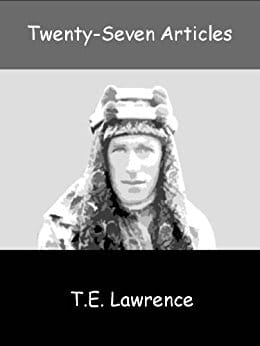
Twenty-Seven Articles by T.E. Lawrence

Author: T.E. Lawrence
Rating: 9/10
Last Read: April 2017

Quick Summary

Twenty-Seven Articles is a short essay by T.E. Lawrence. On the surface, these articles are a set of notes and advice for his fellow soldiers who were going to work with indigenous Arab forces. I was quite surprised to find the general applicability of many of these articles to business, especially from a consulting perspective.

This short read can leave you with at least one piece of advice that you can use in your own life – why not take the time to read it? Best of all – it’s out of copyright, so you can find it for free on the internet!

My Highlights

Valuable advice for any new relationship:

Go easy for the first few weeks. A bad start is difficult to atone for, and the Arabs form their judgments on externals that we ignore. When you have reached the inner circle in a tribe, you can do as you please with yourself and them.

A few useful notes for consultants and advisors:

In matters of business deal only with the commander of the army, column, or party in which you serve. Never give orders to anyone at all, and reserve your directions or advice for the C.O., however great the temptation (for efficiency’s sake) of dealing with his underlings. Your place is advisory, and your advice is due to the commander alone. Let him see that this is your conception of your duty, and that his is to be the sole executive of your joint plans.

Win and keep the confidence of your leader. Strengthen his prestige at your expense before others when you can.

A few notes useful for managing up or consulting:

Never refuse or quash schemes he may put forward; but ensure that they are put forward in the first instance privately to you. Always approve them, and after praise modify them insensibly, causing the suggestions to come from him, until they are in accord with your own opinion. When you attain this point, hold him to it, keep a tight grip of his ideas, and push them forward as firmly as possibly, but secretly, so that to one but himself (and he not too clearly) is aware of your pressure.

Remain in touch with your leader as constantly and unobtrusively as you can. Live with him, that at meal times and at audiences you may be naturally with him in his tent. Formal visits to give advice are not so good as the constant dropping of ideas in casual talk.

Treat the sub-chiefs of your force quite easily and lightly. In this way you hold yourself above their level. Treat the leader, if a Sherif, with respect. He will return your manner and you and he will then be alike, and above the rest. Precedence is a serious matter among the Arabs, and you must attain it.

Your ideal position is when you are present and not noticed. Do not be too intimate, too prominent, or too earnest. Avoid being identified too long or too often with any tribal sheikh, even if C.O. of the expedition. To do your work you must be above jealousies, and you lose prestige if you are associated with a tribe or clan, and its inevitable feuds.

Cling tight to your sense of humour. You will need it every day. A dry irony is the most useful type, and repartee of a personal and not too broad character will double your influence with the chiefs. Reproof, if wrapped up in some smiling form, will carry further and last longer than the most violent speech. The power of mimicry or parody is valuable, but use it sparingly, for wit is more dignified than humour. Do not cause a laugh at a Sherif except among Sherifs.

A note I need to absorb personally:

It is difficult to keep quiet when everything is being done wrong, but the less you lose your temper the greater your advantage. Also then you will not go mad yourself.

This is valuable advice for anyone who has to manage employees or external teams:

Do not try to do too much with your own hands. Better the Arabs do it tolerably than that you do it perfectly. It is their war, and you are to help them, not to win it for them. Actually, also, under the very odd conditions of Arabia, your practical work will not be as good as, perhaps, you think it is.

Understand what the other side of the table really wants. What is said on the surface is probably not all there is:

The open reason that Bedu give you for action or inaction may be true, but always there will be better reasons left for you to divine. You must find these inner reasons (they will be denied, but are none the less in operation) before shaping your arguments for one course or other. Allusion is more effective than logical exposition: they dislike concise expression. Their minds work just as ours do, but on different premises. There is nothing unreasonable, incomprehensible, or inscrutable in the Arab. Experience of them, and knowledge of their prejudices will enable you to foresee their attitude and possible course of action in nearly every case.

The beginning and ending of the secret of handling Arabs is unremitting study of them. Keep always on your guard; never say an unnecessary thing: watch yourself and your companions all the time: hear all that passes, search out what is going on beneath the surface, read their characters, discover their tastes and their weaknesses and keep everything you find out to yourself.

The Old Man and the Sea

Author: Ernest Hemingway
Rating: 9/10
Last Read: May 2017

Quick Summary:  The Old Man and the Sea is a short book by Hemingway which focuses on an old Cuban fisherman who has gone three months without catching a fish.  He is seen as bad luck, and sets out to sea alone so as to not bring bad luck upon his young companion.

The old man manages to finally break his streak of bad luck by hooking a big fish – but he gets dragged further out to sea by the fish for two days as he strains against the lines and hopes to catch it.  His opponent is more than he bargained for, and a great struggle ensues.

This is a quick read, but I found it to be very emotionally powerful. I feel for the old man, struggling to survive and prove himself against a great foe, and for the eventual tragedy at the end. I agree with the old man, it would have been better if he had not gone out so far and hooked such a notable creature.

My Highlights

Everything about him was old except his eyes and they were the same color as the sea and were cheerful and undefeated. –loc 66

He no longer dreamed of storms, nor of women, nor of great occurrences, nor of great fish, nor fights, nor contests of strength, nor of his wife. He only dreamed of places now and of the lions on the beach. –loc 204

Every day is a new day. It is better to be lucky. But I would rather be exact. Then when luck comes you are ready. –loc 268

He also drank a cup of shark liver oil each day from the big drum in the shack where many of the fishermen kept their gear. It was there for all fishermen who wanted it. Most fishermen hated the taste. But it was no worse than getting up at the hours that they rose and it was very good against all colds and grippes and it was good for the eyes. –loc 312

No one should be alone in their old age, he thought. But it is unavoidable. –loc 407

He looked across the sea and knew how alone he was now. But he could see the prisms in the deep dark water and the line stretching ahead and the strange undulation of the calm. The clouds were building up now for the trade wind and he looked ahead and saw a flight of wild ducks etching themselves against the sky over the water, then blurring, then etching again and he knew no man was ever alone on the sea. –loc 518

I wonder why he jumped, the old man thought. He jumped almost as though to show me how big he was. I know now, anyway, he thought. I wish I could show him what sort of man I am. But then he would see the cramped hand. Let him think I am more man than I am and I will be so. I wish I was the fish, he thought, with everything he has against only my will and my intelligence. –loc 547

He was comfortable but suffering, although he did not admit the suffering at –loc 552

Holy Mary, Mother of God, pray for us sinners now and at the hour of our death. Amen.” Then he added, “Blessed Virgin, pray for the death of this fish. Wonderful though he is.” –loc 557

The thousand times that he had proved it meant nothing. Now he was proving it again. Each time was a new time and he never thought about the past when he was doing it. –loc 567

The punishment of the hook is nothing. The punishment of hunger, and that he is against something that he does not comprehend, is everything. –loc 656

I’m clear enough in the head, he thought. Too clear. I am as clear as the stars that are my brothers. Still I must sleep. They sleep and the moon and the sun sleep and even the ocean sleeps sometimes on certain days when there is no current and a flat calm. –loc 664

“Fish,” the old man said. “Fish, you are going to have to die anyway. Do you have to kill me too?” –loc 792

You are killing me, fish, the old man thought. But you have a right to. Never have I seen a greater, or more beautiful, or a calmer or more noble thing than you, brother. Come on and kill me. I do not care who kills who. –loc 796

“Come on, fish,” he said. But the fish did not come. Instead he lay there wallowing now in the seas and the old man pulled the skiff up onto him. –loc 827

Then his head started to become a little unclear and he thought, is he bringing me in or am I bringing him in? If I were towing him behind there would be no question. Nor if the fish were in the skiff, with all dignity gone, there would be no question either. But they were sailing together lashed side by side and the old man thought, let him bring me in if it pleases him. I am only better than him through trickery and he meant me no harm. –loc 854

But that was the location of the brain and the old man hit it. He hit it with his blood mushed hands driving a good harpoon with all his strength. He hit it without hope but with resolution and complete malignancy. –loc 879

“But man is not made for defeat,” he said. “A man can be destroyed but not defeated.” I am sorry that I killed the fish though, he thought. Now the bad time is coming and I do not even have the harpoon. The dentuso is cruel and able and strong and intelligent. But I was more intelligent than he was. Perhaps not, he thought. Perhaps I was only better armed. –loc 890

It is silly not to hope, he thought. Besides I believe it is a sin. Do not think about sin, he thought. There are enough problems now without sin. Also I have no understanding of it. –loc 903

Besides, he thought, everything kills everything else in some way. Fishing kills me exactly as it keeps me alive. –loc 914

Luck is a thing that comes in many forms and who can recognize her? I would take some though in any form and pay what they asked. –loc 1010

The wind is our friend, anyway, he thought. Then he added, sometimes. And the great sea with our friends and our enemies. And bed, he thought. Bed is my friend. Just bed, he thought. Bed will be a great thing. It is easy when you are beaten, he thought. I never knew how easy it was. And what beat you, he thought. –loc 1036

Hitchhiker’s Guide to the Galaxy (Book 1)

Author: Douglas Adams
Rating: 9/10
Last Read: February 2017

Quick Summary:  Hitchhiker’s Guide is a science fiction book that follows the adventure of Arthur Dent and his unlikely companions. This books is full of nonsense – aliens with two heads, ridiculous names, strange encyclopedia articles, and mice running experiments on humans.  If you love to laugh, this book is for you. No, really, that’s the only recommendation you need.

If you want to take your enjoyment of this book to the next level, I recommend reading it out loud to yourself, your friends, your dog, or your spouse. Adams’s humor jumps to another level when you have to try to say the words written on the page out loud. Having read this book multiple times, I can definitely say that everything was funnier when I said it out loud.

Definitely an enjoyable read (and re-read).  Also a worthy pre-bed book, though you might find that the giggles don’t help you fall asleep.

My Highlights

The thing that used to worry him most was the fact that people always used to ask him what he was looking so worried about. –loc 425

“Time is an illusion. Lunchtime doubly so.” –loc 668

At first Ford had formed a theory to account for this strange behavior. If human beings don’t keep exercising their lips, he thought, their mouths probably seize up. After a few months’ consideration and observation he abandoned this theory in favor of a new one. If they don’t keep on exercising their lips, he thought, their brains start working. –loc 984

Or do you just find that coming to terms with the mindless tedium of it all presents an interesting challenge?” –loc 1288

“You know,” said Arthur, “it’s at times like this, when I’m trapped in a Vogon airlock with a man from Betelgeuse, and about to die of asphyxiation in deep space, that I really wish I’d listened to what my mother told me when I was young.” “Why, what did she tell you?” “I don’t know, I didn’t listen.” “Oh.” Ford carried on humming. –loc 1346

They both sat on the pavement and watched with a certain unease as huge children bounced heavily along the sand and wild horses thundered through the sky taking fresh supplies of reinforced railings to the Uncertain Areas. –loc 1420

Curiously enough, the only thing that went through the mind of the bowl of petunias as it fell was Oh no, not again. Many people have speculated that if we knew exactly why the bowl of petunias had thought that we would know a lot more about the nature of the Universe than we do now. –loc 1933

It is an important and popular fact that things are not always what they seem. –loc 2356

For instance, on the planet Earth, man had always assumed that he was more intelligent than dolphins because he had achieved so much—the wheel, New York, wars and so on—while all the dolphins had ever done was muck about in the water having a good time. But conversely, the dolphins had always believed that they were far more intelligent than man—for precisely the same reasons. –loc 2357

“You know,” said Arthur thoughtfully, “all this explains a lot of things. All through my life I’ve had this strange unaccountable feeling that something was going on in the world, something big, even sinister, and no one would tell me what it was.”
“No,” said the old man, “that’s just perfectly normal paranoia. Everyone in the Universe has that.” –loc 2771

“Maybe. Who cares?” said Slartibartfast before Arthur got too excited. “Perhaps I’m old and tired,” he continued, “but I always think that the chances of finding out what really is going on are so absurdly remote that the only thing to do is to say hang the sense of it and just keep yourself occupied. Look at me: I design coastlines. I got an award for Norway.” –loc 2776

The Man in the High Castle

Author: Philip K. Dick
Rating: 7/10
Last Read: February 2017

Quick Summary:  As a long time sci-fi fan (and Philip K. Dick fan), I was disappointed that I never read The Man in the High Castle.  Once I saw it was being made into a mini-series, I was motivated to finally read it.

The Man in the High Castle is a short novel set in an alternate universe. The notable difference between the book’s universe and our own is that the Axis won WWII. The United States is split between Japan and Germany. The book takes place in Japanese-occupied San Francisco and follows multiple Japanese, American, and German characters. The characters are interrelated, if only through chance meetings, and they provide different views into the culture and challenges of this alternative world.

If you’re looking for a complete story with a nice ending, The Man in the High Castle is not for you. The book offers no resolution, it is simply a glimpse into an alternative reality and a study of the characters who live there.

Overall I enjoyed reading the book – it was an excellent pre-bed reading option.

My Highlights

Yes, these new young people, of the rising generation, who did not remember the days before the war or even the war itself—they were the hope of the world. Place difference did not have the significance for them. It will end, Childan thought. Someday. The very idea of place. Not governed and governing, but people. –loc 92

‘What profit it a man if he gain the whole world but in this enterprise lose his soul?’” –loc 170

Random, and yet rooted in the moment in which he lived, in which his life was bound up with all other lives and particles in the universe. –loc 190

Tagomi had never ridden on such a ship; when he met Mr. Baynes he would have to take care to appear blasé, no matter how large the rocket turned out to be. Now to practice. He stood in front of the mirror on the office wall, creating a face of composure, mildly bored, inspecting his own cold features for any giveaway. Yes, they are very noisy, Mr. Baynes, sir. One cannot read. But then the flight from Stockholm to San Francisco is only forty-five minutes. –loc 225

“You never know what they’re going to do,” Juliana said. “They hide their real thoughts.” –loc 438

Watching him, Juliana thought, It’s idealism that makes him that bitter. Asking too much out of life. Always moving on, restless and griped. I’m the same way; I couldn’t stay on the West Coast and eventually I won’t be able to stand it here. Weren’t the old-timers like that? But, she thought, now the frontier isn’t here; it’s the other planets. –loc 492

Perhaps if you know you are insane then you are not insane. Or you are becoming sane, finally. Waking up. I suppose only a few are aware of all this. Isolated persons here and there. But the broad masses . . . what do they think? All these hundreds of thousands in this city, here. Do they imagine that they live in a sane world? Or do they guess, glimpse, the truth . . . –loc 572

They want to be the agents, not the victims, of history. They identify with God’s power and believe they are godlike. That is their basic madness. They are overcome by some archetype; their egos have expanded psychotically so that they cannot tell where they begin and the godhead leaves off. It is not hubris, not pride; it is inflation of the ego to its ultimate—confusion between him who worships and that which is worshiped. Man has not eaten God; God has eaten man. –loc 587

What they do not comprehend is man’s helplessness. I am weak, small, of no consequence to the universe. It does not notice me; I live on unseen. But why is that bad? Isn’t it better that way? Whom the gods notice they destroy. Be small . . . and you will escape the jealousy of the great. –loc 590

That McCarthy, he thought, is a damn good shop foreman. He has the knack of needling a man, getting him to put out his best efforts, to do his utmost in spite of himself. He’s a natural leader; he almost inspired me, for a moment, there. But—McCarthy had gone off, now; the effort had failed. –loc 691

“We must all have faith in something,” Mr. Tagomi said. “We cannot know the answers. We cannot see ahead, on our own.” –loc 1001

Gemeinschaft—folkness. –loc 2316

“Juliana, it’s all darkness,” Joe said. “Nothing is true or certain. Right?” “Maybe so,” she said absently, continuing to try to read. –loc 2329

Nothing. Heart pounding. Respiration and all somatic processes, including all manner of diencephalic-controlled autonomic responses to crisis: adrenaline, greater heartbeat, pulse rate, glands pouring, throat paralyzed, eyes staring, bowels loose, et al. Stomach queasy and sex instinct suppressed. –loc 2363

And yet, nothing to see; nothing for body to do. Run? All in preparation for panic flight. But where to and why? Mr. Tagomi asked himself. No clue. Therefore impossible. Dilemma of civilized man; body mobilized, but danger obscure. –loc 2365

Calmly, even harshly, Paul said, “Robert, you must face reality with more courage.” –loc 2531

Childan thought, He’s actually saying: Which are you Robert? He whom the oracle calls “the inferior man,” or that other for whom all the good advice is meant? Must decide, here. You may trot on one way or the other, but not both. Moment of choice now. –loc 2581

The oracle enigmatic. Perhaps it has withdrawn from the world of man in sorrow. The sages leaving. We have entered a Moment when we are alone. We cannot get assistance, as before. Well, Mr. Tagomi thought, perhaps that too is good. Or can be made good. One must still try to find the Way. –loc 3179

But we cannot do it all at once; it is a sequence. An unfolding process. We can only control the end by making a choice at each step. –loc 3516

We do not have the ideal world, such as we would like, where morality is easy because cognition is easy. Where one can do right with no effort because he can detect the obvious. –loc 3519

Juliana said, “Oracle, why did you write The Grasshopper Lies Heavy? What are we supposed to learn?”
“You have a disconcertingly superstitious way of phrasing your question,” Hawthorne said. –loc 3680

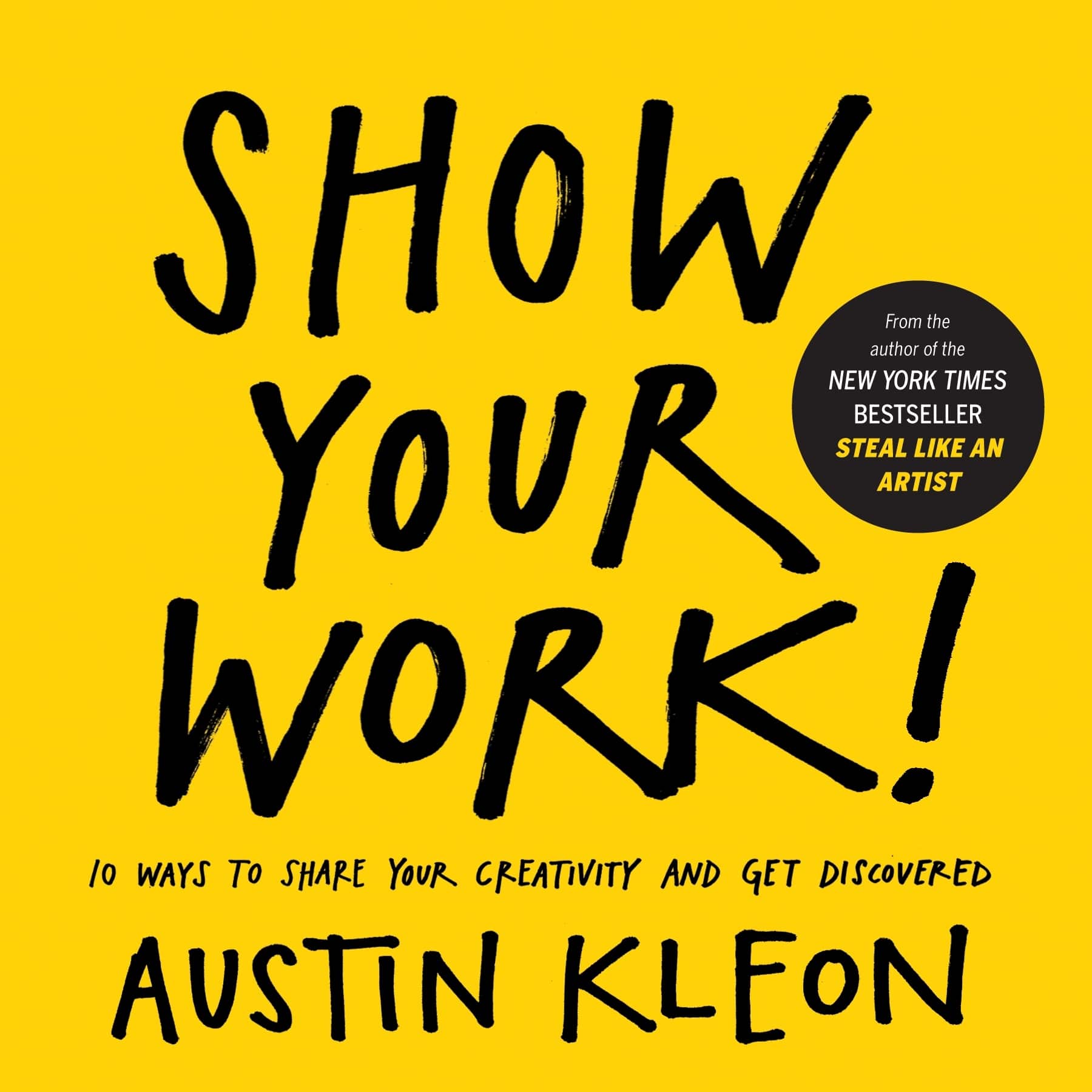
Show Your Work!


Author: Austin Kleon
Rating: 9/10
Last Read: December 2014

Quick Summary:  Show Your Work! is focused entirely on encouraging you to share your development process and work with your audience.  We are all supremely interested in what other people are doing and finding new tools and techniques to improve ourselves.  Kleon wants us to find holes in our communities and fill them, to share what we learn with others, and to document our own work processes.  When we share material and techniques, we can develop more of an audience and receive advice from our community in turn.  Give and people will give back.

This is another book that inspired me creatively in a major way.  Show Your Work! influenced me to start my own websites and to start sharing what I know about firmware development.  Even reviewing my notes to share with you inspires me to create and be more active in the world.

Once a day, after you’ve done your day’s work, go back to your documentation and find one little piece of your process that you can share. Where you are in your process will determine what that piece is. If you’re in the very early stages, share your influences and what’s inspiring you. If you’re in the middle of executing a project, write about your methods or share works in progress. If you’ve just completed a project, show the final product, share scraps from the cutting-room floor, or write about what you learned. If you have lots of projects out into the world, you can report on how they’re doing—you can tell stories about how people are interacting with your work.

My Highlights

Instead of wasting their time “networking,” they’re taking advantage of the network. By generously sharing their ideas and their knowledge, they often gain an audience that they can then leverage when they need it—for fellowship, feedback, or patronage. –loc 26

Imagine if your next boss didn’t have to read your résumé because he already reads your blog. Imagine being a student and getting your first gig based on a school project you posted online. Imagine losing your job but having a social network of people familiar with your work and ready to help you find a new one. Imagine turning a side project or a hobby into your profession because you had a following that could support you. –loc 34

The best way to get started on the path to sharing your work is to think about what you want to learn, and make a commitment to learning it in front of others. –loc 95

Find a scenius, pay attention to what others are sharing, and then start taking note of what they’re not sharing. Be on the lookout for voids that you can fill with your own efforts, no matter how bad they are at first. Don’t worry, for now, about how you’ll make money or a career off it. –loc 96

Share what you love, and the people who love the same things will find you. –loc 99

It sounds a little extreme, but in this day and age, if your work isn’t online, it doesn’t exist. –loc 117

Become a documentarian of what you do. Start a work journal: Write your thoughts down in a notebook, or speak them into an audio recorder. Keep a scrapbook. Take a lot of photographs of your work at different stages in your process. Shoot video of you working. This isn’t about making art, it’s about simply keeping track of what’s going on around you. Take advantage of all the cheap, easy tools at your disposal—these days, most of us carry a fully functional multimedia studio around in our smartphones. –loc 196

A daily dispatch is even better than a résumé or a portfolio, because it shows what we’re working on right now. –loc 217

The form of what you share doesn’t matter. Your daily dispatch can be anything you want—a blog post, an email, a tweet, a YouTube video, or some other little bit of media. There’s no one-size-fits-all plan for everybody. –loc 221

Don’t worry about everything you post being perfect. Science fiction writer Theodore Sturgeon once said that 90 percent of everything is crap. The same is true of our own work. The trouble is, we don’t always know what’s good and what sucks. That’s why it’s important to get things in front of others and see how they react. “Sometimes you don’t always know what you’ve got,” says artist Wayne White. “It really does need a little social chemistry to make it show itself to you sometimes.” –loc 235

Ideally, you want the work you post online to be copied and spread to every corner of the Internet, so don’t post things online that you’re not ready for everyone in the world to see. –loc 252

“Post as though everyone who can read it has the power to fire you.” –loc 253

The act of sharing is one of generosity—you’re putting something out there because you think it might be helpful or entertaining to someone on the other side of the screen. –loc 256

I had a professor in college who returned our graded essays, walked up to the chalkboard, and wrote in huge letters: “SO WHAT?” She threw the piece of chalk down and said, “Ask yourself that every time you turn in a piece of writing.” It’s a lesson I never forgot. –loc 257

Always be sure to run everything you share with others through The “So What?” Test. Don’t overthink it; just go with your gut. If you’re unsure about whether to share something, let it sit for 24 hours. Put it in a drawer and walk out the door. The next day, take it out and look at it with fresh eyes. Ask yourself, “Is this helpful? Is it entertaining? Is it something I’d be comfortable with my boss or my mother seeing?” There’s nothing wrong with saving things for later. The save as draft button is like a prophylactic—it might not feel as good in the moment, but you’ll be glad you used it in the morning. –loc 260

“Stock and flow” is an economic concept that writer Robin Sloan has adapted into a metaphor for media: “Flow is the feed. It’s the posts and the tweets. It’s the stream of daily and sub-daily updates that remind people you exist. Stock is the durable stuff. It’s the content you produce that’s as interesting in two months (or two years) as it is today. It’s what people discover via search. It’s what spreads slowly but surely, building fans over time.” Sloan says the magic formula is to maintain your flow while working on your stock in the background. –loc 268

In my experience, your stock is best made by collecting, organizing, and expanding upon your flow. Social media sites function a lot like public notebooks—they’re places where we think out loud, let other people think back at us, then hopefully think some more. But the thing about keeping notebooks is that you have to revisit them in order to make the most out of them. You have to flip back through old ideas to see what you’ve been thinking. Once you make sharing part of your daily routine, you’ll notice themes and trends emerging in what you share. You’ll find patterns in your flow. –loc 273

Don’t think of your website as a self-promotion machine, think of it as a self-invention machine. –loc 296

Your influences are all worth sharing because they clue people in to who you are and what you do—sometimes even more than your own work. –loc 333

Online, the most important form of attribution is a hyperlink pointing back to the website of the creator of the work. This sends people who come across the work back to the original source. The number one rule of the Internet: People are lazy. If you don’t include a link, no one can click it. Attribution without a link online borders on useless: 99.9 percent of people are not going to bother Googling someone’s name. –loc 372

What if you want to share something and you don’t know where it came from or who made it? The answer: Don’t share things you can’t properly credit. Find the right credit, or don’t share. –loc 376

Words matter. Artists love to trot out the tired line, “My work speaks for itself,” but the truth is, our work doesn’t speak for itself. Human beings want to know where things came from, how they were made, and who made them. –loc 401

The stories you tell about the work you do have a huge effect on how people feel and what they understand about your work, and how people feel and what they understand about your work effects how they value it. –loc 403

Your work doesn’t exist in a vacuum. Whether you realize it or not, you’re already telling a story about your work. Every email you send, every text, every conversation, every blog comment, every tweet, every photo, every video—they’re all bits and pieces of a multimedia narrative you’re constantly constructing. If you want to be more effective when sharing yourself and your work, you need to become a better storyteller. You need to know what a good story is and how to tell one. –loc 408

If you study the structure of stories, you start to see how they work, and once you know how they work, you can then start stealing story structures and filling them in with characters, situations, and settings from your own life. –loc 419

Every client presentation, every personal essay, every cover letter, every fund-raising request—they’re all pitches. They’re stories with the endings chopped off. A good pitch is set up in three acts: The first act is the past, the second act is the present, and the third act is the future. The first act is where you’ve been—what you want, how you came to want it, and what you’ve done so far to get it. The second act is where you are now in your work and how you’ve worked hard and used up most of your resources. The third act is where you’re going, and how exactly the person you’re pitching can help you get there. Like a Choose Your Own Adventure book, this story shape effectively turns your listener into the hero who gets to decide how it ends. –loc 434

Strike all the adjectives from your bio. If you take photos, you’re not an “aspiring” photographer, and you’re not an “amazing” photographer, either. You’re a photographer. Don’t get cute. Don’t brag. Just state the facts. –loc 468

If you want fans, you have to be a fan first. If you want to be accepted by a community, you have to first be a good citizen of that community. If you’re only pointing to your own stuff online, you’re doing it wrong. You have to be a connector. The writer Blake Butler calls this being an open node. If you want to get, you have to give. If you want to be noticed, you have to notice. Shut up and listen once in a while. Be thoughtful. Be considerate. –loc 538

If you want followers, be someone worth following. Donald Barthelme supposedly said to one of his students, “Have you tried making yourself a more interesting person?” This seems like a really mean thing to say, unless you think of the word interesting the way writer Lawrence Weschler does: For him, to be “interest-ing” is to be curious and attentive, and to practice “the continual projection of interest.” To put it more simply: If you want to be interesting, you have to be interested. –loc 548

Make stuff you love and talk about stuff you love and you’ll attract people who love that kind of stuff. It’s that simple. –loc 557

Brancusi practiced what I call The Vampire Test. It’s a simple way to know who you should let in and out of your life. If, after hanging out with someone you feel worn out and depleted, that person is a vampire. If, after hanging out with someone you still feel full of energy, that person is not a vampire. Of course, The Vampire Test works on many things in our lives, not just people—you can apply it to jobs, hobbies, places, etc. –loc 569

Keep your balance. You have to remember that your work is something you do, not who you are. This is especially hard for artists to accept, as so much of what they do is personal. Keep close to your family, friends, and the people who love you for you, not just the work. –loc 629

The first step in evaluating feedback is sizing up who it came from. You want feedback from people who care about you and what you do. Be extra wary of feedback from anybody who falls outside of that circle. –loc 634

At some point, you might consider turning off comments completely. Having a form for comments is the same as inviting comments. “There’s never a space under paintings in a gallery where someone writes their opinion,” says cartoonist Natalie Dee. “When you get to the end of a book, you don’t have to see what everyone else thought of it.” Let people contact you directly or let them copy your work over to their own spaces and talk about it all they want. –loc 650

Instead of having a donate now button on my website, I have buy now and hire me buttons. But even though I operate more like a traditional salesman, I do use some of the same tactics as crowdfunders: I try to be open about my process, connect with my audience, and ask them to support me by buying the things I’m selling. –loc 683

Even if you don’t have anything to sell right now, you should always be collecting email addresses from people who come across your work and want to stay in touch. –loc 694

Keep your own list, or get an account with an email newsletter company like MailChimp and put a little sign-up widget on every page of your website. Write a little bit of copy to encourage people to sign up. Be clear about what they can expect, whether you’ll be sending daily, monthly, or infrequent updates. Never ever add someone’s email address to your mailing list without her permission. –loc 701

Be ambitious. Keep yourself busy. Think bigger. Expand your audience. Don’t hobble yourself in the name of “keeping it real,” or “not selling out.” Try new things. If an opportunity comes along that will allow you to do more of the kind of work you want to do, say Yes. If an opportunity comes along that would mean more money, but less of the kind of work you want to do, say No. –loc 719

Add all this together and you get a way of working I call chain-smoking. You avoid stalling out in your career by never losing momentum. Here’s how you do it: Instead of taking a break in between projects, waiting for feedback, and worrying about what’s next, use the end of one project to light up the next one. Just do the work that’s in front of you, and when it’s finished, ask yourself what you missed, what you could’ve done better, or what you couldn’t get to, and jump right into the next project. –loc 771

His thinking is that we dedicate the first 25 years or so of our lives to learning, the next 40 to work, and the last 15 to retirement, so why not take 5 years off retirement and use them to break up the work years? He says the sabbatical has turned out to be invaluable to his work: “Everything that we designed in the seven years following the first sabbatical had its roots in thinking done during that sabbatical.” –loc 782

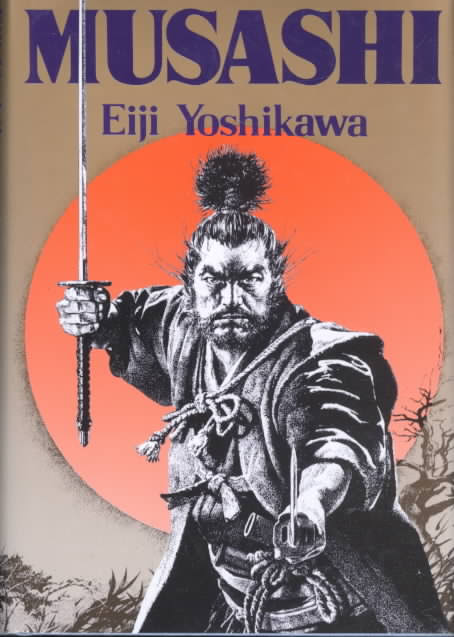
Musashi

Author: Eiji Yoshikawa
Rating: 9/10
Last Read: Nov 2017

Quick Summary: This novel is quite the epic read, in both length and enjoyment.  The book follows Miyamoto Musashi, a famous Japanese swordsman, across many journeys in the years of his life, culminating with his famous fight with Sasaki Kojiro.  The novel is divided up into different stages in Musashi’s life, also representing different stages in his growth and development. 

There are many philosophical and practical lessons to be gained from this book.  Zen themes permeate throughout, as can be expected in a book about a Japanese swordsman.  There is also much time to think of filial obligations, the path one has dedicated himself to in life, revenge, and other grandiose concepts that we all struggle with in our life’s journey.

I thoroughly enjoyed reading this book and look forward to my next reading.

My Highlights

Most important, he gradually transformed himself from an instinctive fighter into a man who fanatically pursued the goals of Zen-like self-discipline, complete inner mastery over oneself, and a sense of oneness with surrounding nature.
–loc 162

He called out, but there was no reply, nor did he expect one. A vacant house has an aura all its own.
–loc 743

After a while, Takuan grew reflective. “How peaceful it is here,” he sighed, sounding both religious and childlike. “Why, when we could live out our lives in a flower-filled paradise, do we all prefer to weep, suffer and get lost in a maelstrom of passion and fury, torturing ourselves in the flames of hell? I hope that you, at least, won’t have to go through all that.”
–loc 825

The captain, who was by now screaming, had his sheathed sword in hand. “I’ve taken all I can take. Now you’re going to get what’s coming to you!”
Takuan burst out laughing. “Does that mean you plan to cut off my head? If so, forget it. It would be a terrible bore.”
“Huh?”
“A bore. I can’t think of anything more boring than cutting off a monk’s head. It would just fall to the floor and lie there laughing up at you. Not a very grand accomplishment, and what good could it possibly do you?”
–loc 1377

“What are you saying, Otsū?” objected Takuan. “There’s nothing wrong with my mind, and I’m not joking. I’m only telling the truth, which no one seems to like to hear. He’s a dolt, so I called him a dolt. You want me to lie?”
–loc 1395

The captain was a man in his forties, ten years or so older than Takuan, but it was clear from their faces at this moment that strength of character is not a matter of age. Takuan’s tongue-lashing had humbled the older man and his bluster had evaporated.
–loc 1431

When word reached the temple priest, he nodded sagely and remarked that the human mouth is the gateway to catastrophe.
–loc 1472

“Listen, men and women of Miyamoto. I have something to say, something important.” The hue and cry died down. “It is not I who deserve the credit for capturing Takezō. It was not I who accomplished it, but the law of nature. Those who break it always lose in the end. It is the law that you should respect.”
–loc 1781

Loneliness, she mused, is like hunger; it isn’t outside but inside oneself. To be lonely, she thought, is to sense that one lacks something, something vitally necessary, but what she knew not.
–loc 1855

“That’s not the point, you imbecile! The trouble with you is that you don’t even know how to think. You seem to be under the misconception that if you perform one brave deed, that alone makes you a samurai. Well, it doesn’t! You let that one act of loyalty convince you of your righteousness. The more convinced you became, the more harm you caused yourself and everyone else. And now where are you? Caught in a trap you set for yourself, that’s where!” He paused. “By the way, how’s the view from up there, Takezō?” “You pig! I won’t forget this!” “You’ll forget everything soon. Before you turn into dried meat, Takezō, take a good look at the wide world around you. Gaze out onto the world of human beings, and change your selfish way of thinking. And then, when you arrive in that other world beyond and are reunited with your ancestors, tell them that just before you died a man named Takuan Sōhō told you this. They’ll be overjoyed to learn you had such excellent guidance, even if you did learn what life was all about too late to bring anything but shame to your family name.”
–loc 1968

Anger over petty emotional trifles is for women, not men.
–loc 2096

“Sorry, Takezō. It’s out of my hands. It’s the law of nature. You can’t do things over again. That’s life. Everything in it is for keeps. Everything! You can’t put your head back on after the enemy’s cut it off. That’s the way it is. Of course, I feel sorry for you, but I can’t undo that rope, because it wasn’t me who tied it. It was you. All I can do is give you some advice. Face death bravely and quietly. Say a prayer and hope someone bothers to listen. And for the sake of your ancestors, Takezō, have the decency to die with a peaceful look on your face!”
–loc 2136

The life that had been given to him was something to be treasured and cherished, polished and perfected.
–loc 2351

He who knows the art of the warrior is not confused in his movements. He acts and is not confined.
–loc 2479

“You may read as much as you want. A famous priest of ancient times once said, ‘I become immersed in the sacred scriptures and read thousands of volumes. When I come away, I find that my heart sees more than before.’
–loc 2485

He wondered if he’d ever again meet the man who’d saved his life. And again he was struck by Takuan’s concern for his fellow man, which seemed all-encompassing and completely devoid of selfishness. Musashi realized how narrow-minded he himself had been, how petty, to suppose that the monk felt a special compassion for him alone; his generosity encompassed Ogin, Otsū, anyone in need whom he thought he could help.
–loc 2616

These days he often felt deep admiration for other people’s work. He found he respected technique, art, even the ability to do a simple task well, particularly if it was a skill he himself had not mastered.
–loc 3240

He stopped along the way to look at several well-known temples, and at each of them he bowed and said two prayers. One was: “Please protect my sister from harm.” The other was: “Please test the lowly Musashi with hardship. Let him become the greatest swordsman in the land, or let him die.”
–loc 3262

If the young cannot harbor great dreams in their souls, who can? At the moment Musashi was imagining how he could create a place of his own in the world.
–loc 3271

It was odd that they should have thought of it that way. Having since learned from Takuan that life is a jewel to be treasured, Musashi knew that far from giving up nothing, he and Matahachi had unwittingly been offering their most precious possession. Each had literally wagered everything he had on the hope of receiving a paltry stipend as a samurai. In retrospect, he wondered how they could have been so foolish.
–loc 3498

True, you sensed belligerence in me, but it was only a reflection of your own.”
–loc 4055

“Don’t you understand yet?” he asked. “That you’re too strong is the only thing I have to teach you. If you continue to pride yourself on your strength, you won’t live to see thirty. Why, you might easily have been killed today. Think about that, and decide how to conduct yourself in the future.”
–loc 4540

“Fighting isn’t all there is to the Art of War. The men who think that way, and are satisfied to have food to eat and a place to sleep, are mere vagabonds. A serious student is much more concerned with training his mind and disciplining his spirit than with developing martial skills. He has to learn about all sorts of things—geography, irrigation, the people’s feelings, their manners and customs, their relationship with the lord of their territory. He wants to know what goes on inside the castle, not just what goes on outside it. He wants, essentially, to go everywhere he can and learn everything he can.”
–loc 4595

Sometimes, he was thinking, it works the other way around. These pampered young sons of Kyoto were in a position to see what was happening at the center of things and to know what was going on everywhere, but it would not have occurred to them that while they were watching the great open sea, somewhere else, at the bottom of a deep well, a frog was steadily growing larger and stronger. Here in Koyagyū, well away from the country’s political and economic center, sturdy samurai had for decades been leading a healthy rural life, preserving the ancient virtues, correcting their weak points and growing in stature.
–loc 4643

His perspicacity, which people admired, was one factor, but to survive in such turbulent times, Sekishūsai had to have an inner fortitude lacking in the ordinary samurai of his time; they were all too apt to side with a man one day and shamelessly desert him the next, to look after their own interests—with no thought to propriety or integrity—or even to slaughter their own kinsmen should they interfere with personal ambitions.
–loc 4701

In Sekishūsai’s view, the Art of War was certainly a means of governing the people, but it was also a means of controlling the self.
–loc 4715

To tell the truth, being from samurai families, we don’t know anything about tea. Our intention was to inquire personally after Sekishūsai’s health and persuade him to give us a lesson in swordsmanship.”
“He understands that perfectly, of course. But he’s spending his old age in retirement and has acquired the habit of expressing many of his thoughts in terms of tea.”
–loc 4843

The old man had not shut his gate merely to wandering students but to all the affairs of this world, to its honors as well as its tribulations. He had put behind him worldly desire, both his own and that of others.
–loc 5423

You should know that the path of darkness and desire leads only to frustration and misery—frustration and misery beyond salvation.”
–loc 5602

“Ah, even I’m beginning to think priests are crazy. Everywhere they go, they meet no one but people rushing toward hell.”
–loc 5625

Neither the townspeople nor the farmers nor the daimyō realized that they were being carefully fitted into a feudal system that would eventually bind them hand and foot. No one was thinking of what things might be like in another hundred years. No one, that is, except Ieyasu.
–loc 5672

It was not hard to find able swordsmen. What was hard to find was a real man. While the world was full of people, all too full, finding a genuine human being was not easy. In his travels, Musashi had come to believe this very deeply, to the point of pain, and it discouraged him. But then his mind always turned to Takuan, for there, without doubt, was an authentic, unique individual. “I guess I’m lucky,” thought Musashi. “At least I’ve had the good fortune to know one genuine man. I must make sure the experience of having known him bears fruit.
–loc 7251

Moreover, while not being thrown off balance by the prospect of death was a mental state of a higher order, it was not really so difficult to face death if one knew that one had to die.
–loc 7416

When I hear him talk, I wonder whether Nobunaga and Hideyoshi and Ieyasu are really such great men. I know they’re supposed to be important, but is it really so wonderful to take control of the country if you get the idea that you’re the only person in it who counts?”
–loc 7538

Takuan had taught him life’s first lesson, namely that there are a lot of people in the world who may very well be one’s betters.
–loc 7768

Before letting his pride and confidence betray him into underestimating an adversary, he wanted to size him up from every possible angle. While laying his groundwork, he would remain sociable, even if at times this might strike his opponent as being cowardly or subservient.
–loc 7771

Those who love seek a philosophy and, because of this, are fond of solitude.
–loc 8242

Musashi wondered how many people there were who on this night could say: “I was right. I did what I should have done. I have no regrets.” For him, each resounding knell evoked a tremor of remorse. He could conjure up nothing but the things he had done wrong during the last year. Nor was it only the last year—the year before, and the year before that, all the years that had gone by had brought regrets. There had not been a single year devoid of them. Indeed, there had hardly been one day. From his limited perspective of the world, it seemed that whatever people did they soon came to regret. Men, for example, took wives with the intention of living out their lives with them but often changed their minds later. One could readily forgive women for their afterthoughts, but then women rarely voiced their complaints, whereas men frequently did so. How many times had he heard men disparage their wives as if they were old discarded sandals?
–loc 8740

Satisfied with this third effort, he put his brush down. Although the three sentences had been written with the same intent, the first two could conceivably mean he would have no regrets whether he acted rightly or wrongly, whereas the third emphasized his determination to act in such a way as to make self-reproach unnecessary.
–loc 8759

Musashi repeated the resolution to himself, realizing it was an ideal he could not achieve unless he disciplined his heart and his mind to the utmost of his ability. Nevertheless, to strive for a state in which nothing he did would cause regrets was the path he must pursue. “Someday I will reach that state!” he vowed, driving the oath like a stake deep into his own heart.
–loc 8762

As soon as I laid eyes on him, I knew there was danger. To me, that sign you put up looks more like an announcement of mourning for the House of Yoshioka. It’s very sad, but it seems to be the way of the world that people never realize when they’re finished.
–loc 9344

Kojirō’s tone became snide. “It also seems to be typical of people on the way down that they won’t accept an act of kindness in the spirit in which it’s offered.
–loc 9347

Judging her in terms of swordsmanship, he thought to himself, “She’s perfect! She doesn’t leave herself open anywhere.” As she whisked the tea, he sensed in her the same unearthly proficiency that one might observe in a master swordsman poised to strike. “It’s the Way,” he thought, “the essence of art. One has to have it to be perfect at anything.”
–loc 9642

“If you become self-conscious about the proper way to drink, you won’t enjoy the tea. When you use a sword, you can’t let your body become too tense. That would break the harmony between the sword and your spirit. Isn’t that right?”
–loc 9656

“I want you to take a good look at that girl’s head. You’ll see then just how pretty she is. I want you to see with your own eyes what a woman is like after she dies. Nothing but bones. I want you to know the folly of passion.”
–loc 10664

“Takuan, you can carry a lantern through this life, but it won’t do you any good unless you open your eyes. What are they anyway? Just holes in your head, funny ornaments?”
–loc 10738

I think every man should have a place he can regard as home, even if it’s nothing more than a little shack. Without a house, a person gets lonely-feels lost somehow.
–loc 10827

Maybe I’m just a vagabond at heart.” “You’re not the only one, by any means. It’s only natural, but you should avoid the temptation of thinking that your dreams can be realized only in some far-off place. If you think that way, you’ll neglect the possibilities in your immediate surroundings. Most young people do, I fear, and become dissatisfied with their lives.” Kōetsu laughed. “But an idle old man like myself has no business preaching to the young.
–loc 10831

There was a difference between Musashi’s idea of preparation and his opponent’s. Denshichirō, though physically prepared, had only begun to pull himself together spiritually, whereas Musashi had started fighting long before he presented himself to his enemy. For him, the battle was now entering its second and central phase.
–loc 11228

His second opportunity came in the form of Denshichirō’s attempt to draw him out. One way of fighting would be to accept this; the other would be to ignore it and create an opening of his own. Caution was in order; in a case like this, victory is like the moon reflected on a lake. If one jumps for it impulsively, one can drown.
–loc 11235

It is said that one need not be young to enjoy playing games.
–loc 11326

The peony, remarked Yoshino, was the king of flowers. Perhaps it was only natural that its withered branches had a quality not to be found in ordinary wood, just as certain men had a worth not displayed by others. “How many men are there,” she mused, “whose merit endures after the blossoms have faded and died?” With a melancholy smile, she answered her own question. “We human beings blossom only during our youth, then become dry, odorless skeletons even before we die.”
–loc 11546

Why should I cling to A life so far removed from Beauty and passion? Peonies though lovely Shed their bright petals and die. Takuan’s poem was in the Japanese style. Mitsuhiro chose to write in the Chinese manner, setting down lines from a poem by Tsai Wen: When I am busy, the mountain looks at me. When I am at leisure, I look at the mountain. Though it seems the same, it is not the same, For busy-ness is inferior to leisure.
–loc 11559

Even as they bloom
A breath of sadness hangs
Over the flowers.
Do they think of the future,
When their petals will be gone?
–loc 11564

The servant returned in less than an hour with a note from Kōetsu: “When we have another chance, let us meet again. Life, though it may seem long, is in truth all too short. I beg you to take the best possible care of yourself. My regards from afar.”
–loc 11946

“You’ll be lucky if it doesn’t lead you straight to hell!” “This river, you know, may be the three-pronged river of hell; this road, the mile-long road to perdition; the hill I’ll soon climb, the mountain of needles on which the damned are impaled. Nevertheless, this is the only path toward true life.” “The way you talk, you may already be possessed by the god of death.” “Think what you like. *There are people who die by remaining alive and others who gain life by dying.
–loc 12561

It wasn’t that he had forgotten the lesson Takuan had taught him: the truly brave man is one who loves life, cherishing it as a treasure that once forfeited can never be recovered. He well knew that to live was more than merely to survive. The problem was how to imbue his life with meaning, how to ensure that his life would cast a bright ray of light into the future, even if it became necessary to give up that life for a cause. If he succeeded in doing this, the length of his life—twenty years or seventy—made little difference. A lifetime was only an insignificant interval in the endless flow of time.
–loc 12592

“I know myself better than anyone else does. I’m neither a genius nor a great man.”
–loc 12743

My dying will have a meaning to me, just as yours has to you. If you can face the end calmly, so can I. I won’t be trampled down like an insect, or drown in a moment of grief. I have to decide for myself. Nobody else can do it for me, not even you.”
–loc 12761

She felt her very soul had left her, but she did not think of this as a parting. It was more as though the two of them were being engulfed in a great wave of life and death.
–loc 12780

To the universe, the death of one man could hardly have any more significance than that of a butterfly, but in the realm of mankind, a single death could affect everything, for better or worse. Musashi’s only concern now was how to die a noble death.
–loc 12911

It’s because by painting a picture or carving an image of the Buddha, they draw closer to him. A swordsman can purify his spirit in the same way. We human beings all look up at the same moon, but there are many roads we may travel to reach the top of the peak nearest it. Sometimes, when we lose our way, we decide to try someone else’s, but the ultimate aim is to find fulfillment in life.”
–loc 13161

“Why, when you have a mother like yours, don’t you try to do something to make her happy? Having no parents, I can’t help feeling you’re not as grateful as you ought to be. It’s not that you don’t show her enough respect. But somehow, even though you’re blessed with the best thing a person can have, you seem to think no more of it than of so much dirt. If I had a mother like yours, I’d be much more eager to improve myself and do something really worthwhile simply because there’d be someone to share my happiness. Nobody rejoices over a person’s accomplishments as much as his parents.
–loc 13414

His hand glued to the underside of his sword hilt, Musashi’s eyes seemed to pierce Gonnosuke’s body. Inwardly, the battle had already begun, for the eye can damage a man more seriously than sword or staff. After the opening slice is made with the eye, the sword or staff slips in effortlessly.
–loc 14362

For the first time, he asked whether it was possible for an insignificant human being to become one with the universe.
–loc 14583

“Out with it. Speak. A man should state his thoughts simply and clearly.”
–loc 15275

When asked by one of his underlings why he displayed such deference toward a stranger, Yajibei confessed that he had acted very badly toward his own father and mother while they were still alive. “At my age,” he said, “I feel I have a filial duty to all older people.”
–loc 15429

Civilization, Musashi was thinking, does not flourish until men have learned to exercise control over the forces of nature. He wondered why the people here in the center of the Kanto Plain were so powerless, why they allowed themselves to be oppressed by nature. As the sun rose, Musashi caught glimpses of small animals and birds reveling in the riches that man had not yet learned to harvest. Or so it seemed.
–loc 16018

Still, Musashi thought, if a man dwells only on the dangers ahead, he cannot advance a single step, let alone make his way through life successfully.
–loc 16028

Furthermore, in the case of a child, no one, not even his parents, can actually guarantee his future. “Is it really possible to decide objectively what’s good for a child and what’s not?” he asked himself. “If it’s a matter of developing Sannosuke’s talents and guiding him in the right direction, I can do that. I guess that’s about as much as anyone can do.”
–loc 16029

He wanted to make a change, a radical one, since he’d long suspected that only those who had actually grown their own grain and vegetables really understood how sacred and valuable they were.
–loc 16096

A year or two earlier, he had wanted only to conquer all rivals, but now the idea that the sword existed for the purpose of giving him power over other people was unsatisfying. To cut people down, to triumph over them, to display the limits of one’s strength, seemed increasingly vain. He wanted to conquer himself, to make life itself submit to him, to cause people to live rather than die. The Way of the Sword should not be used merely for his own perfection. It should be a source of strength for governing people and leading them to peace and happiness.
–loc 16120

On the following day, it was still raining. Iori, delighted, took out the book again and said, “Shall we begin?” “Not today. You’ve had enough of reading for a while.” “Why?” “If you do nothing but read, you’ll lose sight of the reality around you. Why don’t you take the day off and play? I’m going to relax too.” “But I can’t go outside.” “Then just do like me,” said Musashi, sprawling on his back and crossing his arms under his head. “Do I have to lie down?” “Do what you want. Lie down, stand up, sit—whatever’s comfortable.”
–loc 16211

In his own way, he had submitted to the attitude of the peasants. On that day he became nature’s manservant. He ceased trying to impose his will on nature and let nature lead the way, while at the same time seeking out possibilities beyond the grasp of other inhabitants of the plain.
–loc 16252

“The same rules must apply to governing people,” he said to himself. In his notebook, he wrote: “Do not attempt to oppose the way of the universe. But first make sure you know the way of the universe.”
–loc 16256

A few minutes later, he reined up in front of the village headman’s gate. There, written in shiny ink on a fresh board, hung a sign: “Reminder for the People of the Village: Your plow is your sword. Your sword is your plow. Working in the fields, don’t forget the invasion. Thinking of the invasion, don’t forget your fields. All things must be balanced and integrated. Most important, do not oppose the Way of successive generations.”
–loc 16492

Musashi treated them all fairly and equally, first convincing them that it was pointless to live like animals. He then tried to impress upon them the importance of exerting a little extra effort so as to give their children a chance for a better life. To be real human beings, he told them, they must work for the sake of posterity.
–loc 16575

“He must be awfully important. That’s what I want to be when I grow up.” “Important?” “Umm.” “You shouldn’t aim so low.” “What do you mean?” “Look at Mount Fuji.” “I’ll never be like Mount Fuji.” “Instead of wanting to be like this or that, make yourself into a silent, immovable giant. That’s what the mountain is. Don’t waste your time trying to impress people. If you become the sort of man people can respect, they’ll respect you, without your doing anything.
–loc 16635

“When people live together in harmony, the earth is a paradise,” Musashi went on gravely. “But every man has a bad side as well as a good side. There are times when only the bad comes out. Then the world’s not paradise, but hell. Do you understand what I’m saying?” “Yes, I think so,” said Iori, more subdued now. “There’s a reason we have manners and etiquette. They keep us from letting the bad side take over. This promotes social order, which is the objective of the government’s laws.” Musashi paused. “The way you acted . . . It was a trivial matter, but your attitude couldn’t help but make the man angry. I’m not at all happy about it.”
–loc 16676

the lessons he teaches his disciples.” “As I’m sure you know, the Hon’ami family served the Ashikaga shōguns. From time to time they’ve also been called upon to polish the Emperor’s swords. Kōetsu was always saying that Japanese swords were created not to kill or injure people but to maintain the imperial rule and protect the nation, to subdue devils and drive out evil. The sword is the samurai’s soul; he carries it for no other purpose than to maintain his own integrity. It is an ever-present admonition to the man who rules over other men and seeks in doing so to follow the Way of Life. It’s only natural that the craftsman who polishes the sword must also polish the swordsman’s spirit.”
–loc 16860

“The owners are like parents who protect their children so jealously that the children grow up to be fools. In the case of children, more are being born all the time—doesn’t make any difference if a few are stupid. But swords .
–loc 16926

“What was it you noticed about him? You only saw him from a distance.”
“You wouldn’t understand. When you do, you’ll be old and withered like me.”
“But there must have been something.”
“I admired his alertness. He wasn’t taking any chances, even on a sick old man like me. When he came through the gate, he paused and looked around—at the layout of the house, at the windows, whether they were open or closed, at the path to the garden—everything. He took it all in at a single glance. There was nothing unnatural about it. Anyone would have assumed he was simply halting for a moment as a sign of deference. I was amazed.”
–loc 17779

Remember, when the cherry blossom falls, it must rely on the wind to spread its pollen.”
“You mustn’t fall, Father. You must try to live.”
The old man glared and raised his head. “Talk like that proves you’re still a child!
–loc 17798

It pleased him that today, as on other days, he had on spotless underwear, in the tradition of the good samurai, who started each day with a smile and an uncertainty: by evening he might be a corpse.
–loc 18262

When they finally reached a pine-covered knoll, Musashi made a quick survey of the terrain and said, “This’ll do fine.” To him, any place could serve as home—more than that: wherever he happened to be was the universe.
–loc 18475

An old saying came back to his mind: it is easy to surpass a predecessor, but difficult to avoid being surpassed by a successor.
–loc 19061

“In my opinion, this is something that happens to all men. Age creeps up on us while we’re not looking. Times change. The followers surpass their leaders. A younger generation opens up a new way. . . . This is the way it ought to be, for the world advances only through change. Yet this is inadmissible in the field of swordsmanship. The Way of the Sword must be a way that does not permit a man to age.
–loc 19074

Tadaaki stood up. “I, too, must take my leave of the world.” Suppressed sobs were audible. His final words were stern, yet full of affection. “Why mourn? Your day has come. It’s up to you to see that this school advances into a new age with honor. Beginning now, be humble, work hard and try with all your might to cultivate your spirit.”
–loc 19129

He felt he had arrived at an undeniable truth: custom had made the unnatural appear natural, and vice versa.
–loc 19319

While custom was bred by daily experience, being on the boundary between life and death was something that occurred only a few times during a lifetime. Yet the ultimate aim of the Way of the Sword was to be able to stand on the brink of death at any time: facing death squarely, unflinchingly, should be as familiar as all other daily experiences. And the process had to be a conscious one, though movement should be as free as if it were purely reflexive.
–loc 19320

“Well, young people do grow up. Old people just get older, no matter how hard they work at staying young.”
–loc 19610

It seemed to be the story of the man’s life, but then, Takuan reflected, that couldn’t have been too different from his own. Whether people were great or not, there was not much variety in their inner life experience. Any difference lay merely in how they dealt with common human weaknesses. To Takuan, both he and the other man were basically a bundle of illusions wrapped in human skin.
–loc 19756

To hear you tell it, you’re doing something grand for the sake of other people. In fact, you’re putting yourself before others. Has it not occurred to you that you leave quite a number of people unhappy?” “One can’t consider himself when one is working on behalf of society.” “Stupid fool!” He struck Jōtarō soundly on the cheek with his fist. “One’s self is the basis of everything. Every action is a manifestation of the self. A person who doesn’t know himself can do nothing for others.”
–loc 19832

It occurred to Musashi what an odd fact it was that most children could draw—and sing, for that matter—but that they forgot how to as they grew older. Perhaps the little bit of wisdom they acquired inhibited them. He himself was no exception.
–loc 20456

In some ways, Iori was too serious for his years. He paid close attention to his personal finances, never wasted a thing, was meticulously neat, and felt grateful for every bowl of rice, every fair day. He was, in short, fastidious, and he looked down on people who were not.
–loc 20942

“Don’t let it worry you. We don’t have anything worth stealing.”
“We have our lives! They’re not nothing.”
“Ha, ha. I keep my life locked up. Don’t you?”
–loc 21065

I tell you, Sado, there’s nothing worse than having people make you out to be more than you are.
–loc 21387

“If you can bear up under hardship, you can experience a pleasure greater than the pain,” Musashi said solemnly. “Day and night, hour by hour, people are buffeted by waves of pain and pleasure, one after the other. If they try to experience only pleasure, they cease to be truly alive. Then the pleasure evaporates.”
–loc 21733

An easy existence imposed restrictions; he could not submit to them.
–loc 21748

“To tell the truth, I myself have run up against a wall. There are times when I wonder if I have any future. I feel completely empty. It’s like being confined in a shell. I hate myself. I tell myself I’m no good. But by chastising myself and forcing myself to go on, I manage to kick through the shell. Then a new path opens up before me.
–loc 21757

Speculation wouldn’t get him very far. The Art of War demanded that he find out where he stood and act accordingly.
–loc 21864

“If I desert the Way, I fall into the depths. Yet when I try to pursue it to the peak, I find I’m not up to the task. I’m twisting in the wind halfway up, neither the swordsman nor the human being I want to be.” “That seems to sum it up.” “You can’t know how desperate I’ve been. What should I do? Tell me! How can I free myself from inaction and confusion?” “Why ask me? You can only rely on yourself.”
–loc 21931

Musashi reread the last two lines. Leaves and branches . . . How many people were thrown off course by irrelevant matters? Was he himself not an example? While the thought seemed to lighten his burden, his doubts would not go away. Why would his sword not obey him? Why did his eyes wander from his goal? What prevented him from achieving serenity?
–loc 21982

People had long since stopped talking about her great beauty. Flowers bloomed and flowers fell.
–loc 22471

Musashi resented being a public hero. In view of his exploits, it was inevitable that he would be made one, but he did not seek this. What he really wanted was more time to himself for meditation. He needed to develop harmony, to make sure his ideas did not outpace his ability to act.
–loc 22494

“I think this trip may be the decisive point in Musashi’s life. He disciplines himself constantly. He isn’t likely to lose to Kojirō. Still, in a fight like that, you never know. There’s a superhuman element involved. All warriors have to face it; winning or losing is partly a matter of luck.”
–loc 22525

“It’ll be a test of strength between a man who’s a genius, but really somewhat conceited, and an ordinary man who’s polished his talents to the utmost, won’t it?” “I wouldn’t call Musashi ordinary.” “But he is. That’s what’s extraordinary about him. He’s not content with relying on whatever natural gifts he may have. Knowing he’s ordinary, he’s always trying to improve himself. No one appreciates the agonizing effort he’s had to make. Now that his years of training have yielded such spectacular results, everybody’s talking about his ‘god-given talent.’ That’s how men who don’t try very hard comfort themselves.”
–loc 22530

Kōetsu looked like what he was, a man of leisure who had deliberately set himself apart from the rest of the world. At the moment, his eyes lacked that gleam that emanated from them when he concentrated on artistic creation. Now they were like a smooth sea, calm and unruffled, under a clear, bright sky.
–loc 22537

“He said you don’t have to be in a temple to practice religious discipline. It’s more difficult, but he said it’s more praiseworthy to be able to control yourself and keep your faith in the midst of lies and filth and conflict—all the ugly things in the outside world—than in the clean, pure surroundings of a temple.”
–loc 22583

Kojirō disagreed. “The whole point of the Art of War is to be quick to seize an opening. Even when a man takes precautions, it often happens that his opponent will have anticipated them and devised means of offsetting them. It’s much better to approach the situation with an open mind and move with perfect freedom.
–loc 22819

“You have to do more than just practice martial arts, you know. You have to learn from books. And although you should be the first to help when help is needed, you should try to be more modest than the other boys.”
–loc 22988

“You’re bright, Iori, but be careful. Don’t let your rough upbringing get the best of you. Keep yourself under tight rein. You’re still a child; you have a long life ahead of you. Guard it carefully. Save it until you can give it for a really good cause—for your country, your honor, the Way of the Samurai. Hold on to your life and make it honest and brave.”
–loc 22992

“You can win, though, can’t you, Sensei?” “I wouldn’t even waste my time thinking about it.” “You mean you’re sure you won’t lose?” “Even if I do lose, I promise to do it bravely.”
–loc 23004

“Everyone has a public and private life,” he thought. “Behind all that fanfare, a woman stands weeping her heart out.”
–loc 23246

He saw the white paper as the great universe of nonexistence. A single stroke would give rise to existence within it. He could evoke rain or wind at will, but whatever he drew, his heart would remain in the painting forever. If his heart was tainted, the picture would be tainted; if his heart was listless, so would the picture be. If he attempted to make a show of his craftsmanship, it could not be concealed. Men’s bodies fade away, but ink lives on. The image of his heart would continue to breathe after he himself was gone.
–loc 23312

A samurai’s wife must not weep and go to pieces when he goes off to war. Laugh for me, Otsū. Send me away with a smile. This may be your husband’s last departure.”
–loc 23405

Waiting just long enough for a wave to strike the reef and retreat, Musashi suddenly said in a quiet voice, “You’ve lost, Kojirō.” “What?” Ganryū was shaken to the core. “The fight’s been fought. I say you’ve been defeated.” “What are you talking about?” “If you were going to win, you wouldn’t throw your scabbard away. You’ve cast away your future, your life.”
–loc 23534

Their lives were totally absorbed in deadly combat, and both were free from conscious thought.
–loc 23551

Kojirō had put his confidence in the sword of strength and skill. Musashi trusted in the sword of the spirit. That was the only difference between them.
–loc 23598


The Meaning of It All: Thoughts of a Citizen Scientist

Author: Richard Feynman
Rating: 7/10
Last Read: Jan 2017

Quick Summary: I love Richard Feynman, so I was especially glad to discover one of his books on my bookshelf that I hadn’t read before!  The Meaning of It All is a collection of three lectures musing on some of the more philosophical aspects of science.  Feynman examines religion, politics, science, and the unscientific trends of the modern age.  I must say – while I enjoyed reading the thoughts of this great man, I don’t know that this provided a novel view on any of these ideas to me. 

My Highlights

Is Science of any value? I think a power to do something is of value. Whether the result is a good thing or a bad thing depends on how it is used, but the power is a value.
–pg 6

Once in Hawaii I was taken to see a Buddhist temple. In the temple a man said, “I am going to tell you something that you will never forget.” And then he said, “To every man is given the key to the gates of heaven. The same key opens the gates of hell.”
And so it is with science.
–pg 6

Why do we grapple with problems? We are only in the beginning. We have plenty of time to solve the problems. THe only way that we will make a mistake is that in the impetuous youth of humanity we will decide we know the answer. This is it. No one else can think of anything else. And we will jam. We will confine man to the limited imagination of today’s human beings.
We are not so smart. We are dumb. We are ignorant. We must maintain an open channel.
–pg 57

The first one has to do with whether a man knows what he is talking about, whether what he says has some basis or not. And my trick that I use is very easy. If you ask him intelligent questiosn — that is, penetrating, interested, honest, frank, direct questions on the subject, and no trick questions — then he quickly gets stuck. It is like a child asking naive questions. If you ask naive but relevant questions, then almost immediately the person doesn’t know the answer, if he is an honest man. It is important to appreciate that.
— pg 65

I would like to remind you that you can be pretty sure of things even though you are uncertain, that you don’t have to be so in-the-middle, in fact not at all in-the-middle. People say to me, “Well, how can you teach your children what is right and wrong if you don’t know?” Because I’m pretty sure of what’s right and wrong. I’m not absolutely sure; some experiences may change my mind. But I know what I would expect to teach them. But, of course, a child won’t learn what you teach him.
–pg 67

What I’m asking for in many directions is abject honesty. I think that we should have a more abject honesty in political matters. And I think we’ll be freer that way.
I woudl like to point out that people are not honest. Scientists are not honest at all, either. It’s useless. Nobody’s honest. Scientists are not honest. And people usually believe that they are. That makes it worse. By honest I don’t mean that you only tell what’s true. But you make clear the entire situation. You make clear all the information that is required for somebody else who is intelligent to make up their mind.
–pg 106

Norse Mythology

Author: Neil Gaiman
Rating: 8/10
Last Read: Feb 2017

Quick Summary: While I vaguely know the characters and events in the Norse mythology, I actually hadn’t read any of the stories themselves. I was quite surprised to see that Neil Gaiman had taken a stab at rewriting some of the myths.  His retelling of the stories had me laughing regularly (unless I was cursing Loki for more of his dangerous antics).  I’m always in search of some good light reading before bed.  And I love mythology – the stories and the characters contain important insights and lessons to learn from.  The only disappointing part is that I was able to finish this book in two sittings!

My Highlights

Some norns give people good lives, and others give us hard lives, or short lives, or twisted lives. They will shape your fate, there at Urd’s well.
–loc 233

“One drink from the water of your well, Uncle Mimir,” said Odin. “That is all I ask for.” Mimir shook his head. Nobody drank from the well but Mimir himself. He said nothing: seldom do those who are silent make mistakes.
–loc 241

Hoenir was tall and good-looking, and he looked like a king. When Mimir was with him to advise him, Hoenir also spoke like a king and made wise decisions. But when Mimir was not with him, Hoenir seemed unable to come to a decision, and the Vanir soon tired of this. They took their revenge, not on Hoenir but on Mimir: they cut off Mimir’s head and sent it to Odin. Odin was not angry. He rubbed Mimir’s head with certain herbs to prevent it from rotting, and he chanted charms and incantations over it, for he did not wish Mimir’s knowledge to be lost. Soon enough Mimir opened his eyes and spoke to him. Mimir’s advice was good, as it was always good.
–loc 255

“Because,” said Thor, “when something goes wrong, the first thing I always think is, it is Loki’s fault. It saves a lot of time.”
–loc 274

It’s called Mjollnir, the lightning-maker. First of all, it’s unbreakable—doesn’t matter how hard you hit something with it, the hammer will always be undamaged.” Thor looked interested. He had already broken a great many weapons over the years, normally by hitting things with them. “If you throw the hammer, it will never miss what you throw it at.” Thor looked even more interested. He had lost a number of otherwise excellent weapons by throwing them at things that irritated him and missing, and he had watched too many weapons he had thrown disappear into the distance, never to be seen again. “No matter how hard or how far you throw it, it will always return to your hand.” Thor was now actually smiling. And the thunder god did not often smile.
–loc 402

“I . . . will ransom my head,” said Loki. “I have treasures I can give you.”
“Eitri and I already have all the treasure we need,” said Brokk. “We make treasures. No, Loki. I want your head.”
–loc 422

“You are fools,” she said. “Especially you, Loki, because you think yourself clever.”
–loc 482

“Loki son of Laufey,” said Odin, “this is the result of your poor counsel.”
“And it was as bad as all your other advice,” said Balder.
Loki shot him a resentful glance.
“We need the builder to lose his wager,” said Odin. “Without violating the oath. He must fail.”
“I don’t know what you expect me to do about it,” said Loki.
I do not expect anything from you,” said Odin. “But if this builder succeeds in finishing his wall by the end of tomorrow, then your death will be painful, and long, and a bad and shameful death at that.
–loc 569

The wolf cub ate its meat raw, but it spoke as a man would speak, in the language of men and the gods, and it was proud. The little beast was called Fenrir.
–loc 700

“You lie, All-father. You lie in the way that some folk breathe.
–loc 767

“Fair enough,” said Thor. “What’s the price?”
“Freya’s hand in marriage.”
“He just wants her hand?” asked Thor hopefully. She had two hands, after all, and might be persuaded to give up one of them without too much of an argument. Tyr had, after all.
“All of her,” said Loki. “He wants to marry her.”
–loc 852

Do you wonder where poetry comes from? Where we get the songs we sing and the tales we tell? Do you ever ask yourself how it is that some people can dream great, wise, beautiful dreams and pass those dreams on as poetry to the world, to be sung and retold as long as the sun rises and sets, as long as the moon will wax and wane? Have you ever wondered why some people make beautiful songs and poems and tales, and some of us do not? It is a long story, and it does no credit to anyone: there is murder in it, and trickery, lies and foolishness, seduction and pursuit. Listen.
–loc 972

No one, then or now, wanted to drink the mead that came out of Odin’s ass. But whenever you hear bad poets declaiming their bad poetry, filled with foolish similes and ugly rhymes, you will know which of the meads they have tasted.
–loc 1246

It is not the end. There is no end. It is simply the end of the old times, Loki, and the beginning of the new times. Rebirth always follows death.
–loc 2415