The Warrior Ethos

Author: Steven Pressfield
Rating: 6/10
Last Read: June 2014

Quick Summary: This is a quick read.  Pressfield examines the warrior values and mindset in a variety of cultures throughout history. This book is pretty quick and segmented, structured as almost a series of thoughts on various topics related to the warrior ethos.  

Mostly it’s a collection of statements with some anecdotes – it could have been more fully fleshed out to be really something good. There are still interesting precepts to mull over – that provides value to me, even if the overall text is weak.

My Highlights

The Spartans do not ask how many are the enemy but where are they. —Plutarch –loc 15

At a deeper level, the Warrior Ethos recognizes that each of us, as well, has enemies inside himself. Vices and weaknesses like envy and greed, laziness, selfishness, the capacity to lie and cheat and do harm to our brothers. The tenets of the Warrior Ethos, directed inward, inspire us to contend against and defeat those enemies within our own hearts. –loc 106

Be brave, my heart [wrote the poet and mercenary Archilochus]. Plant your feet and square your shoulders to the enemy. Meet him among the man-killing spears. Hold your ground. In victory, do not brag; in defeat, do not weep. –loc 118

The god who ruled the battlefield was Phobos. Fear. –loc 123

The Spartan king Agesilaus was once asked what was the supreme warrior virtue, from which all other virtues derived. He replied, “Contempt for death.” –loc 139

Courage—in particular, stalwartness in the face of death—must be considered the foremost warrior virtue. –loc 141

The dictionary defines ethos as: The moral character, nature, disposition and customs of a people or culture. –loc 145

“You’ve got the watches,” say the Taliban, “but we’ve got the time.” –loc 171

Individuals in a guilt-based culture internalize their society’s conceptions of right and wrong. The sinner feels his crime in his guts. He doesn’t need anyone to convict him and sentence him; he convicts and sentences himself. –loc 204

The West is a guilt-based culture. Since the Judeo-Christian God sees and knows our private deeds and innermost thoughts, we are always guilty of something, with no way out save some form of divine absolution, forgiveness or grace. –loc 206

A shame-based culture is the opposite. In a shame-based culture, “face” is everything. All that matters is what the community believes of us. –loc 208

The Japanese warrior culture of Bushido is shame-based; it compels those it deems cowards or traitors to commit ritual suicide. The tribal cultures of Pashtunistan are shame-based. The Marine Corps is shame-based. So were the Romans, Alexander’s Macedonians and the ancient Spartans. –loc 213

There’s a well-known gunnery sergeant in the Marine Corps who explains to his young Marines, when they complain about pay, that they get two kinds of salary—a financial salary and a psychological salary. The financial salary is indeed meager. But the psychological salary? Pride, honor, integrity, the chance to be part of a corps with a history of service, valor, glory; to have friends who would sacrifice their lives for you, as you would for them—and to know that you remain a part of this brotherhood as long as you live. How much is that worth? –loc 285

This is another key element of the Warrior Ethos: the willing and eager embracing of adversity. –loc 413

The payoff for a life of adversity is freedom. –loc 419

“You may defeat us,” said the tribal elders, “but you will never defeat our poverty.” –loc 423

For warrior cultures—from the Sioux and the Comanche to the Zulu and the mountain Pashtun—honor is a man’s most prized possession. Without it, life is not worth living. –loc 439

The American brand of honor is inculcated on the football field, in the locker room and in the street. Back down to no one, avenge every insult, never show fear, never display weakness. Play hurt, never quit. –loc 446

Honor is the psychological salary of any elite unit. Pride is the possession of honor. –loc 457

Honor is connected to many things, but one thing it’s not connected to is happiness. In honor cultures, happiness as we think of it—“life, liberty and the pursuit of happiness”—is not a recognized good. Happiness in honor cultures is the possession of unsullied honor. Everything else is secondary. –loc 458

Patton said, “Americans play to win at all times. I wouldn’t give a hoot in hell for a man who lost and laughed. That’s why Americans have never lost a war and never will lose one.” –loc 478

The will to fight, the passion to be great, is an indispensable element of the Warrior Ethos. It is also a primary quality of leadership, because it inspires men and fires their hearts with ambition and the passion to go beyond their own limits. –loc 480

Second, they don’t solve the problem. Neither remark offers hope or promises a happy ending. They’re not inspirational. The deliverers of these quips don’t point to glory or triumph—or seek to allay their comrades’ anxiety by holding out the prospect of some rosy outcome. The remarks confront reality. They say, “Some heavy shit is coming down, brothers, and we’re going to go through it.” –loc 527

For the warrior, all choices have consequences. His decisions have meaning; every act he takes is significant. What he says and does can save (or cost) his own life or the lives of his brothers. –loc 545

Selflessness is a virtue in a warrior culture. Civilian society gives lip service to this, while frequently acting as selfishly as it possibly can. –loc 570

Cyrus of Persia believed that the spoils of his victories were meant for one purpose—so that he could surpass his enemies in generosity. I contend against my foes in this arena only: the capacity to be of greater service to them than they are to me. –loc 617

Let us conduct ourselves so that all men wish to be our friends and all fear to be our enemies. –loc 622

The Bhagavad-Gita changes this. It takes the Warrior Ethos and elevates it to a loftier and nobler plane—the plane of the individual’s inner life, to his struggle to align himself with his own higher nature. –loc 641

In other words, by the interior exercise of his exterior Warrior Ethos. Arjuna’s divine instructor (one of whose titles in Sanskrit is “Lord of Discipline”) charges his disciple to: Fix your mind upon its object. Hold to this, unswerving, Disowning fear and hope, Advance only upon this goal. –loc 648

Collective Unconscious, meaning that part of the psyche that is common to all cultures in all eras and at all times. –loc 675

The Collective Unconscious, Jung said, contains the stored wisdom of the human race, accumulated over thousands of generations. –loc 676

The lieutenant pointed to Alexander and said to the yogi, “This man has conquered the world! What have you accomplished?”
The yogi looked up calmly and replied, “I have conquered the need to conquer the world.” –loc 704

What Alexander was acknowledging was that the yogi was a warrior too. An inner warrior. Alexander looked at him and thought, “This man was a fighter when he was my age. He has taken the lessons he learned as a warrior dueling external enemies and is turning them to use now as he fights internal foes to achieve mastery over himself.” –loc 709

The hardest thing in the world is to be ourselves. –loc 714

Let us be, then, warriors of the heart, and enlist in our inner cause the virtues we have acquired through blood and sweat in the sphere of conflict—courage, patience, selflessness, loyalty, fidelity, self-command, respect for elders, love of our comrades (and of the enemy), perseverance, cheerfulness in adversity and a sense of humor, however terse or dark. –loc 726

Tides of War

Author: Steven Pressfield
Rating: 9/10
Last Read: September 2014

Quick Summary: Another novel in Steven Pressfield’s historical series – this one focuses on the  Peloponnesian War and the historical figure Alcibiades.  The novel is again told through the eyes of a minor character, an Athenian soldier fighting in the war.  Other historical characters make an appearance, including Lysander, Socrates, and Pericles.  

Alcibiades is a prime example of an individual who was brought down by his own ego.  Ego is your enemy, remember that.

Further Reading: The Virtues of War, Gates of Fire

My Highlights

Men hate nothing worse than that mirror held before them whose reflection displays their own failure to prove worthy of themselves. –loc 273

“Banish all thought of retreat, brothers. No avenue remains but to advance, and no alternative save victory or death.” –loc 396

Experience teaches that however numerous the brigade or army, the work of war is performed by small units, and each must possess to be effective one man like Lion who is unacquainted with fear, who arises cheerful each morning despite all hardship, ready to shoulder another’s load with a laugh and turn his hand to all tasks, however mean or humble. A unit lacking a man like Lion will never endure, while one with such a mate may be beaten but never broken. –loc 449

A beautiful woman is in the same fix. She cannot but perceive herself as two creatures—the private soul known to her intimates and that external proxy presented to the world by her good looks. The attention she receives may be gratifying to her vanity, but it is empty and she knows it. –loc 538

They sought only the surface, and for reasons of their own vanity. –loc 543

As an actor you of all people should know that death takes many and far more evil forms than the physical. Isn’t that what tragedy is all about? –loc 550

“Note further, gentlemen, that this single quality by which we convict these women and sentence them to exile from humanity is one over which they themselves possess no authority, a quality thrust upon them willy-nilly at birth. This is the antithesis of freedom, is it not? It is the use one makes of a slave. We treat even our dogs and horses better, granting to them their subtleties and contradictions of character and esteeming or contemning them thereby.” Socrates drew up and inquired of the company if any found fault with his meditation thus far. He was endorsed by all and exhorted to continue. “And yet we who consider ourselves free men often act in this manner not only toward others but toward ourselves as well. We account and define our persons by qualities gifted to or deprived us at birth, to the exclusion of those earned or acquired thereafter, brought into being by enterprise and will. This to my mind is an evil greater than degradation. It is self-degradation.” –loc 575

Socrates resumed. “Pondering this state of self-slavery, I began to puzzle: what precisely are the qualities which make men free?”
“Our will, as you said,” put in Acumenus the physician.
“And the force to exercise it,” added Mantitheus.
–loc 584

“No doubt with my poor cloak and sword–barbered beard I am perceived throughout the camp as a figure of fun. Yet I maintain that, unfettered by the constraints of the mode, I am the most free of men.” –loc 600

“Which takes precedence, do we believe, man or law? To set a man above the law is to negate law entire, for if the laws do not apply equally to all, they apply to none. To install one man upon such a promontory founds that flight of steps by which another may later ascend. –loc 623

In fact I suspect, don’t you, brothers, that when our companion nominates myself as indispensable, his intent is to establish that precedent by which he may next anoint himself.” –loc 625

His Theory of Forms arises from that selfsame interpretation. As the material manifestation of an individual horse embodies the particular and the transitory, Plato suggested, so must there exist within some higher realm the ideal form of Horse, universal and immutable, of which all corporeal horses “partake” or “participate in.” –loc 864

Democracy is a sword which cuts two ways. It emancipates the individual, setting him free to shine as no other scheme of governance. But that blade possesses an under-edge. Its spawn is spite and envy. This is why Pericles bore himself with modesty, remote from the multitude, for fear of their jealousy.” –loc 1167

“You came this close, Alcibiades,” Lysander is said to have spoken.
In response his adversary quoted the proverb “Close captures no crowns.”
To which Lysander replied, “God grant that be your epitaph,” and, turning, spurred away. –loc 1700

What I fear has nothing to do with groves or vines, Callicles, but the virtues which cultivation of the land imparts: modesty, patience, reverence for the gods, of which this Alcibiades knows little and cares less. He is a product of the city and evinces all its vices: vanity, arrogance, impatience, and immodesty before heaven.” –loc 2041

You define yourselves not as who you are, but as who you may become, and hasten over oceans to this shore you can never reach. –loc 2133

“Hope is a dangerous liquor,” my savior Lysander had addressed the ephorate in a speech so notorious it had actually been written down and circulated, unheard-of in Lacedaemon. “War has unstoppered the flasket, and nothing may seal it again.” –loc 3768

“How does one lead free men?”
“By being better than they,” Alcibiades responded at once. –loc 4089

“A commander’s role is to model arete, excellence, before his men. One need not thrash them to greatness; only hold it out before them. They will be compelled by their own nature to emulate it.” –loc 4096

If force must be employed with a subordinate, take care that it be minimal. If I command you, “Pick up that bowl,” and set a swordpoint to your back, you will obey but no part will own the action. You will exculpate yourself, accounting, “He made me do it, I had no choice.” But if I only suggest and you comply, then you must own your compliance and, owning it, stand by it. –loc 4223

Corollary to the principle of minimal force was that of minimal supervision. When Alcibiades issued a combat assignment, he imparted the objective only, leaving the means to the officer himself. The more daunting the chore, the more informally he commanded it. I never saw him issue an order from behind a desk. –loc 4242

Always assign a man more than he believes himself capable of. Make him rise to the occasion. In this way you compel him to discover fresh resources, both in himself and others of his command, thus enlarging the capacity of each, while binding all beneath the exigencies of risk and glory. –loc 4245

As we seek to make our enemies own their defeats at our hands, so we must make our friends own their victories. The less you give a man, and have him succeed, the more he draws his achievement to his heart. Remember we may elevate the fleet in two ways only. By acquiring better men or making those we have better. Even were the former practicable I would disdain it, for a hired man may hire out to another master but a man who makes himself master stays loyal forever. There was an oarsman –loc 4248

Shit rolls downhill, soldiers say, but so does confidence. –loc 5327

Courage is born of obedience. It is the issue of selflessness, brotherhood, and love of freedom. Boldness, on the other hand, is spawned of defiance and disrespect; it is the bastard brat of irreverence and outlawry. –loc 5385

“Let me phrase the question differently. Do we believe that the law, even an unjust law, must be obeyed? Or may the individual take it on himself to decide which laws are just and which unjust, which worthy of obedience and which not?”
I protested that it was not justice which Socrates had received, and thus its disallowance was legitimate.
“Let us hear your opinion, Jason. Is it better to perish through injustice inflicted upon one by others, or to live, having inflicted injustice on them?” –loc 5964

“You forget one, Jason, upon whom I would be inflicting injustice. The Laws. Suppose the Laws sat among us now. Might they not say something like this: ‘Socrates, we have served you all your life. Beneath our protection you grew to manhood, married, and raised a family; you pursued your livelihood and studied philosophy. You accepted our boons and the security we provided. Yet now, when our verdict no longer suits your convenience, you wish to put us aside.’ How would we answer the Laws?”
“Some men must be set above the laws.”
“How can you strike this posture, my friend, who argued with such fervor, that day, the contravening course?” –loc 5970

The supreme mystery of existence is this: that, perceiving it for what it is, we yet cling to it. And existence, despite all, discovers measures to reanimate our despoliated hearts. –loc 6186

He would lecture me, I knew, on vices. Three he abhorred—fear, hope, and love of country. He abominated only one beyond these: contemplation of past or future. These were offenses against nature, Telamon maintained, as they bound one to aspiration, to a result whose issue was adjudicated by forces, above the earth and beneath, which mortals may neither alter nor apprehend. Alcibiades was guilty of these, my mate observed, and of another violation of heaven’s law. Alcibiades perceived war as a means. In truth it was an end. Where our commander claimed to honor only Necessity, Telamon served a divinity more primordial. –loc 6414

War waged for advantage yields only ruin. Yet one may not disown war, which abides as constant as the seasons and eternal as the tides. –loc 6424

“What world is it you seek, Pommo, that is ‘better’ than this? Do you imagine like Alcibiades that you, or Athens, may elevate yourselves or anyone to some loftier sphere? This world is the only one that exists. Learn its laws and obey them. This is true philosophy.” –loc 6426

what is nobility that a beast may own it as well as a man? Is it not that capacity of soul by which one donates himself to an object greater than his own self-interest? –loc 6662

How lead free men? Only by this means: the summoning of each to his nobility. –loc 6663

Once a Hero

Author: Michael A. Stackpole
Rating: 9/10
Last Read: February 2014

Quick Summary:  A fantasy tale involving two separate story arcs across a 500 year time period – one in the past which involves the hero (Neal) and the other in the story’s present with an elf.  The story involves tensions between humans and elves, and their common enemy who Neal tried to vanquish in the past.

Excellent fantasy read – couldn’t put it down when I read through it the first time.  The story element is interesting (Similar to Talion: Revenant).

My Highlights

“without a scar, I might forget. I’m not thinking I suffer hurts so lightly that I’ll be wanting to be unmindful of them.”

“I have forced myself to be aware of everything on a battlefield. Awareness is the key to winning.”

If you are to be understood, you must speak to them in the manner which they will understand.

The island itself was deserted, and sitting there between two small rootlets of the grand tree, I managed a lot more thinking. I didn’t like all of it, but I’ve found that when you finally sit down to do the thinking that must be done, chances are there’s not much of it that will make you smile.

The hurt was in the hearing and because of what the words have made me think about. It is difficult to discover you have been deceiving yourself.

“You are forgiven if you wish, but I did not count it a fault against you.”

Puzzlement again knotted Berengar’s brow. “I don’t understand his choice.”
“Is that because it was a bad choice, or just the choice you would not have made in his place?”

Hatred is too strong an emotion to be wasted on harmless differences such as race.

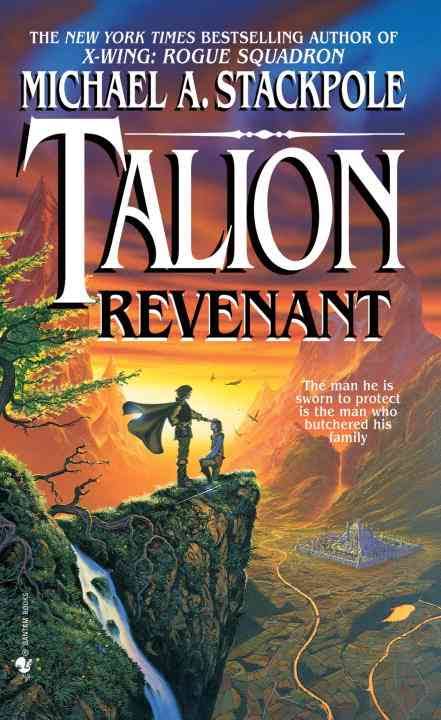
Talion: Revenant

Author: Michael A. Stackpole
Rating: 9/10
Last Read: February 2014

Quick Summary:  An orphan becomes a Justice of the Talions – traveling the countryside, dispensing justice where there is no law (akin to the confessors from *The Sword of Truth* series).  Things get complicated with our Justice is tasked with defending the king of the country that invaded his homeland.

When I was done, I felt sad that this was just a standalone novel – I liked the character and the universe enough that I wanted more. (Stackpole says it’s the book for which he most often gets sequel requests)

My Highlights

“I will not wish you good luck, because a Talion does not depend upon luck. Have courage and trust yourself.”

Such a simple job did not annoy me as it did others because, for me, it provided a reference point within reality and reassured me that while I dealt with good and evil, and the vast gray area in between, there were jobs that could be finished and finished well. In its own small way it confirmed the possibility of progress, and how any task that could be started could also be completed.

I am merely a man who realizes he is capable of mistakes, but I am also a man who is willing to take responsibility for those errors.

Lothar grumbled. “But he died from my attack. That was stupid. He just helped Marana win as if he was just her second sword.” I frowned. “A tool is just a tool, unless it does the job by itself.

Remember that a stalemate is a stalemate as long as no one acts.

A man who you fear will kill you is often afraid of the same treatment at your hands. There are times when two men in such a position both defend to prevent injury and deny victory to themselves. The person to act in that situation, if he has the required skills, will break the stalemate and be the victor.”

But the anger was swallowed, in turn, by the pride I had in myself. I worked hard for everything, and if that threatened them, it also marked them as petty and small.

Justice must be tempered by mercy and common sense. Justice is your gift to the world, not your right or privilege. Remember this and live by it. In this you will serve well.

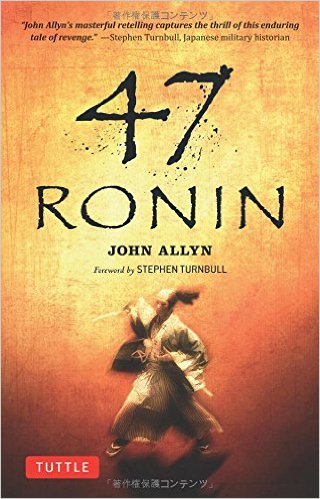
47 Ronin

Author: John Allyn
Rating: 7/10
Last Read: January 2014

Quick Summary: A retelling of the tale of the 47 Ronin. The samurai of Lord Asano spend months planning revenge for their disgraced master, who had been ordered to commit seppuku.  This story covers the downfall of Lord Asano, the disbandment of the samurai, the life led in the interim, and the long, careful planning spent to bring about their revenge.

Please don’t judge this novel by the movie – this is a much more realistic retelling of the tale of this historical legend.

My Highlights

The path of honor was easy to follow when it was easy to see.

When there were conflicts between choice of action, such as Hara had raised, the solutions could not be expected to satisfy everyone.

“You see,” he went on, “some people live all their lives without knowing which path is right. They’re buffeted by this wind or that and never really know where they’re going. That’s largely the fate of the commoners—those who have no choice over their destiny. For those of us born as samurai, life is something else. We know the path of duty and we follow it without question.”

Remember, there’s sacrifice involved in any kind of life. Even the man who chooses the safe way has to give up the thrill of combat. The point is that once you know what you want, you must be prepared to sacrifice everything to get.

In the end this was all that mattered, for a man will only be as long as his life but his name will be for all time.

The Sands of Mars

Author: Arthur C. Clarke
Rating: 8/10
Last Read: June 2014

Quick Summary: A famous sci-fi writer gets a chance to travel to mars (and takes lots of shit for how unrealistic his writings about sci-fi and space travel were). He meets the colonial leadership on Mars, eventually finding native creatures and falling in love with the planet.

Arthur C. Clarke is one of my favorite sci-fi writers, and this was his first published sci-fi novel.  The fact that he takes the chance to make his main character a writer, and has that writer get picked on for his wild and crazy predictions about the future of human space travel was quite enjoyable.  The story was a smooth read as well – highly recommended.

My Highlights

Well, this is it, thought Gibson. Down there is all my past life, and the lives of all my ancestors back to the first blob of jelly in the first primeval sea. No colonist or explorer setting sail from his native land ever left so much behind as I am leaving now. Down beneath those clouds lies the whole of human history; soon I shall be able to eclipse with my little finger what was, until a lifetime ago, all of Man’s dominion and everything that his art had saved from time.

This inexorable drawing away from the known into the unknown had almost the finality of death. Thus must the naked soul, leaving all its treasures behind it, go out at last into the darkness and the night.

Gibson had found it very hard to get his impressions of space down on paper; one could not very well say “space is awfully big” and leave it at that.

Only Hilton, who seemed to possess unlimited reserves of patience, took life easily and relaxed while the others fussed around him.

It’s always fatal to adapt oneself to one’s surroundings. The thing to do is to alter your surroundings to suit you.”

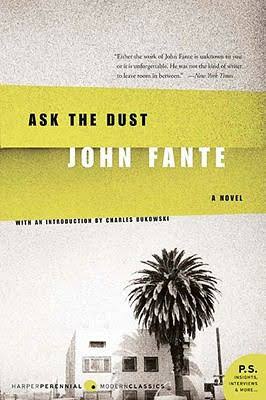
Ask the Dust

Author: John Fante
Rating: 6/10
Last Read: April 2014

Quick Summary: Arturo Bandini is a struggling writer in LA during the depression.  He’s convinced of his own greatness, but can’t seem to get the words onto the page correctly!  This follows his adventures (and madness) through the city, into love, and on a mad chase after his love into the desert.

I heard this book described as “The Great Gatsby of the West Coast.”  I’m not totally sure about that one – I like Gatsby much more.  I didn’t love the book, but it was still a decent read.  Perhaps I should give it a second chance one day.

I picked it up because one of my favorite poets – Charles Bukowski – loved this book.  One bonus for me was the fact that Bukowski wrote the foreword! What a surprise. 

My Takeaways

No matter how convinced you are of your own talent, if you cannot do the work and produce output, you are nothing.  Ego is your enemy.

My Highlights

But let me say that the way of his words and the way of his way are the same: strong and good and warm.

Almighty God, I am sorry I am now an atheist, but have You read Nietzsche? Ah, such a book!

“My advice to all young writers is quite simple. I would caution them never to evade a new experience. I would urge them to live life in the raw, to grapple with it bravely, to attack it with naked fists.”

every morning you’ll see the mighty sun, the eternal blue of the sky, and the streets will be full of sleek women you never will possess, and the hot semitropical nights will reek of romance you’ll never have, but you’ll still be in paradise, boys, in the land of sunshine.

You are nobody, and I might have been somebody, and the road to each of us is love.

God was such a dirty crook, such a contemptible skunk, that’s what he was for doing that thing to that woman. Come down out of the skies, you God, come on down and I’ll hammer your face all over the city of Los Angeles, you miserable unpardonable prankster. If it wasn’t for you, this woman would not be so maimed, and neither would the world

a Bandini with dynamite in his body and volcanic fire in his eyes, who goes to this Camilla Lopez and says: see here, young woman, I have been very patient with you, but now I have had enough of your impudence, and you will kindly oblige me by removing your clothes.

the world seemed a myth, a transparent plane, and all things upon it were here for only a little while; all of us, Bandini, and Hackmuth and Camilla and Vera, all of us were here for a little while, and then we were somewhere else; we were not alive at all; we approached living, but we never achieved it. We are going to die. Everybody was going to die.

The world was dust, and dust it would become.

What doth it profit a man if he gain the whole world and suffer the loss of his own soul?

“What’s the matter with him?”
“T. B.” she said.
“Tough.”
“He won’t live long.”
I didn’t give a damn. “We all have to die someday.”

He was going to die in a year, she said. He had left Los Angeles and gone to the edge of the Santa Ana desert. There he lived in a shack, writing feverishly. All his life he had wanted to write. Now, with such little time remaining, his chance had come.

There came over me a terrifying sense of understanding about the meaning and the pathetic destiny of men. The desert was always there, a patient white animal, waiting for men to die, for civilizations to flicker and pass into the darkness. Then men seemed brave to me, and I was proud to be numbered among them. All the evil of the world seemed not evil at all, but inevitable and good and part of that endless struggle to keep the desert down.

I looked southward in the direction of the big stars, and I knew that in that direction lay the Santa Ana desert, that under the big stars in a shack lay a man like myself, who would probably be swallowed by the desert sooner than I, and in my hand I held an effort of his, an expression of his struggle against the implacable silence toward which he was being hurled. Murderer or bartender or writer, it didn’t matter: his fate was the common fate of all, his finish my finish; and here tonight in this city of darkened windows were other millions like him and like me: as indistinguishable as dying blades of grass. Living was hard enough. Dying was a supreme task. And Sammy was soon to die.

To hell with that Hitler, this is more important than Hitler, this is about my book. It won’t shake the world, it won’t kill a soul, it won’t fire a gun, ah, but you’ll remember it to the day you die, you’ll lie there breathing your last, and you’ll smile as you remember the book.

This was the life for a man, to wander and stop and then go on, ever following the white line along the rambling coast, a time to relax at the wheel, light another cigaret, and grope stupidly for the meanings in that perplexing desert sky.

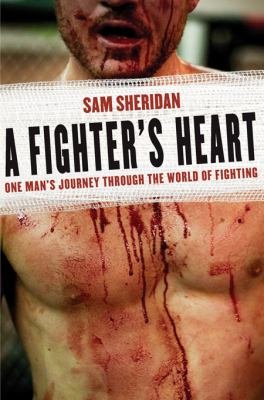
A Fighter’s Heart

Author: Sam Sheridan
Rating: 7/10
Last Read: April 2014

Quick Summary:  A guy who has found himself in possession of a bunch of cash and the intention to not work decides to dedicate himself to becoming a fighter.  The book covers his journey through different fights and training camps, and provides insight into the mind of a fighter and the athletes who participate in the sport.

My Takeaways

Fundamentals are important.

Fighting is not totally about violence – even if it is a violent activity.  There can be a sense of peace and satisfaction that arises out of the struggling with others and learning to master yourself.

It captured the idea that life is born of struggle and striving, that true joy and understanding do not come from comfort and safety; they come from epiphany born in exhaustion (and not exhaustion for its own sake). Safety and comfort are mortal danger to the soul.

My Highlights 

I learned one of the most important lessons in life: Keep your mouth shut. –loc 98

I was discovering the key to building endurance: Push on when you feel you can’t, and next time that moment will come later. I –loc 476

This is a guy who kicked so hard that if you blocked with your arm, he’d break it—and yet he had the utter control to not be baited. That’s what I admired, more than anything. Apidej is a devout Buddhist, and he meditated often, and I was curious about that. Something in that attitude seemed like the real warrior attitude, secure in self-knowledge, aware of things that don’t matter and untroubled by them. –loc 624

By doing something repeatedly, though, and understanding it, you can diffuse and defuse the fear. This is true for sailing, riding motorcycles, asking girls out—even getting hit in the face by a man who wants to kill you. –loc 656

It captured the idea that life is born of struggle and striving, that true joy and understanding do not come from comfort and safety; they come from epiphany born in exhaustion (and not exhaustion for its own sake). Safety and comfort are mortal danger to the soul. –loc 698

If only I could find a way to get it to pay for itself—that’s how I had done all my traveling before. It’s a part of my philosophy: You can always get it to pay for itself somehow. –loc 703

You have a specific responsibility to existence, to God if you like, to taste, touch, and smell what there is to experience. You have to do everything. If given an option between doing something and not doing it, you have to do it; because you’ve already done the “not do it” part. –loc 714

All of the old gods required sacrifice, forms of which exist today: Thus the ritual of sacrifice reveals an almost universal attribute of the archaic deity to whom sacrifices are offered: He or she is a carnivore. –loc 1156

“Truth in observation, that’ll win a fight,” he said. –loc 1335

But I fell back on those immortal words at the base of all good decision making: Fuck it. –loc 1448

I think I have a fatal flaw; when I get hit, I just want to hit back, without rhyme or reason. –loc 1555

“Do you ever watch animals, horses and cows and birds?” asked Darryl’s father, a tall, thick, distinguished man with an open, handsome face and gray hair. He made the motions of jostling his elbows for space, for position. “It’s natural, everything fights.” –loc 1807

“You have to learn from everybody, and stay open-minded, learn and watch carefully: Observation is critical. Watch how they grip. Guys who have been to a lot of different schools are very good because they learn so many different techniques. Now there is so much interchange that we have a lot of broad innovation and spreading ideas.” –loc 2105

Being willing to lose is important, to take risks, to find new ways of doing things; I’ve heard this again and again from different fighters. –loc 2108

You know only 5 percent of what there is to know. Fight your own pride and ego and be open-minded and always learning new techniques, new things from anyone. –loc 2231

Love has given him belief in himself. It’s what makes a dog fight past forty-five minutes. Love is what makes us great, and this display of strength, heart, and love is what brings us all to the fights. –loc 2644

I quickly came to understand one of Virgil’s governing precepts, which is fight when it’s good for you. Don’t stand and fight when your opponent wants to. Move around—fight only when it’s better for you. Muhammad Ali’s first fight with Floyd Patterson is a perfect example. Ali just kept moving and moving and moving, and every now and again paused to hit Floyd, and then moved some more. Boxing critics hated him for it, the “cowardice” of it, but it was unbeatable. Floyd didn’t have an answer. –loc 2936

Afterward, as I was taking off my wraps, Virgil said, “Fundamentals, Sam, fundamentals. If you don’t have them, you will run into somebody else’s.” –loc 2948

“Don’t let me rush you. Wait for things to be right, be deliberate. You don’t want to be flying down the freeway so fast you can’t see the scenery, because you’ll miss your exit. I’ll try and hurry you up, but don’t let me, stay within yourself, within what you want to do, and wait for the opening.” –loc 3187

Look strong when you are weak, Virgil would counsel. –loc 3421

After the fight, Mike said that his ferocity was all gone, he couldn’t even kill the bugs in his house. He had completely lost the killer instinct in the sixth round. “At one point, I thought life was about acquiring things,” he said. “Life is totally about losing everything.” –loc 3587

I was a big fan of something the English call the “wind-up.” You play someone very seriously with something you know will make them crazy, just to get them to lose composure. I’ve seen him do it to little boys who come into the gym. “Oh, I heard about you, you were the one crying when that Korean kid stole your bike,” and the little boy will be raging, “That wasn’t me!” Virgil used to do that at the juvenile hall with young toughs in front of their friends. The –loc 3877

A woman walked by, and Virgil talked about the sound of her footsteps. “I listen to people walk,” he said. “That can tell you a lot.” –loc 4126

“By becoming aware, you can understand that there is no ownership of body or mind, that thoughts are just illusions, and that suffering can be overcome.” –loc 4278

“Pain is a friend. It is a reminder to mindfulness, and it tells us in the end that it is only pain, another illusion, and this helps our understanding.” –loc 4311

“Mindfulness can be brought to bear on everything, can be a part of everything, of your training, and of your fighting,” Ajahn told me. The monks had no trouble at all with the fact that I was a sometime fighter. “If you are mindful in boxing, then you can be aware and not trapped in a same movement, you can be formless, and formless can not be beat—as long as you are strong inside and have your feet rooted,” Ajahn said. Virgil would have agreed with him. –loc 4462

“Mindfulness will help you see without illusion.” –loc 4467

I had a professor once tell me that man cannot view himself clearly; only less complicated organisms can be completely understood. –loc 4852

The appreciation of gameness, then, is probably both cultural and biological. The love of aggression, a willingness to fight regardless of safety or consequences, is a biological key to success, to domination. –loc 4864

There comes a moment when we stop creating ourselves. —John Updike –loc 5314

Michael Kimmel, in his book Manhood in America, talks about the “homosociality” of the manly arenas (sports, business); for a man, the most important thing is “his reputation as a man among men.” –loc 5342

Kimmel writes that for men, one of the deepest fears is that “others will see us as less than manly, as weak, timid, frightened.” –loc 5417

manhood, that endless test, is a sham, an illusion of sorts; because when you start fighting, you realize there’s never an end to it, there’s always somebody better—stronger, faster, bigger, younger, whatever, something. –loc 5441

Having a fighter’s heart, having gameness, is about knowing yourself and not being afraid of losing. You become a better version of yourself. Nobility is a by-product of that attitude, just like love is a byproduct of aggression. –loc 5498

Cormac McCarthy wrote a book called Blood Meridian in which the character of the judge makes an argument that war is the most essential of human activities. He starts by saying that men are born for games, and that everybody, even children, know that “play is nobler than work.” If that is true, says the judge, then what changes the quality of the game but the stakes? And what could be a more valuable stake than your life? So war, the game you play with your life, is the greatest of human endeavors. –loc 5508

I do not believe that men were meant for games, that that is their highest purpose. Work is nobler than play. I believe that men were meant for work, that their highest calling is to build, not destroy or even protect. Learning to fight, trying to embody the virtues of the hunter and warrior—these things are useful and important, even essential. But don’t be content with being a warrior, be a builder as well. Make something. The true calling of man, real manhood, is about creation, not destruction, and everyone secretly knows it. –loc 5516

Every love can be merciless. –loc 5566

Best of Robert E. Howard, Vol 1

Author: Robert E Howard
Rating: 8/10
Last Read: March 2014

Quick Summary: Collection of short stories and poems by Robert E. Howard. He created many different characters, the most notable being Conan the Barbarian.  Much of his work is in the “pulp fiction” style, and he includes many elements of horror in his writings (think of Lovecraft).

Pick this up if you like quick fantasy reads – especially nice before bed.  He is one of my favorite fantasy & pulp writers.

My Highlights

“You are young,” said the palaces and the temples and the shrines, “but we are old. The world was wild with youth when we were reared. You and your tribe shall pass, but we are invincible, indestructible. We towered above a strange world, ere Atlantis and Lemuria rose from the sea; we still shall reign when the green waters sigh for many a restless fathom above the spires of Lemuria and the hills of Atlantis and when the isles of the Western Men are the mountains of a strange land. “How many kings have we watched ride down these streets before Kull of Atlantis was even a dream in the mind of Ka, bird of Creation? Ride on, Kull of Atlantis; greater shall follow you; greater came before you. They are dust; they are forgotten; we stand; we know; we are. Ride, –loc 473

and man, the jest of the gods, the blind, wisdomless striver from dust to dust, following the long bloody trail of his destiny, knowing not why, bestial, blundering, like a great murderous child, yet feeling somewhere a spark of divine fire…. –loc 657

Thus far I was prepared; from now on we must trust to our luck and our craft. –loc 688

And what, mused Kull, were the realities of life? Ambition, power, pride? The friendship of man, the love of women–which Kull had never known–battle, plunder, what? Was it the real Kull who sat upon the throne or was it the real Kull who had scaled the hills of Atlantis, harried the far isles of the sunset, and laughed upon the green roaring tides of the Atlantean sea? How could a man be so many different men in a lifetime? For Kull knew that there were many Kulls and he wondered which was the real Kull. –loc 742

“Man, are you mad?” she asked, “that in your madness you come seeking that from which strong men fled screaming in old times?” “I seek a vengeance,” he answered, “that can be accomplished only by Them I seek.” She shook her head. “You have listened to a bird singing; you have dreamed empty dreams.” “I have heard a viper hiss,” he growled, “and I do not dream. Enough of this weaving of words. –loc 4190

“Barbarism is the natural state of mankind,” the borderer said, still staring somberly at the Cimmerian. “Civilization is unnatural. It is a whim of circumstance. And barbarism must always ultimately triumph.” –loc 8337

“Nobody writes realistic realism, and if they did, nobody would read it. The writers that think they write it just give their own ideas about things they think they see. The sort of man who could write realism is the fellow who never reads or writes anything.” –loc 9766

He understood that selling window blinds, or drilling holes in sheet metal all week, or working at the rent-a-car counter at the airport is not enough to fill a man’s heart. –loc 9838

“There was pageantry and high illusion and vanity, and the beloved tinsel of glory without which life is not worth living,” wrote Howard concerning times gone by: “All empty show and the smoke of conceit and arrogance, but what a drab thing life would be without them.” For him, there is no meaning or beauty in life other than what we dream into it. –loc 9845

The Other Wes Moore

Author: Wes Moore
Rating: 7/10
Last Read: 2014

Quick Summary: A military officer analyzes the lives and actions of himself and an inmate sharing his name to try to determine what would have caused their lives to deviate in such a way.

Key Takeaways

Don’t forget how much of an effect environment, family, and birth lottery have on your life.

It made me think deeply about the way privilege and preference work in the world, and how many kids who didn’t have “luck” like mine in this instance would find themselves forever outside the ring of power and prestige. So many opportunities in this country are apportioned in this arbitrary and miserly way, distributed to those who already have the benefit of a privileged legacy.

My Highlights

But even the worst decisions we make don’t necessarily remove us from the circle of humanity.

life and death, freedom and bondage, hang in the balance of every action we take.

Watende, a Shona word that means “revenge will not be sought,”

“I guess it’s hard sometimes to distinguish between second chances and last chances.”

I decided not to respond directly to this latest protest of his innocence. Instead, I asked a question: “Do you think we’re all just products of our environments?” His smile dissolved into a smirk, with the left side of his face resting at ease. “I think so, or maybe products of our expectations.” “Others’ expectations of us or our expectations for ourselves?” “I mean others’ expectations that you take on as your own.” I realized then how difficult it is to separate the two. The expectations that others place on us help us form our expectations of ourselves.

He also taught me an important lesson about leadership: it always comes with having to make tough decisions.

They believed that excuses were tools of the incompetent and forced every cadet to believe the same.

“When it is time for you to leave this school, leave your job, or even leave this earth, you make sure you have worked hard to make sure it mattered you were ever here.”

Life’s impermanence, I realized, is what makes every single day so precious. It’s what shapes our time here. It’s what makes it so important that not a single moment be wasted.

It made me think deeply about the way privilege and preference work in the world, and how many kids who didn’t have “luck” like mine in this instance would find themselves forever outside the ring of power and prestige. So many opportunities in this country are apportioned in this arbitrary and miserly way, distributed to those who already have the benefit of a privileged legacy.

The common bond of humanity and decency that we share is stronger than any conflict, any adversity, any challenge. Fighting for your convictions is important. But finding peace is paramount. Knowing when to fight and when to seek peace is wisdom.

“I hear you, but it’s not the process you should focus on; it’s the joy you will feel after you go through the process.”

… the incredible power of stories to change people’s lives. By establishing himself as the protagonist of his own story, he inspired me and countless other young people to see ourselves as capable of taking control of our own destinies, and to realize how each decision we make determines the course of our life stories.