
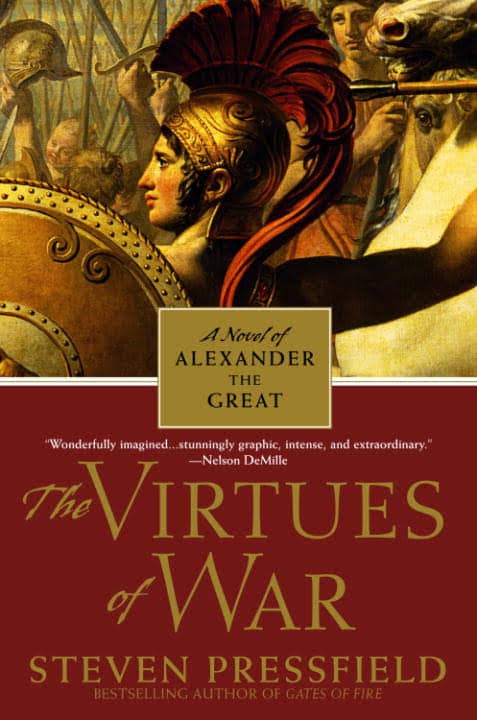
Author: Steven Pressfield
Rating: 9/10
Last Read: December 2013
Quick Summary: This book is told through the eyes of a scribe following Alexander on his conquering journey across Asia, leading to his ultimate demise. The shortest summary can be pulled from the book itself:
This is tragedy. For which of us can rise above what he is? Tragedy is the arrest of a man by his own nature. He is blind to it. He cannot transcend it. If he could, it would not be tragedy. And tragedy’s power derives from our own realization, commoner as well as king, that life truly is like that. We have fashioned our ruin with our own hands.
Further Reading: Gates of Fire, Tides of War
My Highlights
Those who do not understand war believe it contention between armies, friend against foe. No. Rather friend and foe duel as one against an unseen antagonist, whose name is Fear, and seek, even entwined in death, to mount to that promontory whose ensign is honor. –loc 234
There are further items, Telamon taught, which have no place in the soldier’s kit. Hope is one. Thought for future or past. Fear. Remorse. Hesitation. –loc 456
A warrior must not advance to battle hopeless—that is, devoid of hope. Rather let him set aside all baggage of expectation—of riches, celebrity, even death—and spur beneath extinction’s scythe lightened of all, save surrender to that outcome known only to the gods. –loc 464
“For the self-control of the warrior, which we observe and admire in his comportment, is but the outward manifestation of the inner perfection of the man. Such virtues as patience, courage, selflessness, which the soldier seems to have acquired for the purpose of defeating the foe, are in truth for use against enemies within himself—the eternal antagonists of inattention, greed, sloth, self-conceit, and so on. –loc 469
When each of us recognizes, as we must, that we too are engaged in this struggle, we find ourselves drawn to the warrior, as the acolyte to the seer. –loc 472
The true man-at-arms, in fact, can overcome his enemy without even striking a blow, simply by the example of his virtue. In fact he can not only defeat this foe but also make him his willing friend and ally, and even, if he wishes, his slave. –loc 473
Here, for your education, Itanes, I must address a question that causes all young officers consternation. I mean the experience of empathy for the foe. Never be ashamed to feel this. It is not unmanly. Indeed, I believe it the noblest demonstration of martial virtue. –loc 614
War is fear, let no man say otherwise. –loc 682
“Let me underscore this only, my friends, in regard to the foe. It is not our place to hate these men or to take pleasure in their slaughter. We fight today not to seize their lands or lives, but their preeminence among the Greeks. With luck, they will fight at our sides when Philip turns for Asia and marches against the Persian throne. –loc 778
No army ever won a battle when its elite unit was destroyed. –loc 782
I alone am master of my life! I vowed in that instant not only to dedicate myself to the study of horses and horsemanship, to make myself without peer as cavalryman and cavalry officer, but to educate myself in all things, to become my own tutor, selecting the subjects I needed to master and seeking instruction on my own. –loc 1328
Regret, Telamon had taught, has no place in the soldier’s kit of war. I know this is true. But I know, as well, that no act comes without a price. All men must answer for their crimes. I shall for mine. –loc 1362
The sarissas know their work is war. They are sorry for this. They cry for the suffering they cause. –loc 1844
He is dead. I weep, not only out of respect for the brilliant Rhodian, though I feel that in abundance, but for the role of chance and luck in the affairs of men, and the knowledge of how tenuous is our hold, all of us, upon this thing we call life. –loc 1852
Because a thing has never been done, gentlemen, is no reason to say it cannot be. And, in my view, no reason not to try. –loc 1915
Do you know what faculty I claim in myself as preeminent beyond all rivals? Not warcraft or conquest. Certainly not politics. Imagination. –loc 1964
The life of peace is fitting for a mule or an ass. I would be a lion! –loc 2701
One cannot be a philosopher and a warrior at the same time, as Parmenio has said. And one cannot be a man and a king. –loc 2783
Always attack. Even in defense, attack. The attacking arm possesses the initiative and thus commands the action. To attack makes men brave; to defend makes them timorous. If I learn that an officer of mine has assumed a defensive posture in the field, that officer will never hold command under me again. –loc 2822
When deliberating, think in campaigns and not battles; in wars and not campaigns; in ultimate conquest and not wars. –loc 2826
Seek the decisive battle. What good does it do us to win ten scraps of no consequence if we lose the one that counts? I want to fight battles that decide the fate of empires. –loc 2828
It is as important to win morally as to win militarily. By which I mean our victories must break the foe’s heart and tear from him all hope of contesting us again. I do not wish to fight war upon war, but by war to produce such a peace as will admit of no insurrection. –loc 2831
The object of campaign is to bring about a battle that will prove decisive. We feint; we maneuver; we provoke to one end: to compel the foe to face us in the field. –loc 2835
The object of pursuit after victory is not only to prevent the enemy from re-forming in the instance (this goes without saying), but to burn such fear into his vitals that he will never think of re-forming again. –loc 2843
As commanders, we must save our supreme ruthlessness for ourselves. Before we make any move in the face of the enemy, we must ask ourselves, free of vanity and self-deception, how the foe will counter. Unearth every stroke and have an answer for it. Even when you think you have thought of everything, there will be more work to do. Be merciless with yourself, for every careless act is paid for in our own blood and the blood of our countrymen. –loc 2849
Let us conduct ourselves in such a fashion that all nations wish to be our friends and all fear to be our enemies. –loc 2862
No advantage in war is greater than speed. To appear suddenly in strength where the enemy least expects you overawes him and throws him into consternation. –loc 2864
Be conservative until the crucial moment. Then strike with all the violence you possess. –loc 2873
Remember: We need win at only one point on the field, so long as that point is decisive. –loc 2874
Don’t punch; counterpunch. The purpose of an initial evolution—a feint or draw—is to provoke the enemy into committing himself prematurely. Once he moves, we countermove. –loc 2883
An officer must lead from the front. How can we ask our soldiers to risk death if we ourselves shrink from hazard? –loc 2888
Leverage of position means the occupation of that site which compels the enemy to move. When we face an enemy marshaled in a defensive posture, our first thought must be: What post can we seize that will make him withdraw? –loc 2890
Here is something the instructors of war do not teach: the art of confronting the irrational, of disarming the groundless and the unknown. –loc 3076
Pick one way and don’t look back. Nothing is worse than indecision. Be wrong, but be wrong decisively. –loc 3139
Can you please your constituents? Never let me hear that word! The men are never happy with anything. The march is always too long, the way always too rough. –loc 3140
Hardship. Give your men something that can’t be done, not something that can. Then place yourself at first hazard. –loc 3141
Rationality is superstition by another name. –loc 3147
Great commanders do not temper their measures to What Is; they bring forth What May Be. –loc 3148
Nothing is harder in war than to stand fast. –loc 3185
Sweat, speed, action—these are the antidotes to fear. –loc 3231
The material a commander manipulates is the human heart. –loc 3310
His art lies in producing courage in his own men and terror in the foe. –loc 3311
The general produces courage by discipline, training, and fitness; by fairness and order; superior pay, armament, tactics, and supply; by his dispositions in the field; and by the genius of his own presence and actions. –loc 3311
When men know they will be attacked, they feel fear; when they know they will attack, they feel strength. –loc 3340
To contend chivalrously against the chivalrous foe refines us, as gold in the crucible. –loc 3359
The ordeal of command consists in this: that one makes decisions of fatal consequence based on ludicrously inadequate intelligence. –loc 3675
“Success,” says Telamon, “is the weightiest burden of all. We are victors now. All our dreams have come true.” –loc 4394
When they were starving, your officers were a corps of comrades. But now each has grown touchy and quick to take insult. They are no longer mates, but rivals. You give them so much money, you make them independent of you. –loc 4452
Gold buys adherents; it turns good men arrogant and bad men ungovernable. –loc 4454
No man speaks the truth to a king. –loc 4484
“To be royal,” Sisygambis has said, “is to tread barefoot upon the razor’s edge. –loc 4538
“This man has conquered the world! What have you done?”
The philosopher replied without an instant’s hesitation, “I have conquered the need to conquer the world.” –loc 4773This is tragedy. For which of us can rise above what he is? Tragedy is the arrest of a man by his own nature. He is blind to it. He cannot transcend it. If he could, it would not be tragedy. And tragedy’s power derives from our own realization, commoner as well as king, that life truly is like that. We have fashioned our ruin with our own hands. –loc 4819
For have you not noticed of these sages, my friends, that they are the consummate soldiers? Inured to pain, oblivious to hardship, each takes up his post at dawn and does not relinquish it for thirst, hunger, heat, cold, fatigue. He is cheerful in all weathers, self-motivated, self-governed, self-commended. –loc 4854
“But there is one thing to which you are indeed attached, to your soul’s detriment.”
“And what is that, my friend?”
“Your victories. You remain proud of them. This is not good for you.”
–loc 4863“You should be able to walk away from all this now, this night. Get up! Take nothing! Can you? –loc 4866
I schooled you as a boy, Alexander, to be superior to fear and to anger. You learned eagerly. You vanquished hardship and hunger and cold and fatigue. But you have not learned to master your victories. These hold you. You are their slave. –loc 4875
War is a crime, Alexander. In the end it is but butchery. For all the poets’ anthems, war’s object is nothing nobler than the imposition of one nation’s will upon another by means of force and threat of force. –loc 4951

