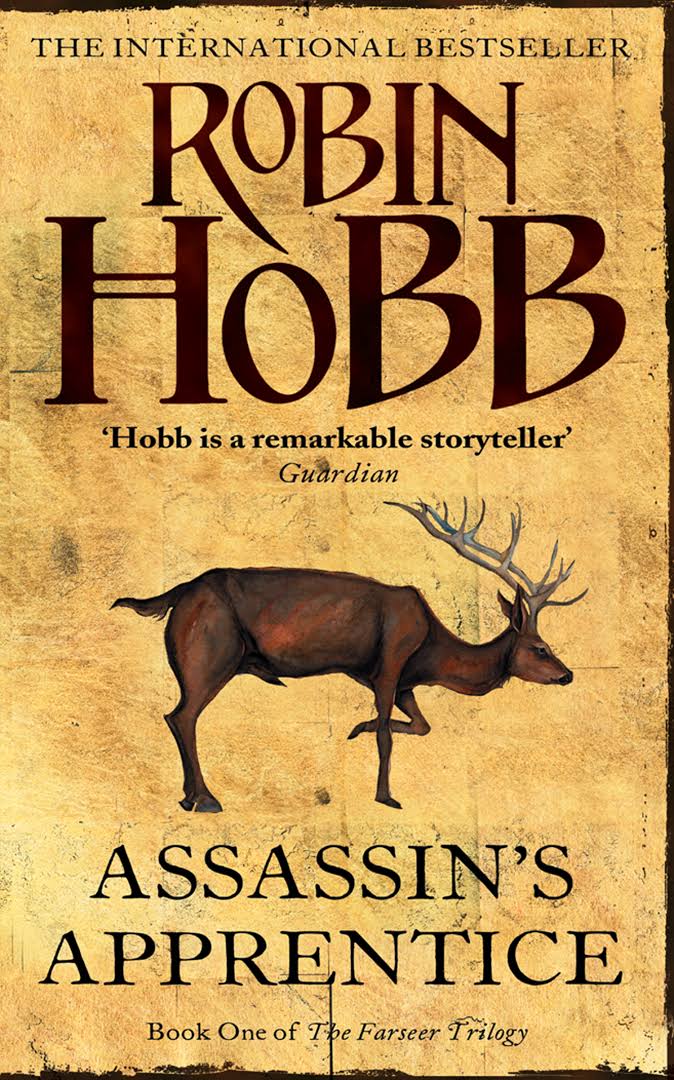
Assassin’s Apprentice

Author: Robin Hobb
Rating: 6/10
Last Read: August 2010

Quick Summary: An outcast bastard son of a prince is secretly trained to be an assassin from a young age.  The book follows him though his childhood and training, culminating in his first mission. The book is a pretty good fantasy read: interesting characters, internal struggles, and political scheming abound.  A book for those who like Arya’s character in A Song of Ice and Fire

I did not continue on with the series.

My Highlights

The group of onlookers was growing. A few showed pity in their eyes, but none interfered. Some of what I was feeling passed to Nosy, who dropped over onto his side and showed his belly in supplication while thumping his tail in that ancient canine signal that always means, “I’m only a puppy. I cannot defend myself. Have mercy.” Had they been dogs, they would have sniffed me over and then drawn back. But humans have no such inbred courtesies.

“There is this, boy. And you should remember it in every situation, not just this one. Learning is never wrong. Even learning how to kill isn’t wrong. Or right. It’s just a thing to learn, a thing I can teach you.

“I’m not a real prince. I’m a bastard.” It came oddly from my mouth, that word I heard so often and so seldom said. Burrich sighed softly.
“Be your blood, boy, and ignore what anyone else thinks of you.”
“Sometimes I get tired of doing the hard things.”
“So do I.”

“You don’t know that. You only hear what the gossips say. You aren’t old enough to understand some things. You’ve never seen a wild bird lure predators away from its young by pretending to be injured.”
“I don’t believe that,” I said, but I suddenly felt less confident saying it. “He never did anything to make me think he cared about me.”
Chade turned to look at me and his eyes were older, sunken and red.
“If you had known he’d cared, so would others. When you are a man, maybe you’ll understand just how much that cost him. To not know you in order to keep you safe. To make his enemies ignore you.”
“Well, I’ll “not know’ him to the end of my days, now,” I said sulkily.

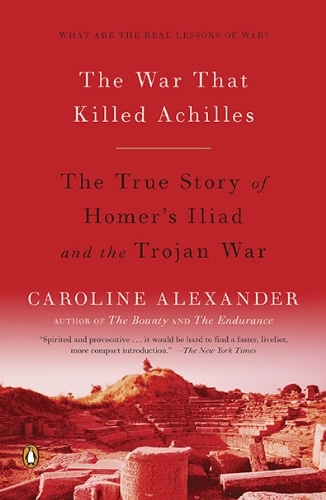
The War that Killed Achilles

Author: Caroline Alexander
Rating: 6/10 (better for casual readers interested in the Iliad)
Last Read: August 2010

Quick Summary: When I originally picked up this book, I thought it was going to be a historical retelling of the Trojan War – however, I quickly realized this was meant to be an accessible interpretation to the story of the Iliad, drawing forth lessons and themes for the modern reader.  I studied the classics pretty deeply, so I was a bit disappointed in this fact.  

I recommend this book to anyone who is not familiar with the classic story of the Iliad – this is a highly accessible introduction to the themes that run throughout this ancient work, and perhaps after reading it you will decide to tackle the real thing.

Death: the Iliad is ever mindful that war is about men killing or men killed. In the entire epic, no warrior, whether hero or obscure man of the ranks, dies happily or well. No reward awaits the soldier’s valor; no heaven will receive him.

Further Reading: lliad, Odyssey, Aeneid

My Highlights

Remarkably, there are no accounts, in Greek epic or mythology, of the fall of any of the Greek cities; all emotional pathos was invested in the loss of the Asiatic settlement of Troy. –loc 347

Thus, drawing on its long tradition, the Iliad used conventional epic events and heroes to challenge the heroic view of war. Is a warrior ever justified in challenging his commander? Must he sacrifice his life for someone else’s cause? How is a catastrophic war ever allowed to start— and why, if all parties wish it over, can it not be ended? Giving his life for his country, does a man betray his family? Do the gods countenance war’s slaughter? Is a warrior’s death compensated by his glory? These are the questions that pervade the Iliad. –loc 379

Muhammad Ali’s famous refusal to fight in Vietnam: I ain’t got no quarrel with the Viet Cong. . . . No Viet Cong ever called me nigger. . . . I am not going 10,000 miles to help murder, kill and burn other people to simply help continue the domination of white slavemasters over dark people. –loc 467

Although the winning of glory in combat is the aim of the conventional hero of combat poetry, in the Iliad glory is usurped by sympathy for the human being, possessed of a family and life story, who has been extinguished. –loc 1189

His descendants, so the ancient prophecy runs, will inherit the Troad; it was in deference to this tradition that the Romans claimed Trojan Aineias as their founder—a tradition that has recently received new consideration in view of DNA findings that indicate that the Etruscans, the first rulers of Rome, originated from Anatolia. –loc 1212

Death: the Iliad is ever mindful that war is about men killing or men killed. In the entire epic, no warrior, whether hero or obscure man of the ranks, dies happily or well. No reward awaits the soldier’s valor; no heaven will receive him. The Iliad’s words and phrases for the process of death make clear that this is something baneful: dark night covers the dying warrior, hateful darkness claims him; he is robbed of sweet life, his soul goes down to Hades bewailing its fate. Again and again, relentlessly, the Iliad hammers this fact: The death of any warrior is tragic and full of horror. Even in war, death is regrettable. –loc 1279

“Man’s days are like grass, like the blossom of the field, so he blooms. For the wind passes over it and it is not there.” –loc 1322

As with the leafage flourishing on a dense tree—it drops, and puts forth others—so with the generation of flesh and blood. –loc 1324

Life is more precious than glory; this is the unheroic truth disclosed by the greatest warrior at Troy. –loc 1721

Life is more precious even than glory. Achilles never wavers in this judgment. It is not, after all, for glory that he sacrifices his life, but for Patroklos. –loc 3719

The recent DNA discoveries are reported in John Hooper, “Etruscan Mystery Solved,” Guardian, June 18, 2007, 23. –loc 4210

On Killing: The Psychological Cost of Learning to Kill in War and Society

Author: Lt. Col. Dave Grossman
Rating: 6/10
Last Read: August 2010

Quick Summary: Lt. Col. Grossman gives an overview of the psychological costs humans incur when they take a life and how societies are able to condition soldiers to get through these mental barriers. 

This is an interesting introduction to the subject, though I felt like Grossman does take too many opportunities to let his personal opinion through, rather than providing a well-cited academic work. He selects statistical sources that assist his claim, even though many of them have been shown to be sensationalized or discredited (trends of increasing violence, video games helping increase violent behavior, SLA Marshal’s study).  

The review of our barriers against killing and structures to overcome those barriers are still interesting even with this serious flaw.

My Highlights

The potential of close-up, inescapable, interpersonal hatred and aggression is more effective and has greater impact on the morale of the soldier than the presence of inescapable, impersonal death and destruction.

there is within most men an intense resistance to killing their fellow man. A resistance so strong that, in many circumstances, soldiers on the battlefield will die before they can overcome it

When a man is frightened, he literally stops thinking with his forebrain (that is, with the mind of a human being) and begins to think with the midbrain (that is, with the portion of his brain that is essentially indistinguishable from that of an animal), and in the mind of an animal it is the one who makes the loudest noise or puffs himself up the largest who will win.

when someone withholds something traumatic it can cause great damage. When you share something with someone it helps to place it in perspective, but when you hold it inside, as one of my psychology students once put it, “it eats you alive from the inside out.” Furthermore, there is great therapeutic value in the catharsis that comes with lancing these emotional boils. The essence of counseling is that pain shared is pain divided, and there was much pain shared during these periods.

“The soldier above all other people,” said MacArthur, “prays for peace, for they must suffer and bear the deepest wounds and scars of war.”

Robert Heinlein once wrote that fulfillment in life involved “loving a good woman and killing a bad man.”

Winston Churchill said that “it is the primary right of men to die and kill for the land they live in, and to punish with exceptional severity all members of their own race who have warmed their hands at the invader’s hearth.”

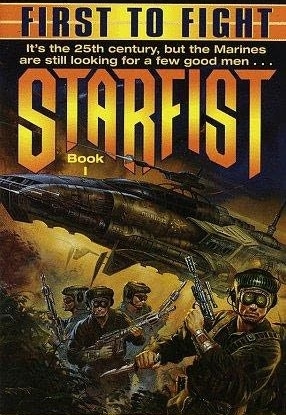
Starfist: First to Fight

Author: Dan Cragg & David Sherman
Rating: 6/10
Last Read: August 2010

Quick Summary: This follows the lives and experiences of marines in space during the 25th century – dealing with new recruits, old fuckups, and handling warlords on outer world.  Reads like a military novel in the future.

Looking for militaristic marine sci-fi novel of the future?  Check out Starship Troopers.

Looking for some relaxing junk militaristic sci-fi?  Not a bad pick.  I did not continue the series.

My Highlights

“All right, recruits,” Neeley announced one day during a classroom training session, “I’m gonna give you Neeley’s Thirteen Rules for Staying Alive in Combat. You listening?
“One: Incoming fire always has the right-of-way.
“Two: Keep it simple, stupid.
“Three: Keeping it simple is the hardest thing in the world.
“Four: Never stand next to anyone braver than you are.
“Five: If things are going too well, it’s an ambush.
“Six: The easiest way is mined.
“Seven: The one thing you never run out of is the enemy.
“Eight: Infrared works both ways.
“Nine: Professionals are always predictable.
“Ten: We always wind up fighting amateurs.
“Eleven: When the enemy’s in range, so are you.
“Twelve: When in doubt, shoot until your magazine is empty.”
Neeley placed his hands on his hips and smiled fiercely. “You remember those rules and you’ll be okay.”

I just made up a new rule: Never stand next to anyone dumber than you!

Alice’s Adventures in Wonderland

Author: Lewis Carroll
Rating: 8/10
Last Read: August 2010

Quick Summary: Truly a book of nonsense – Alice is a little girl who falls down a rabbit hole and wanders through a fantastic world.  Sometimes it feels like you’re in the middle of an acid trip, other times it just feels like weird nonsense. But there’s plenty of poetry, riddles, and interesting turns of language around.

My Highlights

‘How am I to get in?’ asked Alice again, in a louder tone. ‘Are you to get in at all?’ said the Footman. ‘That’s the first question, you know.’

And with that she began nursing her child again, singing a sort of lullaby to it as she did so, and giving it a violent shake at the end of every line: ‘Speak roughly to your little boy, And beat him when he sneezes: He only does it to annoy, Because he knows it teases.’

‘Would you tell me, please, which way I ought to go from here?’
‘That depends a good deal on where you want to get to,’ said the Cat.
‘I don’t much care where–‘ said Alice.
‘Then it doesn’t matter which way you go,’ said the Cat.
‘–so long as I get somewhere,’ Alice added as an explanation.
‘Oh, you’re sure to do that,’ said the Cat, ‘if you only walk long enough.’

She had quite forgotten the Duchess by this time, and was a little startled when she heard her voice close to her ear. ‘You’re thinking about something, my dear, and that makes you forget to talk. I can’t tell you just now what the moral of that is, but I shall remember it in a bit.’ ‘Perhaps it hasn’t one,’ Alice ventured to remark. ‘Tut, tut, child!’ said the Duchess. ‘Everything’s got a moral, if only you can find it.’

“Never imagine yourself not to be otherwise than what it might appear to others that what you were or might have been was not otherwise than what you had been would have appeared to them to be otherwise.”

‘That’s the reason they’re called lessons,’ the Gryphon remarked: ‘because they lessen from day to day.’

The White Rabbit put on his spectacles. ‘Where shall I begin, please your Majesty?’ he asked.
‘Begin at the beginning,’ the King said gravely, ‘and go on till you come to the end: then stop.

Now, here, you see, it takes all the running you can do, to keep in the same place. If you want to get somewhere else, you must run at least twice as fast as that!” ~ The Queen

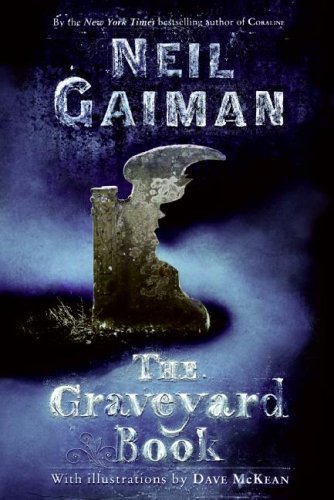
The Graveyard Book

Author: Neil Gaiman
Rating: 10/10
Last Read: July 2016

Quick Summary: A boy’s family is murdered, and he manages to escape to a graveyard.  The ghosts of the graveyard raise and protect the boy.  Many adventures and childish antics ensue.

I was looking for a book to read that would be relaxing before bed.  After reading the Amazon book summary, I was going to skip over it – the premise seemed cheesy.  I’m glad I decided to give it a whirl – I finished it within the next 24 hours.

My Highlights

A graveyard is not normally a democracy, and yet death is the great democracy, and each of the dead had a voice, and an opinion as to whether the living child should be allowed to stay, and they were each determined to be heard, that night. –loc 333

His guardian was unperturbed. “It is neither fair nor unfair, Nobody Owens. It simply is. –loc 743

“They kill themselves, you mean?” said Bod. He was about eight years old, wide-eyed and inquisitive, and he was not stupid. “Indeed.” “Does it work? Are they happier dead?” “Sometimes. Mostly, no. It’s like the people who believe they’ll be happy if they go and live somewhere else, but who learn it doesn’t work that way. Wherever you go, you take yourself with you. If you see what I mean.” –loc 1222

The dance sped up, and the dancers with it. Bod was breathless, but he could not imagine the dance ever stopping: the Macabray, the dance of the living and the dead, the dance with Death. –loc 1960

Fear is contagious. You can catch it. Sometimes all it takes is for someone to say that they’re scared for the fear to become real. Mo was terrified, and now Nick was too. –loc 2277

At the best of times his face was unreadable. Now his face was a book written in a language long forgotten, in an alphabet unimagined. Silas wrapped the shadows around him like a blanket, and stared after the way the boy had gone, and did not move to follow. –loc 2358

“The dead dun’t disappoint you. They’ve had their life, done what they’ve done. We dun’t change. The living, they always disappoint you, dun’t they? You meet a boy who’s all brave and noble, and he grows up to run away.” –loc 2403

Thackeray Porringer was Bod’s height and age, and seemed to be in much better temper with him; he would walk with Bod in the evenings, and tell stories of unfortunate things that had happened to his friends. Normally the stories would end in the friends being hanged until they were dead for no offense of theirs and by mistake, although sometimes they were simply transported to the American Colonies and they didn’t have to be hanged unless they came back. –loc 2809

And then, with a hopeful whine, WILL YOU BE OUR MASTER? “I’m afraid not.” IF YOU WERE OUR MASTER, WE COULD HOLD YOU IN OUR COILS FOREVER. IF YOU WERE OUR MASTER, WE WOULD KEEP YOU SAFE AND PROTECT YOU UNTIL THE END OF TIME AND NEVER LET YOU ENDURE THE DANGERS OF THE WORLD. “I am not your master.” NO. Bod felt the Sleer writhing through his mind. It said, THEN FIND YOUR NAME. –loc 3104

Jack nodded thoughtfully. “If this is true,” said Jack, “and if I am now a Jack-all-alone, then I have an excellent reason for killing you both.” Bod said nothing. “Pride,” said the man Jack. “Pride in my work. Pride in finishing what I began.” –loc 3503

“How could you make her forget me?” Silas said, “People want to forget the impossible. It makes their world safer.” –loc 3646

“I called you boy, didn’t I? But time passes in the blink of an eye, and it’s a young man you are now, isn’t it? How old are you?” “About fifteen, I think. Though I still feel the same as I always did,” Bod said, but Mother Slaughter interrupted, “And I still feels like I done when I was a tiny slip of a thing, making daisy chains in the old pasture. You’re always you, and that don’t change, and you’re always changing, and there’s nothing you can do about it.” –loc 3732

Bod said, “I want to see life. I want to hold it in my hands. I want to leave a footprint on the sand of a desert island. I want to play football with people. I want,” he said, and then he paused and he thought. “I want everything.” –loc 3828

“Sleep my little babby- / oh Sleep until you waken / When you wake you’ll see the world / If I’m not mistaken… / Kiss a lover / Dance a measure, / Find your name / And buried treasure…” Then the last lines of the song came back to Mistress Owens, and she sang them to her son. “Face your life / Its pain, its pleasure, / Leave no path untaken” –loc 3855

“Leave no path untaken,” repeated Bod. “A difficult challenge, but I can try my best.”

Into the Wild

Author: Jon Krakauer
Rating: 6/10
Last Read: August 2010

Quick Summary: A young man decides to give it all up and go wander the world.  He dies in the Alaskan wilderness.  

There have been lots of debates about the death of Chris McCandless, many complaining that the more likely case is starvation (rather than poisoning).  Krakauer recently commented on this as well.  Either way, people like to debate endlessly about whether McCandless is a falsely glorified idiot or not.  

The book is interesting – and if you have a soul full of wanderlust you can appreciate his drive.  But I wouldn’t call it a must-read.

My Highlights

I wanted movement and not a calm course of existence. I wanted excitement and danger and the chance to sacrifice myself for my love. I felt in myself a superabundance of energy which found no outlet in our quiet life. LEO TOLSTOY, “FAMILY HAPPINESS”

I’d like to repeat the advice I gave you before, in that I think you really should make a radical change in your lifestyle and begin to boldly do things which you may previously never have thought of doing, or been too hesitant to attempt. So many people live within unhappy circumstances and yet will not take the initiative to change their situation because they are conditioned to a life of security, conformity, and conservatism, all of which may appear to give one peace of mind, but in reality nothing is more damaging to the adventurous spirit within a man than a secure future. The very basic core of a man’s living spirit is his passion for adventure. The joy of life comes from our encounters with new experiences, and hence there is no greater joy than to have an endlessly changing horizon, for each day to have a new and different sun. If you want to get more out of life, Ron, you must lose your inclination for monotonous security and adopt a helter-skelter style of life that will at first appear to you to be crazy. But once you become accustomed to such a life you will see its full meaning and its incredible beauty.

“Chastity is the flowering of man; and what are called Genius, Heroism, Holiness, and the like, are but various fruits which succeed it.”

Rather than love, than money, than fame, give me truth. I sat at a table where were rich food and wine in abundance, an obsequious attendance, but sincerity and truth were not; and I went away hungry from the inhospitable board. The hospitality was as cold as the ices. HENRY DAVID THOREAU, WALDEN, OR LIFE IN THE WOODS

For children are innocent and love justice, while most of us are wicked and naturally prefer mercy. G. K. CHESTERTON

Children can be harsh judges when it comes to their parents,Read more

It is easy, when you are young, to believe that what you desire is no less than what you deserve, to assume that if you want something badly enough, it is your God-given right to have it.

Next to “And so it turned out that only a life similar to the life of those around us, merging with it without a ripple, is genuine life, and that an unshared happiness is not happiness…. And this was most vexing of all,” he noted, “HAPPINESS ONLY REAL WHEN SHARED.”