I’ve been increasingly interested in the power of the unconscious, especially with regards to creativity and insight. Creativity and self-knowledge seem to come from nowhere, and I can understand how people of all ages have felt like they had a divine connection or received inspiration from a muse. Certainly, I cannot create well with the cerebral part of my brain – it seems to flow from somewhere deeper and mostly inaccessible.
I’ve occasionally used the I Ching, an ancient Chinese divination manual, as a tool for both getting unstuck and gaining deeper insight into my thoughts on a question. The book can act as a mirror you hold up to yourself, enabling you to see your situation in a different light.
For the next month, I’ll be exploring my unconscious by consulting the I Ching every day. Perhaps having a trigger can help us access the deeper parts of our being, the parts so often inaccessible to us. What might be revealed to me that I’m not paying attention to? What might be revealed to me by simply asking myself (or “the universe”) to share some insight?
Many poo-poo the act of consulting an oracle, because the answers are vague and can apply to many situations. Certainly generating a random number, associating it with a reading in a book, and applying it to your situation is not “rational”. I am not seeking a rational method for self-knowledge I have my doubts that even the most “rational” thinkers can truly escape the irrational aspects of their own nature. Anyone who claims to be rational is ignoring the power that cognitive and emotional biases have over our minds – there is no escaping them.
The answers from the I Ching serve as a useful tool for analyzing our own minds and getting unstuck. No matter the situation, taking a different view is invaluable. And who can disregard the use of such a text by wise and capable men throughout history, including Confucius, Carl Jung, and Mao Zedong?
On Wednesday, Rozi and I were on an errand downtown, and I decided we should abandon work to have a tea break at the Yerba Buena Gardens. We never noticed that behind the Yerba Buena Gardens waterfall is a civil rights monument dedicated to Dr. King. There are two iconic photographs, as well as a series of Dr. King’s quotes. Each quote is printed in English and translated into one additional language. Walking through the monument, I was awestruck by the unceasing power of Dr. King’s words.
I’ve had these two quotes in particular stuck in my mind since visiting the monument. They spoke to me in a way that still sends chills down my spine.
“There is nothing in all the world greater than freedom. It is worth paying for; it is worth going to jail for. I would rather die in abject poverty with my convictions than live in inordinate riches with the lack of self-respect.”
“We must rapidly begin to shift from a thing-oriented society to a person-oriented society. When machines and computers, profit motives and property rights are considered more important than people, the giant triplets of racism, materialism, and militarism are incapable of being conquered”
Our society is still trapped in the vice of our thing-oriented society. Perhaps we don’t really want to escape – we love our toys, alcohol, weed, and sugar.
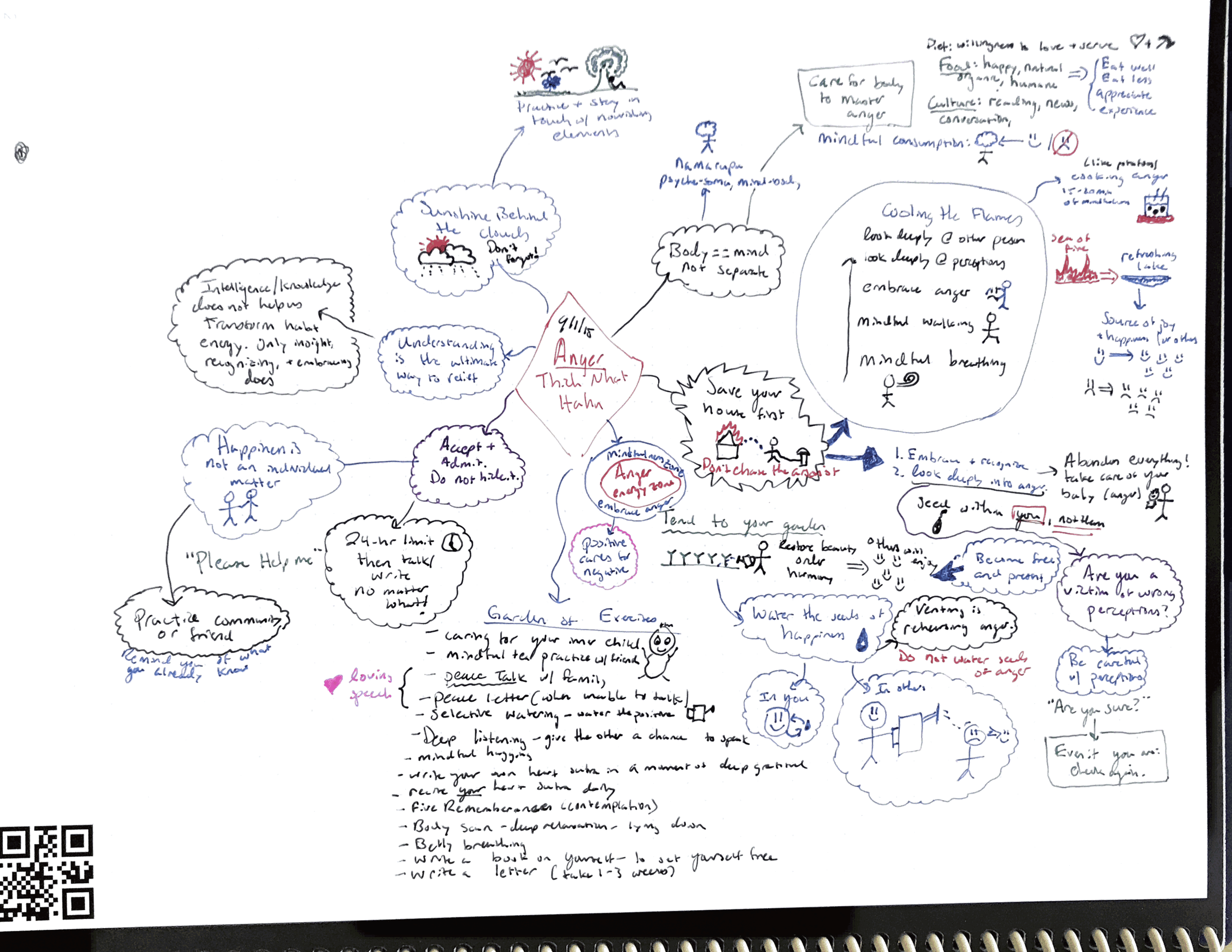
It’s telling that I’ve managed to read Anger twice now, but haven’t shared the book notes yet. I’ve decided to revisit Deep Nutrition while I work through my overwhelming book note backlog.
After reading so many books, it can be quite disturbing to look at a book which you’ve previously read and have no recollection of its thesis or plot. I originally started my highlighting and book review process to attempt to combat this memory loss, and reviewing my book nots at regular intervals has been quite helpful.
I recently started creating mind maps while I’m reading a book. After a reading session (usually the next day), I take a moment to draw out some of the points that stand out in my mind. Creating these maps helps me in many ways:
I can stretch my memory muscles, increasing recall
I am forced to distill complex ideas into single words and short phrases
I create visual connections between ideas
I create visual anchors to associate with words and ideas when possible
I’m still quite new at this practice and my mind maps are rough and cluttered. Plus, my drawing skills are greatly atrophied.
So far they’ve helped me cement the ideas from the two books in my mind, and I have a handy one-page cheat sheet whenever I need a refresher.
I was in great need of this reminder in particular:
Instead, consider using the question as a chance to see more deeply in what this interaction is for, where are you hoping to go? Focus on status roles, the creation and resolution of tension, and most of all, changing minds.
If you’re not working to change minds, why are you here again?
My Thursdays are dedicated to two purposes:
Volunteering at the Japanese Tea Garden
Working on my business (rather than in my business)
Gardening helps me turn off my thinking brain, focus on quality, and step away from my computer for a few hours. It’s practically impossible to step into the garden early in the morning without peace entering into your soul.
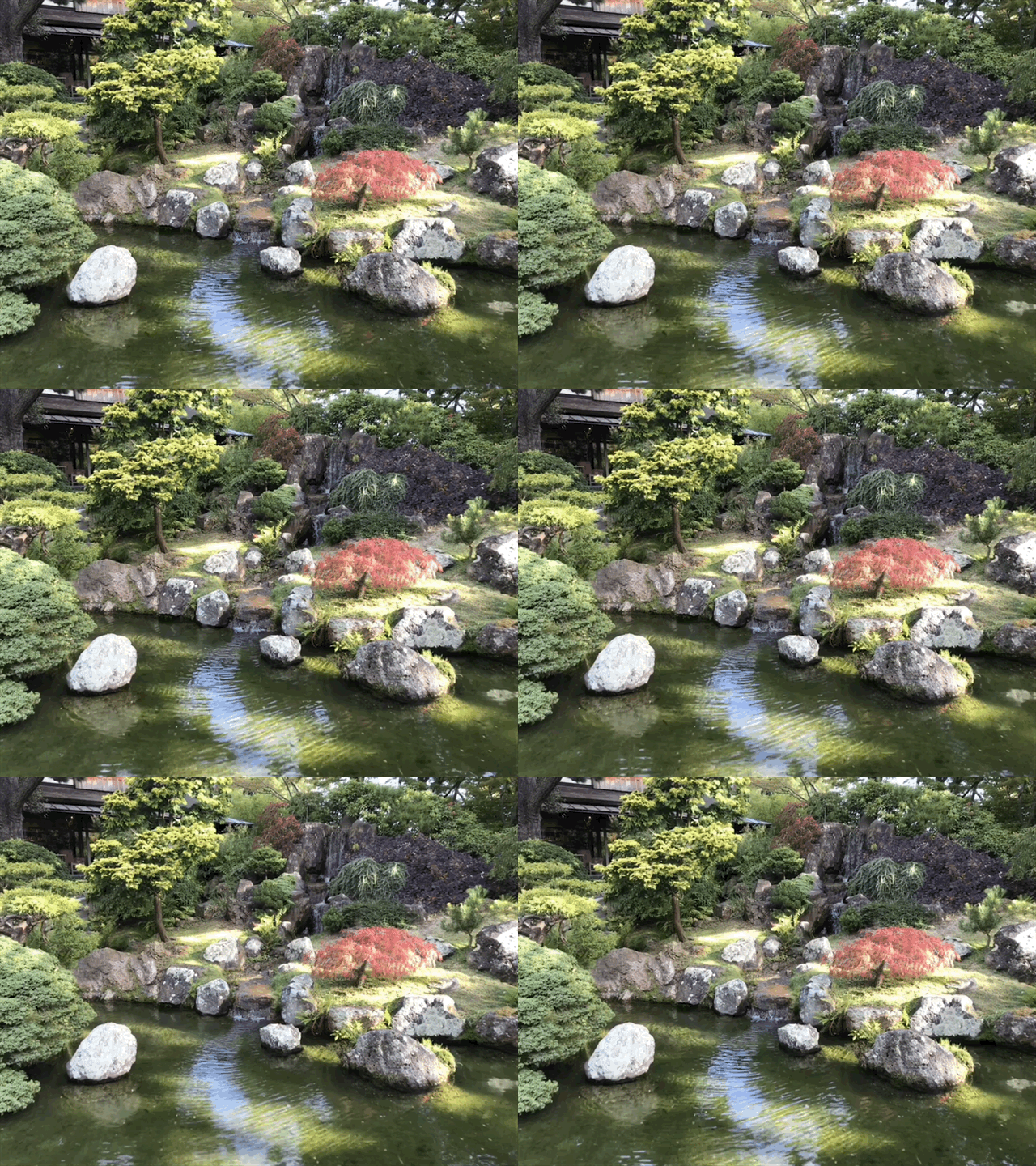
The past few months have been quite foggy, but we got some brilliant sunshine this Thursday, so I snapped a few photos.
I love playing with loops using Apple’s live images. Water is always a fun subject:
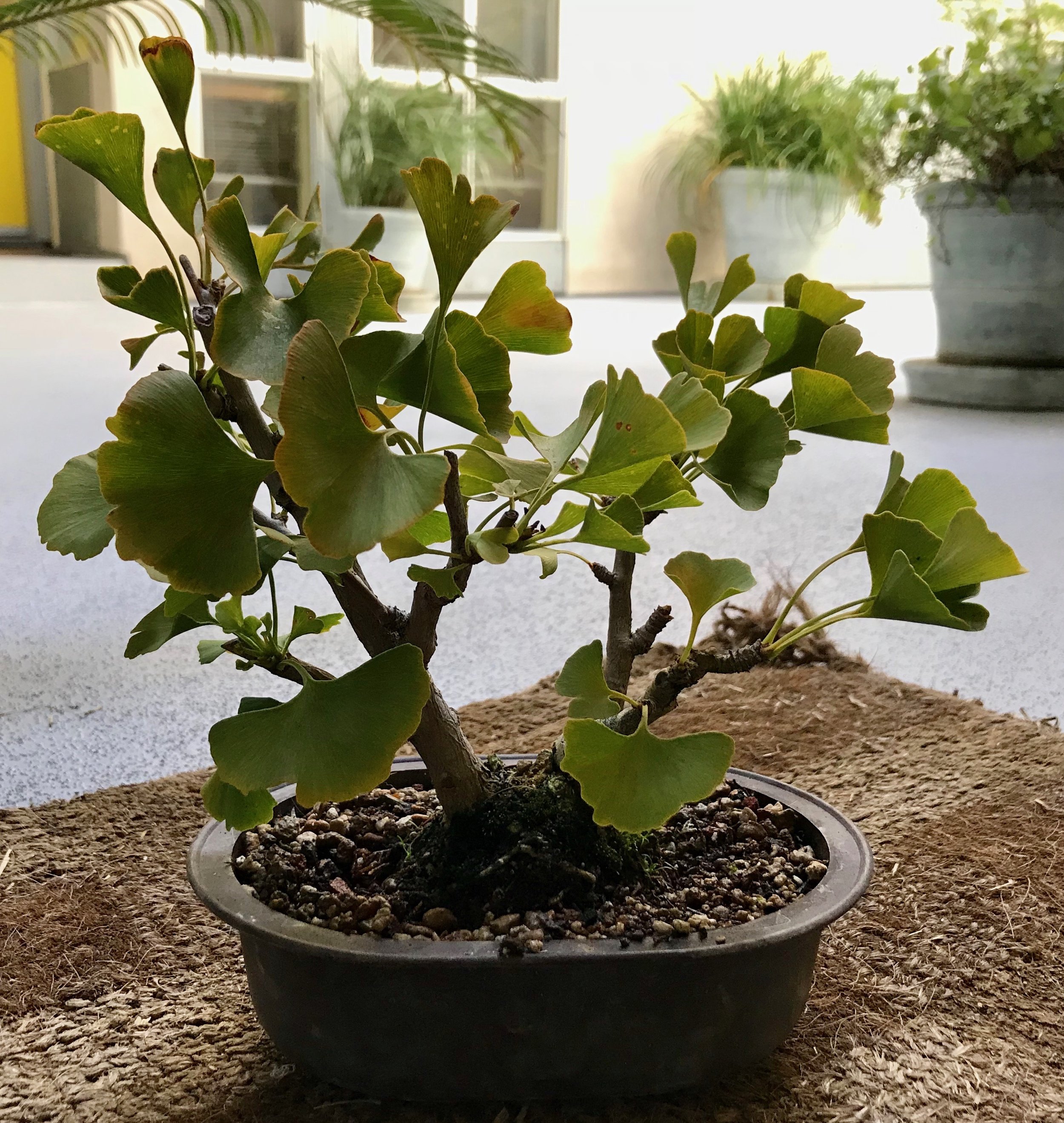
I was talked into attending a bonsai auction at the behest of my gardening friends. You can’t go to an auction without joining in on the fun, and picked up a (seemingly) lifetime supply of wire, some pots, a few tools, and this 10-yr old Ginkgo.
I have no idea what to do with it yet, other than prevent it from dying.
Since my mind is focused on plants, I’ll leave you with this quote on gardening which I lifted from Tim Ferris’s newsletter:
“Gardening is not outcome-oriented. A successful harvest is not the end of a gardener’s existence, but only a phase of it. As any gardener knows, the vitality of a garden does not end with a harvest. It simply takes another form. Gardens do not ‘die’ in the winter but quietly prepare for another season.” ― James P. Carse, Finite and Infinite Games
I was inspired by Ruth Malan’s traces to gather my musings together in a single place and to share them regularly. Essentially, this is a public combination of my commonplace book and my journal. I intend for this to be mostly stream-of-consciousness, so my thoughts may be potentially disjointed. You have been warned.
Wisdom seems to be coming to grips with paradoxes. There also seems to be the ability to safely operating within the paradoxes without the feeling of “this isn’t logical!” or “this makes no sense!”. Such a definition of Wisdom confirms to me that our ability to perceive is limited – otherwise we might be able to more readily see and identify these “paradoxes”.
I watched an interview with Chamath Palihapitiya, CEO of Social Capital and a former exec at Facebook. The whole interview is worth watching. Rich capitalists are very rarely this forthcoming. Here are notes I jotted down:
Internet businesses are the primary target for the “fail fast” mindset, because they are trying to exploit the psychology of large populations. Failing fast is about exploiting a lot of people – if it doesn’t work you want to learn ASAP so you can adjust.
Moderate growth and moderate compounding is the goal for long-term businesses and long-term progress
Slow and steady when working hard problems
Turn off your social apps and give your brain a break.
Social media = short term thinking
You don’t want to be motivated by what everyone else is saying/thinking.
Acknowledge that the things you spend hours a day doing are rewiring your psychology and physiology. You now have to take that same brain and use it to be successful in the world. If your brain is wired toward short-term thinking and dopamine hits from social media, you’ve made your job much harder.
Proactively try to wire your brain chemistry to be long-term focused
It seems to me that it’s quite impossible to use social media and attention-based electronic device (phones, television, games – all reward us with dopamine) without becoming addicted and pulled into a state of distraction. At least, in the default state of their use.
Effects can be mitigated by reducing the systems which feed us dopamine hits: disable notifications, remove email & web browsers, block internet access, limit when and how you check, etc. But these strategies don’t eliminate the distraction or addiction mechanisms. We are always fighting against them.
My phone doesn’t have an email app or a web browser. I block email and social media access on my computer before 12pm. Social media is only available for a short 1-2 hour window, and then it’s off again. Even then, I feel so distracted and impulsive after checking it just once! I’ve also started using Tweetdeck, since I can filter out specific topics, hide all notifications except for direct comments, and avoid seeing what people “like”. Most of my social media posts are scheduled through third-party websites.
One goal I would like to work on: keeping my phone in airplane mode most of the time. I get so many spam calls, and why do people need instant access to me? The interruptions and the frustration from receiving spam calls all day also impacts my thought process.
Advice: do not practice things you do not want to become
Your brain makes it (whatever you practice) a part of your physical brain structure
As you practice the task and routinize it – the activation is easier.
You build a little machine – a habit – and it’s really there in your brain
If you want to change it, you can’t undo it – it’s there permanently
You have to build a machine that shuts it off, and then another machine to replace it
When you get stressed the old machine comes back!
Character is “how you build yourself across time”. It really matters. Only practice what you want to become.
I’ve also been listening to Jordan Peterson’s biblical lectures, which are quite fascinating. I just finished with the Cain and Abel lecture, a story I’ve found myself thinking about quite deeply since I finished reading East of Eden (a book that may have saved my life, in a few ways). Peterson talks quite a bit about the idea of the Sacrifice, and its importance in human affairs. After watching this lecture, I’ll be trying out a new morning reflection/journaling prompt:
Every morning, ask: what sacrifice do I have to make to make things better? Not just for me, but also for my family, friends, clients, the world.
Another way to put it:
What thing could I let go of that’s impeding my progress?
Back to programming our brains. We can help keep ourselves on track by intentionally creating momentum in our lives. Rather than create big goals, we can create a series of small goals reached continuously. We benefit from boosts in morale by regularly achieving our small goals. We also get to see much more frequent indications of progress than when we target giant goals.
Tiny Habits is a great (and free) 5-day email course which uses the idea of small goals and continual momentum for building habits.
I’ve used the Tiny Habits method to program many new habits. Today I’ve started intentionally crafting them again. Here are the three I’m currently working on:
After I sit down I will reset my shoulders
After I flush the toilet, I will do 3 squats
Every time my computer prompts me to take a break, I will take three deep breaths
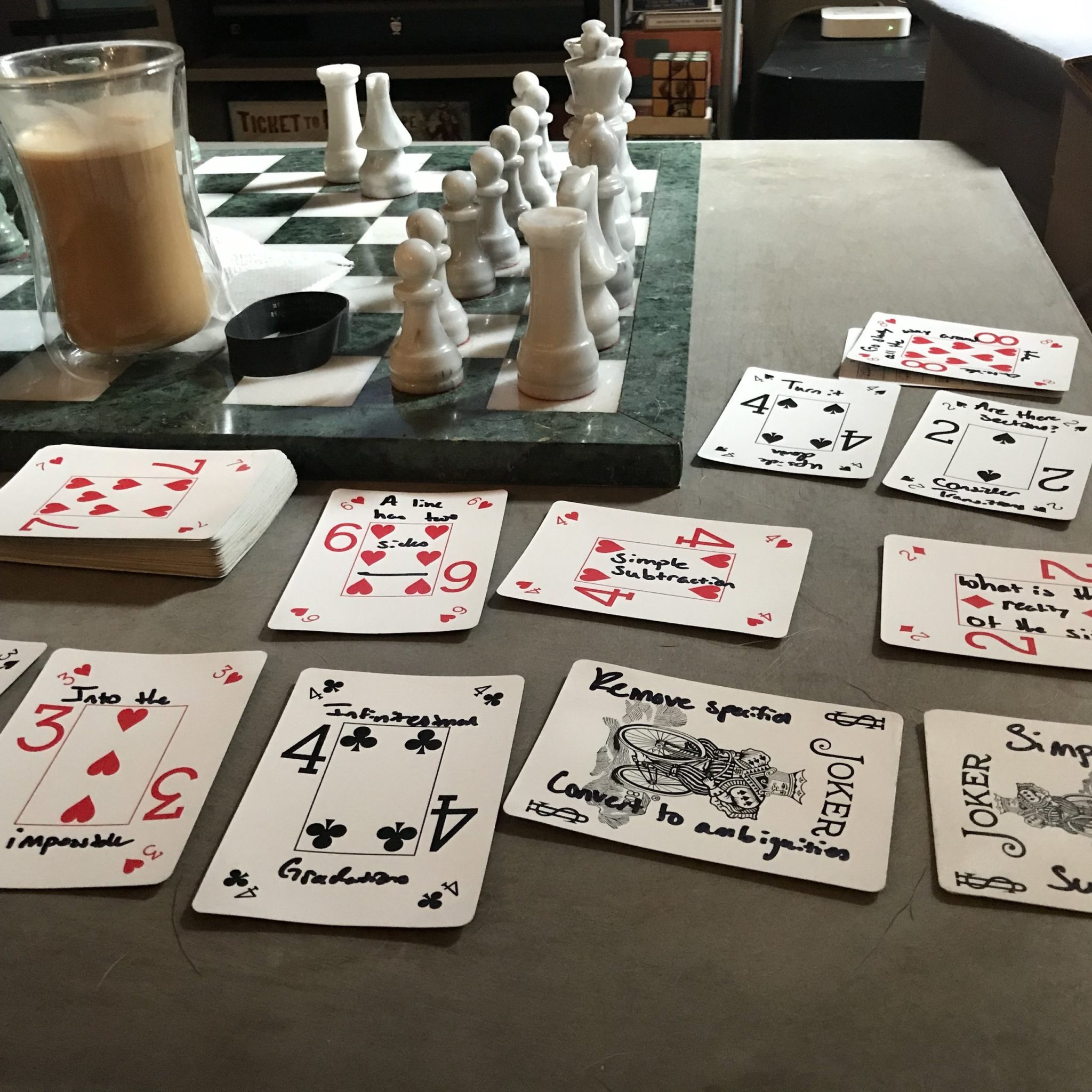
I spent my morning creating a set of Oblique Strategy cards. Oblique Strategies are a creation of Brian Eno and Peter Schmidt, and are meant as a tool to get “unstuck” when working on a creative problem. I view it as almost an oracular method (à la the I Ching, which I consult to get unstuck in my life). The goal is to get unstuck by taking a different approach or viewing our problem from a different perspective.
I used two retired playing card decks to create my Oblique Strategies deck. The strategy list I consulted had more strategies than cards, so I doubled up some related or paradoxical items. You can also consult the Oblique Strategy Oracle online, if you don’t want to go through the work of making your own deck.
After creating the cards, I’m pondering their potential use in meetings with my clients. If they can help me get unstuck by creating a totally new view of the problem, can they also work with clients? The answer is “yes” – but I need to figure out how to deliver that message. “Oh, luckily I carry an oracle in my pocket that we can consult.”
It’s funny that we create and rely on such devices. As I write the cards out, I can picture my self interpreting them in different ways depending on the situation. We think we are rational creatures, but how wrong we are – we are ruled by the irrational. By latching onto irrationality, we can do amazing things. The irrational self is our source of creativity and new ideas.
I’ve been cleaning up some long-standing Evernote notes. These are some quotes that stood out to me.
Goldmund Unleashed (@GoldmundUnleash):
An effective artist is one who studies his own life, records experiences, and finds a medium to share so other lives can be enriched. You can do this at any age.
I’m trying to apply Goldmund’s advice via this ‘Collected Musings’ concept. This brings up another quote from Kapil Gupta:
Then what should you do with your life: See. Create. Then see. Then create. The seeing is for Understanding. The creating is for immersion.
Confucius:
Everything flows on and on like this river, without pause, day and night.
A recent quotes from Kapil Gupta:
No human being can affect another The one who is affected affects himself (But exquisitely rare is the individual who is Truly interested in no longer affecting himself)
A quote from Zen Keys, by Thich Nhat Hanh, attributed to Buddha:
The self of which you speak, great self or small self, is only a concept that does not correspond to any reality.